순두부찌개 (sundubu-jjigae) — The Stew That Arrives at Your Table Still Bubbling
순두부찌개 (sundubu-jjigae)
순두부찌개 (sundubu-jjigae) means a jjigae — a Korean stew — made by boiling 순두부 (sundubu), the soft tofu that hasn’t yet been pressed and set into a block. Most people learn this word from a restaurant door long before they meet it in a dictionary. You’re walking down an alley on a December evening, you spot a shop with its windows fogged milky white, you push the door open — and before you’ve even sat down, you hear the ttukbaegi at the next table bubbling away. That sound is how the word sticks.
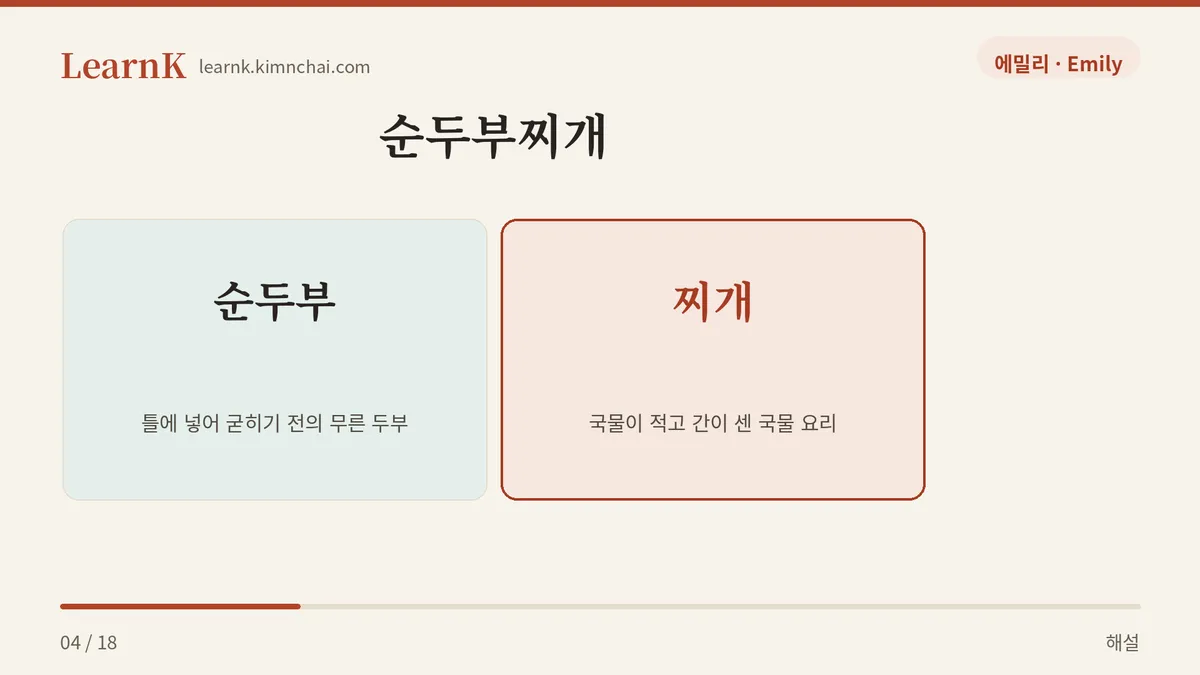
The word splits into two parts. The front half, 순두부 (sundubu), is the ingredient. Boil soybean milk, add the coagulant, and it curdles into soft clouds; press those curds into a mold and you get the firm rectangular tofu everyone knows, while the loose, unset stage is 순두부 (sundubu). It’s soft enough to collapse the moment your spoon touches it — you don’t so much chew it as let it slide down.
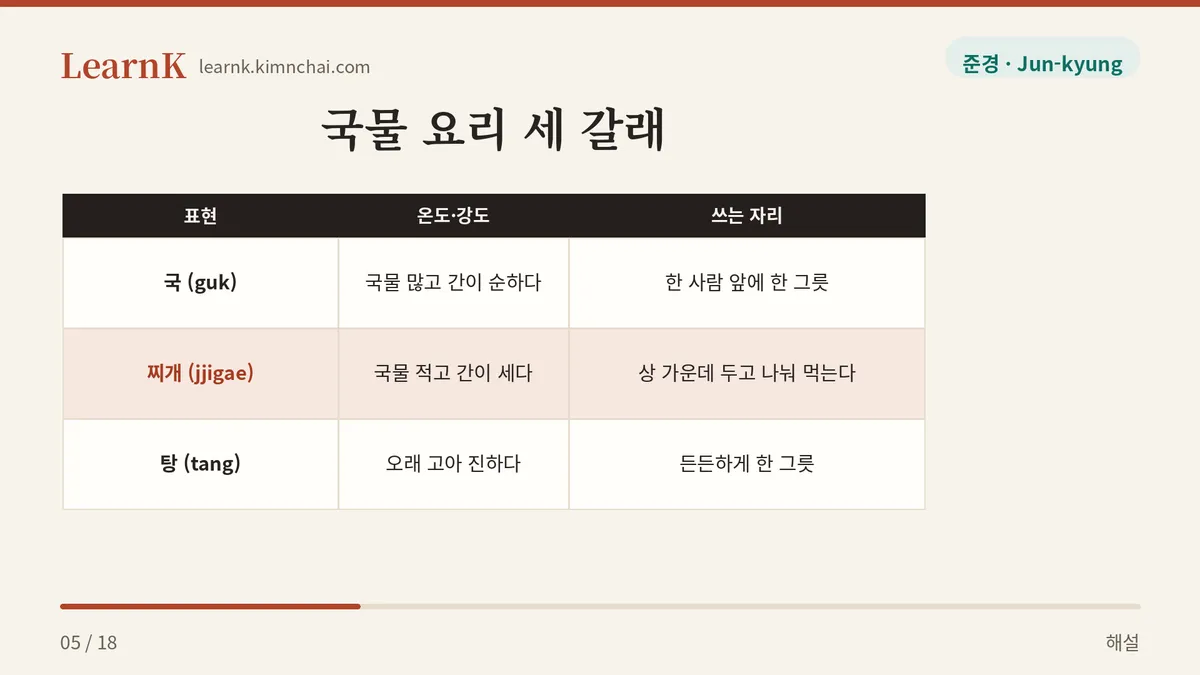
The back half, 찌개 (jjigae), is the cooking format. Korean broth dishes fall roughly into three families. 국 (guk) has plenty of broth and mild seasoning, and it’s set down one bowl per person. 찌개 (jjigae) has less broth and stronger seasoning, and traditionally sits in the middle of the table for everyone to dip a spoon into. 탕 (tang) is the long-simmered, deeply concentrated kind. 순두부찌개 (sundubu-jjigae) belongs to the jjigae family — but interestingly, restaurants serve it in a single-portion ttukbaegi placed in front of each person. It’s a jjigae that happens to be perfect for eating alone, which puts it in a slightly unusual spot. Ask anyone to name dishes you can order solo without feeling awkward, and this one is always near the top of the list.
As for nuance, 순두부찌개 (sundubu-jjigae) is the name of a thing, so it carries no politeness level of its own. The temperature gets set at the end of the sentence. To a friend: 순두부찌개 먹자 (sundubu-jjigae meokja). At a restaurant: 순두부찌개 하나 주세요 (sundubu-jjigae hana juseyo). To your mother: 순두부찌개 끓여 드릴까요? (sundubu-jjigae kkeullyeo deurilkkayo?)
Checking it in the National Institute of Korean Language dictionary
The National Institute of Korean Language’s Basic Korean Dictionary defines the word like this.
순두부찌개 (sundubu-jjigae) 「noun」 순두부를 넣어서 끓인 찌개. (A jjigae made by boiling soft tofu.) [en] sundubujjigae; soft bean curd jjigae — Jjigae, stew, made by boiling soft tofu. [ja] スンドゥブチゲ — おぼろ豆腐チゲ:おぼろ豆腐を入れて煮立てたチゲ料理。 [es] sundubu jjigae, estofado de sundubu — Estofado hecho con sundubu. [zh] 嫩豆腐汤 — 放入嫩豆腐炖煮而成的汤。 — National Institute of Korean Language, Basic Korean Dictionary (krdict.korean.go.kr)
Notice that the definition is exactly one line long. The dictionary says nothing about spicy, and nothing about red. Put soft tofu in and boil it, and that’s 순두부찌개 (sundubu-jjigae). The red, fiery version you usually meet in restaurants is simply the most widespread style — it isn’t a condition of the word. A white, unspiced one is 순두부찌개 (sundubu-jjigae); so is one with clams; so is one with pork. That’s also why the Japanese definition leads with おぼろ豆腐 (unpressed, soft tofu) and the Chinese renders it as 嫩豆腐 (tender tofu). What every translation grabs hold of is not the heat but the softness of the tofu.
There’s no Portuguese definition in this dictionary. For reference, it would come out roughly as sundubu jjigae — ensopado coreano (jjigae) feito com tofu macio — but that one line is our own translation, not dictionary material, and we want to be clear about that.
Let’s also look at the real usage examples the dictionary lists.
순두부찌개에 고추기름이 많이 들어가서 매콤한 맛이 강하다. There’s a lot of chili oil in the sundubu-jjigae, so it has a strong kick to it. — National Institute of Korean Language, Basic Korean Dictionary (krdict.korean.go.kr)
This is the kind of answer you’d get after taking one spoonful and asking why it’s so hot. And it’s precise in pinning the source of the heat on 고추기름 (gochugireum), chili oil, rather than on chili powder. The red color of 순두부찌개 (sundubu-jjigae) usually comes from oil in which chili powder has been fried. 매콤하다 (maekomhada) is one notch gentler than 맵다 (maepda) — it doesn’t mean unbearably hot, it means pleasantly hot.
반찬이 별게 없으니 순두부찌개라도 끓이자. There’s nothing much for side dishes, so let’s at least make some sundubu-jjigae. — National Institute of Korean Language, Basic Korean Dictionary (krdict.korean.go.kr)
This is something you say after opening the fridge. What you mustn’t miss here is the particle -라도 (-rado). It carries a note of resignation: not the best option, but this at least. The very fact that this particle is attached tells you where 순두부찌개 (sundubu-jjigae) sits. It’s not a dish you lay out for a special occasion — it’s the one you boil up in a hurry to fill the table when you’re out of ingredients. And in fact, a pack of soft tofu is cheap, requires no knife work, and is bubbling in ten minutes.
메뉴에는 없지만 순두부찌개를 제공한다. It’s not on the menu, but they serve sundubu-jjigae. — National Institute of Korean Language, Basic Korean Dictionary (krdict.korean.go.kr)
This means it isn’t written on the menu board, but ask and you’ll get it. Korean restaurants often have hidden items like this. 제공하다 (jegonghada) is a stiff word better suited to notices and descriptive writing than to everyday conversation, so this sentence reads less like something said between friends and more like a restaurant listing or an information blurb.
순두부찌개를 끓이다. / 순두부찌개를 만들다. / 순두부찌개 만드는 방법. / 순두부찌개 추가. / 순두부찌개 냄새. To boil sundubu-jjigae. / To make sundubu-jjigae. / How to make sundubu-jjigae. / One more sundubu-jjigae. / The smell of sundubu-jjigae. — National Institute of Korean Language, Basic Korean Dictionary (krdict.korean.go.kr)
This short list is actually the most practical part. In Korean, the verb that attaches to broth dishes is overwhelmingly 끓이다 (kkeurida), to boil. 만들다 (mandeulda), to make, isn’t wrong, but it points at the whole cooking process; the picture of a pot on the fire going bubble-bubble lives only in 끓이다 (kkeurida). And 순두부찌개 추가 (sundubu-jjigae chuga) is what you raise your hand and call out in a restaurant, so the particles have been dropped entirely. There are places where stripping the particles is in fact the natural thing to do.
A real conversation
Situation: A snowy December evening. They’ve just walked into a sundubu place near the office and taken their seats.
Jun-kyung: 아, 이제 좀 살 것 같다. 너 뭐 먹을래? Ah, I feel alive again. What are you going to have?
Emily: 나는 무조건 순두부찌개. 이런 날엔 이거지. Sundubu-jjigae, no question. This is the weather for it.
Jun-kyung: 매운 거 괜찮아? 여기 고추기름 많이 넣어서 좀 맵던데. Can you handle spicy? They use a lot of chili oil here, it’s pretty hot.
Emily: 그럼 난 순한 맛으로. 아 참, 계란 넣어 달라고 해야지. Then I’ll go mild. Oh right, I should ask them to add an egg.
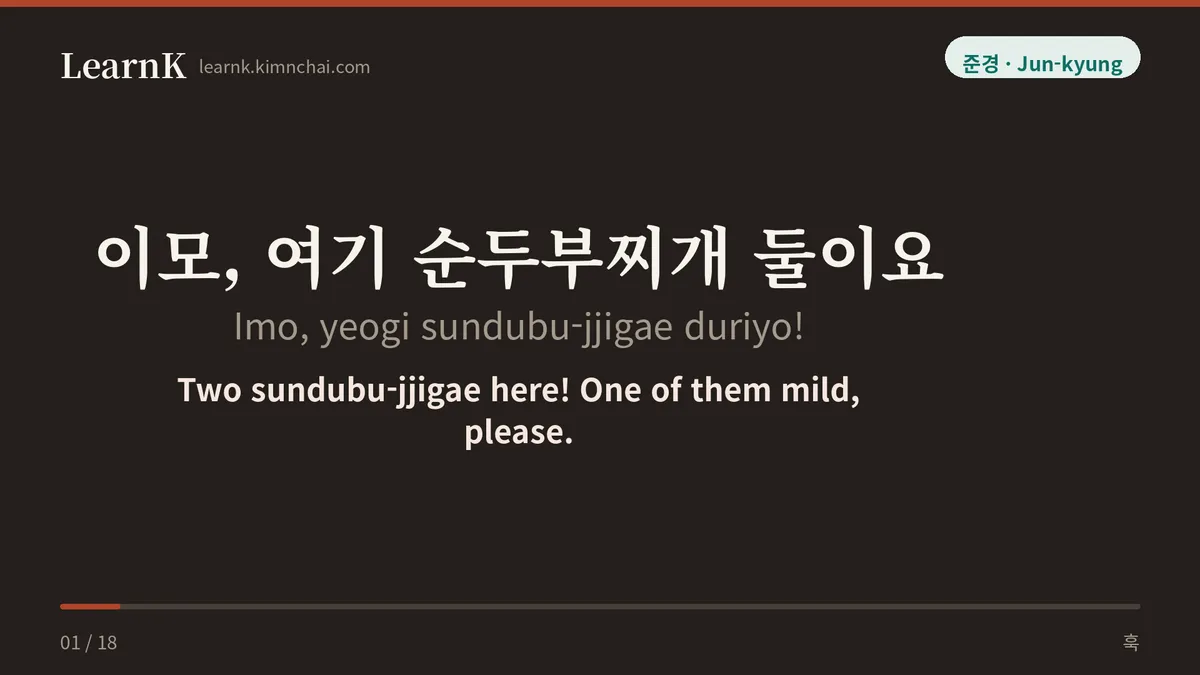
Jun-kyung: 이모, 여기 순두부찌개 둘이요! 하나는 순한 맛으로 주세요. Excuse me, two sundubu-jjigae here! One of them mild, please.
Emily: 야, 목소리 왜 이렇게 커. 다들 쳐다보잖아. Hey, why are you so loud. Everyone’s staring.
Say it this way and it sounds off
순두부찌개 (sundubu-jjigae) is a food name, so it isn’t a word that sorts out politeness. Instead, there are two misunderstandings learners trip over again and again.
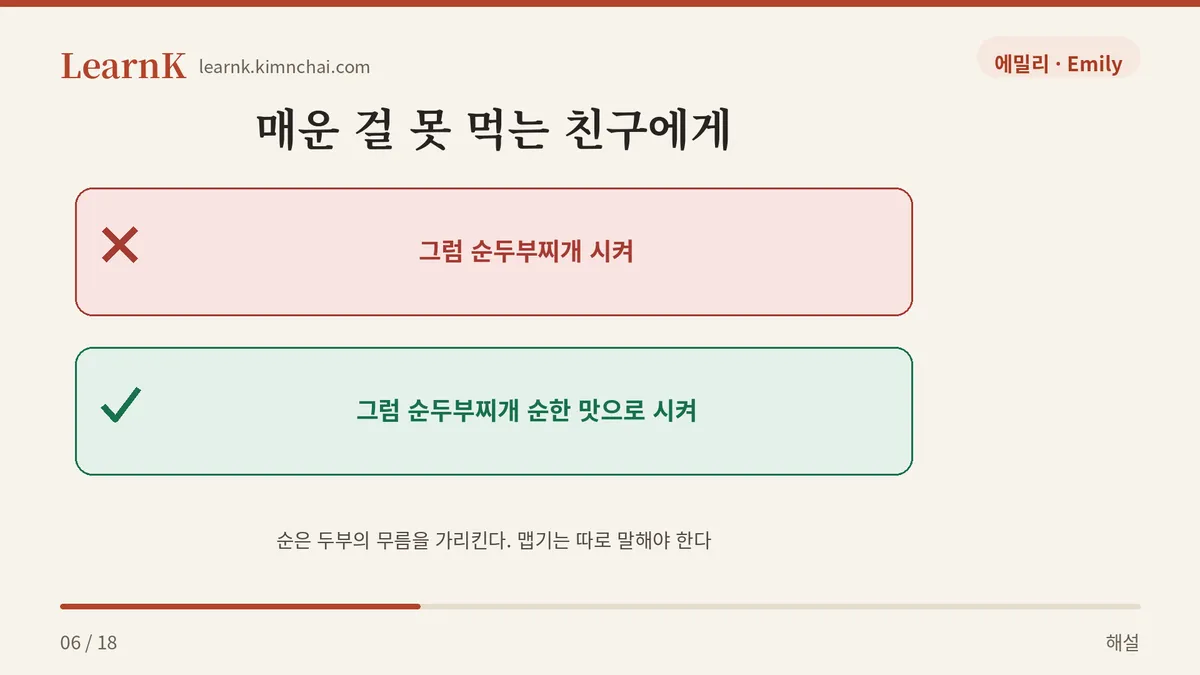
✗ (to a friend who can’t handle spicy food at all) 너 매운 거 못 먹지? 그럼 순두부찌개 시켜. (Neo maeun geo mot meokji? Geureom sundubu-jjigae sikyeo.) ✓ (to a friend who can’t handle spicy food at all) 너 매운 거 못 먹지? 그럼 순두부찌개 순한 맛으로 시켜. (Neo maeun geo mot meokji? Geureom sundubu-jjigae sunhan mateuro sikyeo.) → It’s easy to read the 순 (sun) in 순두부 (sundubu) as meaning “mild in flavor,” but the word refers to the firmness of the tofu. Order it plain at a restaurant and what usually arrives is red and fiery. If you want to choose the heat level, you have to say 순한 맛 (sunhan mat) — mild, 보통 (botong) — regular, or 매운맛 (maeun mat) — hot, separately.
✗ 오늘 저녁은 순두부국을 끓였어요. (Oneul jeonyeogeun sundubu-gugeul kkeullyeosseoyo.) ✓ 오늘 저녁은 순두부찌개 를 끓였어요. (Oneul jeonyeogeun sundubu-jjigae-reul kkeullyeosseoyo.) → 국 (guk) and 찌개 (jjigae) are divided by how much broth there is and how strong the seasoning is. Soft tofu simmered down thick and fiery is conventionally called a 찌개 (jjigae). The grammar is perfectly fine, but to a Korean ear it sounds like the name of a menu item that doesn’t exist.
Example sentences by situation
1. Looking into the fridge of your studio apartment (to a friend, casual speech)
야, 시켜 먹기도 애매한데 순두부찌개나 끓일까? (Ya, sikyeo meokgido aemaehande sundubu-jjigae-na kkeullilkka?) Hey, ordering in feels like overkill — should I just make some sundubu-jjigae?
It’s one of those in-between evenings when delivery isn’t worth the fee but you’re too hungry to skip dinner. The -나 (-na) here is a sibling of the -라도 (-rado) from the dictionary example above, adding a lightness that says this isn’t some big decision.
2. Ordering one more at a restaurant (to the staff, polite speech)
여기 순두부찌개 하나 추가요! 밥도 한 공기 주세요. (Yeogi sundubu-jjigae hana chugayo! Bapdo han gonggi juseyo.) One more sundubu-jjigae over here! And another bowl of rice, please.
This is what you say when someone in your party shows up late. 추가요 (chugayo) isn’t in any grammar textbook — it’s restaurant speech — but it’s exactly how people say it. A first-time customer who drops this one line comes across as someone whose Korean is pretty solid.
3. To a colleague who drank too much last night (a senior at work to a junior)
어제 많이 마셨지? 얼큰하게 순두부찌개 어때? (Eoje mani masyeotji? Eolkeunhage sundubu-jjigae eottae?) You drank a lot last night, didn’t you? How about something hot and spicy — sundubu-jjigae?
This is 해장 (haejang) territory — the ritual of dissolving a hangover in hot broth. Plenty of hot, fiery, broth-heavy dishes are candidates for haejang, and 순두부찌개 (sundubu-jjigae) gets picked especially often because it’s gentle enough for a sore stomach. 얼큰하다 (eolkeunhada) overlaps 맵다 (maepda) with 시원하다 (siwonhada), so it points not at heat that hurts but at heat that clears you out and makes you feel better.
Polite and casual forms, and related expressions
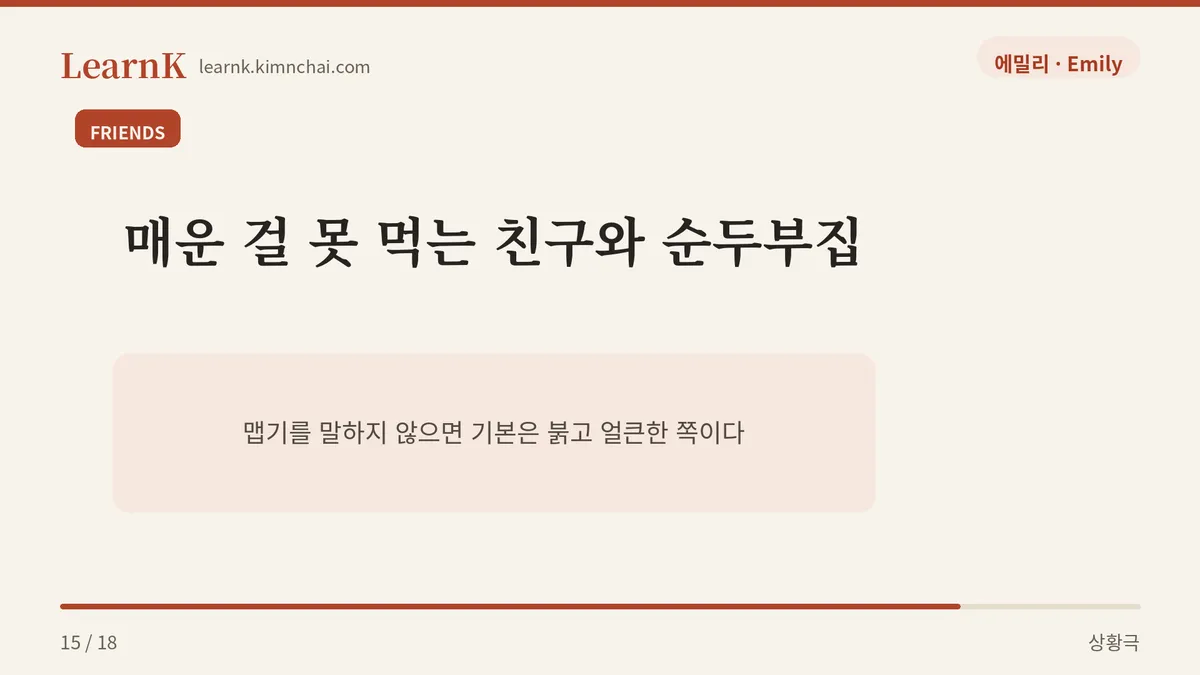
The name itself never changes, so politeness is built at the end of the sentence. To a friend: 순두부찌개 먹으러 갈래? (meogeureo gallae?). At a restaurant: 순두부찌개 하나 주세요 (hana juseyo). In a more careful setting: 순두부찌개 하나 주시겠어요? (hana jusigesseoyo?). When suggesting it to someone older than you, 순두부찌개 어떠세요? (eotteoseyo?) works nicely.
Lining it up against similar broth dishes brings its position into focus.
| Expression | Temperature & intensity | Where it’s used |
|---|---|---|
| 순두부찌개 (sundubu-jjigae) | Soft and fiery. Comes to the table boiling in its ttukbaegi | Solo lunch, hangover cure, cold winter evenings |
| 된장찌개 (doenjang-jjigae) | Savory and salty. Not spicy | The default of home cooking. Good with people who can’t take heat |
| 김치찌개 (kimchi-jjigae) | Sour, spicy, and deep | The day after drinking; the kind of meal where you eat two bowls of rice |
| 콩비지찌개 (kongbiji-jjigae) | Thick and mild | The table of older family members; winter home cooking |
순두부찌개 (sundubu-jjigae) and 된장찌개 (doenjang-jjigae) are cousins in that both are built on soybeans, but they occupy different places. If 된장찌개 (doenjang-jjigae) is the shared bowl in the middle that everyone dips a spoon into, 순두부찌개 (sundubu-jjigae) is your own ttukbaegi, set down in front of you.
Cultural background — why the ttukbaegi comes to the table still boiling
Order 순두부찌개 (sundubu-jjigae) and it will arrive, almost without exception, in a 뚝배기 (ttukbaegi). It’s a thick vessel shaped from clay and fired, so it takes heat slowly and gives it up slowly. Which means it goes on bubbling for a good while even after it’s been lifted off the flame and set on the table. This is the moment that startles first-time visitors: the food arrives making noise.
The custom of adding the egg at the end comes from the same fact. Crack a raw egg into the ttukbaegi once it’s on the table and the residual heat cooks it on its own. How far you cook it is a matter of taste — some people stir it in with their chopsticks so it dissolves into the broth, while others leave the yolk untouched and scoop it up whole at the very end. Rice is the same. Some people dump the whole bowl straight into the ttukbaegi; others spoon out just the broth and pour it over their rice, one spoonful at a time. There’s no right answer.
In Korean dramas and films, the place where characters open up is almost always a table with food on it. There’s a scene that repeats again and again: someone sits down still angry, takes one spoonful of hot broth, and only then starts to talk — and what’s sitting in the middle of that table is a ttukbaegi like this one. It’s the same context in which the Korean phrase 밥 한번 먹자 (bap hanbeon meokja), “let’s eat sometime,” functions as both a greeting and a signal about the relationship.
One nice fact for fans of Korean culture: 순두부찌개 (sundubu-jjigae) is one of the most successful Korean dishes outside Korea, and North American Korean restaurant menus often write it as “soondubu” or “sundubu tofu stew.” Quite a few learners meet the word abroad first and only later come to Korea to line it up with the spelling.
Today’s quiz
You’ve walked into a sundubu place with a friend who can’t eat spicy food at all. Which is the most natural and safest thing to say?
- 너 매운 거 못 먹지? 그럼 순두부찌개 시켜. (Neo maeun geo mot meokji? Geureom sundubu-jjigae sikyeo.)
- 너 매운 거 못 먹지? 그럼 순두부찌개 순한 맛으로 시켜. (Neo maeun geo mot meokji? Geureom sundubu-jjigae sunhan mateuro sikyeo.)
- 너 매운 거 못 먹지? 그럼 순두부국 시켜. (Neo maeun geo mot meokji? Geureom sundubu-guk sikyeo.)
The answer is 2. Number 1 mistakes the 순 (sun) in 순두부 (sundubu) for “mild in flavor,” so if you order it that way, something red and fiery arrives and your friend is in trouble. Number 3 sounds off because 순두부국 (sundubu-guk) isn’t a menu name that’s conventionally used. If you want to choose the heat level, the accurate move is to add the words 순한 맛 (sunhan mat) separately.
Definitions and example sentences are from the National Institute of Korean Language’s Basic Korean Dictionary (krdict.korean.go.kr); that portion of this post, including our translations, is licensed under CC BY-SA 2.0 KR.