순정남 (sunjeongnam) — The Man Who Only Has Eyes for One Person, K-Drama's Most Beloved Character
순정남
순정남 (sunjeongnam) means a man who keeps liking one person for a long time — someone whose heart is pure and doesn’t easily change. When the final episode of a 16-part Sunday-night drama ends, viewer message boards get buried in this single word. “역시 순정남 (yeoksi sunjeongnam)” — “A 순정남, just like I thought.” “16회 내내 저 사람만 봤네 (sip-yuk-hoe naenae jeo saram-man bwatne)” — “He looked at no one but her for all sixteen episodes.” The moment it’s revealed that the male lead — who around episode eight seemed to be getting tangled up with someone else — had actually been holding one person in his heart from the very beginning, this is the first word Korean viewers reach for.
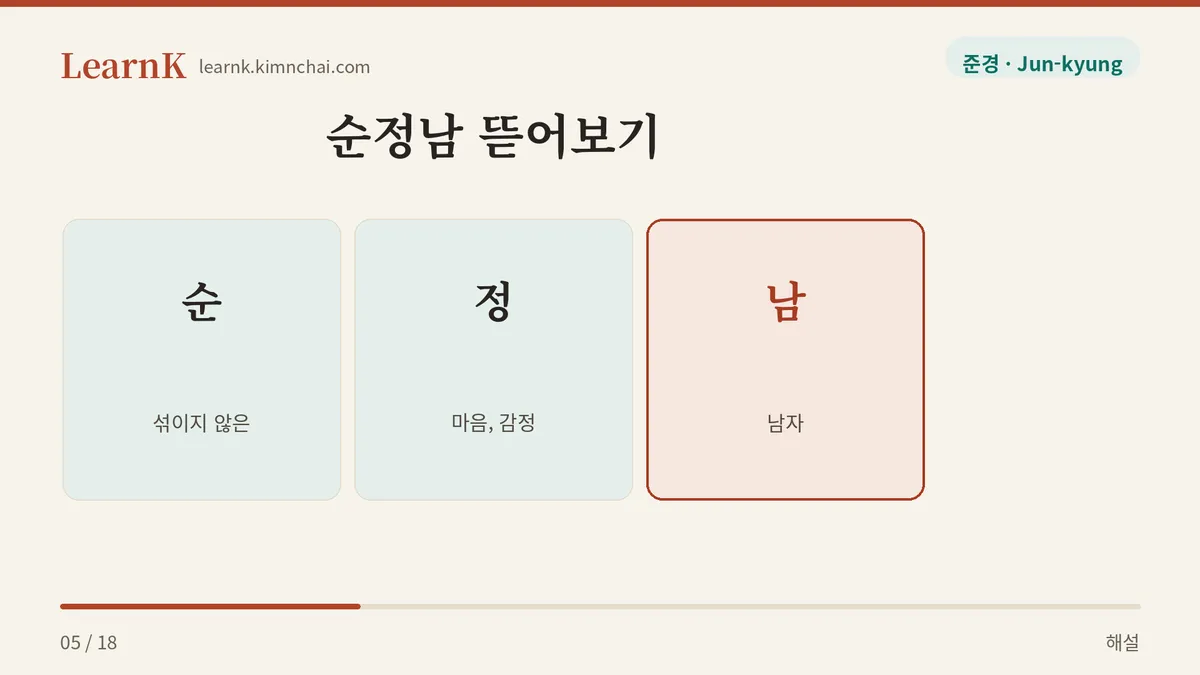
Take it apart by its Chinese characters and the meaning shows through. 순 (純) means unmixed, and 정 (情) refers to the heart, or feelings. Add 남 (男), man, and you get “a man with an unmixed heart.” Here, “unmixed” doesn’t mean kind or innocent — it means his heart isn’t split in several directions. That distinction matters more than you’d expect. No matter how good-natured and considerate a man is, if his heart wanders from this person to that one, nobody calls him a 순정남. Conversely, a man who is blunt and terrible at expressing himself is a 순정남 if he’s been looking at the same person for years.
The temperature is warm, but half-teasing. This word isn’t used as pure praise. When someone says “쟤 순정남이야 (jyae sunjeongnam-iya)” — “That guy is a 순정남” — it’s usually about half “he’s steady, that’s admirable” and half “does he really have to go that far? It’s exasperating.” Admiration and mockery live inside one word. One more thing: this isn’t a formal, written-language term. It’s closer to a word that settled into everyday life through dramas and internet forums. So you’ll almost never see it in meeting minutes or official documents — it lives in conversations between friends and in people’s reactions to what they’ve watched.
A Real Conversation
Setting: 11 p.m. on a Sunday, the living room at Jun-kyung’s place. The final episode of the 16-part drama the two of them have been watching together just ended. Cold chicken is still sitting in the box.
준경: 아… 끝났다. 나 진짜 남주가 저럴 줄은 몰랐어. Ah… it’s over. I really didn’t expect the male lead to turn out like that.
에밀리: 봐, 내가 뭐랬어. 저 사람 1회부터 순정남이었다니까. See, what did I tell you? That guy was a one-hearted man from episode one.
준경: 무슨 순정남이야. 8회까지 사람 헷갈리게 해놓고. What one-hearted man? He kept us all confused until episode eight.
에밀리: 그게 순정남 국룰이잖아. 말은 안 하고 혼자 끙끙 앓다가 마지막에 터뜨리는 거. That’s the standard rule for these guys — say nothing, suffer alone, then let it all out at the end.
준경: 하… 나도 저렇게 한 사람만 봤으면 지금쯤 결혼했겠다. Sigh… if I’d focused on one person like that, I’d probably be married by now.
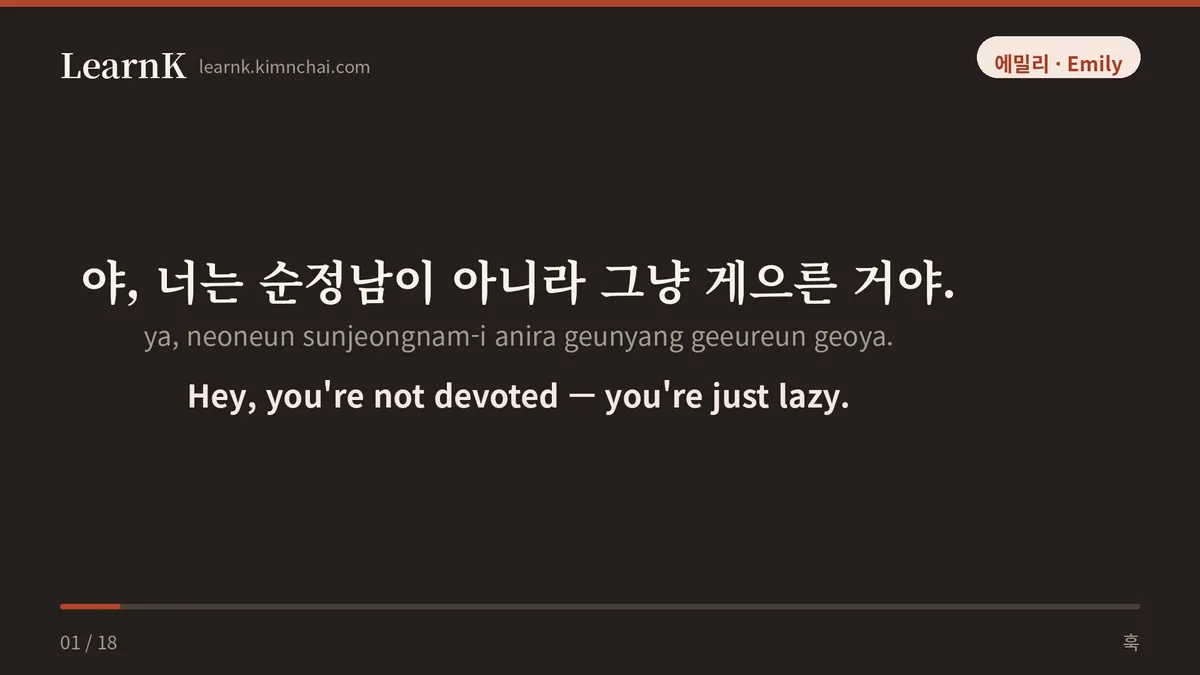
에밀리: 야, 너는 순정남이 아니라 그냥 게으른 거야. Hey, you’re not devoted — you’re just lazy.
These Uses Sound Off
✗ (To a manager at a client company) 부장님, 사모님 얘기하실 때 보면 정말 순정남이세요. (bujangnim, samonim yaegi hasil ttae bomyeon jeongmal sunjeongnam-iseyo.) “Sir, when you talk about your wife, you’re such a 순정남.”
✓ (To a friend) 너 진짜 못 말리는 순정남이다. (neo jinjja mot mallineun sunjeongnam-ida.) “You are one hopeless 순정남.”
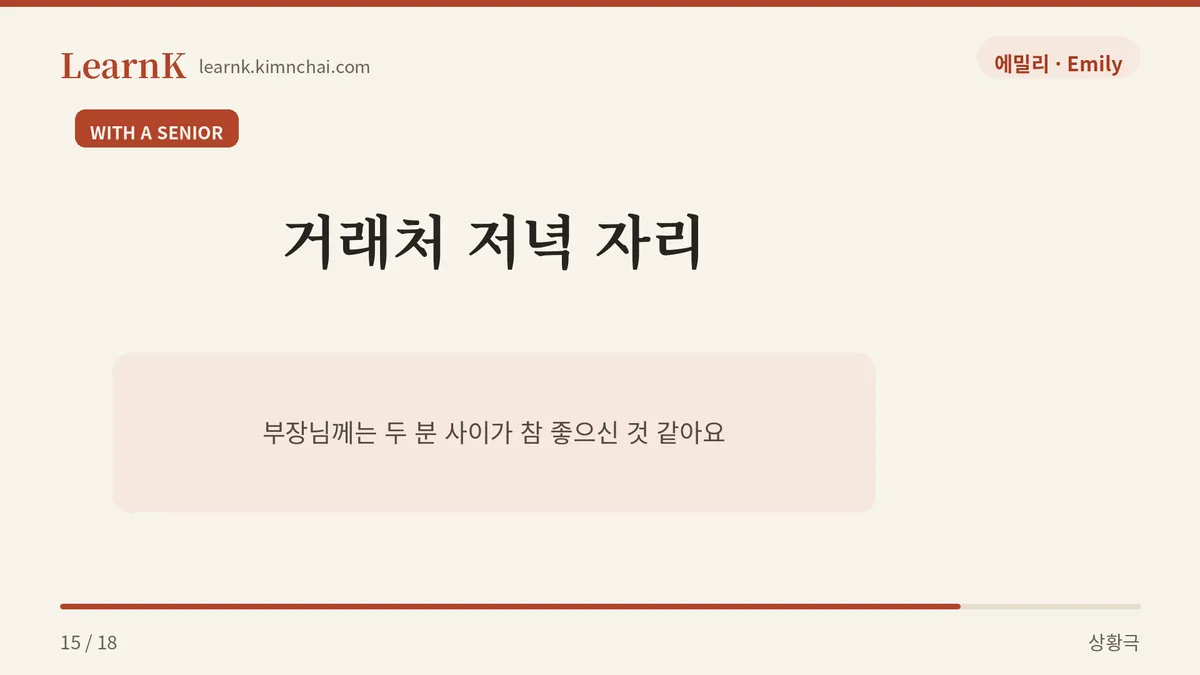
→ This word carries a streak of affectionate teasing. Aimed at the romance or married life of someone older than you, it becomes a casual poke at their private life. With a senior, something like “두 분 사이가 참 좋으신 것 같아요 (du bun saii-ga cham joeusin geot gatayo)” — “The two of you seem to have such a good relationship” — is the safe choice.
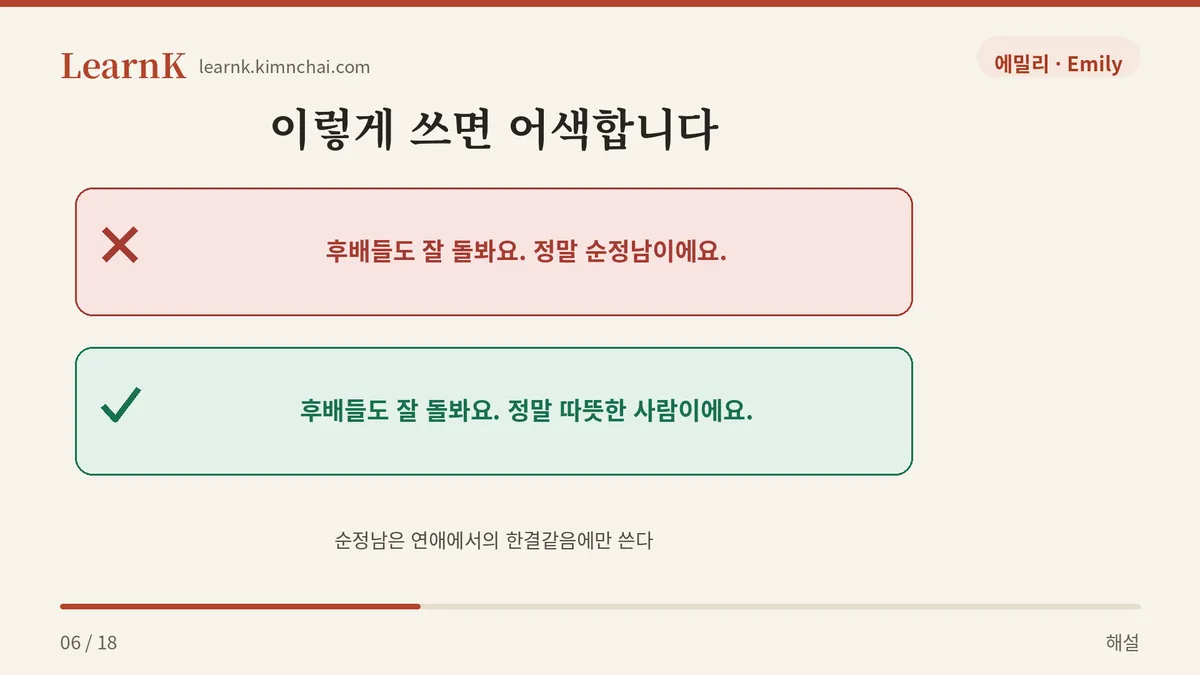
✗ 그분은 길고양이 밥도 챙기고 후배들도 잘 돌봐요. 정말 순정남이에요. (geubun-eun gilgoyangi bap-do chaenggigo hubae-deul-do jal dolbwayo. jeongmal sunjeongnam-ieyo.) “He feeds the stray cats and looks after his juniors. He’s a real 순정남.”
✓ 그분은 길고양이 밥도 챙기고 후배들도 잘 돌봐요. 정말 따뜻한 사람이에요. (geubun-eun gilgoyangi bap-do chaenggigo hubae-deul-do jal dolbwayo. jeongmal ttatteutan saram-ieyo.) “He feeds the stray cats and looks after his juniors. He’s a genuinely warm person.”
→ 순정남 doesn’t point to general goodness — it’s limited to steadfastness in romance. Stick it on any kind person and the sentence slips right off a Korean ear.
Example Sentences by Situation
1. Teasing a friend about a long-running crush
걔 아직도 그 선배 좋아한대. 진짜 못 말리는 순정남이야. (gyae ajikdo geu seonbae joahandae. jinjja mot mallineun sunjeongnam-iya.) “Apparently he still likes that 선배 (seonbae, an older student or senior). He’s a truly hopeless 순정남.”
This is the single most common sentence at a college reunion. Adding 못 말리는 (mot mallineun, “unstoppable, hopeless”) tips it from admiration toward teasing, and adding 진짜 (jinjja, “really”) loads that teasing with affection. The person on the receiving end usually waves a hand and says “아니야, 그냥 친한 거야 (aniya, geunyang chinhan geoya)” — “No, we’re just close.”
2. Leaving a comment about a drama
이 드라마 남자 주인공, 요즘 보기 드문 순정남이네요. (i deurama namja jugong, yojeum bogi deumun sunjeongnam-ineyo.) “The male lead in this drama is a 순정남 — rare these days.”
This is the form you’ll see most often in online reviews and social media posts. It ends in -네요 (-neyo), so it’s polite, but since it’s addressed to a faceless crowd it carries no pressure. The word sounds most natural exactly like this — when you’re talking about a third person.
3. Joking about yourself
나 이래 봬도 순정남이야. 10년 동안 한 사람만 좋아했어. (na irae bwaedo sunjeongnam-iya. sip nyeon dongan han saram-man joahaesseo.) “Believe it or not, I’m a 순정남. I liked one person for ten years.”
Said about yourself, it stops being a serious confession and becomes a joke. That’s because 이래 봬도 (irae bwaedo, literally “even though I look like this”) sets up the punchline: “contrary to how I appear.” It’s a classic self-introduction at a drinking table.
Politeness Levels and Similar Expressions
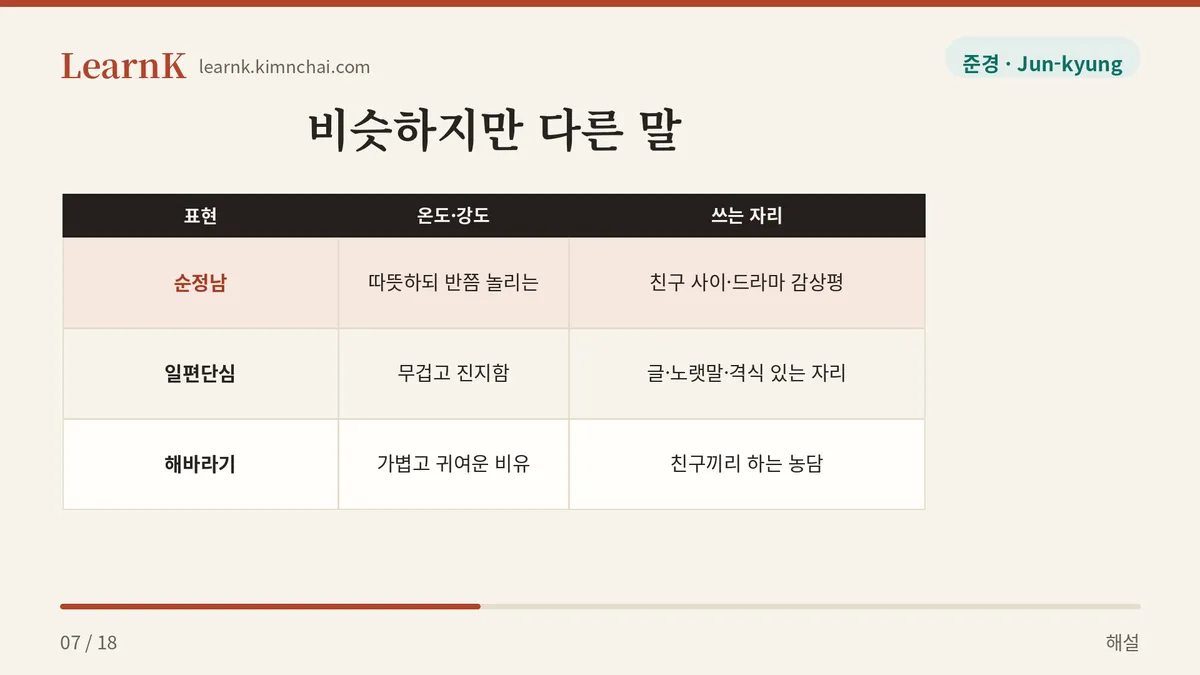
순정남 is a noun, so there’s no honorific built into the word itself. But as the misuse examples showed, there’s a felt rule that it’s something you say about a third person, not to someone’s face. “순정남이시네요 (sunjeongnam-isineyo)” is grammatically perfectly fine, but in practice people rarely say it.
| Expression | Temperature / Intensity | Where it’s used |
|---|---|---|
| 순정남 (sunjeongnam) | Warm, but half-teasing | Among friends, drama reactions, social media. Not used toward seniors |
| 일편단심 (ilpyeondansim) | Heavy and serious | Writing, song lyrics, formal settings. Used for men and women alike |
| 순애보 (sunaebo) | Tender and story-like | Refers to a whole love story, not to a person |
| 해바라기 (haebaragi) | Light, cute metaphor | Jokes like “쟤는 완전 그 사람 해바라기야” (“He’s totally her sunflower”) |
| 바람둥이 (baramdungi) | The exact opposite, negative | For teasing or talking someone down |
The pair that confuses learners most is 순정남 and 일편단심. 일편단심 (一片丹心) means “a single piece of a crimson heart” — a far more refined and weighty word, so using it while teasing a friend makes the sentence go stiff all of a sudden. And 순애보 doesn’t point to a person; it points to a story. Say “그 사람 순애보야 (geu saram sunaebo-ya)” and it sounds like that person’s entire love life is one long narrative.
Cultural Background — A Word That Came from Romance Comics
Comics are a big reason 순정 (sunjeong) hardened into the word Koreans use for the emotional register of a love story. In Korea, the entire genre of romance comics aimed at girl readers is called 순정만화 (sunjeongmanhwa). Back in the era of comic cafés and rental shops in the 1980s and ’90s, one whole side of the shelves was simply the “순정” section. So for Koreans, 순정 is the name of a genre before it’s a dictionary definition — and the word drags that genre’s atmosphere along with it: the heart that waits a long time, the heart that can’t speak, the heart that in the end never changes.
When Koreans talk about male leads in dramas, viewers commonly sort them into two types. One is the cold, willful “bad boy”; the other is the 순정남. What’s interesting is that the title of 순정남 gets attached more often to the second male lead (서브 남주, seobeu namju) than to the lead himself — the character who waits a long time by the heroine’s side and, in the end, never gets her. So the word carries less of a winner’s glow and more of an ache, and it’s even produced a set phrase viewers sigh out: “서브 남주가 진짜 순정남인데 (seobeu namju-ga jinjja sunjeongnam-inde)” — “But the second lead is the real 순정남…”
Among younger speakers today, the word bends one more time. In an atmosphere where changing romantic partners often is taken as normal, the 순정남 gets jokingly called an “endangered species.” The stock version of that joke is “요즘 세상에 순정남이 어디 있냐 (yojeum sesang-e sunjeongnam-i eodi innya)” — “Where would you even find a 순정남 these days?” Praise and mockery, longing and resignation, all at once: get a feel for that temperature and you’ve basically mastered the word.
Today’s Quiz
In which of the following situations is 순정남 the most natural thing to say?
- When your manager picks up the whole tab for the team dinner
- When your friend has liked the same person for five years running
- When you see a junior colleague feeding the stray cats every day
Show the answer
Answer: 2
순정남 doesn’t mean “a kind person” — it points to someone who has looked at one person for a long time. For 1, “부장님, 통이 크시네요 (bujangnim, tong-i keusineyo)” — “Sir, that’s generous of you” — fits; for 3, “정말 따뜻한 사람이네요 (jeongmal ttatteutan saram-ineyo)” — “What a warm person.” And when you say the line in 2, the Korean way is not to look serious but to say it half-smiling: “진짜 못 말리는 순정남이야 (jinjja mot mallineun sunjeongnam-iya).”