탕수육 (tangsuyuk) — Why There's Always One More Plate Next to Your 짜장면 (jjajangmyeon)
Today’s expression is 탕수육 (tangsuyuk). 탕수육 means a Chinese dish made by coating meat in batter, frying it, and pouring over it a thickened starch sauce boiled with vinegar, soy sauce, sugar, and vegetables. You won’t be far off if you think of it as the equivalent of English sweet and sour pork or Japanese 酢豚 (subuta).
In Korea, though, this word does a lot more work than just naming a dish. The afternoon the last of the moving boxes comes through the door; the evening exams finally end; the day friends helped you with something and you owe them a meal — ordering only 짜장면 (jjajangmyeon) feels a little stingy, so you add one more plate, and that plate is 탕수육. When a Korean says “탕수육도 시킬까?” (“Should we get tangsuyuk too?”), it’s less a question about what to eat than a declaration: today, let’s eat properly. So this is a word you read off the mood in the room, not just off the menu.
탕수육 is a noun, so there are no conjugations to memorize. Instead, it’s much faster to learn the phrases it always travels with, as whole chunks. 탕수육을 시키다 (tangsuyugeul sikida, to order tangsuyuk), 탕수육 소자·중자·대자 (soja·jungja·daeja, small plate · medium plate · large plate), and the two that Koreans have been arguing about online for over a decade — 부먹 (bumeok, pouring the sauce over it) and 찍먹 (jjingmeok, dipping it in the sauce). Know just these four chunks and you’ll almost never get stuck ordering at a 중국집 (jungguk-jip, a Korean-Chinese delivery restaurant).
Checking the National Institute of Korean Language dictionary
The National Institute of Korean Language’s Basic Korean Dictionary lists 탕수육 as a noun and defines it like this:
탕수육 「noun」 튀김옷을 입혀 튀긴 고기에 식초, 간장, 설탕, 채소 등을 넣고 끓인 녹말 물을 부어 만든 중국요리. (A Chinese dish made by frying batter-coated meat and pouring over it a boiled starch sauce made with vinegar, soy sauce, sugar, vegetables, and so on.) — National Institute of Korean Language, Basic Korean Dictionary (krdict.korean.go.kr)
What’s fun is that the entire recipe is packed into the definition. You need both parts — the ‘fried meat’ and the ‘boiled starch sauce’ — for it to count as 탕수육. This dictionary also provides translations in several languages.
[en] sweet and sour pork — A Chinese dish made by frying flour-coated meat, and pouring a boiled mixture of vinegar, soybean sauce, sugar, vegetables, etc., over the meat. [ja] すぶた【酢豚】 — 衣を被せて揚げた豚肉に、酢・カンジャン・砂糖・野菜などを合わせて沸かしたあんをかけて作った中華料理。 [es] cerdo en salsa agridulce — Comida china que se prepara friendo la carne bañada en masa, y echando encima de la carne frita una salsa de almidón hervida con vinagre, salsa de soja, azúcar y verduras. [zh] 韩式糖醋肉片 — 猪肉上裹面衣而油炸后,再倒进用醋、酱油、白糖、蔬菜熬的淀粉汤而成的中国料理。 — National Institute of Korean Language, Basic Korean Dictionary (krdict.korean.go.kr)
(Portuguese isn’t included in this dictionary. For reference, it would come out to something like porco agridoce — but that one line is our own rendering, not dictionary content.)
The real usage examples in the same dictionary make it clear exactly where this word sits in Korean life.
민준이는 탕수육이 나오자 입맛을 다시며 껄떡였다. (The moment the tangsuyuk arrived, Min-jun smacked his lips and couldn’t hold back.) — National Institute of Korean Language, Basic Korean Dictionary (krdict.korean.go.kr)
This sentence paints the reaction at the exact moment the plate lands on the table. 입맛을 다시다 (immasseul dasida) is that little mouth movement you make when you want something badly, and 껄떡이다 (kkeoltteogida) is when the craving is written all over you. In other words, the dictionary itself acknowledges that when 탕수육 shows up, even a well-mannered person briefly falls apart.
모처럼 중국집에 간 나는 라조기가 먹고 싶었지만 닭고기를 먹지 못하는 동생 때문에 대신 탕수육을 주문해야 했다. (On a rare trip to a Korean-Chinese restaurant, I wanted rajogi, but because of my younger sibling who can’t eat chicken I had to order tangsuyuk instead.) — National Institute of Korean Language, Basic Korean Dictionary (krdict.korean.go.kr)
Here you can see its nature as a dish meant to be shared. If someone at the table can’t eat chicken, you go with 탕수육, which is pork — it holds the position of “the plate nobody has to sit out” at a Korean-Chinese restaurant.
나는 자장면, 탕수육, 라조기 등을 시켜 이사를 도와준 친구들을 대접했다. (I ordered jajangmyeon, tangsuyuk, rajogi and so on to treat the friends who had helped me move.) — National Institute of Korean Language, Basic Korean Dictionary (krdict.korean.go.kr)
Notice that ‘moving’ and ‘treating someone’ land in the same sentence. Ordering Chinese food on moving day is practically a custom in Korea, and among those dishes 탕수육 is the plate that shows how grateful you are.
나는 자장면과 탕수육만 있으면 그 어떤 성찬도 부럽지 않다. (As long as I have jajangmyeon and tangsuyuk, I don’t envy any feast.) — National Institute of Korean Language, Basic Korean Dictionary (krdict.korean.go.kr)
This shows that 짜장면 and 탕수육 come as a matched pair. Saying these two beat any expensive course meal isn’t an exaggeration — it’s something a lot of Koreans genuinely say.
우리 탕수육 큰 걸로 하나 더 먹자. (Let’s get one more tangsuyuk — the big one.) — National Institute of Korean Language, Basic Korean Dictionary (krdict.korean.go.kr)
Short, but there’s a lot to learn here. 큰 걸로 (keun geollo, “the big one”) is the everyday way of saying 대자 (daeja, large) from earlier, and 하나 더 (hana deo, “one more”) tells you it’s counted by the plate. The warmth of this line, traded in 반말 (banmal, casual speech), is exactly the warmth of the settings where 탕수육 belongs.
Seeing it in a real conversation
Situation: The afternoon of Emily’s moving day. Everything has been carried in, and boxes are still stacked on the floor. Jun-kyung spreads out some newspaper and picks up his phone.
Jun-kyung: 자, 이제 밥 먹자. 이사했으면 짜장면이지. Alright, let’s eat. Moving day means jjajangmyeon.
Emily: 짜장면만? 나 탕수육도 먹고 싶은데. Just jjajangmyeon? But I want tangsuyuk too.
Jun-kyung: 오, 좀 아네. 그래, 탕수육도 하나 시키자. 소자? 중자? Oh, you know your stuff. Fine, let’s order tangsuyuk too. Small or medium?
Emily: 중자. 오늘 도와준 사람이 몇인데. Medium. Look how many people helped out today.
Jun-kyung: 콜. 근데 너 부먹이야, 찍먹이야? Deal. By the way — sauce poured on, or on the side?
Emily: 당연히 찍먹이지. 눅눅해지면 그게 탕수육이야? Dipping, obviously. If it goes soggy, is that even tangsuyuk?
That last line is the heart of the conversation. Grammatically it’s a question, but what it means is a firm assertion: “that is not tangsuyuk.” Korean very often uses this kind of rhetorical comeback in place of a flat statement.
These sound unnatural
Since 탕수육 is the name of an object, you don’t have to adjust it depending on who you’re talking to. There are, however, two misunderstandings learners often run into.
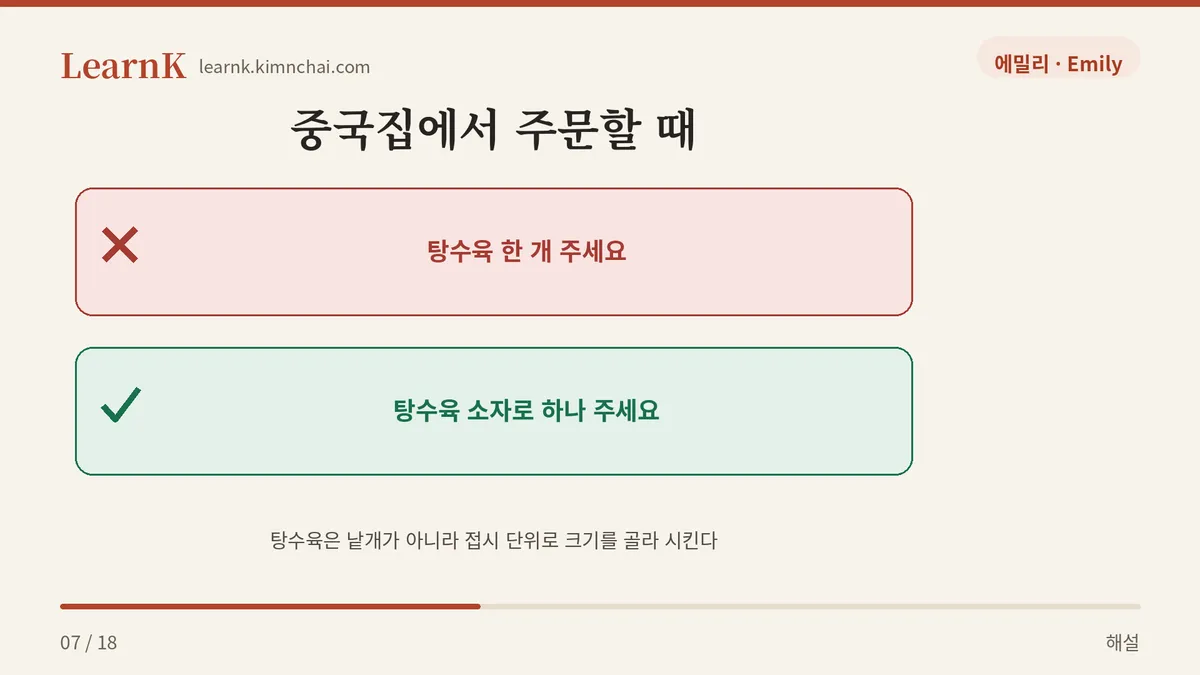
✗ (at a Korean-Chinese restaurant) 여기요, 탕수육 한 개 주세요. ✓ (at a Korean-Chinese restaurant) 여기요, 탕수육 소자로 하나 주세요. / 탕수육 작은 거 하나요. → 탕수육 is ordered by the plate, choosing a size, so it doesn’t pair well with 한 개 (han gae), which counts individual items. It’s natural to say 소자·중자·대자, or simply pick 작은 거 (jageun geo, the small one) or 큰 거 (keun geo, the big one).
✗ (pointing at a pork cutlet) 이거 탕수육이랑 똑같네. ✓ (pointing at a pork cutlet) 이거 탕수육이랑 비슷한데, 소스가 없네. → Not everything fried counts as 탕수육. As the dictionary definition says, you need that sweet-and-sour starch sauce too; without it, Koreans count it as a different food entirely.
Example sentences by situation
Situation 1 — Treating the friends who helped you move
오늘 도와줘서 고마워. 짜장면이랑 탕수육 (tangsuyuk) 시킬 테니까 많이 먹어. Thanks for helping today. I’ll order jjajangmyeon and tangsuyuk, so eat plenty. This is 반말, used with peers or people younger than you, not with someone senior. 시킬 테니까 (sikil tenikka, “since I’ll be ordering”) already implies that you’re paying, so you don’t need to add “내가 살게” (naega salge, “it’s on me”) — it comes across anyway.
Situation 2 — Ordering from a Korean-Chinese restaurant by phone
여기 행복아파트 101동인데요, 짬뽕 둘에 탕수육 (tangsuyuk) 소자 하나 주세요. This is Haengbok Apartments, building 101 — two jjamppong and one small tangsuyuk, please. Giving the address first and the food afterward is the standard order for a Korean delivery call. Stringing menu items together with the particle 에 (e), as in 둘에 하나 (dure hana, “two of these plus one of those”), makes you sound very fluent.
Situation 3 — The delivery arrives with the sauce already poured on
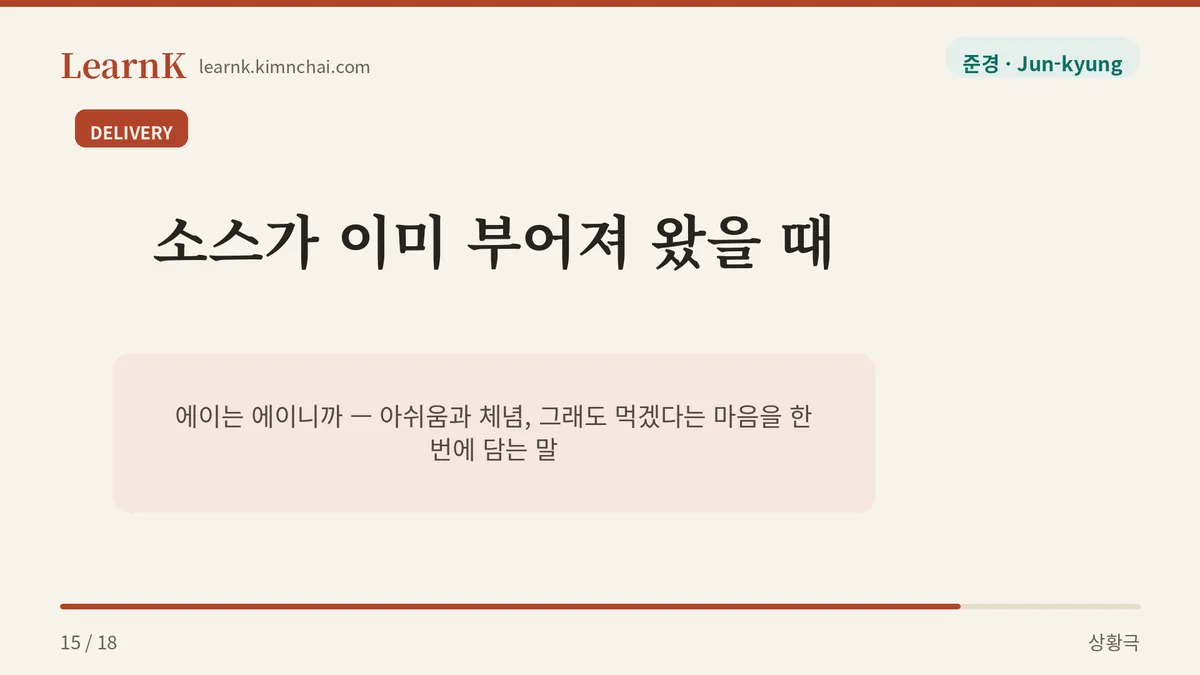
아, 소스 미리 부어서 왔네. 나 찍먹인데… 그래도 탕수육 (tangsuyuk) 은 탕수육이니까 먹자. Ah, they poured the sauce already. I’m a dipper… but tangsuyuk is tangsuyuk, let’s eat. The structure “A는 A니까” (A-neun A-nikka, “A is A, after all”) is commonly used to say that even if something is disappointing, its essence hasn’t changed. Here it carries disappointment, resignation, and the determination to eat it anyway, all at once.
Polite vs. casual speech, and related expressions
The name of the food itself has no honorific form, but the sentences you use to order it or offer it change with the setting.
- Casual (friends, family): 탕수육 시키자 / 탕수육 하나 더 먹을래?
- Polite (at a restaurant, with someone senior): 탕수육 하나 주세요 / 탕수육도 한 접시 시킬까요?
Its character comes into sharper focus when you compare it with the dishes that always sit next to it on a Korean-Chinese menu.
| Expression | Flavor / intensity | Where it’s used |
|---|---|---|
| 탕수육 (tangsuyuk) | Sweet and sour, not spicy | The default plate that everyone from kids to grown-ups eats. The safest pick when you’re sharing with a group |
| 깐풍기 (kkanpunggi) | Spicy and salty, strong | Drinking food. Among people who like it hot |
| 유린기 (yuringi) | Fresh and light | For when fried food feels heavy. Comes piled with vegetables |
| 라조기 (rajogi) | Spicy and thick | Among people who eat chicken. It’s the dish that appeared in the dictionary example above |
If it’s your first time at a Korean-Chinese restaurant and you have no idea what to pick, 탕수육 is about as close to a correct answer as it gets. Almost nobody has to skip it, which makes “탕수육 시킬까요?” one of the few suggestions you can throw out without first asking about anyone’s preferences.
Cultural background — two plates on a sheet of newspaper
Korea’s Chinese restaurants didn’t come straight from mainland China; they began with the restaurants of ethnic Chinese immigrants who settled in Korea, and along the way the food was rebuilt for Korean tastes. So although 탕수육 is classified as ‘Chinese cuisine,’ it’s really closer to Korean-style Chinese food. Which means if you go to China and look for the same name, you may get a somewhat different dish.
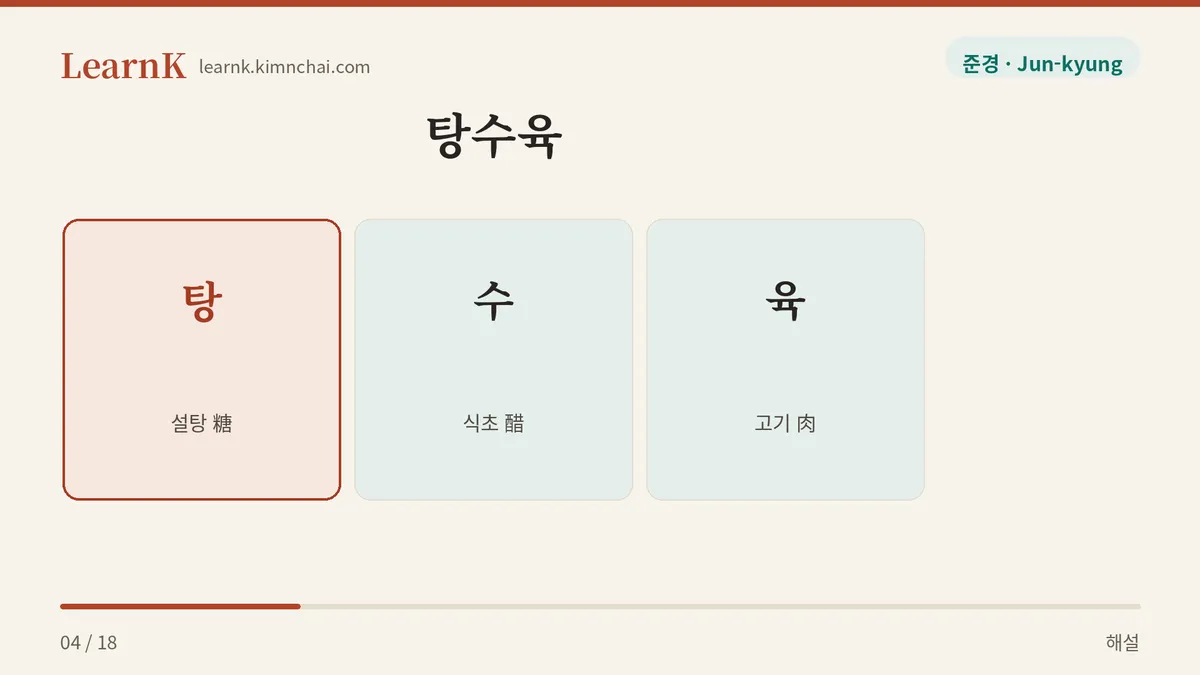
As for where the name comes from, the widely repeated explanation traces it to the Sino-Korean characters for sugar (糖), vinegar (醋), and meat (肉). That means the three things listed in the dictionary definition — vinegar, sugar, and meat — are sitting right inside the name itself, so calling those three to mind when you memorize the word makes it stick.
More than anything, 탕수육 is ‘food for days when something happened.’ Moving, graduation, exam results, a guest you haven’t seen in ages. In Korean dramas and variety shows, the scene of newspaper spread out among the moving boxes with bowls of 짜장면 and a plate of 탕수육 on top comes back again and again, and that image alone, with no dialogue at all, tells you “something big happened for these people today.” A single prop explains the whole situation.
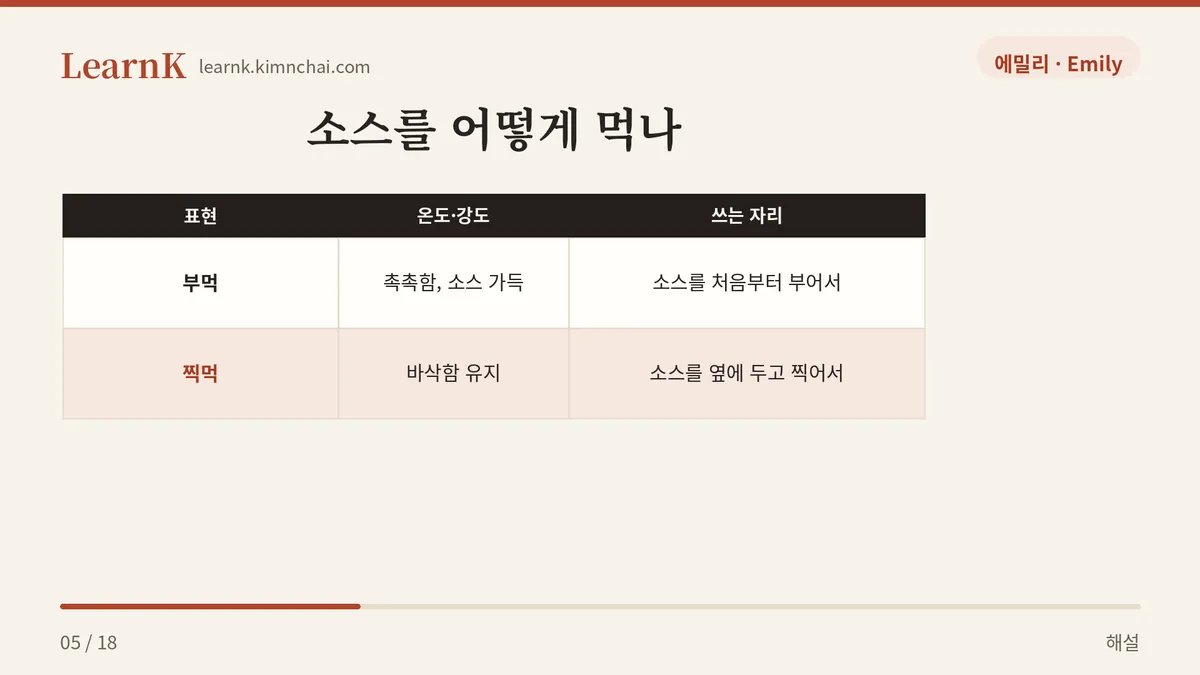
And then there’s 부먹 and 찍먹. Whether the sauce should be poured over from the start or kept on the side for dipping has been a half-joking debate on the Korean internet for over a decade, common enough that variety shows put it to a cast vote. Nobody actually gets angry about it. But ask a Korean friend “너 부먹이야, 찍먹이야?” and the conversation will absolutely come alive at least once — the question asks about a food preference, but it’s also a signal that you’re ready to be relaxed and friendly with them.
Today’s quiz
Your friends helped you move. To thank them, you want to add one more plate alongside the 짜장면, so you call the Korean-Chinese restaurant. What’s the most natural thing to say?
- 탕수육 한 개 주세요.
- 탕수육 소자로 하나 주세요.
- 탕수육을 찍먹해 주세요.
Answer: 2. 탕수육 is ordered by the plate, choosing a size, so 한 개 (option 1) sounds off. The 찍먹 in option 3 is a way the eater chooses to eat it, not something you order from the restaurant. If you really want to ask, you say “소스는 따로 주세요” (“please put the sauce on the side”). And if there are a lot of people, just move up from 소자 to 중자 or 대자 — the dictionary example above, “큰 걸로 하나 더,” is exactly that situation.
Definitions and example sentences are from the National Institute of Korean Language’s Basic Korean Dictionary (krdict.korean.go.kr); that portion of this post, including our translations, is licensed under CC BY-SA 2.0 KR.