Tteokbokki — Korea's Soul Food, and How to Say Its Name Right
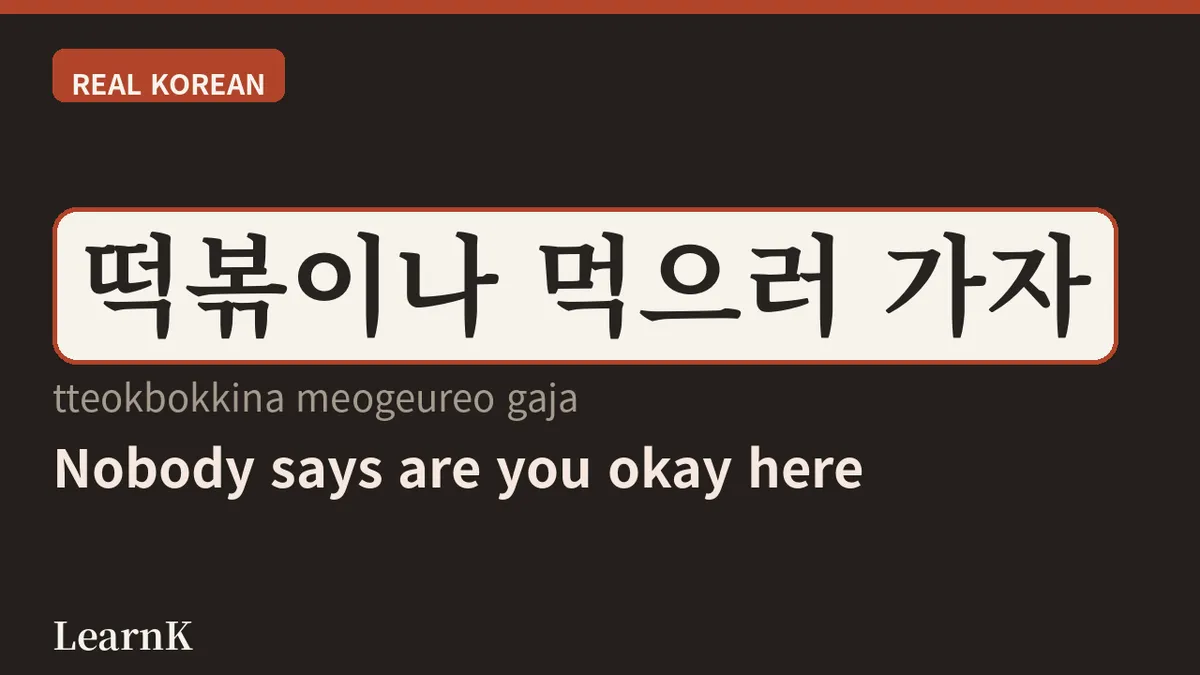
떡볶이
When you watch Korean dramas, you’ll often see a scene where the main character, after a rough day, sits down at a street food cart or a snack shop (bunsikjip) and picks up something red and spicy with their chopsticks. That’s 떡볶이 (tteokbokki)! Students just out of school, office workers on payday, friends craving a late-night snack — it’s a beloved Korean street food for everyone, young and old. Today, we’ll take a deep dive into this one word, from pronunciation to culture.
Meaning and Nuance
떡볶이 (tteokbokki) is a dish made by cutting garaetteok (a rice cake stick) into bite-sized pieces, then stir-frying or simmering them with a gochujang-based sauce and vegetables. When you pronounce it, the key is to clearly sound out the tense consonant ‘ㄸ’ at the start of 떡 (tteok) and the final consonant ‘ㄱ’. Its signature spicy-sweet flavor means it’s often paired with the expression 매콤달콤하다 (maekomdalkomhada). Keep in mind, too, that it’s more than just a simple snack — it’s a word that symbolizes ‘comfort’ and ‘nostalgia’.
Checking the National Institute of Korean Language Dictionary
First, let’s check the definition from the National Institute of Korean Language, an official government body.
떡볶이 (noun): A dish made by cutting garaetteok into suitable pieces and stir-frying it with vegetables and seasonings such as soy sauce or gochujang. [en] tteokbokki — Boiled rice cake with seasoning, made by boiling garaetteok, rice cake stick, vegetables, seasonings such as soy sauce, gochujang, red chili paste, etc. [zh] 辣炒年糕 — 将长条年糕切成适当大小,加入酱油或辣椒酱等调料和各种蔬菜一同炒熟的食物。 — National Institute of Korean Language, Basic Korean Dictionary (krdict.korean.go.kr)
Let’s look at a few of the real usage examples listed in the dictionary, exactly as they appear, and add some commentary on the situation in each.
나는 학교 수업을 마치면 친구들과 매일같이 노점에서 떡볶이를 사 먹었다. — National Institute of Korean Language, Basic Korean Dictionary (krdict.korean.go.kr)
This sentence shows a typical everyday scene for Korean students: stopping by a street stall (nojeom, a roadside vendor) with friends after school to eat tteokbokki.
승규는 떡볶이나 호떡 같은 길거리 음식을 좋아한다. — National Institute of Korean Language, Basic Korean Dictionary (krdict.korean.go.kr)
Here, tteokbokki is mentioned alongside hotteok as a prime example of ‘street food (길거리 음식)’.
응. 거기 떡볶이 되게 맛있지? 너무 맛있어서 자꾸만 가게 돼. — National Institute of Korean Language, Basic Korean Dictionary (krdict.korean.go.kr)
This is a natural casual (banmal) conversation between friends. Colloquial expressions like ‘되게 (really/very)’ and ‘자꾸만 (over and over)’ show up alongside it.
가게 주인은 빨간 떡볶이에 튀김을 넣은 뒤 긴 주걱으로 뒤섞었다. — National Institute of Korean Language, Basic Korean Dictionary (krdict.korean.go.kr)
A common sight at a snack shop, this gives a glimpse of Koreans’ love for combinations — enjoying tteokbokki together with ‘튀김 (deep-fried food)’.
Practical Example Sentences by Situation
Now let’s build a feel for real-life use with some original example sentences.
-
On an afternoon after exams are over, suggesting to a friend: 우리 떡볶이 먹으러 갈래? (uri tteokbokki meogeureo gallae?) — “Want to go grab some tteokbokki?”
-
To a foreign friend who can’t handle spicy food: 저는 안 매운 떡볶이로 주세요. (jeoneun an maeun tteokbokkiro juseyo.) — “I’ll have the non-spicy tteokbokki, please.”
-
When you’re suddenly missing the food from back home: 오늘따라 학교 앞 떡볶이가 너무 생각나. (oneulttara hakgyo ap tteokbokkiga neomu saenggangna.) — “For some reason, I’m really craving the tteokbokki from in front of my school today.”
Comparing Polite vs. Casual Speech and Similar Expressions
Even with the same meaning, your tone changes depending on who you’re talking to.
- Casual (banmal): 떡볶이 먹을래? (tteokbokki meogeullae?) — to a friend or younger sibling.
- Polite (jondaenmal): 떡볶이 드실래요? (tteokbokki deusillaeyo?) — to someone older or to a customer. Notice the use of ‘드시다’, the honorific form of ‘먹다 (to eat)’.
Similar snack-shop menu items include 라볶이 (rabokki) (ramen + tteokbokki) and 국물떡볶이 (gungmul-tteokbokki) (soupy tteokbokki with plenty of broth) — handy to know when ordering.
Cultural Background
For Koreans, tteokbokki isn’t just food — it’s a symbol of jeong (情), the warm affection shared between people. In dramas, too, you’ll often see characters soothe their upset hearts with a single plate of tteokbokki. For example, a scene where a friend offers, “Let’s go get some tteokbokki” at the end of a hard day is a classic comforting moment in Korean coming-of-age dramas (a paraphrase of a typical situation). Dipping deep-fried snacks in the spicy sauce, then frying rice in whatever sauce is left over — that’s the Korean-style ‘full course’ of enjoying tteokbokki.
Closing Quiz
You asked someone older, “떡볶이 드실래요? (Would you like some tteokbokki?)” Here, ‘드시다’ is the honorific form of which verb?
(Answer: It’s the honorific form of ‘먹다 (to eat)’. If you were talking to a friend, you could switch it to the casual ‘먹을래?’.)
Definitions and example sentences are from the National Institute of Korean Language’s Basic Korean Dictionary (krdict.korean.go.kr); that portion of this post, including our translations, is licensed under CC BY-SA 2.0 KR.