왠지 (waenji) — When You Can't Name the Reason, but Your Heart Leans First
왠지
왠지 (waenji) means “without knowing quite why.” When you can’t point to a reason, but your heart has already tilted one way, these two syllables go in front of that tilt. Meeting someone for the first time and feeling strangely at ease. Wanting to get home early today of all days. Wanting to take the long way around a street you walk every day — Korean doesn’t just let these vague states slide past. It marks them at the front of the sentence.
There’s one important thing to notice here. 왠지 does not mean “there is no reason.” It’s closer to a confession: there must be a reason somewhere, but I can’t get it into words. That’s why sentences with 왠지 tend to run at a low temperature — soft, unhurried. A signal that you don’t intend to insist comes bundled in with it. Say 왠지 그런 것 같아 (waenji geureon geot gata) and you’re also passing along some room to be wrong: “this is how I feel, but I’m not going to argue about it.”
One more thing. 왠지 attaches to the good just as readily as the bad. You can say 왠지 좋다 (waenji jota), and you can say 왠지 싫다 (waenji silta). It isn’t a word that decides the direction of a judgment — it only marks the fact that the grounds for that judgment are blurry. Whatever predicate follows, it sits quietly up front.
Checking the National Institute of Korean Language Dictionary
왠지 「adverb」
- 왜 그런지 모르게. (Without knowing why something is so.) [en] somehow — For some reason one does not know exactly. [ja] なぜか【何故か】。なんとなく【何となく】 — なぜか分からないが。 [es] dar la sensación, dar a intuir — Sin saber el por qué. [zh] 不知怎的 — 不知道为什么那样。 — National Institute of Korean Language, Basic Korean Dictionary (krdict.korean.go.kr)
A Portuguese gloss isn’t included in this dictionary. If we had to render one, sem saber bem por quê would be about right — but we should note that this single line is our own rendering, not a quotation from the dictionary.
The example sentences the dictionary supplies make it much clearer where this word actually sits.
승규는 나에게 친하게 굴었지만 나는 왠지 그가 가까이 느껴지지 않았다. Seung-gyu acted friendly toward me, but somehow he didn’t feel close to me. — National Institute of Korean Language, Basic Korean Dictionary (krdict.korean.go.kr)
The other person is clearly being good to you, and yet your heart won’t open. You can’t find any fault in them, so you can’t produce a reason either. In a moment like this, 왠지 also carries the possibility that maybe I’m the oversensitive one. It works as a cushion, keeping the remark from turning into groundless criticism of someone else.
비가 오면 왠지 따끈한 가락국수를 먹고 싶은 마음이 든다. When it rains, somehow I get a craving for a hot bowl of udon. — National Institute of Korean Language, Basic Korean Dictionary (krdict.korean.go.kr)
There’s no logical causation between rain and broth. And yet a great many Koreans think of soup or 부침개 (buchimgae, savory pancakes) on a rainy day. A sensation nobody can explain but everybody recognizes — this is exactly where 왠지 sits most comfortably.
왠지 뒤통수가 간지러워서 뒤를 돌아보니, 누군가 나를 빤히 쳐다보고 있었다. Somehow the back of my head prickled, so I turned around — and someone was staring right at me. — National Institute of Korean Language, Basic Korean Dictionary (krdict.korean.go.kr)
Here the senses reacted before the mind did. The reason only comes to light after turning around. Because 왠지 is spoken from the vantage point of “I don’t know why yet,” it gets recruited often when a story needs tension.
나뭇잎이 떨어지는 것을 보니 왠지 쓸쓸해져. Watching the leaves fall, somehow I turn lonely. — National Institute of Korean Language, Basic Korean Dictionary (krdict.korean.go.kr)
A moment when even you don’t know where the feeling came from. It would be strange to declare falling leaves the cause of sadness, but it’s just as hard to say they have nothing to do with it. When you want to speak while leaving that ambiguity intact, you reach for 왠지.
영어는 알고 보면 별것 아닌데 왠지 어렵게 느껴진다. English is nothing much once you get into it, but somehow it feels hard. — National Institute of Korean Language, Basic Korean Dictionary (krdict.korean.go.kr)
Here fact and feeling are out of step. You know objectively that it isn’t difficult, and your heart still refuses to accept that. Korean learners can swap themselves straight into this sentence — something like 한국어 발음은 규칙이 있는데 왠지 입에 안 붙는다 (hangugeo bareumeun gyuchigi inneunde waenji ibe an bunneunda), “Korean pronunciation follows rules, but somehow it just won’t stick in my mouth.”
Seeing It in Real Conversation
Situation: Saturday afternoon, Exit 3 of a subway station, where they’ve come to pick up a monitor bought secondhand. The seller hasn’t shown up at the agreed time.
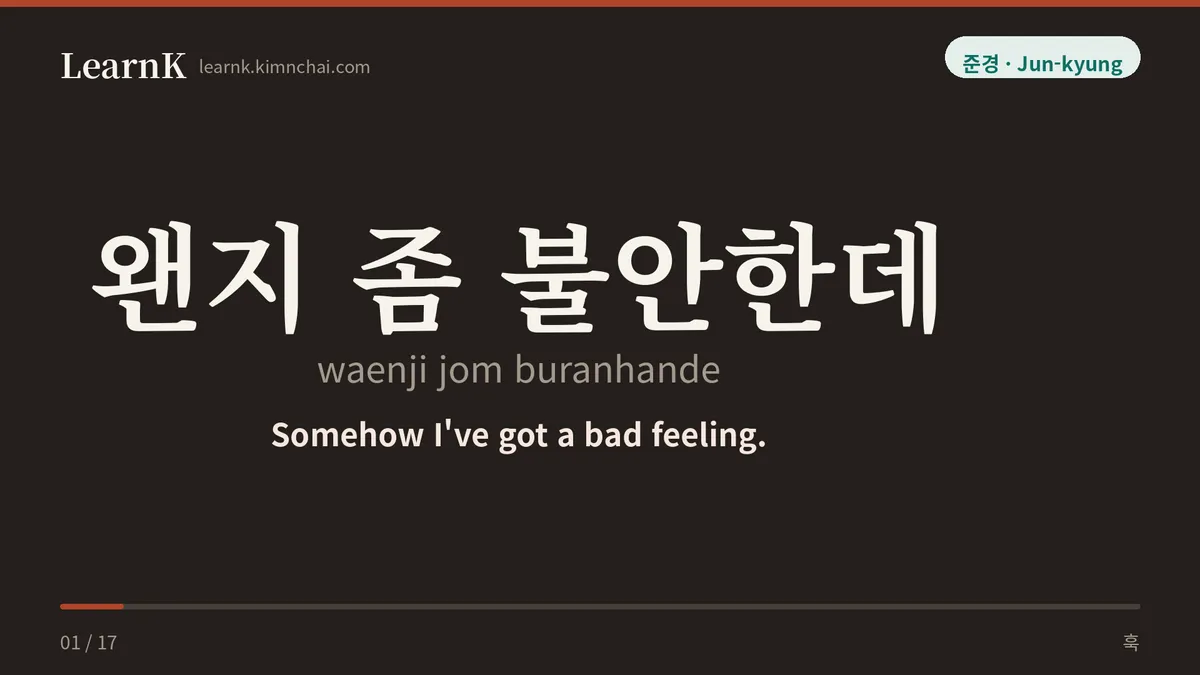
Jun-kyung: 벌써 10분 지났는데 연락도 없네. 왠지 좀 불안한데. It’s already ten minutes past and not a single message. Somehow I’ve got a bad feeling about this.
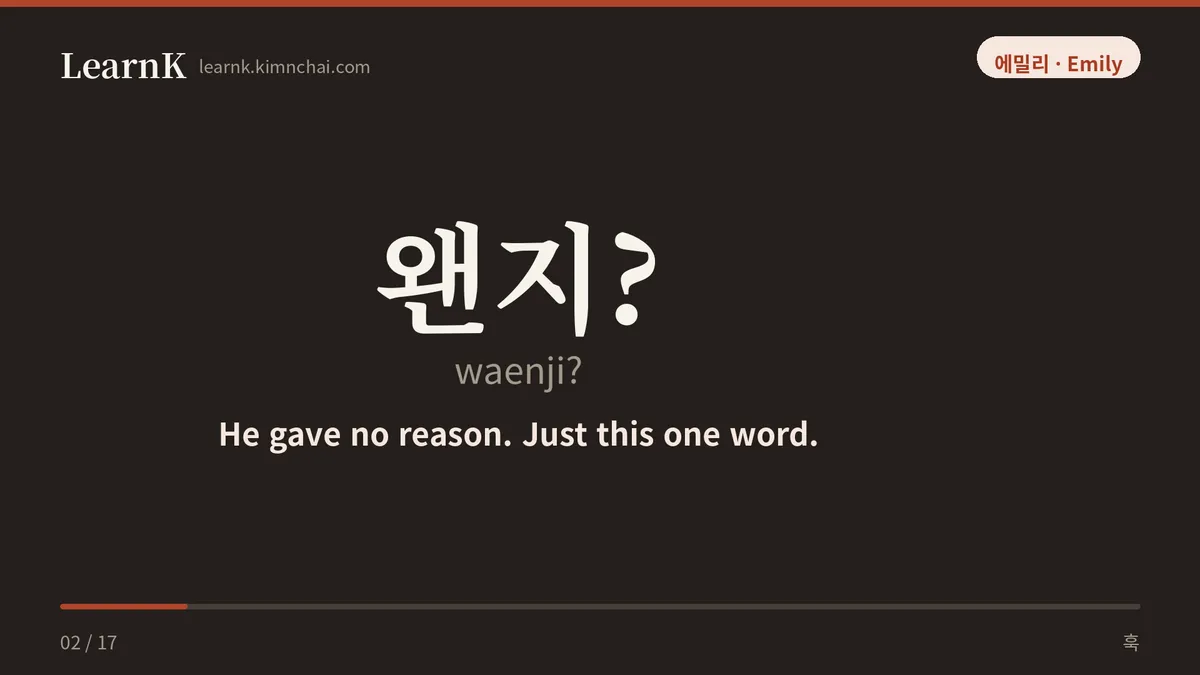
Emily: 아까 채팅할 때도 그랬어. 사진 더 보내 달라니까 계속 딴말하더라고. It was like that in the chat earlier, too. I asked for more photos and he kept changing the subject.
Jun-kyung: 그러니까. 가격도 시세보다 너무 싸고. Right? And the price is way below market, too.
Emily: 나도 그래서 왠지 찜찜했어. 근데 딱 집어 말할 데가 없어서 그냥 왔지. That’s why something felt off to me too. But I couldn’t put my finger on it, so I just came anyway.
Jun-kyung: 야, 그런 느낌 대체로 맞아. 그냥 가자. Hey, that kind of feeling is usually right. Let’s just go.
Emily: 그래. 왠지 오늘은 아닌 것 같다. Yeah. Somehow today just isn’t the day.
Where It Sounds Off
✗ (in an executive meeting) 이번 분기 매출은 왠지 오를 것 같습니다. “Somehow I think revenue will be up this quarter.” ✓ (in an executive meeting) 이번 분기 매출은 신제품 반응을 볼 때 오를 것으로 보입니다. “Judging by the response to the new product, revenue looks set to rise this quarter.” → 왠지 is a word that announces, about yourself, “I can’t produce any grounds for this.” In a room where you’re expected to answer with numbers, it doesn’t come across as modest — it comes across as unprepared. If you have grounds, state the grounds.
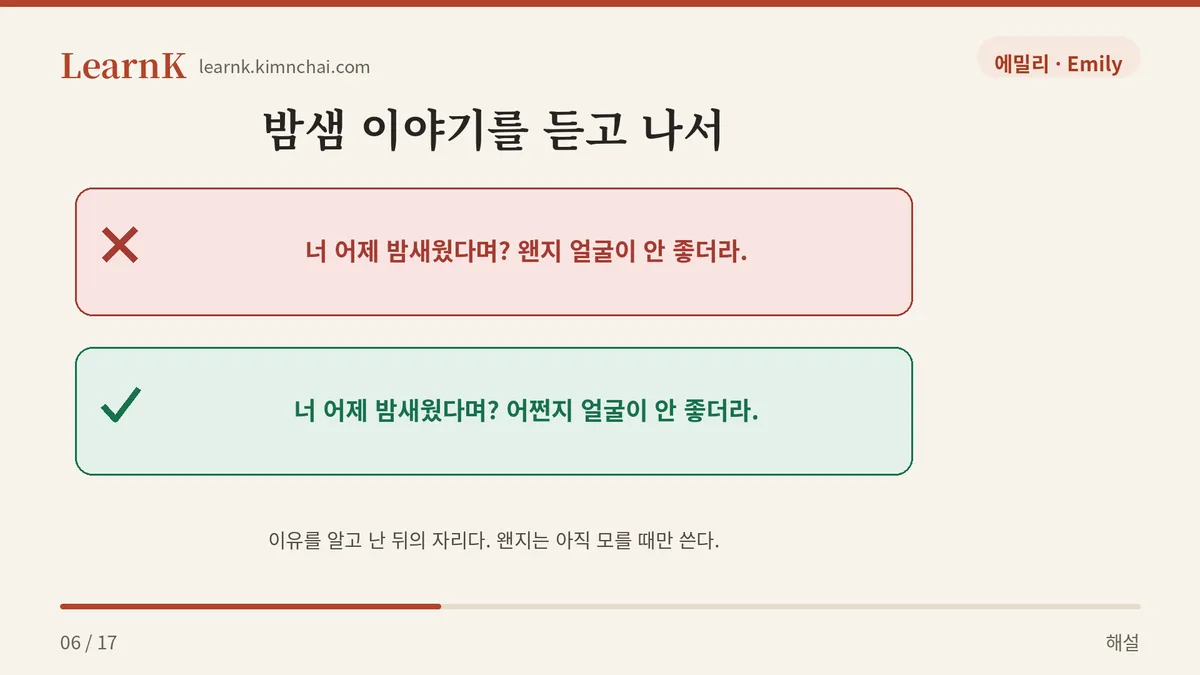
✗ 너 어제 밤새웠다며? 왠지 얼굴이 안 좋더라. ✓ 너 어제 밤새웠다며? 어쩐지 얼굴이 안 좋더라. “You pulled an all-nighter yesterday? No wonder you looked rough.” → This is the position you’re in after already hearing the reason. 왠지 is only for while the reason is still unknown. When you learn the reason and slap your knee — “ah, so that’s why” — the word you want is 어쩐지.
Example Sentences by Situation
1. In an alley of a neighborhood you’ve never visited (to a friend, casual speech)
Sometimes a street you’ve definitely never walked feels familiar anyway. Put that déjà vu into one sentence and it comes out like this.
여기 왠지 전에 와 본 것 같아. (yeogi waenji jeone wa bon geot gata.) “Somehow it feels like I’ve been here before.”
Say 전에 와 봤어 (“I’ve been here before”) and it becomes a claim about fact. Drop in 왠지 and the meaning shifts precisely toward “I have no memory of it, but my body is reacting.”
2. Walking out of a job interview (to a friend, casual speech)
The result isn’t in yet, but the atmosphere wasn’t bad.
대답은 잘 못했는데 왠지 느낌이 나쁘지 않아. (daedabeun jal mothaenneunde waenji neukkimi nappeuji ana.) “I didn’t answer well, but somehow it doesn’t feel bad.”
The fact in front (I answered badly) and the feeling behind it don’t line up. Bridging that mismatch is 왠지’s job. And by using 왠지 instead of flatly declaring 붙을 것 같아 (“I think I got it”), you won’t be left embarrassed by your own words if the rejection comes later.
3. With a neighbor in the elevator (polite speech)
왠지 is an adverb, so it carries no honorific level of its own. Change only the sentence ending and it becomes polite as is.
요즘 밤에 왠지 쌀쌀하지 않으세요? (yojeum bame waenji ssalssalhaji anuseyo?) “Doesn’t it feel a little chilly at night lately, somehow?”
It isn’t a remark made after checking the temperature — it’s a felt impression tossed out, so the other person can pick it up just as lightly with 그렇죠? (“Right?”). A useful shape for opening a short exchange with a neighbor you don’t know well.
Politeness Levels and Similar Expressions
Because 왠지 is an adverb, its form doesn’t change between casual and polite speech. In 왠지 그래 / 왠지 그래요 / 왠지 그렇습니다, the ending at the close of the sentence decides the politeness level, and 왠지 just sits there unchanged. It is worth remembering, though, that it isn’t much used in highly formal documents or reports.
Here is how the words that look similar actually differ.
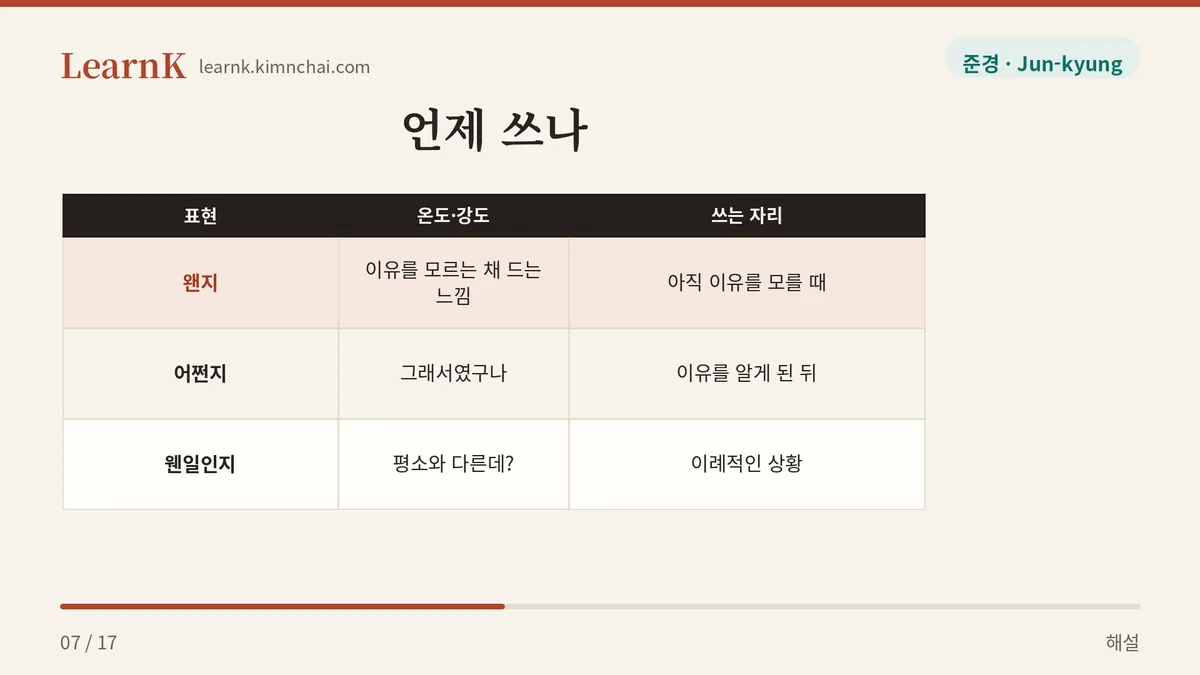
| Expression | Feel / intensity | Where it fits |
|---|---|---|
| 왠지 (waenji) | A feeling that arrives without a known reason. Neutral to wistful | Both speech and writing. Unsuited to formal reporting |
| 어쩐지 (eojjeonji) | The “ah, so that’s why” that comes after you learn the reason | After you’ve learned the story. Swap it with 왠지 and the timing breaks |
| 웬일인지 (wenilinji) | Puzzlement that something out of the ordinary is happening | Unusual situations. 웬일인지 오늘은 조용하다 — “For some reason it’s quiet today” |
| 그냥 (geunyang) | Declining to give a reason at all. Light, offhand | Peers and close friends. As an answer to someone older, it sounds like you can’t be bothered |
| 뭔가 (mwonga) | What’s blurry is the thing, not the feeling | Speech. 뭔가 이상해 — “Something’s off,” when you don’t know what |
Learners mix up 왠지 and 어쩐지 especially often. Split them along the time axis and it’s simple: while the reason is unknown, 왠지; once the reason is known, 어쩐지.
Cultural Background — Where Three Syllables Shrank Into Two
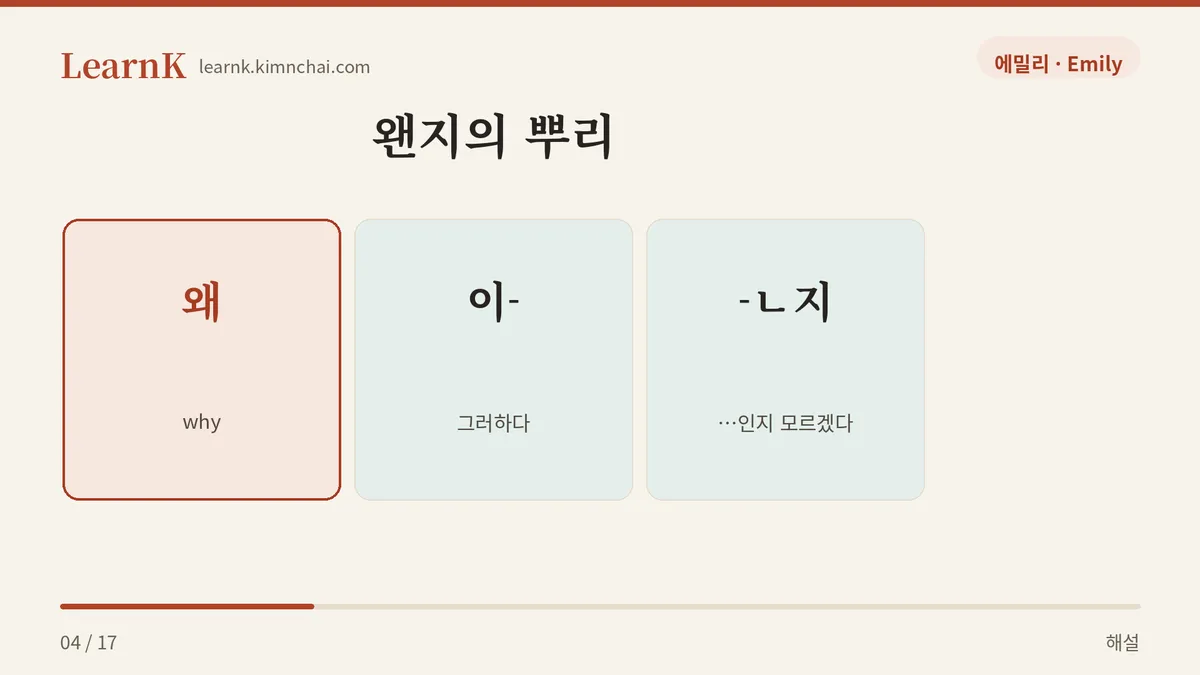
왠지 is a shortened form of 왜인지 (waeinji). ‘왜 + 이- + -ㄴ지’ — that is, “why it is so” — rolled around in the mouth until it became two syllables. When the meaning slips away from you, roll it back to the original form and it clicks right away: 왜인지 모르겠지만, “I don’t know why, but…” That’s roughly the inner sense of it.
And here we arrive at a spelling point native Koreans get wrong all the time. There is essentially only one word that uses the character 왠 — 왠지 — and everything else takes 웬. 웬일 (wenil), 웬만하면 (wenmanhamyeon), 웬 떡 (wen tteok) — all 웬. Only 왠지 gets 왠; the rest get 웬. Memorize that one line and you’ll write it more accurately than plenty of native speakers.
Because the word itself is short and soft, it pairs well with a Korean speech style that finds naming emotions directly a little awkward. Instead of saying “I like you,” people say 왠지 자꾸 생각나 (“somehow I keep thinking about you”). Instead of saying “I think we’re breaking up,” they say 왠지 오늘은 좀 이상했어 (“somehow today felt strange”). That’s why Korean dramas are full of scenes where a character can’t produce a reason, trails off, and stops at 그냥… 왠지 (“just… I don’t know”). It’s a word that lets you fold your certainty halfway down and hold out only your feelings first, which makes it a good fit for places where nothing has been settled yet — just before a confession, just before a goodbye.
Korean has a number of words like this that grant the senses priority over logic. 눈치 (nunchi), the eye for reading how someone else is feeling, and 촉 (chok), the hunch that turns out right with no evidence behind it, belong to the same family. Learning 왠지 is less a matter of memorizing one word than of gaining one of Korean’s margins — the permission to speak while leaving something unexplained.
Today’s Quiz
A friend has just told you, “I pulled an all-nighter yesterday.” Hearing that, you look at their face again — and they really do look exhausted. Which word best fills the blank?
‘너 어제 밤새웠다며? ______ 얼굴이 안 좋더라.’
① 왠지 ② 어쩐지 ③ 웬일인지
Answer: ② 어쩐지
You’ve already heard the reason (the all-nighter), and it explains an observation you made earlier — so 어쩐지 is the right word. ① can only be used while the reason is still unknown, and ③ expresses puzzlement at something unusual and out of the ordinary, which is a different flavor from this sentence. If you had seen your friend’s face before they mentioned the all-nighter, then 왠지 얼굴이 안 좋네 would have been the accurate sentence.
Definitions and example sentences are from the National Institute of Korean Language’s Basic Korean Dictionary (krdict.korean.go.kr); that portion of this post, including our translations, is licensed under CC BY-SA 2.0 KR.