약과 (yakgwa) — The Moment a Honey Cookie's Name Turns Into "This Is Nothing"
약과
If you’ve ever noticed a brown cookie stamped with a honeycomb-like lattice pattern in a Korean café display case, that’s 약과 (yakgwa). 약과 (yakgwa) means a traditional Korean confection made by pressing a dough of honey, oil, and wheat flour into a carved mold to shape it and then frying it in oil — and at the same time it’s a word used to mean “that much is nothing.” It’s a rare kind of word: the name of a cookie that packed up and moved into the territory of comfort.
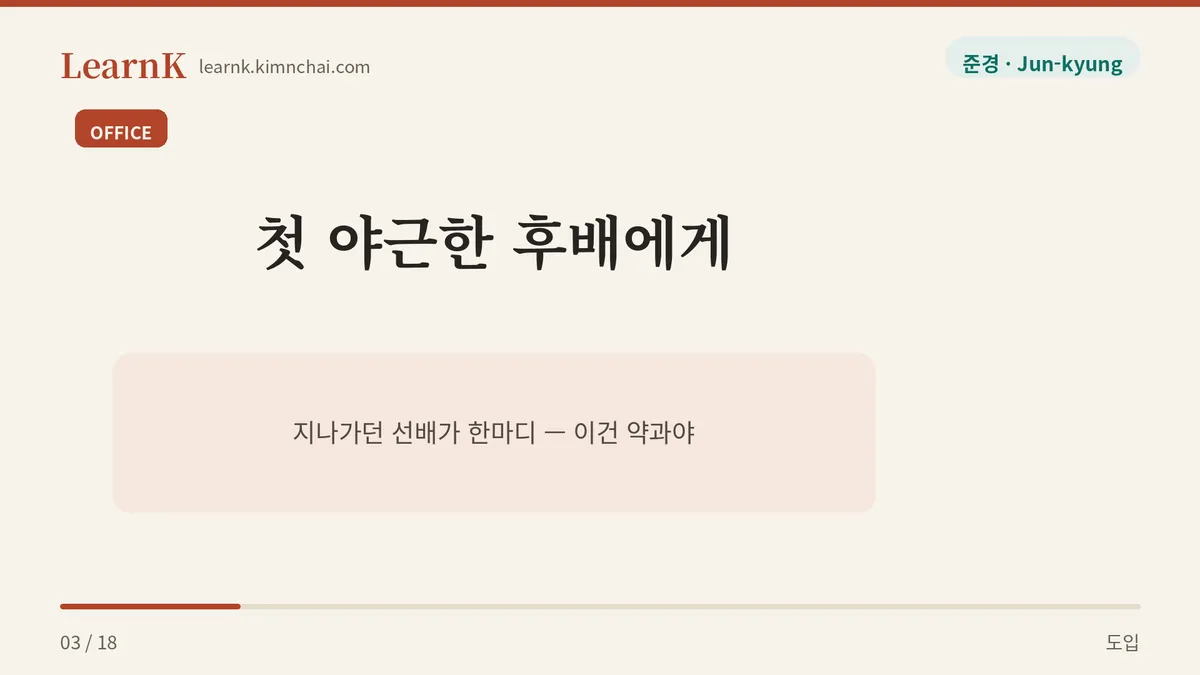
This scene shows up in dramas all the time. A new hire is slumped over their desk, wrecked by their first night of overtime, and a senior colleague passing by tosses out a line: “이건 약과야.” To a learner’s ear, it sounds like snacks came out of nowhere. Open a dictionary and the first meaning really is the cookie. But what that senior colleague just said was, “What you’re going through now is nothing — the real thing hasn’t arrived yet.”
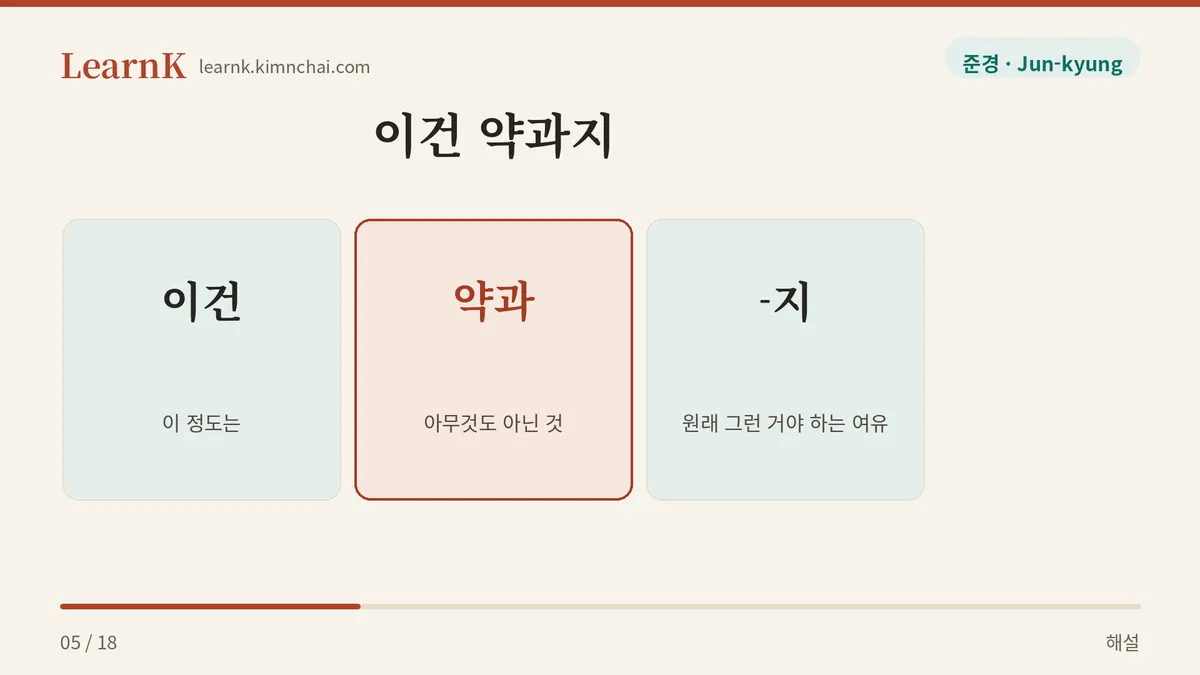
The 약과 (yakgwa) of the second meaning carries two temperatures at once. One is comfort — what you’re facing right now is a size you can handle. The other is a quiet warning — something bigger is waiting behind it. Which is why this word can’t stand alone. It needs something to be measured against for the meaning to hold: whatever is coming next, whatever someone else went through, or whatever happened back in the day.
There are three shapes you’ll hear most: 이건 약과다 (igeon yakgwa-da) / 그 정도면 약과지 (geu jeongdo-myeon yakgwa-ji) / ~에 비하면 약과다 (~e bihamyeon yakgwa-da). It’s mostly used about your own hardship, or between people who know each other’s situation well, to give a heads-up about what’s ahead.
Checking It in the National Institute of Korean Language Dictionary
약과 (yakgwa) (noun) 1. A confection made by pressing a dough of honey, oil, and wheat flour into a mold to shape it, then pan-frying or deep-frying it. [en] yakgwa; honey cookie — A Korean confectionary made by pressing dough made with wheat flour, honey and oil into molds and frying or deep-frying the molded dough pieces. [ja] ヤックァ【薬菓】 — 蜂蜜・油・小麦粉を混ぜてこねたものを型に入れて形を作った後、油で揚げたり焼いたりして作った韓国の伝統菓子。 [es] yakgwa — Galleta elaborada en base a una masa de harina, aceite y miel, que se pone sobre una tabla con forma y luego se fría o saltea en aceite. [zh] 药果,油蜜酥 — 一种点心,将蜂蜜、油、面粉等和到一起并放进模具里做出造型后油煎或油炸而制成的点心。 — National Institute of Korean Language, Basic Korean Dictionary (krdict.korean.go.kr)
약과 (yakgwa) (noun) 2. A word indicating that something is nothing much. [en] nothing — The word meaning that something is nothing in comparison with something else. [ja] 大したことではないことを表す語。 [es] Palabra que expresa que un determinado nivel no afecta a la persona o al objeto. [zh] 轻而易举,不费吹灰之力 — 表示这种程度不算什么。 — National Institute of Korean Language, Basic Korean Dictionary (krdict.korean.go.kr)
Take a close look at the phrase attached to the English definition of the second meaning: in comparison with something else. The dictionary has already nailed it down — this is a word that requires something to compare to.
The Portuguese translation isn’t in the dictionary, so we did it ourselves (our own translation): 1. yakgwa — doce tradicional coreano feito de farinha de trigo, mel e óleo, moldado e frito. / 2. nada — palavra que indica que algo não é nada em comparação com outra coisa.
Among the actual usage examples the dictionary provides, here is the one for the first meaning.
나는 제사상에 올릴 과일과 약과를 차곡차곡 괴었다. (na-neun jesasang-e ollil gwail-gwa yakgwa-reul chagokchagok goeeotda.) I stacked up the fruit and yakgwa to be placed on the ancestral rites table, layer by layer. — National Institute of Korean Language, Basic Korean Dictionary (krdict.korean.go.kr)
Where 약과 (yakgwa) belongs as a food is packed into that single sentence. 제사상 (jesasang) is the table on which food is offered to ancestors, and 괴다 (goeda) is an old-fashioned word for the act of piling fruit or sweets on a dish in layers. Before it was a snack you pick up one at a time, 약과 (yakgwa) was a formal food you stacked and offered.
And a search of the example sentences also turns up lines like these.
우리는 검약과 근면으로 경제적으로 어려운 시절을 잘 견뎠다. (uri-neun geomyak-gwa geunmyeon-euro gyeongjejeog-euro eoryeoun sijeor-eul jal gyeondyeotda.) We got through economically hard times on thrift and diligence. 나는 공약과 정책을 보고 어느 쪽이 더 국민을 위해 일할 사람인지를 판단해. (na-neun gongyak-gwa jeongchaeg-eul bogo eoneu jjog-i deo gungmin-eul wihae ilhal saram-inji-reul pandanhae.) I look at the campaign pledges and policies to judge which side will actually work for the people. 각 나라들은 마약과 관련된 범죄를 국법으로 강하게 처벌하고 있다. (gak naradeur-eun mayak-gwa gwallyeondoen beomjoe-reul gukbeob-euro ganghage cheobeolhago itda.) Every country punishes drug-related crime severely under national law. 구약과 신약. (guyak-gwa sinyak.) The Old Testament and the New Testament. — National Institute of Korean Language, Basic Korean Dictionary (krdict.korean.go.kr)
Not one of those four sentences contains the 약과 (yakgwa) we’re learning. 검약+과, 공약+과, 마약+과, 구약+과 — the particle ~와/과 (wa/gwa), meaning “and,” got attached to the preceding word, and the letters just happen to overlap. The dictionary’s example search pulled these in by matching characters, but for a learner it doubles as a valuable map of traps. Because Korean writes particles attached to the word, the letters 약과 keep getting manufactured across word boundaries. To read “마약과 관련된” in the news without thinking of cookies, you need the habit of taking the preceding syllable in as part of the same chunk.
There’s no dictionary example for the second meaning (= it’s nothing). So the dialogue and example sentences below are all ones we wrote ourselves.
Seeing It in a Real Conversation
Setting: the morning of Seollal, Lunar New Year’s Day. The ancestral rite has just finished and the table is being cleared. Emily picks up a cookie she’s never seen before.
Jun-kyung: 그거 약과. 꿀에 절인 과자야. 하나 먹어 봐, 계속 들어가. That’s yakgwa. A cookie steeped in honey. Try one — you won’t stop.
Emily: 어우, 손에 꿀 다 묻었다. 근데 새벽부터 이만큼 차리느라 힘들었겠어. Ugh, honey all over my hands. But you must be worn out, laying all this out since dawn.
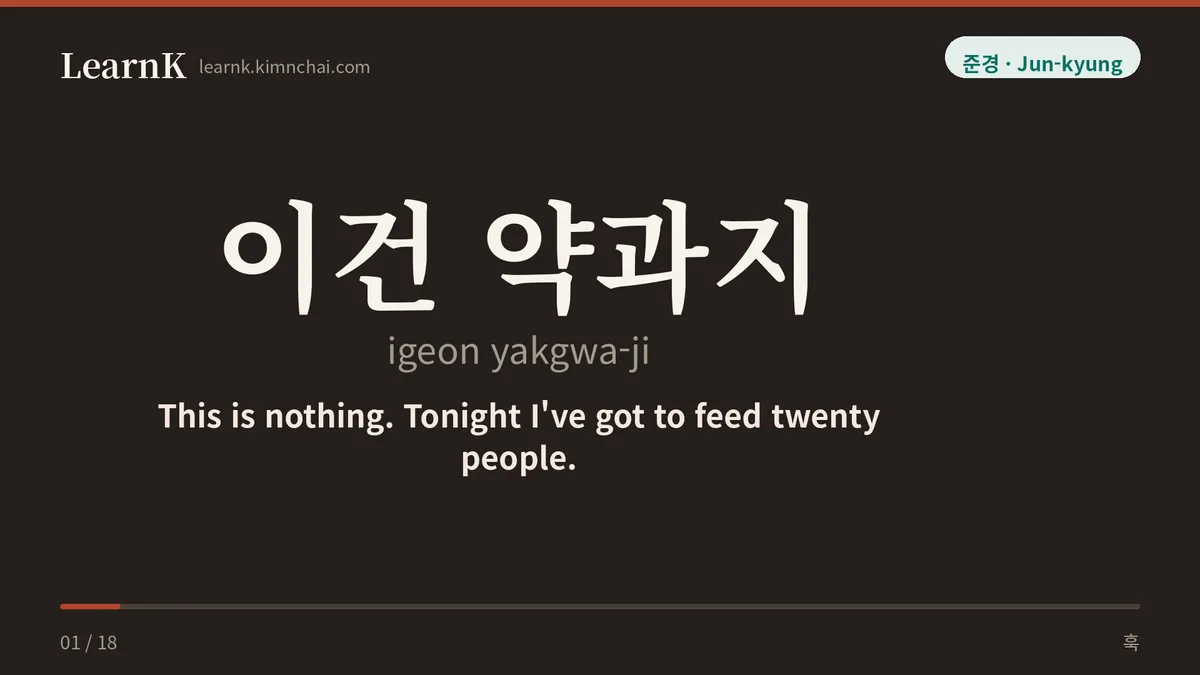
Jun-kyung: 이건 약과지. 저녁에 큰집 가면 스무 명 밥 차려야 해. This is nothing. Tonight at my uncle’s I’ve got to feed twenty people.
Emily: 스무 명? 그럼 아까 설거지 세 판은 진짜 약과였네. Twenty? Then those three loads of dishes really were nothing.
Jun-kyung: 그러니까 지금 앉아서 약과 하나 더 먹어 둬. 힘 나야 버티지. Exactly — so sit down and have another yakgwa now. You’ll need the energy.
Emily: 이 말 진짜 웃긴다. 과자 이름이 위로가 되네. This word is hilarious. A cookie’s name doing the consoling.
Where It Sounds Off
✗ (to a friend who’s scared about surgery next week) 그 정도 수술은 약과야. (geu jeongdo susur-eun yakgwa-ya.) — Surgery like that is nothing. ✓ (to the same friend) 많이 무섭지? 나 그날 병원에 같이 있을게. (mani museopji? na geunal byeongwon-e gachi isseulge.) — Pretty scary, right? I’ll be at the hospital with you that day. → 약과 (yakgwa) is a word that measures the size of hardship. Aim it at someone else’s fear and it doesn’t land as comfort — it lands as “your problem is no big deal.” This word is safe when you use it about your own hardship, or about something the other person has already gotten through.
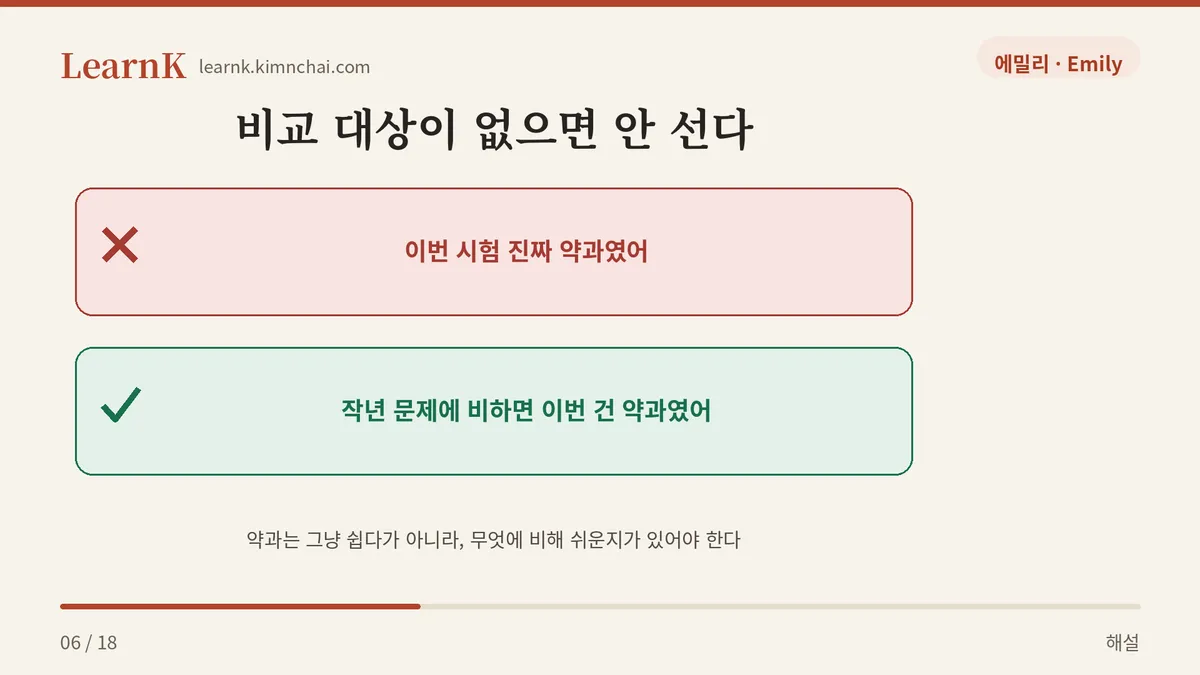
✗ (cheerfully, to yourself after an exam) 이번 시험 진짜 약과였어! (ibeon siheom jinjja yakgwa-yeosseo!) — That exam was really nothing! ✓ 이번 시험 진짜 쉬웠어! / 작년 문제에 비하면 이번 건 약과였어. (ibeon siheom jinjja swiwosseo! / jangnyeon munje-e bihamyeon ibeon geon yakgwa-yeosseo.) — That exam was really easy! / Compared to last year’s questions, this one was nothing. → 약과 (yakgwa) doesn’t simply mean “easy.” There has to be something to compare it to, either inside the sentence or in the surrounding context, for the word to stand up. Use it with nothing to compare and your listener will come back with “compared to what?”
Example Sentences by Situation
Situation 1 — at the office before a deadline, to a junior who just pulled their first late night. The most classic spot of all: comfort with a warning laid on top.
오늘은 약과야. 다음 주 마감 주가 진짜 시작이지. (oneur-eun yakgwa-ya. daeum ju magam ju-ga jinjja sijag-i-ji.) Today was nothing. Next week, deadline week, is where it really starts.
Situation 2 — moving day, evening, sitting on the floor after hauling everything in. Here it’s used to play down your own hardship by setting it against someone else’s bigger one.
5층 계단 이사한 친구 얘기 들으면 우리 건 약과예요. (o-cheung gyedan isa-han chingu yaegi deureumyeon uri geon yakgwa-yeyo.) When you hear about my friend who moved up five flights of stairs, ours was nothing.
Situation 3 — a holiday meal, when an elder starts telling stories about the old days. It shows up constantly in hardship comparisons across generations.
요즘 더위는 약과입니다. 선풍기 하나로 여름 넘기던 때가 있었죠. (yojeum deowi-neun yakgwa-imnida. seonpunggi hana-ro yeoreum neomgideon ttae-ga isseotjyo.) Today’s heat is nothing. There was a time we got through summer with one fan.
Polite and Casual Forms, Plus Similar Expressions
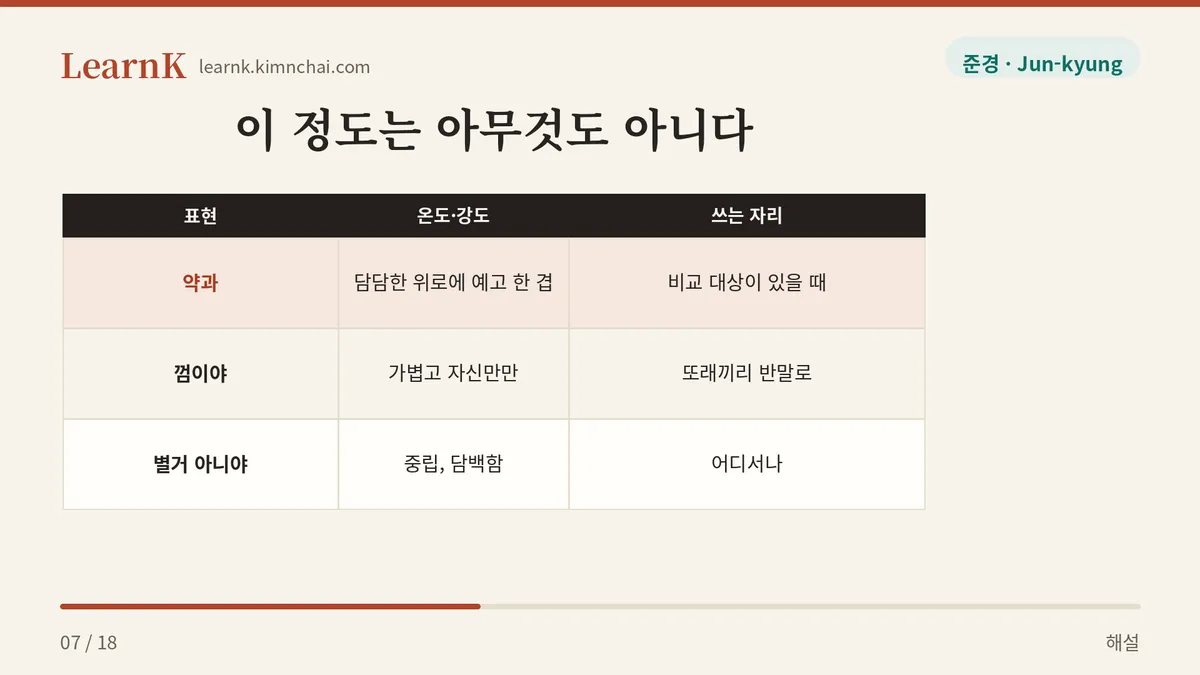
For polite versus casual, you just swap out the ending. 약과입니다 (yakgwa-imnida) — formal, for presentations or for elders. 약과예요 (yakgwa-yeyo) — soft polite, for coworkers or someone you’ve just met. 약과야 / 약과지 (yakgwa-ya / yakgwa-ji) — casual. Adding -지 (-ji) in particular layers on a relaxed “that’s just how it goes” feeling, and it’s the version you’ll hear most often in real conversation.
| Expression | Temperature / intensity | Where it’s used |
|---|---|---|
| 약과 (yakgwa) | Matter-of-fact comfort + a quiet heads-up | Both polite and casual. Only when there’s something to compare to |
| 새 발의 피 (sae bar-ui pi) | So small in quantity it’s trivial; carries some weight (lit. “blood on a bird’s foot”) | Comparing scale. Works in writing and in formal speech too |
| 껌이야 (kkeom-iya) | Light and cocky, with a bit of showing off (lit. “it’s gum”) | Peers, casual speech. Not to anyone above you |
| 별거 아니야 (byeolgeo aniya) | Neutral, plain | Anywhere. Works even without something to compare to |
The easy one to mix up is 껌이야 (kkeom-iya). 약과 (yakgwa) says “it’s hard, but this much is bearable,” while 껌이야 (kkeom-iya) says “it’s easy for me.” The first one acknowledges the hardship; the second denies it. That’s exactly where an attempt at comfort turns into a brag.
Cultural Background — From the Ancestral Rites Table to the Café Display Case
약과 (yakgwa) is written 藥果 in Chinese characters. It’s widely explained that old Korean food names had a convention of attaching the character 약 (藥, “medicine”) to anything made with honey — 약식 (yaksik), 약주 (yakju), and 약고추장 (yakgochujang) belong to the same family. The reason given is that honey was as precious as medicine. Add 과 (果), meaning confection or fruit, and you get 약과 (yakgwa). How it crossed over from the first meaning to the second is hard to say for certain. What you’ll commonly hear, though, is that the image of a soft, sweet cookie that goes down without any effort slid over into “that much is easy to get through.”
약과 (yakgwa) belongs to 한과 (hangwa) — the family of traditional Korean confections. It was a food stacked in layers on the New Year’s rite table and the ancestral rites table, on the 폐백 (pyebaek) table where a newlywed couple greets the groom’s family after the wedding, and on banquet tables. When you see a plate of sweets in the middle of a feast table in a historical drama, it’s usually from this family. For a good while, then, 약과 (yakgwa) carried a strong impression of being “that thing in Grandma’s fridge.”
But in the 2020s, 약과 (yakgwa) came back as a dessert for young people. Riding the wave of enjoying old things in new ways, it moved into café display cases and gets sold paired with ice cream or coffee. Yakgwa from famous shops sells out within minutes of online sales opening — enough that people coined the word 약케팅 (yakketing), a blend of 약과 (yakgwa) and 티케팅 (ticketing), comparing it to scrambling for concert tickets. In holiday-episode dramas, there’s often a scene where an elder says something like “이만하면 약과” right after a long night of frying jeon pancakes, and once you know this word you can see two pictures overlapping in that one sentence: the cookies stacked on the table, and the bigger thing that hasn’t arrived yet.
Today’s Quiz
A friend is having a rough time after getting yelled at by a customer on their first day of a part-time job. You’ve worked at the same shop for two years, and you know weekend customers are three times the weekday count. Which of the following sounds most natural?
- 그 정도 손님은 약과야. 주말 되면 세 배로 와. (geu jeongdo sonnim-eun yakgwa-ya. jumal doemyeon se bae-ro wa.)
- 네 첫날은 약과였어! 그러니까 울지 마. (ne cheotnal-eun yakgwa-yeosseo! geureonikka ulji ma.)
- 손님이 약과라서 괜찮아. (sonnim-i yakgwa-raseo gwaenchana.)
Answer: 1. The thing being compared to (weekend customers) is right there in the sentence, and comfort and warning come together — the spot where 약과 (yakgwa) stands up best. Number 2 flatly belittles pain the other person just went through, and tacking on “don’t cry” makes it sound even colder. Number 3 ends up calling people yakgwa, so the sentence doesn’t work at all — 약과 (yakgwa) is used about situations and degrees, not about people.
Definitions and example sentences are from the National Institute of Korean Language’s Basic Korean Dictionary (krdict.korean.go.kr); that portion of this post, including our translations, is licensed under CC BY-SA 2.0 KR.