여쭤보다 (yeojjweoboda) — Not Quite '물어보다', but the Warmth of Honorific Speech
When you’re learning Korean, there’s a wall you’re bound to hit: the moment when the meaning stays exactly the same, but you have to swap out the whole word depending on who you’re talking to. 묻다 (mutda) and 여쭤보다 (yeojjweoboda) are a perfect example. When you ask a friend for directions, 물어보다 (mureoboda) is plenty, but when you ask something of your department head at work, your parents-in-law, or a professor, saying ‘물어봐도 돼요? (mureobwado dwaeyo?)’ feels somehow off. The word that fills exactly this gap is today’s expression, 여쭤보다 (yeojjweoboda).
여쭤보다 (yeojjweoboda)
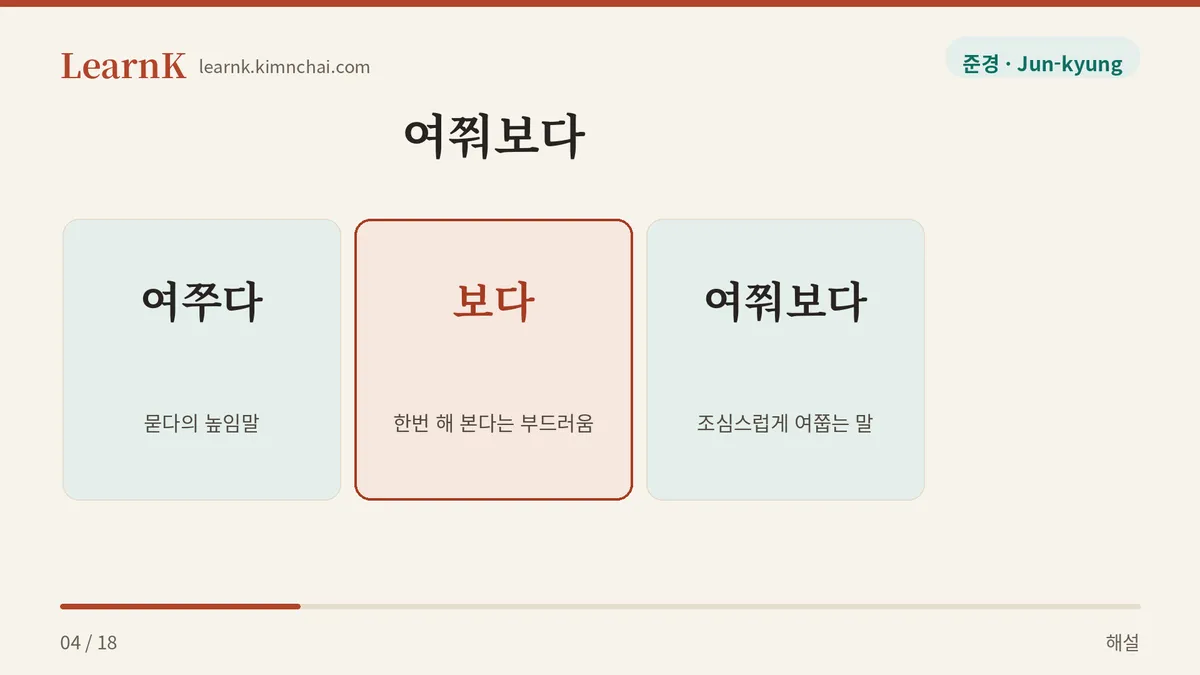
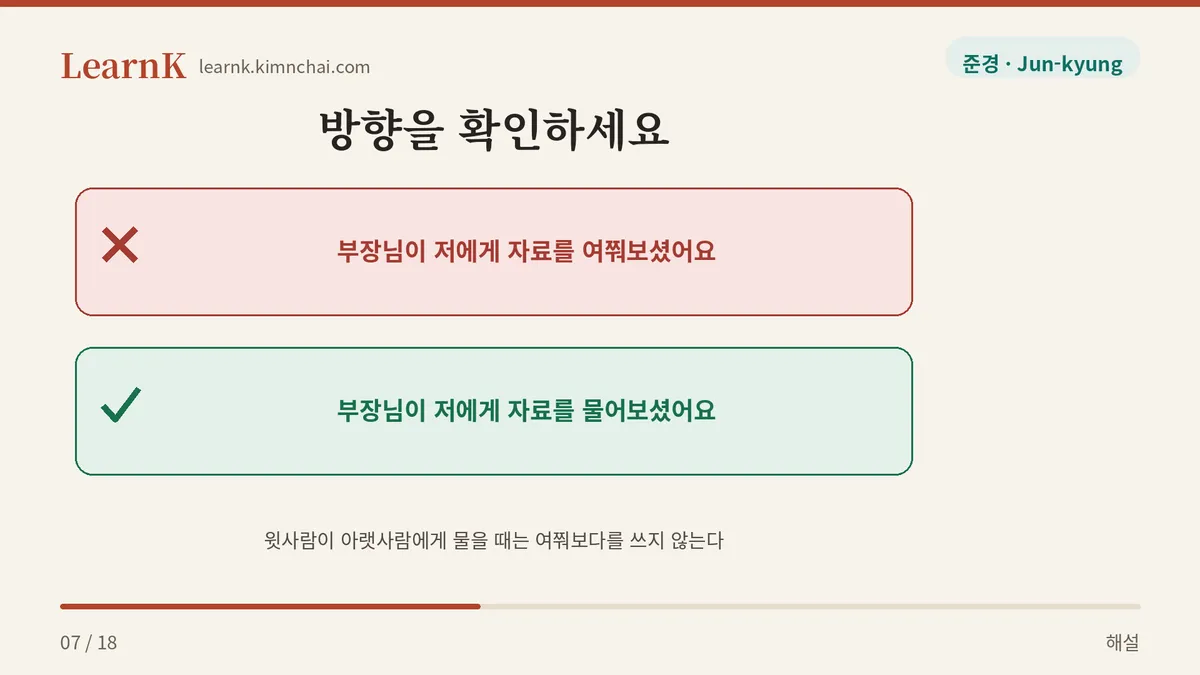
여쭤보다 (yeojjweoboda) is formed from 여쭈다 (yeojuda), the honorific form of ‘묻다 (mutda),’ plus the auxiliary verb ‘보다 (boda).’ The key lies in ‘direction.’ The person being elevated is the one you’re asking — that is, someone above you. It’s not that you’re lowering yourself; you’re raising the other person up. That’s why ‘제가 부장님께 여쭤봤어요 (jega bujangnimkke yeojjweobwasseoyo)’ sounds natural, while in the reverse case — when someone senior asks someone junior — you don’t use 여쭤보다 at all, just plain 물어보다 (mureoboda).
The ‘보다 (boda)’ attached here adds a gentle nuance of ‘giving it a try.’ That’s why 여쭤보다 sounds a bit softer and more tentative than the stiffer ‘여쭙다 (yeojupda).’ It has the feeling of quietly stepping closer while easing the burden on the other person — ‘if it’s not too much trouble, might I…’
Checking the National Institute of Korean Language Dictionary
여쭤보다 (yeojjweoboda) 「verb」 (in honorific speech) To ask in order to find something out. — National Institute of Korean Language, Basic Korean Dictionary (krdict.korean.go.kr)
The dictionary also unpacks this meaning in four other languages.
ask politely — (polite form) To ask in order to find something out. うかがう【伺う】 — わからないことを聞くことを敬っていう語。 preguntar — (EXPRESIÓN DE RESPETO) Hacer preguntas a alguien para que diga lo que se pretende saber. 请教,询问 — (敬语)为了解某事而问询。 — National Institute of Korean Language, Basic Korean Dictionary (krdict.korean.go.kr)
Let’s also look at some real usage examples from the dictionary.
- 기술을 여쭤보다.
- 방법을 여쭤보다.
- 의미를 여쭤보다.
- 가격을 여쭤보다. — National Institute of Korean Language, Basic Korean Dictionary (krdict.korean.go.kr)
- 기술을 여쭤보다 (gisureul yeojjweoboda): You’d use this when you want to learn the secrets of a craft from a veteran master or a senior colleague who has worked at it for a long time. It comes across as far more humble than ‘가르쳐 주세요 (gareuchyeo juseyo).’
- 방법을 여쭤보다 (bangbeobeul yeojjweoboda): For asking someone senior about the ‘how’ of something — like processing paperwork or the steps in a recipe. It’s the form a new employee ends up using most often.
- 의미를 여쭤보다 (uimireul yeojjweoboda): For asking a teacher or an elder the meaning of a difficult Sino-Korean word or an archaic term. Especially handy for Korean learners.
- 가격을 여쭤보다 (gagyeogeul yeojjweoboda): Natural when politely asking the price from an older shop owner at a market or a long-established store.
For the record, note that this headword has no Portuguese translation listed in the dictionary.
A Look Through Real Conversation
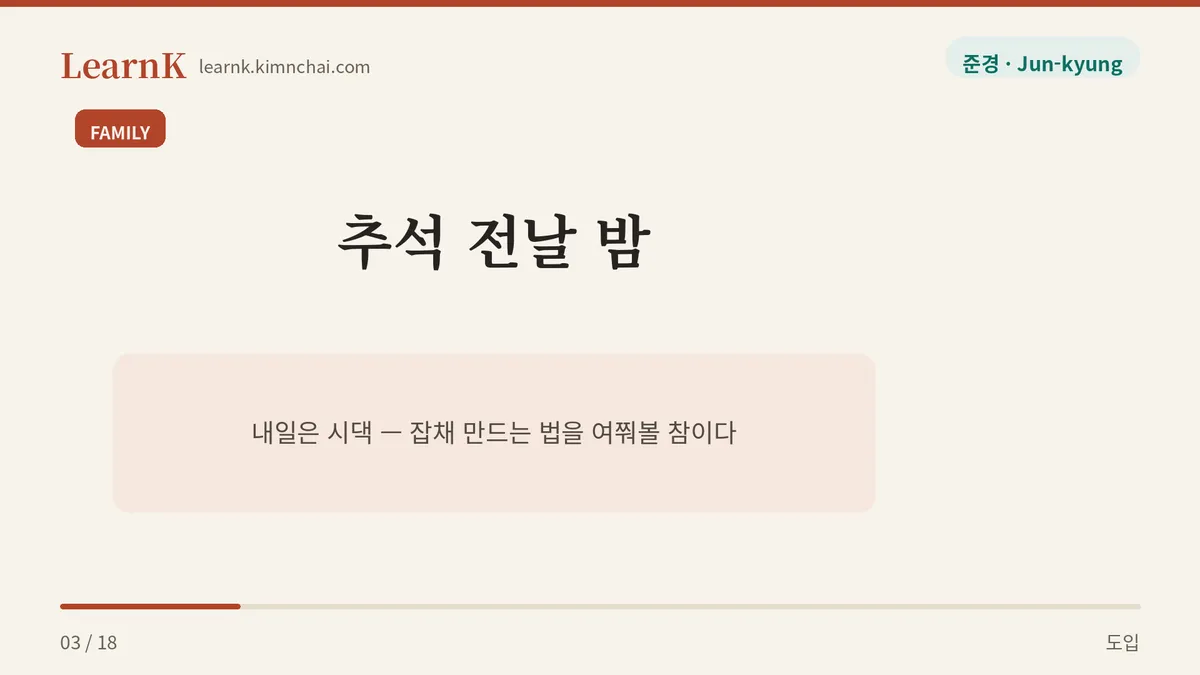
Situation: The night before Chuseok. Tomorrow they’re going to Jun-kyung’s parents’ house. Emily has always been curious about the japchae his mother makes.
Jun-kyung: 내일 가면 어머니가 잡채 잔뜩 하실 거야. 너 그거 완전 좋아하잖아. Mom’s going to make a ton of japchae tomorrow. You love that stuff.
Emily: 응, 나 이번엔 만드는 법 좀 여쭤보려고. 계속 배우고 싶었거든. Yeah, this time I want to ask her how she makes it — I’ve been wanting to learn.
Jun-kyung: 오, 어머니 엄청 좋아하시겠다. 그냥 편하게 물어봐. Oh, Mom would love that. Just ask her, no pressure.
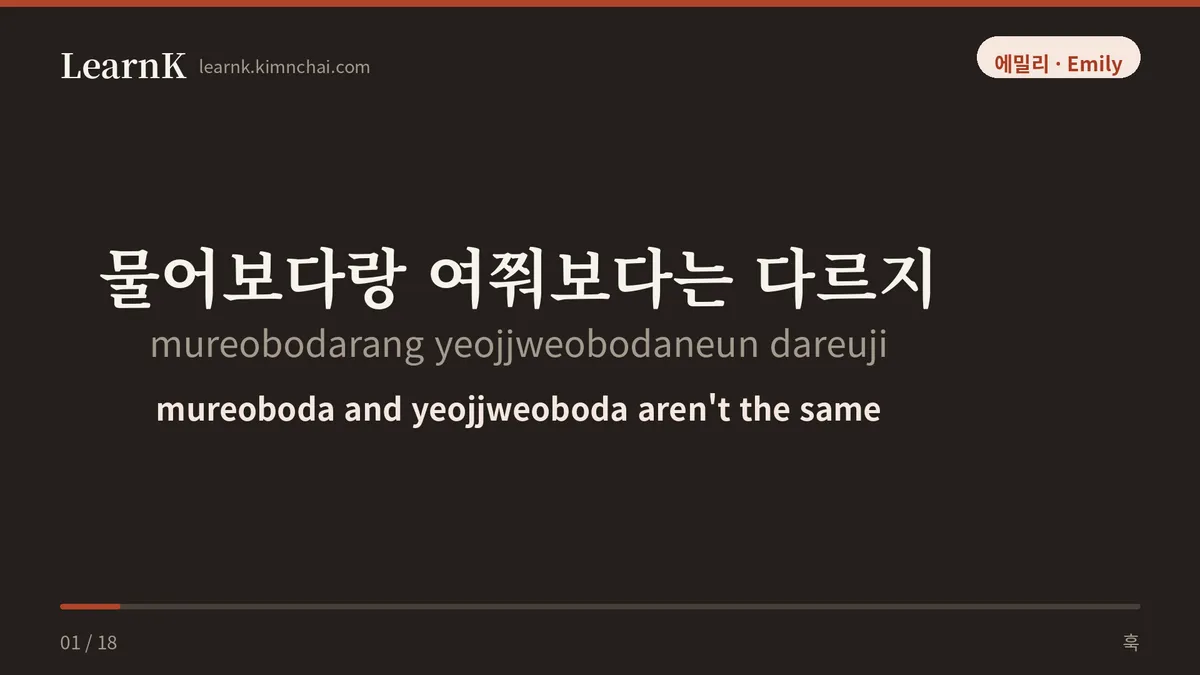
Emily: 야, ‘물어보다’랑 ‘여쭤보다’는 다르지. 어머님한테 ‘물어봤어요’ 하면 좀 그렇잖아. Come on, mureoboda and yeojjweoboda aren’t the same. Saying “I asked you” to your mother-in-law sounds off.
Jun-kyung: 하긴. 너 진짜 한국 사람 다 됐다. True. You’ve basically become Korean.
Emily: 15년째인데 이 정도는 해야지. 내일 잡채 비법 꼭 여쭤볼 거야. It’s been 15 years, I’d better. Tomorrow I’m definitely asking for the japchae secret.
Example Sentences by Situation
-
In a job interview — As the interview winds down, an applicant asks the interviewer: ‘면접 마치기 전에 한 가지만 여쭤봐도 될까요? (myeonjeop machigi jeone han gajiman yeojjweobwado doelkkayo?)’ A textbook sentence for raising a question you’re curious about while staying courteous.
-
In a doctor’s office — A patient says to the doctor: ‘선생님, 검사 결과에 대해 몇 가지 여쭤보고 싶은데요. (seonsaengnim, geomsa gyeolgwae daehae myeot gaji yeojjweobogo sipeundeyo.)’ It fits perfectly when carefully opening up a question to an expert.
-
On the phone — Calling someone older: ‘혹시 지금 통화 괜찮으세요? 여쭤볼 게 있어서요. (hoksi jigeum tonghwa gwaenchanuseyo? yeojjweobol ge isseoseoyo.)’ A polite way of gently signaling what you’re calling about.
Comparing Honorific, Casual, and Similar Expressions
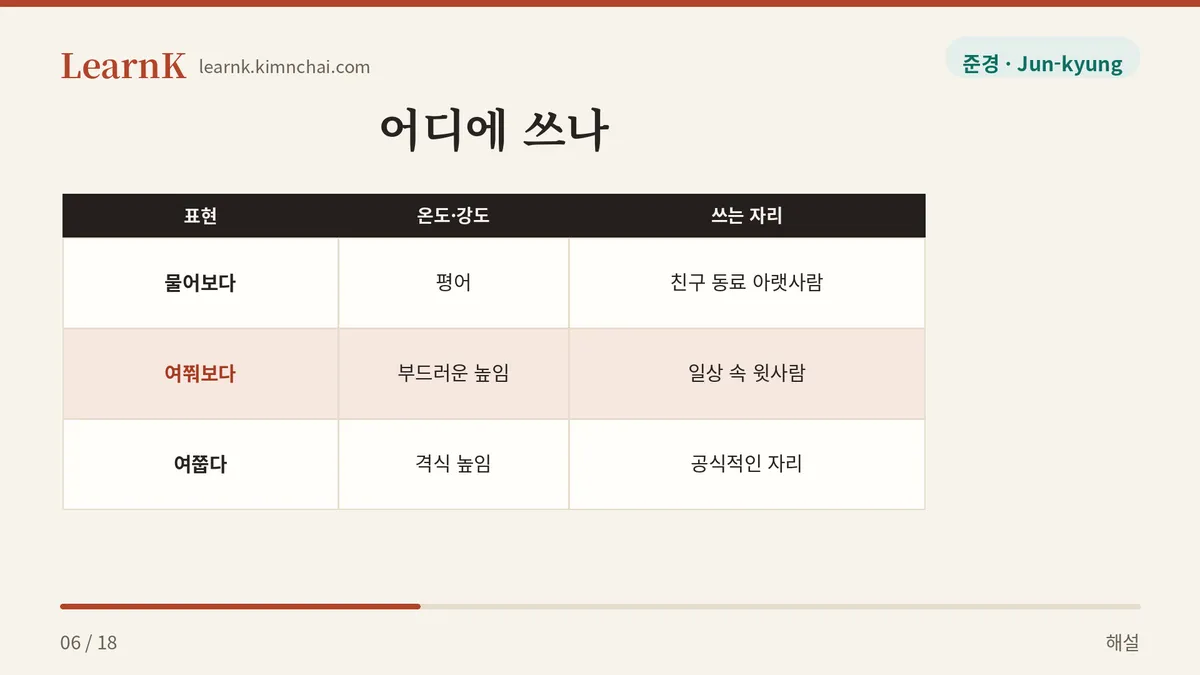
- 묻다 (mutda): The most basic form. No shade of honorifics. Used between friends, as in ‘뭐 하나 물어도 돼? (mwo hana mureodo dwae?)’
- 물어보다 (mureoboda): ‘묻다’ with ‘보다’ attached, making it a little softer. Still not honorific. Used with coworkers, friends, or those junior to you.
- 여쭈다 (yeojuda) / 여쭙다 (yeojupda): The root of 여쭤보다. A bit more formal and literary. ‘말씀 좀 여쭙겠습니다. (malsseum jom yeojupgesseumnida.)’
- 여쭤보다 (yeojjweoboda): The honorific form softened by adding ‘보다’ to 여쭈다. It’s the polite question expression that comes across most naturally in everyday conversation.
To sum up: if the other person is senior to you, use 여쭤보다; if not, use 물어보다 — remember just this one line and you’re already halfway there.
Cultural Background
Korean honorifics go beyond mere etiquette; they map out relationships. Picture a scene in a historical drama where a subordinate lowers himself before the king or a nobleman, saying ‘여쭙겠습니다 (yeojupgesseumnida).’ Even without quoting the lines directly, the sense of hierarchical distance packed into that single phrase carries straight into today’s workplace and family relationships. Even in current dramas, it’s common to see a new employee tentatively broaching a question to a boss, or a son-in-law to his parents-in-law, with ‘여쭤봐도 될까요? (yeojjweobwado doelkkayo?)’ Knowing how to bring out this phrase at the right moment is also a sign that you’ve read the sense of nunchi and social distance that runs through Korean society.
Closing Quiz
Which of the following sentences is the most natural?
- 부장님이 저에게 자료를 여쭤보셨어요.
- 제가 교수님께 성적을 여쭤봤어요.
- 동생한테 답을 여쭤봤어.
.
Answer: Number 2. 여쭤보다 is used only when ‘I’ ask someone senior. In number 1, a senior is asking a junior, so ‘물어보셨어요 (mureobosyeosseoyo)’ is correct; in number 3, the other person is a younger sibling, so ‘물어봤어 (mureobwasseo)’ is right.
Definitions and example sentences are from the National Institute of Korean Language’s Basic Korean Dictionary (krdict.korean.go.kr); that portion of this post, including our translations, is licensed under CC BY-SA 2.0 KR.