Yukgaejang — One Bowl of Soup for Grief and for Summer Heat
육개장 (yukgaejang)
육개장 (yukgaejang) means “a soup made by tearing boiled beef into fine shreds and simmering it with bold, spicy seasoning.” In the red broth you’ll find beef pulled apart along the grain, 대파 (daepa, green onion), 고사리 (gosari, bracken fern), 토란대 (torandae, taro stems), and 숙주 (sukju, mung bean sprouts) all together, and because the chili powder is first bloomed in oil, the color comes out unusually deep. It’s written 육개장, but pronounced [육깨장], with a tensed consonant in the middle.
If you’ve been watching Korean dramas for a long time, your eyes may already know the place this soup belongs: the reception room of a funeral hall. At every table where people in black are sitting, you’ll see this red soup along with rice, 편육 (pyeonyuk, sliced boiled meat), and a few seasoned vegetable dishes. And yet the same name also shows up at lunch on a midsummer 복날 (boknal, one of the hottest days of the year), on the morning hangover table of someone who drank too much the night before, and on the Wednesday menu board of a company cafeteria. One soup gets set down, exactly the same, in three settings — grief, heat, and hangover — that seem to have nothing to do with one another.
There’s one word you can’t afford to miss when it comes to nuance. Koreans use 얼큰하다 (eolkeunhada) for this soup far more often than 맵다 (maepda, to be spicy). 얼큰하다 isn’t the heat that stabs your tongue; it’s the heat of a hot, thick broth going down your throat and warming you from the inside out. That’s why “얼큰한 육개장” is a compliment, while “매운 육개장” is closer to a plain statement of fact. One more thing: 육개장 isn’t a soup you keep off to the side like a side dish — it’s a soup you 밥을 말아 먹는 (bapeul mara meokneun), that is, one you stir your rice right into. Knowing just these two things gets you close to the temperature a Korean feels when they say this word.
Checking it in the National Institute of Korean Language dictionary
The National Institute of Korean Language’s Basic Korean Dictionary explains the word this way.
육개장 (yukgaejang) 「명사」 (noun) 삶은 쇠고기를 잘게 뜯어 넣고 얼큰하게 양념을 하여 끓인 국. A soup made by tearing boiled beef into fine shreds and simmering it with bold, spicy seasoning. — National Institute of Korean Language, Basic Korean Dictionary (krdict.korean.go.kr)
Here are the multilingual translations the same dictionary attaches. What’s fun is how each language reached for something slightly different first.
[en] yukgaejang; spicy beef soup — A soup made by boiling finely shredded beef with spicy seasoning. [ja] ユッケジャン — 細長めに切ったゆで牛肉に辛めの味付けをして煮込んだ汁。 [es] yukgaejang — Sopa de puerro y carne picante. Sopa picante que se prepara adheriendo trozos de carne de res hervida. [zh] 香辣牛肉汤 — 把煮熟的牛肉撕碎之后加入调料做成的微辣的汤。 — National Institute of Korean Language, Basic Korean Dictionary (krdict.korean.go.kr)
English and Spanish kept yukgaejang as it sounds, while Chinese unpacked the meaning into 香辣牛肉汤 (a fragrant, spicy beef soup). For reference, this dictionary carries no Portuguese translation. In this post we’ve rendered it ourselves as sopa picante de carne bovina desfiada (a spicy soup simmered with finely shredded beef), but we want to be clear that this is our own translation, not the dictionary’s.
Here are the real usage examples listed in the same dictionary.
육개장을 만들어 봤는데 매콤한 맛이 부족한 것 같아. 육개장을 끓이다. 얼큰한 육개장. 육개장 한 그릇. 승규는 땀을 흘려 가면서도 얼큰하게 끓인 육개장에 밥을 말아 먹었다. — National Institute of Korean Language, Basic Korean Dictionary (krdict.korean.go.kr)
- 육개장을 만들어 봤는데 매콤한 맛이 부족한 것 같아. (“I tried making yukgaejang, but I think it’s missing that spicy kick.”) — This is someone who cooked it themselves and isn’t feeling confident about it. Packed into this single sentence is the instinct that in Korean cooking, 육개장 lives or dies by how 얼큰하다 the broth is, not by what’s floating in it.
- 육개장을 끓이다. (“to make — literally, to boil — yukgaejang.”) — With this soup, 끓이다 (kkeurida) goes together far more naturally than 만들다 (mandeulda, to make). Soups, stews, and 탕 (tang) pair with 끓이다 almost without exception.
- 얼큰한 육개장. (“a hearty, warming-spicy yukgaejang.”) — This is the pairing mentioned above. Even the dictionary chose 얼큰한, not 매운, for its headline example.
- 육개장 한 그릇. (“one bowl of yukgaejang.”) — The counter for soup is 그릇 (geureut, bowl). Rice comes in 한 그릇, and so does soup. You can use this exact form when ordering at a restaurant.
- 승규는 땀을 흘려 가면서도 얼큰하게 끓인 육개장에 밥을 말아 먹었다. (“Even as the sweat ran down his face, Seung-gyu stirred rice into his hearty, spicy yukgaejang and ate it.”) — This is the most Korean scene in the whole post. It’s hot out, and yet you eat something hot; you sweat, and you call it 시원하다 (siwonhada). The idea of 이열치열, which we’ll come to later, is right there in one sentence.
See it in a real conversation
The setting: the reception room of a funeral hall, late at night. Two people who have just paid their respects sit facing each other at a corner table.
Jun-kyung: 앉아. 저기 육개장 나온다. Sit down. The yukgaejang is coming out.
Emily: 여기도 육개장이네. 나 한국에서 장례식 세 번 왔는데 세 번 다 이거였어. Yukgaejang here too. I’ve been to three funerals in Korea and it was this all three times.
Jun-kyung: 원래 그래. 국물이 있어야 밥이 넘어가거든. 여기 앉은 사람들 며칠째 제대로 못 먹었을걸. That’s just how it is. You need soup to get the rice down. The people here probably haven’t eaten properly for days.
Emily: 아… 그래서 이렇게 얼큰한 거구나. 정신 좀 들라고. Ah… so that’s why it’s so spicy. To bring you back to yourself a bit.
Jun-kyung: 야, 너 진짜 오래 살았다. 난 그 생각 서른 넘어서 했어. Wow, you really have been here a long time. I didn’t figure that out until I was past thirty.
Emily: 15년이면 국물 맛도 배우지. 밥 좀 말아. 아까부터 숟가락만 들고 있잖아. Fifteen years is enough to learn what the soup means. Put some rice in it. You’ve just been holding your spoon this whole time.
This is where it sounds off
✗ (to the chief mourner) 어머, 여기 육개장 진짜 맛있네요! 어디서 시키신 거예요? (“Oh my, the yukgaejang here is really good! Where did you order it from?”) ✓ (quietly, to the friend who came with you) 국물이 속을 좀 풀어 주네. (“The broth settles your stomach a little, doesn’t it.”) → The 육개장 at a funeral hall isn’t a delicacy laid on to treat guests; it’s the bare minimum courtesy the bereaved family offers so that nobody who comes through the night goes hungry. Reviewing the flavor in front of it means you’ve misread the room. For the chief mourner, one line — “고생 많으십니다” (goseong manseumnida, “this must be so hard for you”) — is enough.
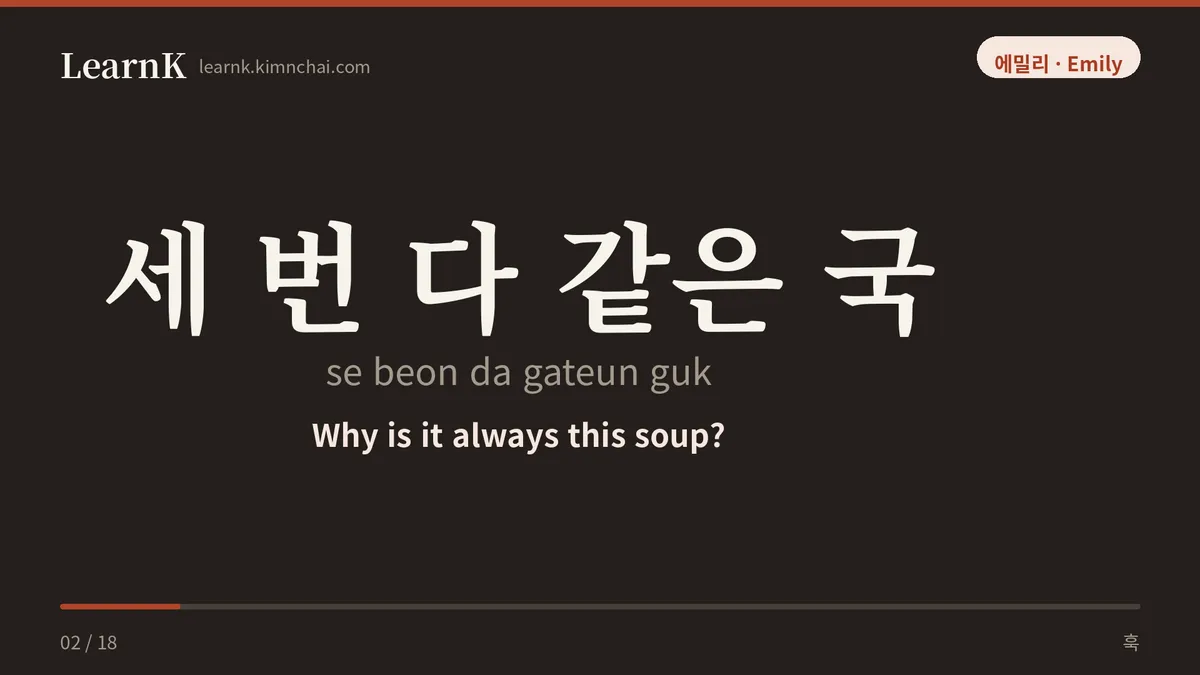
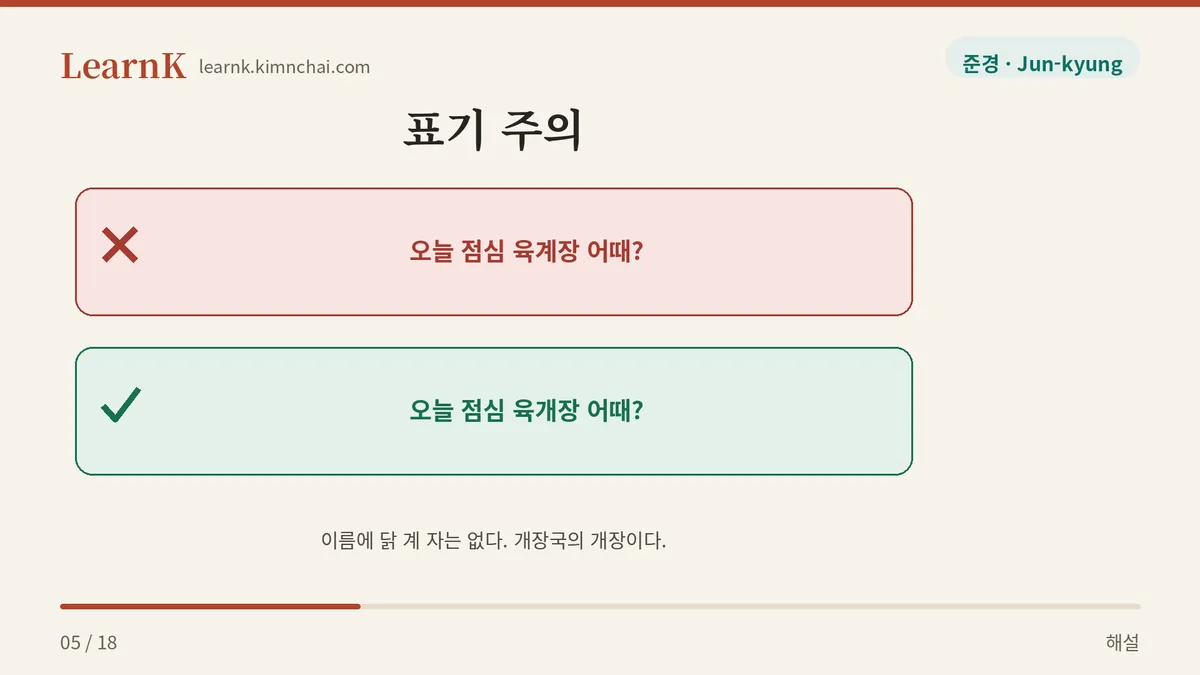
✗ 오늘 점심 육계장 어때? ✓ 오늘 점심 육개장 (yukgaejang) 어때? (“How about yukgaejang for lunch today?”) → A great many people write 육계장, assuming the 계 (鷄) of “chicken” is in there, but there is no chicken in this word. What’s attached at the end is 개장, not 계장. The version made with chicken has its own name: 닭개장 (dakgaejang).
Example sentences by situation
1. Choosing a lunch menu at midday in the peak of summer heat 이렇게 더운 날엔 오히려 얼큰한 육개장이지. (ireoke deoun naren ohiryeo eolkeunhan yukgaejang-iji.) On a day this hot, it’s got to be a hot bowl of yukgaejang instead. This is the sentence that explains why people eat something hot on a hot day. Adding 오히려 (ohiryeo, rather/instead) brings out the nuance of “it goes against common sense, but this is the right call.”
2. To a coworker who drank too much the night before 속 안 좋으면 육개장 국물이라도 좀 떠먹어. (sok an joeumyeon yukgaejang gungmullirado jom tteomeogeo.) If your stomach’s off, at least have a few spoons of the yukgaejang broth. This is a very Korean way of showing concern: even if you can’t manage the solid bits, get at least the broth down. The ending 이라도 (-irado) creates the sense of “at the very least, this much.”
3. Asking your mother for the recipe 엄마, 육개장은 고사리를 얼마나 넣어야 돼요? (eomma, yukgaejang-eun gosarireul eolmana neoeoya dwaeyo?) Mom, how much bracken should I put in the yukgaejang? This is a question with a different answer in every household. The amount of 고사리 (gosari, bracken) and 토란대 (torandae, taro stem) is what defines the character of that family’s 육개장.
Polite vs. casual speech, and similar expressions
육개장 is a noun with no built-in politeness level, so the level of respect is decided by the verb you use with it. To an elder it becomes 육개장 한 그릇 드시겠어요? (yukgaejang han geureut deusigesseoyo?), and to a friend, 육개장 먹을래? (yukgaejang meogeullae?). All you need to keep in mind is that the honorific form of 먹다 (meokda, to eat) is 드시다 (deusida).
Setting it side by side with soups that look similar makes its place much clearer.
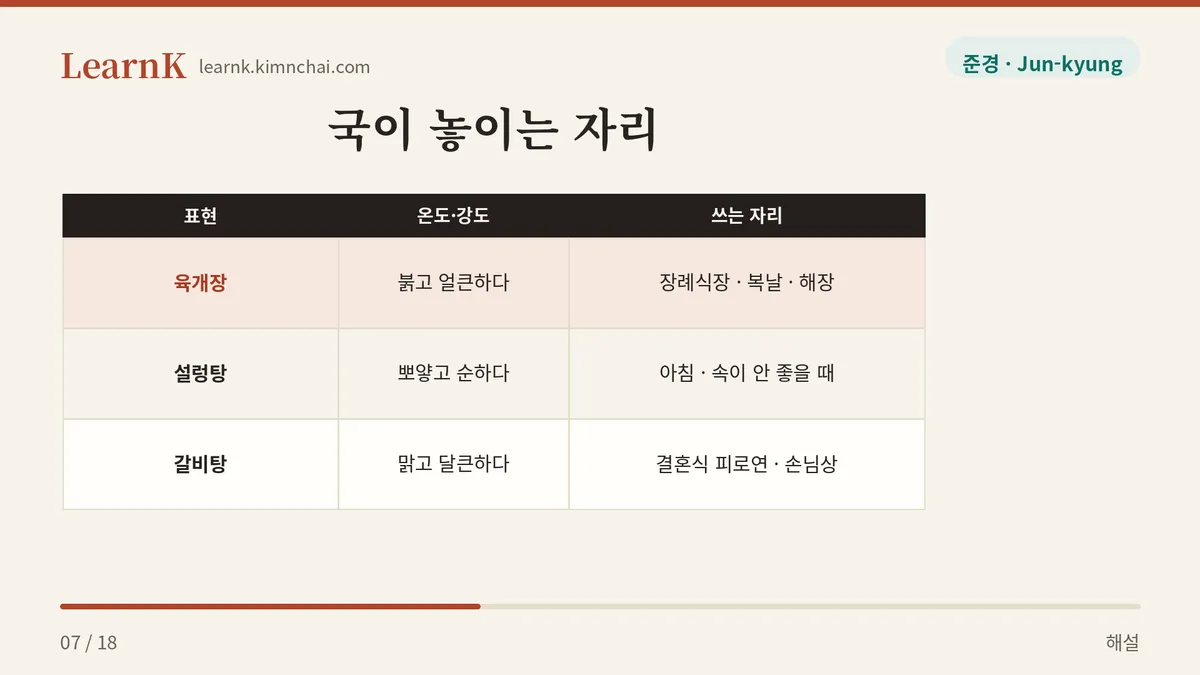
| Expression | Temperature and intensity | Where it’s served |
|---|---|---|
| 육개장 (yukgaejang) | Red and 얼큰하다; warms you heavily from the inside | Funeral halls, 복날 (boknal), hangover mornings, company cafeterias |
| 닭개장 (dakgaejang) | Same method as 육개장, chicken instead of beef | Home cooking, countryside feasts; a bit lighter |
| 설렁탕 (seolleongtang) | Not spicy — milky white and mild | Mornings, when your stomach is upset, when dining with elders |
| 갈비탕 (galbitang) | Clear and gently sweet; a dish for honored guests | Wedding receptions, tables set for guests |
Read the table vertically and one thing stands out: on days of celebration, 갈비탕 comes out; in a house of mourning, 육개장 does. Korea’s big communal tables sort joy from sorrow by the color of the soup.
Cultural background — where the red broth belongs
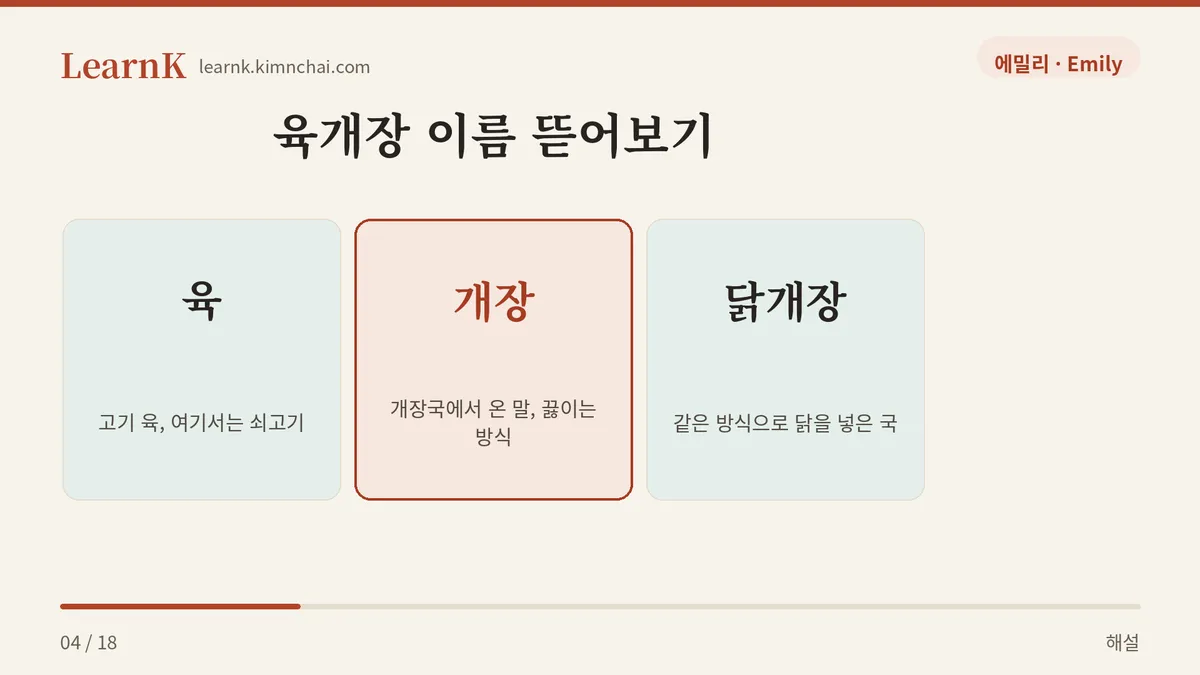
Start with how the name is built. The 개장 at the end originally referred to 개장국 (gaejangguk), a soup once simmered with dog meat. Attach the character 육 (肉), meaning meat, and you get 육개장: the same method, but with beef in place of dog meat. So when it’s made with chicken, it naturally becomes 닭개장. This is also exactly why the spelling 육계장 is wrong — there was never a place for chicken in the name to begin with.
There are very practical reasons why 육개장 became the fixed funeral-hall menu. Mourners come and go for three straight days, day and night, and nobody knows how many will arrive at what hour. The food has to be something you can boil up all at once in a huge pot and keep reheating, something that doesn’t lose much when it cools and is warmed through again. Stir in some rice and it’s a full meal, and it warms the insides of people worn out from sitting up all night. There are also stories connecting the red color to an old custom of warding off bad energy, but it feels more natural to see these practical reasons as coming first.
The 육개장 of a midsummer 복날 has a slightly different grain to it. It’s the flagship dish of 이열치열 (iyeolchiyeol), beating heat with heat, so people eat it dripping with sweat and then say, “아, 시원하다” (“ah, that’s refreshing”). Eating hot soup and calling it 시원하다 is one of the things Korean learners puzzle over the longest — here 시원하다 refers not to temperature but to the feeling of your insides loosening up.
In dramas, too, this soup speaks through the picture before anyone says a line. When a funeral scene comes on, the camera usually pans once across the long tables of the reception room and the red soup bowls lined up on them. The scene where the exhausted chief mourner sits a guest down saying “식사라도 하고 가세요” (“at least have something to eat before you go”) is familiar too. Recognizing what kind of gathering it is from the color of that soup alone, before you can even understand the dialogue — that’s the place this word holds in Korean culture.
Today’s quiz
You’ve just stepped into the reception room of a Korean funeral hall. On every table there is rice, 편육 (pyeonyuk, sliced boiled meat), and one bowl of red, 얼큰한 soup. What is this soup called?
① 갈비탕 (galbitang) ② 육개장 (yukgaejang) ③ 설렁탕 (seolleongtang)
Answer: ② — 갈비탕 is the signature dish of happy occasions like wedding receptions, and 설렁탕 is a milky white soup that isn’t spicy, so the color doesn’t match. The soup that can feed three days’ worth of mourners from a single big pot, and becomes a full meal the moment you stir in rice, is 육개장. And while you’re here, check the spelling one more time: it’s not 육계장, it’s 육개장.
Definitions and example sentences are from the National Institute of Korean Language’s Basic Korean Dictionary (krdict.korean.go.kr); that portion of this post, including our translations, is licensed under CC BY-SA 2.0 KR.