애틋하다 (aeteutada) — When a Drop of Wistfulness Mixes into the Love You Hold
애틋하다 (aeteutada)
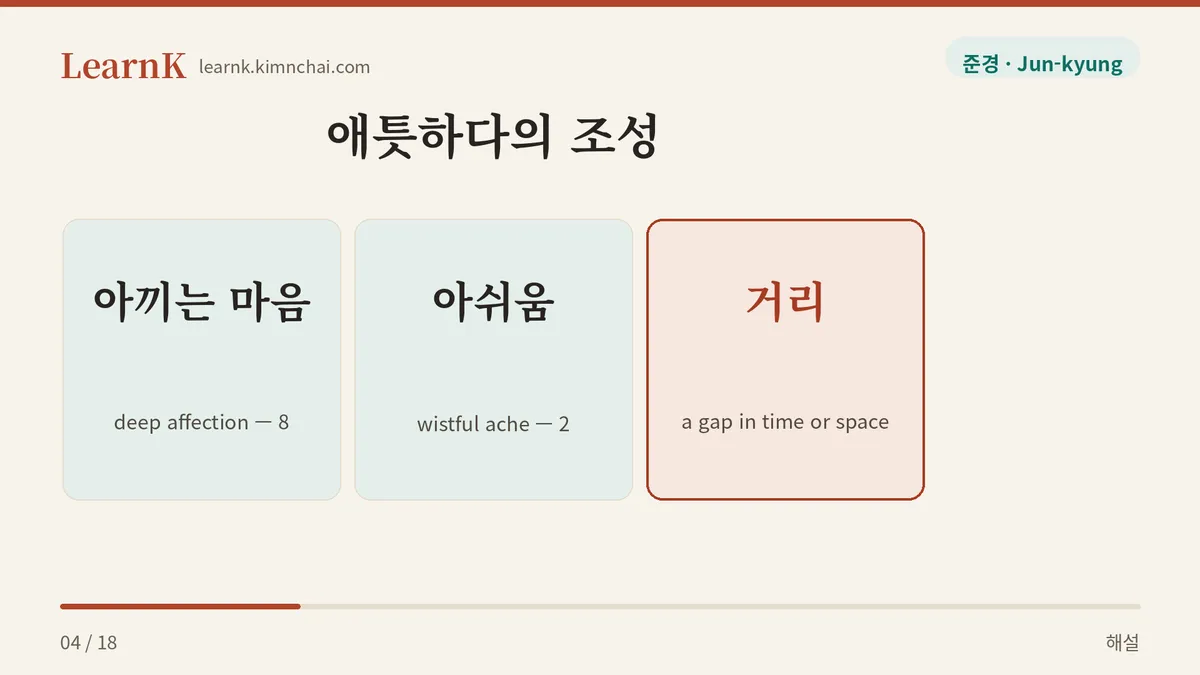
애틋하다 (aeteutada) means that your affection for someone runs deep, and at the same time that feeling can’t quite reach them, so you’re left wistful and aching, with a slow burn somewhere inside. When this word turns up in Korean drama subtitles, the translation usually tips toward either ‘sad’ or ‘sweet.’ But 애틋하다 (aeteutada) holds both at once. If the caring part is 8, about 2 parts wistfulness have to be mixed in for it to be 애틋하다 (aeteutada) — take that 2 away and it’s just ‘nice.’
That’s why the word doesn’t stick to a relationship that’s rolling along fine right in front of you. Calling a friend you see every day 애틋하다 (aeteutada) sounds odd. Instead it attaches to someone or something that distance has already opened up around, or soon will — a younger brother who left for military service, a friend who emigrated, a romance that’s already over, a room you have to empty out today. When affection pools in a gap that has opened up, whether in time or in space, Koreans say 애틋하다 (aeteutada).
The temperature is worth knowing too. 애틋하다 (aeteutada) is not a cry-out-loud emotion. It’s the temperature of your throat tightening for a second and then loosening again — barely visible from the outside. So the word usually comes out in a quiet place, in a low voice. It isn’t something you shout across a table full of drinks; it’s closer to something you mutter standing alone in a room you’ve just cleared out.
It’s an adjective. In a sentence it works as a predicate — 애틋해 (aeteutae), 애틋해요 (aeteutaeyo), 애틋하더라 (aeteutadeora) — and it can also modify a noun, as in 애틋한 사이 (aeteutan sai) and 애틋한 마음 (aeteutan maeum).
Checking the National Institute of Korean Language dictionary
The National Institute of Korean Language’s Basic Korean Dictionary lists 애틋하다 (aeteutada) as an adjective and splits the meaning in two. The order is worth a look. The dictionary puts ‘aching regret’ first and ‘deep affection’ second — meaning the root of this word touches wistfulness before it touches love.
애틋하다 「adjective」
- 섭섭하고 안타까워 애가 타는 듯하다. (To feel as though your insides are burning with disappointment and sympathy.) [en] anxious; regrettable — One’s heart going to someone or something out of regret or sympathy. [ja] やるせない【遣る瀬無い】。せつない【切ない】 — 悲しくて胸がしめつけられるようである。 [es] preocupado, inquieto, intranquilo — Que se siente intranquilo por algo que le causa lástima o pena. [zh] 依恋,深情 — 遗憾惋惜而心焦。 — National Institute of Korean Language, Basic Korean Dictionary (krdict.korean.go.kr)
The dictionary carries no Portuguese definition. So the line below is not a dictionary quotation but our own rendering — aflito, saudoso: sentir o coração apertado de pena ou saudade por alguém.
Hold on to ‘One’s heart going to someone’ in the English definition. The heart goes toward the other person. This isn’t a feeling that stays inside you; it’s a feeling that tries to cross over to the other side and doesn’t quite make it, and the not-making-it part is what shows up as ‘애가 타다 (aega tada),’ the insides burning. The Chinese definition has the same structure, setting 依恋 (attachment) right next to 心焦 (a burning heart). Wanting to stay close and feeling your insides scorch — both live in one word.
- 아끼고 위하는 정이 깊다. (To have deep affection and care for someone.) [en] affectionate — Having deep affection and love for someone. [ja] こまやかだ【細やかだ・濃やかだ】 — 大事にする情が厚い。 [es] sincero, profundo, fiel — Que siente un afecto sincero y profundo por alguien. [zh] 深情,深切 — 疼爱而情深。 — National Institute of Korean Language, Basic Korean Dictionary (krdict.korean.go.kr)
There’s no Portuguese for this sense either, so again this is ours — afetuoso, carinhoso: que nutre um afeto profundo e cuidadoso por alguém.
The Japanese definitions are interesting. Sense 1 gets 「せつない (setsunai)」 and sense 2 gets 「こまやかだ (komayakada)」 — two completely different words. What is one word in Korean splits into two in Japanese. Spanish does the same thing: sense 1 goes to intranquilo (uneasy), sense 2 to profundo (deep). Everything that makes 애틋하다 (aeteutada) hard to carry into another language is right there on the page.
The dictionary’s one real usage example is this single sentence.
아니. 나도 그 애틋하다는 연애편지를 좀 받아 보고 싶어. (No, come on. I’d like to get one of those 애틋하다 love letters myself.) — National Institute of Korean Language, Basic Korean Dictionary (krdict.korean.go.kr)
It’s a fragment of a conversation. The other person has brought up a love letter someone received, and the speaker cuts in with ‘아니 (ani)’ and comes back with ‘나도 (nado), me too.’ There are two things to learn here. First, the modifying clause ‘그 애틋하다는 (geu aeteutadaneun).’ The speaker isn’t reporting their own feeling — they’re picking up the premise that this is what the world calls love letters and quoting it as is. Second, 애틋하다 (aeteutada) attaches not only to people but to objects like letters. More precisely, it isn’t the letter itself that’s 애틋하다 (aeteutada); it’s the feeling packed inside it that never made it across.
Seeing it in real conversation
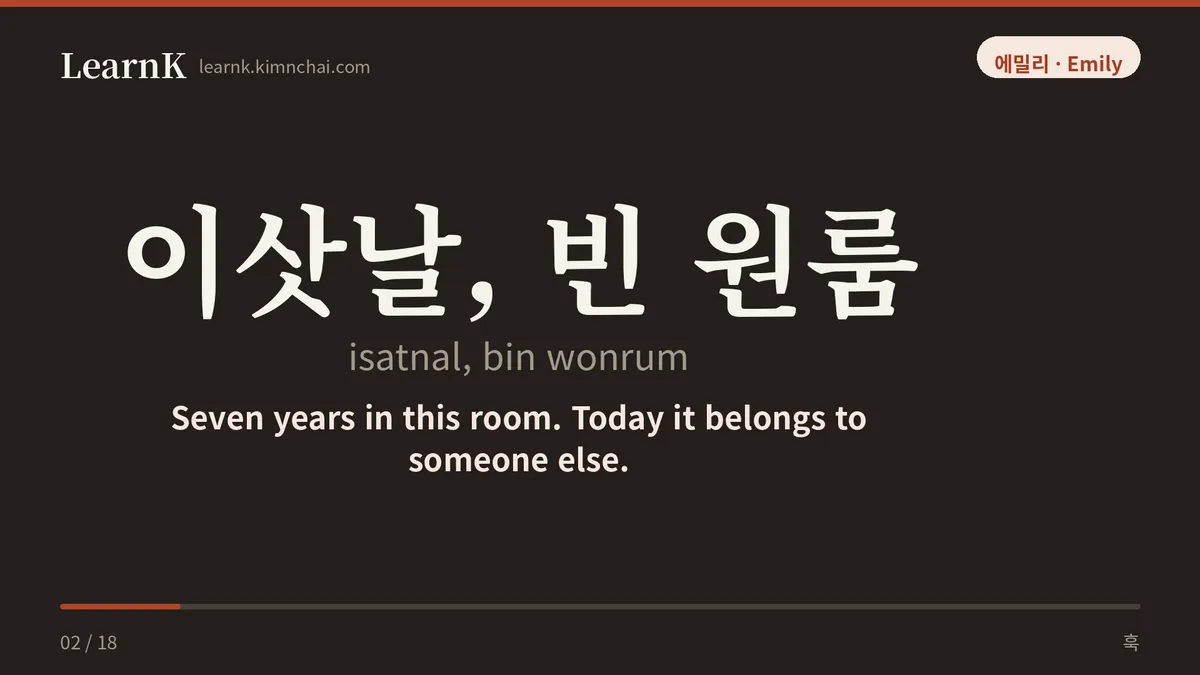
Scene: Emily’s moving day. In the emptied-out studio apartment, right before she locks the door for the last time.
Jun-kyung: 다 뺐다. 열쇠만 반납하면 끝나. 근데 너 왜 안 나와? That’s everything. Just return the key and we’re done. But why aren’t you coming out?
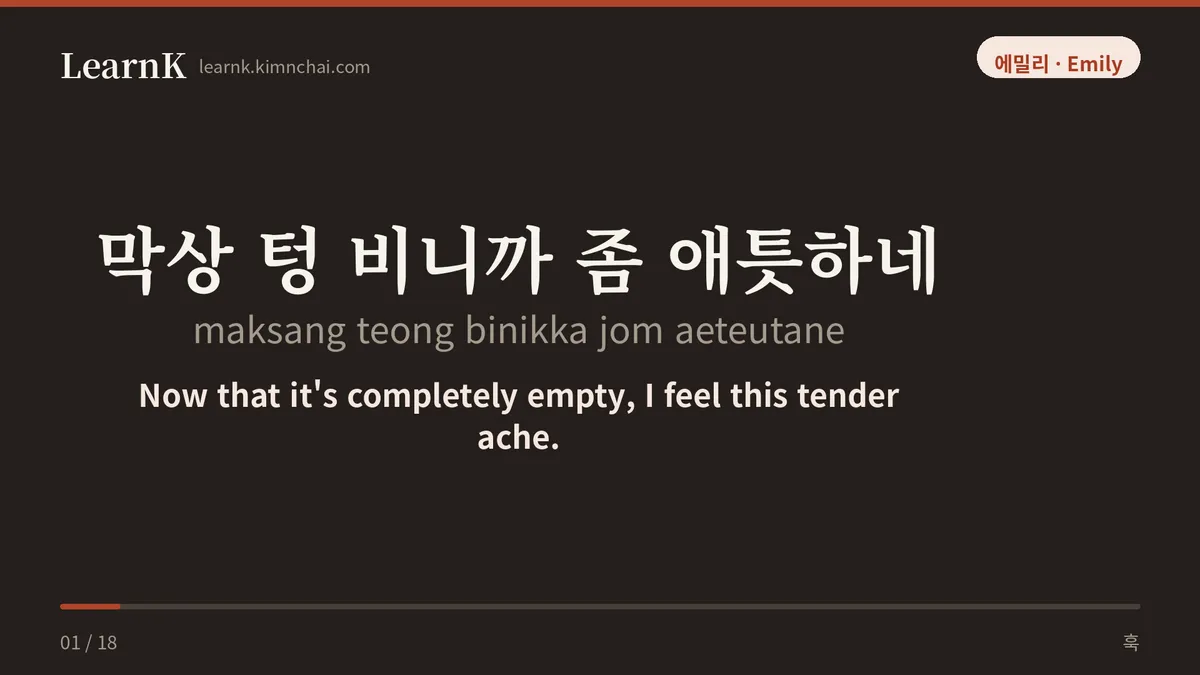
Emily: 잠깐만. 나 여기서 칠 년 살았거든. 막상 텅 비니까 좀 애틋하네. Hold on. I lived here seven years. Now that it’s completely empty, I feel this tender ache.
Jun-kyung: 하긴. 첫 자취방이 제일 그래. Yeah. Your first place on your own always hits like that.
Emily: 주인 할머니가 김장할 때마다 김치 한 통씩 갖다주셨어. 그게 제일 애틋해. The landlady brought me a tub of kimchi every time she made it. That’s what I feel most tenderly about.
Jun-kyung: 인사드리고 가. 할머니도 기다리고 계실걸. Go say goodbye. I bet she’s waiting for you too.
Emily: 응… 근데 나 울 것 같아서 못 가겠어. Yeah… but I feel like I’ll cry, so I can’t go.
Look at where 애틋하다 (aeteutada) lands both times. In each case the thing is already slipping out of her hands. As of today the room she lived in becomes someone else’s room, and as of today the grandmother who gave her kimchi is no longer her neighbor. If the room were still hers and the grandmother were still next door, this word wouldn’t come out.
Where it sounds off
✗ 어제 본 예능 진짜 애틋했어. (The variety show I watched yesterday was really 애틋했어.) ✓ 어제 본 예능 진짜 재밌었어. (The variety show I watched yesterday was really funny.) / 어제 본 다큐 마지막 장면은 좀 애틋했어. (The last scene of the documentary I watched yesterday was a little 애틋했어.) → 애틋하다 (aeteutada) has to have wistfulness and heartache mixed in. Pin it on something that’s simply fun and funny and the word spins in place. Even a variety show can be 애틋하다 (aeteutada) if it’s the episode where long-time members gather for the last time. It’s 애틋하다 (aeteutada) because it’s ending, not because it’s funny.
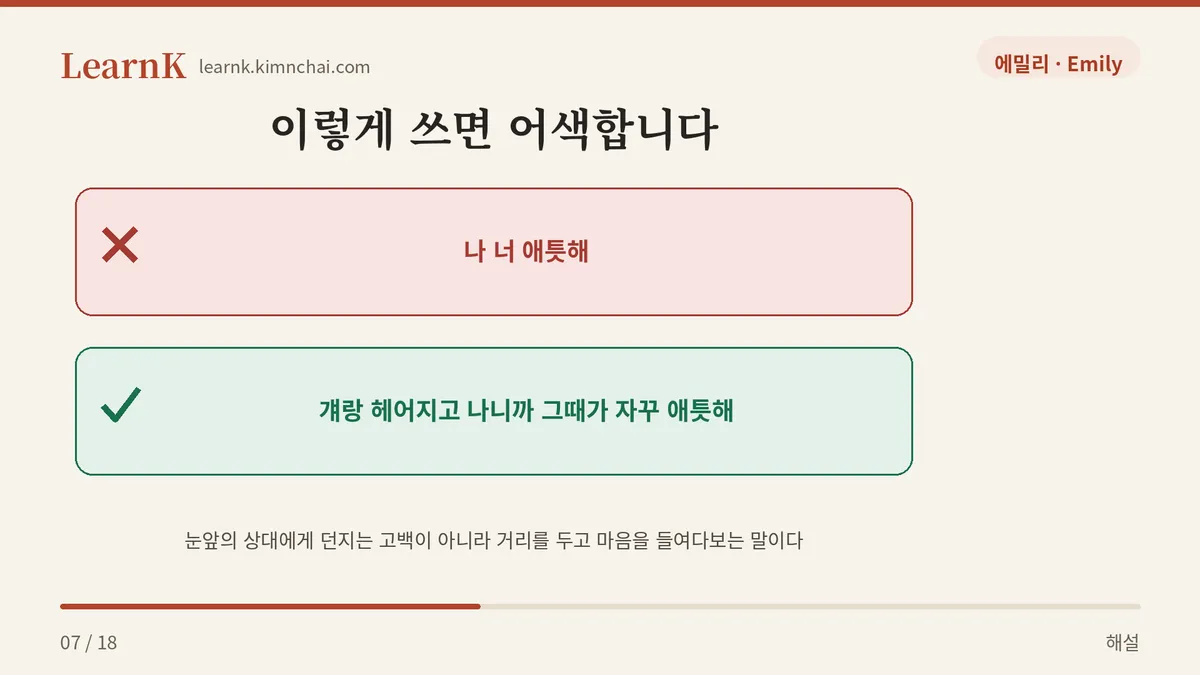
✗ (sitting face to face with your partner, looking into their eyes) 나 너 애틋해. (I feel 애틋해 about you.) ✓ (to a friend) 걔랑 헤어지고 나니까 그때가 자꾸 애틋해. (Now that we’ve broken up, that time keeps feeling 애틋해.) → 애틋하다 (aeteutada) isn’t a confession you toss straight at the person in front of you. It’s a word for looking at your own heart through one layer of distance or time, so used across a table it makes the other person hear ‘is this a breakup speech?’ For someone who’s right beside you, ‘보고 싶었어 (bogo sipeosseo), I missed you’ or ‘많이 아껴 (mani akkyeo), I care about you a lot’ sounds far more natural.
Example sentences by situation
1. Clearing out the empty room of a friend who went abroad to study
걔 슬리퍼가 아직 현관에 그대로 있더라. 좀 애틋하더라. (gyae seullipeoga ajik hyeon-gwane geudaero itdeora. jom aeteutadeora.) Her slippers are still sitting right there in the entryway. It got to me a little.
The person is gone but their things are still there — that’s the situation 애틋하다 (aeteutada) fits most exactly. Adding the ending -더라 (-deora) gives it the nuance of ‘I was there and experienced it myself,’ which makes the feeling something you set down quietly rather than assert.
2. After reading a handwritten letter from your grandmother
할머니 글씨를 보니까 마음이 애틋해졌어요. (halmeoni geulssireul bonikka maeumi aeteutaejyeosseoyo.) Seeing my grandmother’s handwriting, my heart went tender.
‘애틋해지다 (aeteutaejida),’ with -아지다 (-ajida) attached, means your heart moved into that state. It wasn’t 애틋하다 (aeteutada) from the start — the process of becoming that way while reading the letter is built into the word. This form works perfectly well in polite speech too.
3. At work, the day after watching the drama finale
어제 마지막 회 보셨어요? 두 사람 헤어지는 장면이 참 애틋하더라고요. (eoje majimak hoe boseosseoyo? du saram heeojineun jangmyeoni cham aeteutadeoragoyo.) Did you watch the finale last night? The scene where the two of them part was really 애틋하더라고요.
-더라고요 (-deoragoyo) is the polite version of -더라. Drama talk is the safest small-talk topic in a Korean workplace, so this one sentence opens a conversation. Putting ‘참 (cham)’ in front adds a layer of admiration.
Polite and casual forms, and similar expressions
Since 애틋하다 (aeteutada) is an adjective, politeness is adjusted only through the ending. Casual: 애틋해 (aeteutae) / 애틋하더라 (aeteutadeora) / 애틋했어 (aeteutaesseo). Polite: 애틋해요 (aeteutaeyo) / 애틋하더라고요 (aeteutadeoragoyo) / 애틋합니다 (aeteutamnida). Use 애틋합니다 (aeteutamnida) in formal writing or presentations, and 애틋해요 (aeteutaeyo) in everyday polite speech.
One grammar point to watch. Because 애틋하다 (aeteutada) describes a state of the heart, it sounds off if you state someone else’s inner feeling as fact. Rather than ‘준경 씨는 동생이 애틋해요 (Jun-kyung ssineun dongsaengi aeteutaeyo),’ it’s more natural to say ‘준경 씨는 동생이 애틋한 모양이에요 (Jun-kyung ssineun dongsaengi aeteutan moyangieyo)’ or ‘애틋해하더라고요 (aeteutaehadeoragoyo).’ Stepping back a notch with devices like -나 보다 (-na boda) / -는 모양이다 (-neun moyangida) / -더라 (-deora) is a habit of the Korean language.
Setting it beside similar words makes its position clear.
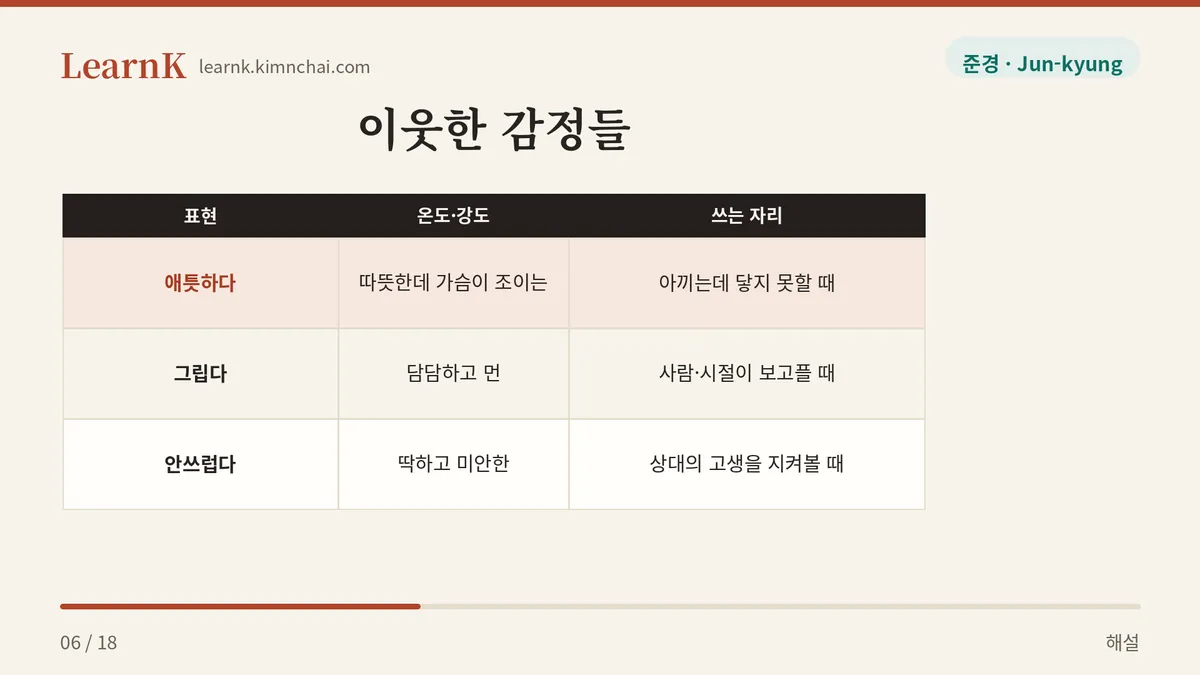
| Expression | Temperature / intensity | Where it’s used |
|---|---|---|
| 애틋하다 (aeteutada) | warm, but with a squeeze in the chest | When wistfulness mixes into affection. People and times that distance has opened up around |
| 그립다 (geuripda) | calm and far off | When you miss a person, a time, or a place. The sense of distance outweighs the ache |
| 안쓰럽다 (ansseureopda) | pitying and apologetic | When you watch someone having a hard time. Carries a looking-down-from-above angle |
| 아련하다 (aryeonhada) | hazy and faraway | When an old memory surfaces faintly. Less about present feeling, more about the resolution of the memory |
| 애절하다 (aejeolhada) | strong and desperate | When love or a plea is urgent. Used in songs and novels, almost never in everyday conversation |
The easy one to mix up is 그립다 (geuripda). 그립다 (geuripda) works as long as the thing is far away, but for 애틋하다 (aeteutada) distance alone isn’t enough — you also need the sense that there’s something more you want to do for them and can’t. That’s why ‘고향이 그립다 (gohyang-i geuripda), I miss my hometown’ sounds natural while ‘고향이 애틋하다 (gohyang-i aeteutada)’ makes people tilt their heads a little, and ‘고향에 계신 부모님이 애틋하다 (gohyang-e gyesin bumonimi aeteutada), I feel 애틋하다 about my parents back home’ sounds natural instead.
Cultural background — the affection you leave partly unsaid
Look again at how the dictionary unpacks sense 1: ‘애가 타는 듯하다 (aega taneun deutada).’ ‘애가 타다 (aega tada)’ is an idiom meaning to fret until your insides go dry. The very fact that the dictionary borrowed this idiom to explain the meaning tells you the felt temperature of the word. 애틋함 (aeteutam) isn’t an emotion you know with your head; it’s described as a tightening sensation deep in the body. (The etymology of 애틋하다 (aeteutada) itself has never been firmly established, so we won’t make claims about it here.)
There’s a reason Korean dramas, especially historical ones, are so full of 애틋한 사이 (aeteutan sai). Class difference, war, family opposition — the basic setup of the story is a structure that makes it impossible to put your heart into words. Feelings that go unspoken pile up, and that pile is exactly 애틋함 (aeteutam). Modern dramas work the same way. Turning away at the airport without stopping them, sitting in the back row at a wedding and slipping out quietly — the moments Korean dramas love are all moments of ‘there’s something I want to say and I’m not saying it.’ Name that spot in one word and you get 애틋하다 (aeteutada).
Everyday life has a similar grain. Koreans tend to substitute something else for saying affection head-on. A parent asks ‘밥은 먹었니 (babeun meogeonni), have you eaten?’ instead of ‘I love you’; the grandmother next door leaves a tub of kimchi at the door without a word. When you look back later at that feeling — never expressed, left behind only as an action — the word 애틋하다 (aeteutada) comes out. So this word points less at the emotion itself than at the fact that the emotion never got expressed in time.
That’s also why Koreans are surprised when a foreign learner starts using this word naturally. It’s a word that’s hard to place from the dictionary definition alone, so putting it in the right spot reads as a signal that you already understand how feelings travel between people in Korean.
Today’s quiz
Which of the following is the most natural situation for using 애틋하다 (aeteutada)?
- Complimenting a friend’s pretty new sneakers
- Stumbling on a photo with your first-job coworkers from ten years ago while moving
- Your department head’s joke at the company dinner turning out unexpectedly funny
- Being thirty minutes late to an appointment because the subway was delayed
The answer is 2. The people in the photo aren’t beside you now, and there’s no going back to that time. The affection remains but there’s no way to reach it — 애틋하다 (aeteutada) points at exactly that spot. Numbers 1 and 3 are pleasure, so ‘예쁘다 (yeppeuda)’ and ‘웃기다 (utgida)’ are the right words, and number 4 is irritation or nerves, so ‘속상하다 (soksanghada)’ or ‘조마조마하다 (jomajomahada)’ fits better. The nervousness in number 4 connects to ‘애가 타다 (aega tada)’ but not to 애틋하다 (aeteutada) — because for something to be 애틋하다 (aeteutada), there has to be affection lying underneath the anxiety.
Definitions and example sentences are from the National Institute of Korean Language’s Basic Korean Dictionary (krdict.korean.go.kr); that portion of this post, including our translations, is licensed under CC BY-SA 2.0 KR.