배고파 / 배고파요 (baegopa / baegopayo) — Why You Shouldn't Ask Your Boss "배고프세요?"
배고파 / 배고파요
배고파 / 배고파요 (baegopa / baegopayo) means “empty enough inside that you need something to eat.” The office where everyone watches the clock with ten minutes left until lunch, the moment you finish coming down the mountain and the noodle shop’s sign appears, the lecture hall pouring out all at once after an exam — Koreans say it at least once a day without fail, which is why it lands on page one of every textbook. And yet the place learners stumble isn’t the meaning. It’s who you say it in front of, and in what shape — that’s where the footing slips.
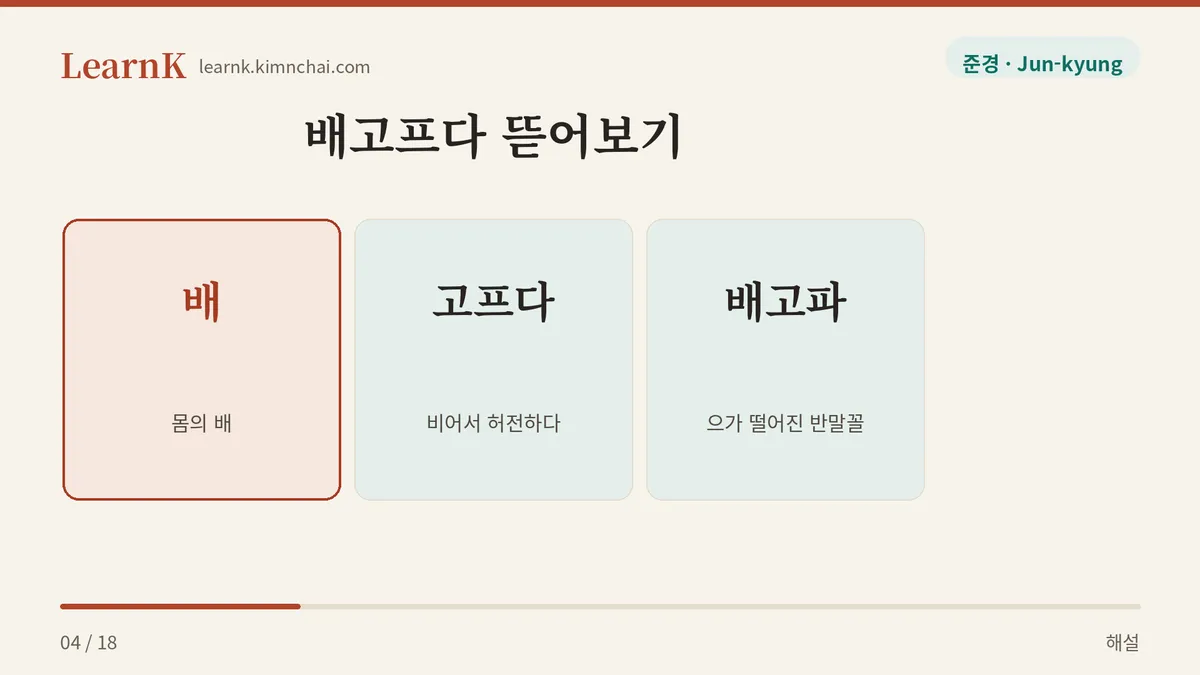
The base form is 배고프다 (baegopeuda). It’s 배 (bae), the body’s stomach, plus 고프다 (gopeuda), an adjective meaning hollow and wanting. The ㅡ in 프 drops out to give 배고파 (baegopa); attach -요 and you get 배고파요 (baegopayo); formalize it and you get 배고픕니다 (baegopeumnida). The steps are clearly marked, so memorizing them is easy.
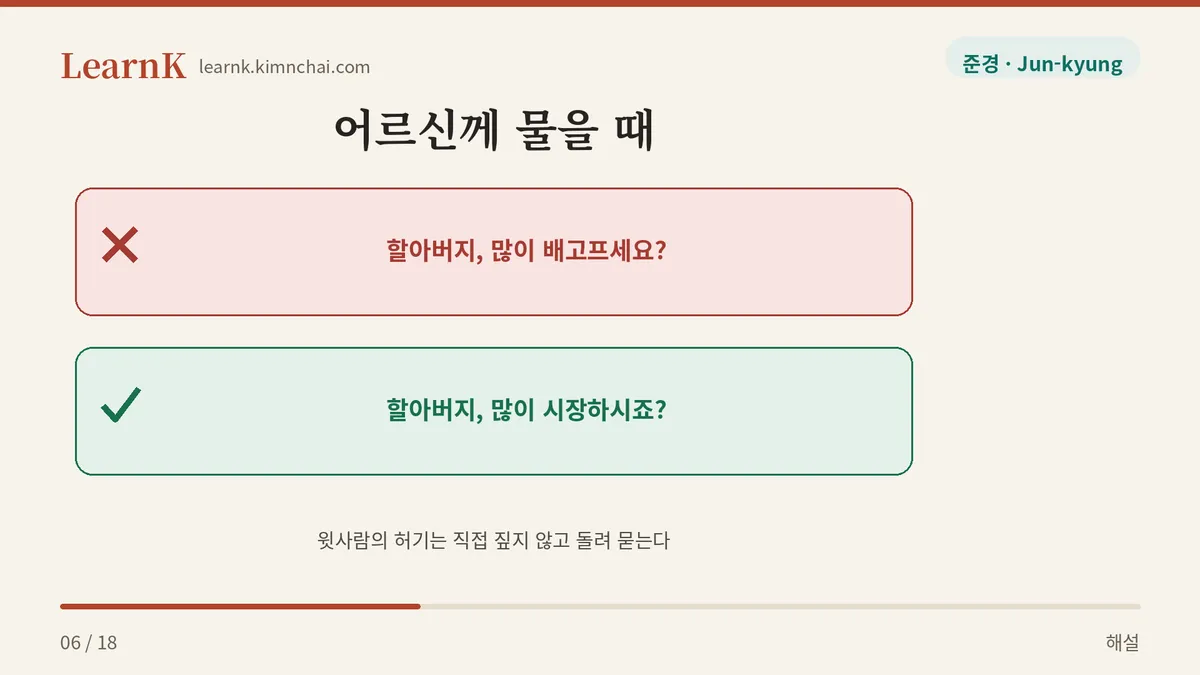
The problem is that one rung of this ladder is empty. Korean honorifics have two separate mechanisms — one that raises the listener (-요, -습니다) and one that raises the subject of the sentence (-시-) — and 배고프다 doesn’t attach well to the second. 배고프세요? (baegopeuseyo?) has nothing wrong with it as far as the grammar book is concerned, but ask an elder this in real life and the air cools ever so slightly. Hunger is a state of the body, and Korean is careful about pointing directly at an elder’s bodily state. So a different word goes in that slot — 시장하다 (sijanghada).
A Real Conversation
Scene: the morning of the company health checkup. A hospital waiting room, waiting their turn for the blood draw. Neither of them has eaten since eight o’clock last night.
Emily: 준경 씨, 나 진짜 죽겠어. 어제부터 물만 마셨어. Jun-kyung, I’m dying here. I’ve had nothing but water since yesterday.
Jun-kyung: 나도. 아침에 지하철에서 빵 냄새 맡는데 배고파서 손이 다 떨리더라. Same. On the subway I smelled bread and got so hungry my hands were shaking.
Emily: 아까 간호사분이 식사하셨냐고 물으시길래 나도 모르게 “아니요, 저 지금 너무 배고파요” 했잖아. The nurse asked if I’d eaten, and I blurted out “No, I’m so hungry right now.”
Jun-kyung: 하하, 그 상황에서 반말 안 나온 게 어디야. Haha, at least casual speech didn’t slip out.
Emily: 야, 나 한국 산 지 십오 년이야. 그 정도는 몸이 알아서 해. Hey, I’ve lived in Korea fifteen years. My body handles that much on its own.
Jun-kyung: 인정. 끝나고 순댓국 가자, 나 지금 배고파 죽겠어. Fair. Let’s get sundae-guk after — I’m starving.
Said This Way, It Sounds Off
✗ (to an elder) 할아버지, 많이 배고프세요? ✓ (to an elder) 할아버지, 많이 시장하시죠? 얼른 상 차릴게요. → The grammar is fine, but pointing directly at an elder’s hunger sounds overly familiar. Asking about an elder’s hunger indirectly, with 시장하시다, is a long-standing habit.
✗ (to an executive during a meeting) 이사님, 저 배고파요. 얼른 끝내죠. ✓ (to an executive during a meeting) 이사님, 시간이 좀 됐네요. 식사부터 하시는 게 어떨까요? → 배고파요 is correct polite speech. It’s just that putting your own bodily state front and center in a formal setting comes across as whiny. The same message goes through perfectly if you rebuild the sentence around the other person’s comfort.
Example Sentences by Situation
1. To your roommate at your place (casual speech)
야, 나 배고파 (baegopa). 라면 하나 끓일 건데 너도 먹을래?
This is the most common setting of all. Among peers, nobody bothers to talk around 배고프다. Using polite speech here would actually make you seem distant.
2. First day at a part-time job, to an older boss (해요체 polite style)
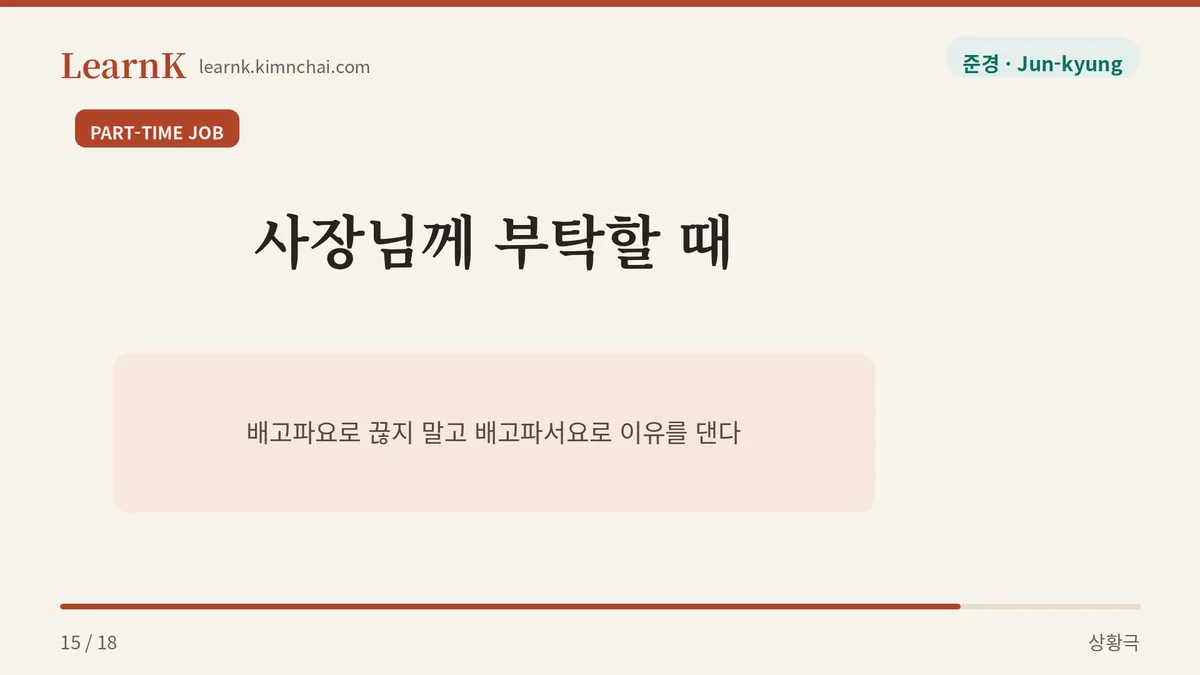
사장님, 저 잠깐 편의점 다녀와도 될까요? 아침을 못 먹어서 좀 배고파서요 (baegopaseoyo).
There’s nothing wrong with telling someone senior how you’re doing. It’s just that instead of stopping flat at 배고파요, the -서요 form — which offers it as a reason — is far softer. That’s because it’s being used as grounds for a request.
3. Welcoming a guest (raising the other person)
오시느라 고생하셨어요. 시장하시죠 (sijanghasijyo)? 국이 다 됐으니 바로 앉으세요.
Same meaning, but when the subject is the other person, the whole word changes. Memorize this one sentence and you’ll also train your ear, because nine times out of ten it’s what you’ll hear when you’re invited to a Korean home.
Politeness Levels and Similar Expressions
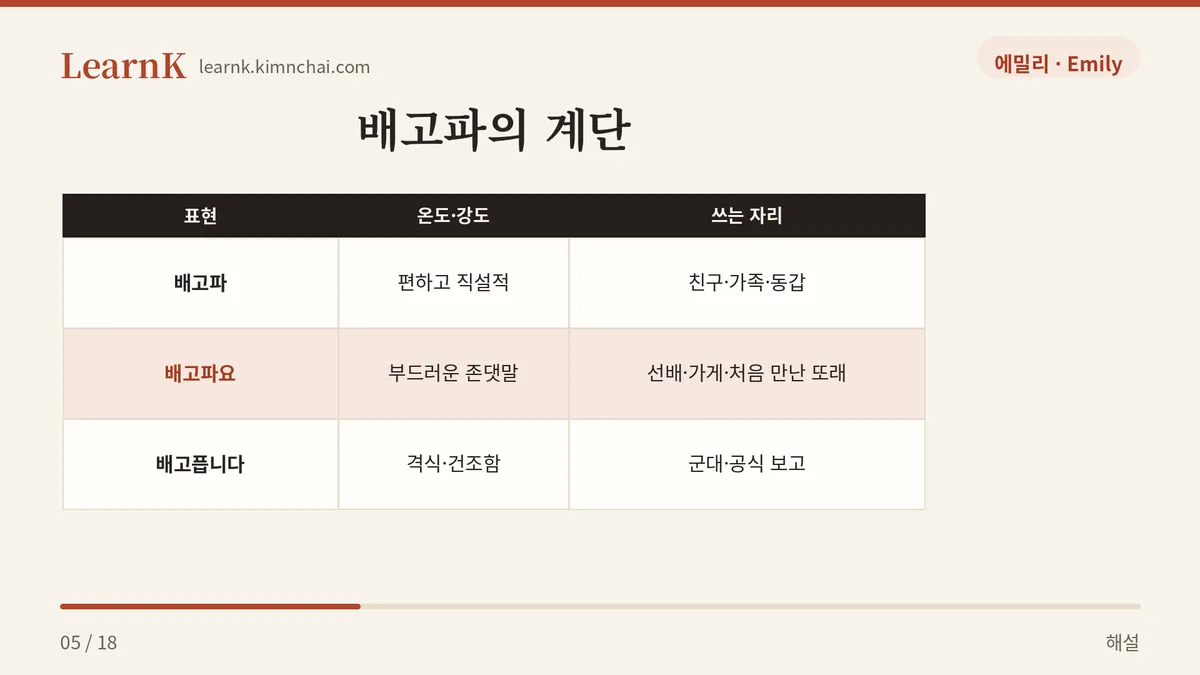
| Expression | Temperature / intensity | Where it’s used |
|---|---|---|
| 배고파 (baegopa) | Relaxed and blunt | Friends, family, same-age peers. Never to someone senior |
| 배고파요 (baegopayo) | Soft polite speech | Close seniors, shops, peers you’ve just met — broadly useful |
| 배고픕니다 (baegopeumnida) | Formal, dry | Military, official reports. Stiff in everyday conversation |
| 출출해요 (chulchurhaeyo) | Mild — about one bite of a snack | Mid-meeting, late-night-snack talk. Fine even in polite settings |
| 시장하시죠? (sijanghasijyo?) | Raises the other person | Asking an elder or a guest about their hunger |
| 허기지다 (heogijida) | Strong and literary | Writing, description. Rarely used in speech |
출출하다 in particular is worth keeping in your pocket. In a setting where 배고파요 would feel like too much, saying “조금 출출하네요” brings up the subject of food while leaving the decision to the other person — a nice bit of breathing room.
Cultural Background — A Country Where the Greeting Is “밥 먹었어?”
In Korea, 밥 먹었어? (bap meogeosseo?) is less a question than a greeting. Nobody’s genuinely curious about whether you’ve eaten; food is standing in for “how have you been.” That’s how much hunger, in this society, was treated not as a private matter but as something looked after together. Korean linguists trace 고프다 to an older word meaning to be empty or to go hungry inside. The sensation of an empty stomach is still sitting right there in the word.
Hunger was a vivid memory here for a very long time — long enough that 보릿고개, the “barley hump” lean season, is still in the dictionary. Elders pressing you to eat more at the table, insisting on packing up the leftover banchan, asking even a total stranger “식사는 하셨어요?” before anything else — it all comes from that same place. It’s also why the drama Reply 1988 (《응답하라 1988》) lingered so long on plates of side dishes traveling up and down the alley. A single scene of sharing food could explain the entire warmth between neighbors.
So the one line “배고파요” carries more weight than you’d think. Between close friends it’s nearly a term of endearment — someone you can tell you’re hungry is already someone you’re comfortable with — while in a difficult setting it becomes a sentence that lays a burden on the other person. The same sentence reading in opposite directions depending on the room: that is the true face of Korean honorifics.
Today’s Quiz
Dinner at a company workshop. The department head sitting next to you hasn’t even picked up their chopsticks. What’s the most natural thing to say?
- 부장님, 배고프세요?
- 부장님, 배고파요?
- 부장님, 시장하시죠? 이것 좀 드셔 보세요.
Answer: 3. Number 1 isn’t grammatically wrong, but pointing directly at a senior’s bodily state sounds overly familiar. Number 2 has no element raising the other person at all, so it’s even more awkward. Use 시장하시다 as in number 3 and follow it immediately by offering food, and a question about hunger turns into an act of looking after someone.
Definitions and example sentences are from the National Institute of Korean Language’s Basic Korean Dictionary (krdict.korean.go.kr); that portion of this post, including our translations, is licensed under CC BY-SA 2.0 KR.