빌런 (billeon) — Not a Supervillain, Just *That* Person
빌런
빌런 (billeon) started out as the English word villain — the bad guy in a movie. But in Korean today it means someone whose over-the-top behavior in a given situation makes life hard for everyone around them, or just makes them laugh. Not an actual villain. The guy sprawled across two seats on the subway with his legs wide open, the coworker who always brings up a brand-new agenda item right as the meeting is wrapping up, the one person firing off a hundred messages by themselves in the group chat — Koreans look at people like this and say, “아, 완전 빌런이네 (a, wanjeon billeon-ine)” — “Ugh, total villain.”
So you won’t find this word in a Korean textbook, but it shows up thousands of times a day on the Korean internet: YouTube comments, community forums, KakaoTalk chats between coworkers. If you’re a learner who wants to watch K-dramas without subtitles, this is one of the words you absolutely have to know.
The heart of the nuance is that it’s light. “저 사람 나쁜 사람이야 (jeo saram nappeun saram-iya)” — “That person is a bad person” — is heavy and serious. But “저 사람 빌런이야 (jeo saram billeon-iya)” — “That person is a 빌런” — is exasperated with a laugh mixed in. It’s a word that steps back and looks at someone as if they were a character in a movie. When a Korean is genuinely angry, they don’t reach for 빌런.
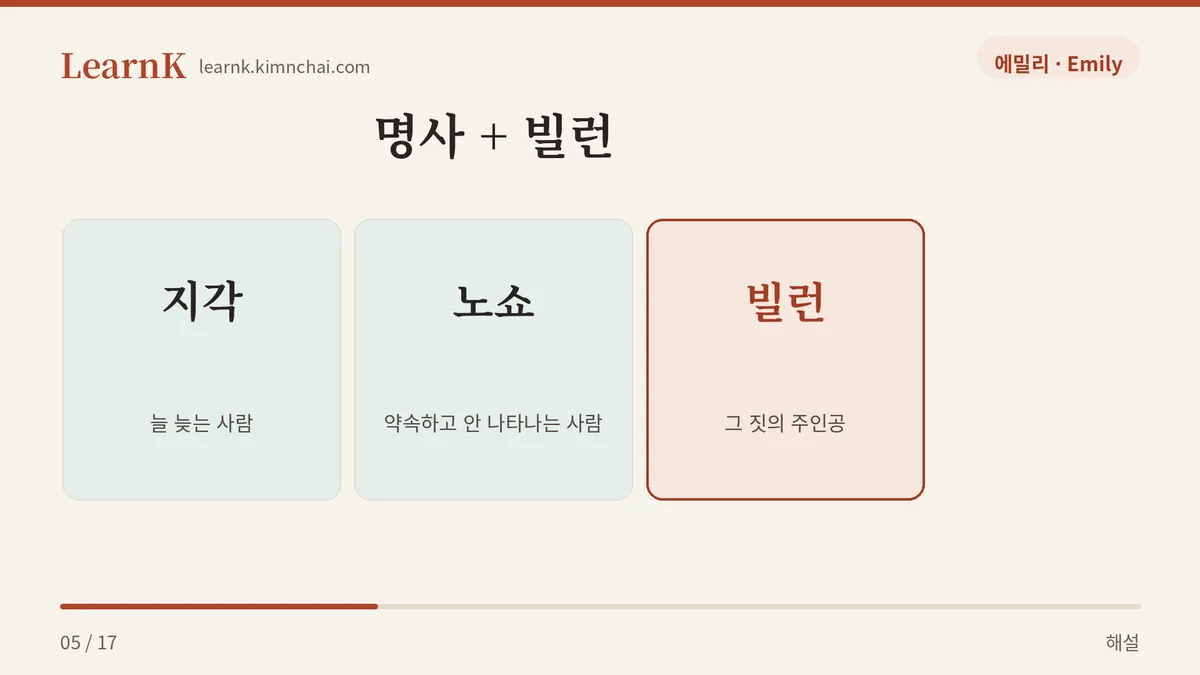
One more important feature — 빌런 is almost always used with another word stuck on the front. Put a single noun in front of it and you’ve invented a brand-new 빌런 on the spot.
- 지각 빌런 (jigak billeon) — someone who’s always late
- 엘리베이터 빌런 (ellibeiteo billeon) — someone who takes the elevator to go up one floor
- 노쇼 빌런 (nosyo billeon) — someone who makes plans and then never shows up
- 분리수거 빌런 (bullisugeo billeon) — the neighbor who leaves the recycling in a total mess
Because this word-building pattern is alive and kicking, you too can coin a brand-new 빌런 today. Koreans will hear it and understand instantly.
Seeing It in Real Conversation
Situation: Saturday afternoon, in front of an apartment complex’s main gate — the meeting spot for a secondhand sale. It’s now twenty minutes past the agreed time.
Jun-kyung: 아직도 안 와? 벌써 이십 분째인데. Still not here? It’s already been twenty minutes.
Emily: 응, 읽씹이야. 이거 완전 노쇼 빌런인데. Yeah, he’s leaving me on read. This guy is a total no-show villain.
Jun-kyung: 야, 그냥 가자. 저번에도 이랬다며. Hey, let’s just go. You said this happened last time too.
Emily: 아 근데 이 가격에 이런 의자가 없단 말이야… 십 분만 더. But I can’t find a chair like this at this price… just ten more minutes.
Jun-kyung: 그러다 너까지 빌런 된다? 나 세 시에 약속 있다고 아까부터 말했잖아. Keep that up and you’ll be the villain too. I told you I have plans at three.
Emily: 어머, 미안. 내가 약속 빌런이었네. 가자, 가자. Oh no, sorry. I was the appointment villain. Let’s go, let’s go.
The thing to notice here is the last two lines. The moment Jun-kyung calls Emily a “빌런,” it isn’t an accusation — it’s a joking protest. And Emily doesn’t get upset either; she picks it right up and calls herself an “약속 빌런.” That’s how 빌런 works: it gets tossed back and forth like a ball between people who are comfortable with each other.
This Sounds Off
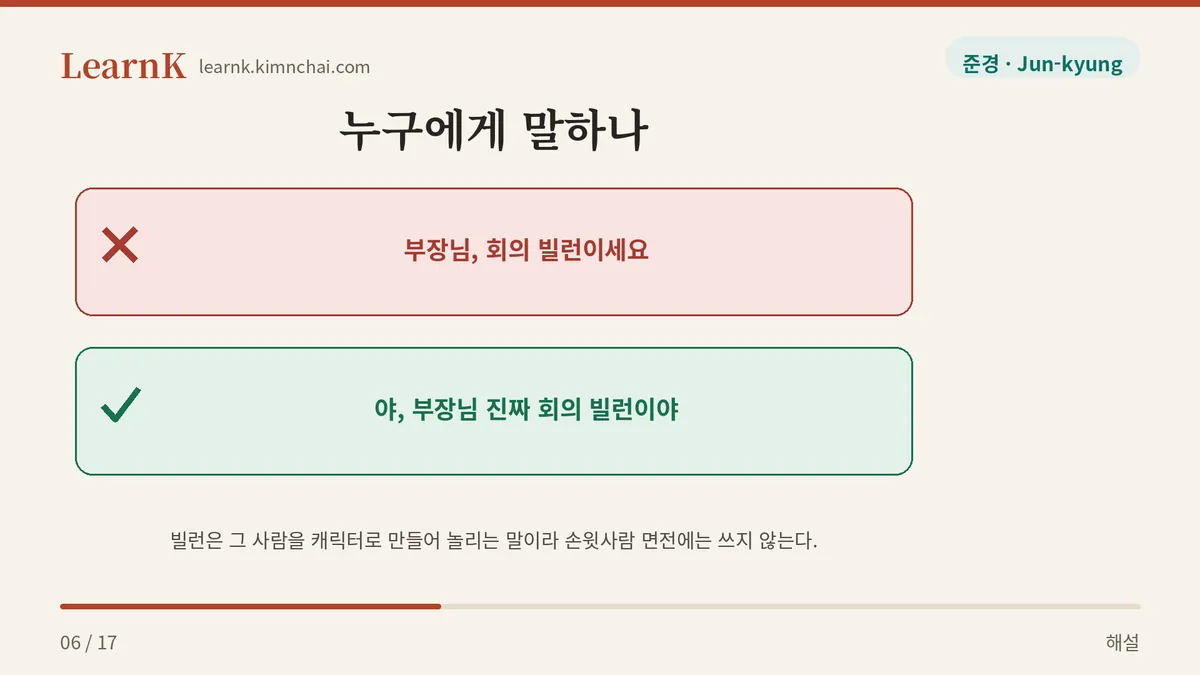
✗ (Said straight to your department head) 부장님, 회의 때마다 회의 빌런이세요. ✓ (Said quietly to a coworker) 야, 부장님 진짜 회의 빌런이야. → 빌런 turns a person into a cartoon character in order to tease them, so saying it to their face stops being a joke and becomes an insult. With anyone senior to you, never say it directly.
✗ (To a friend who’s telling you they got scammed) 와, 그 사람 완전 빌런이다. ✓ (In the same situation) 그건 그냥 사기잖아. 경찰에 신고해야지. → Calling someone a 빌런 in the face of a real crime or serious harm reduces the whole thing to a comic-book episode. Don’t use it when what’s needed is comfort.
Example Sentences by Situation
1. At work, about the coworker who dumps tasks on you right at quitting time
또 여섯 시에 자료 보냈어. 우리 팀 퇴근 빌런 인정. (tto yeoseot si-e jaryo bonaesseo. uri tim toegeun billeon injeong.) “He sent the files at six again. Officially our team’s clock-out villain.”
“인정 (injeong)” is a current slang usage meaning “I’ve got to hand it to them / no denying it.” It pairs extremely well with 빌런. The tone here is less anger than half resignation, half laughter.
2. Talking about yourself (self-deprecation)
나 어제 늦잠 빌런이었어. 알람을 여섯 번 껐대. (na eoje neutjam billeon-ieosseo. allam-eul yeoseot beon kkeotdae.) “I was such an oversleeping villain yesterday. Apparently I turned my alarm off six times.”
The safest way to use 빌런 is on yourself. Calling someone else a 빌런 can be risky, but calling yourself one just sounds cute and quick-witted. This is the usage I especially recommend to Korean learners.
3. Coining a brand-new 빌런 on the spot
우리 옆집에 새벽 청소기 빌런 살아. (uri yeopjib-e saebyeok cheongsogi billeon sara.) “A crack-of-dawn vacuum-cleaner villain lives next door to us.”
“새벽 청소기 빌런” isn’t in any dictionary. It was invented on the spot. And yet Koreans get it immediately and laugh — proof that this expression is a living one.
Politeness Levels and Similar Expressions
Because 빌런 is new slang, it has essentially no polite form. A sentence like “그분은 빌런이십니다” is grammatically possible but nobody actually says it. In situations that call for formality, you have to switch to one of the other words in the table below.
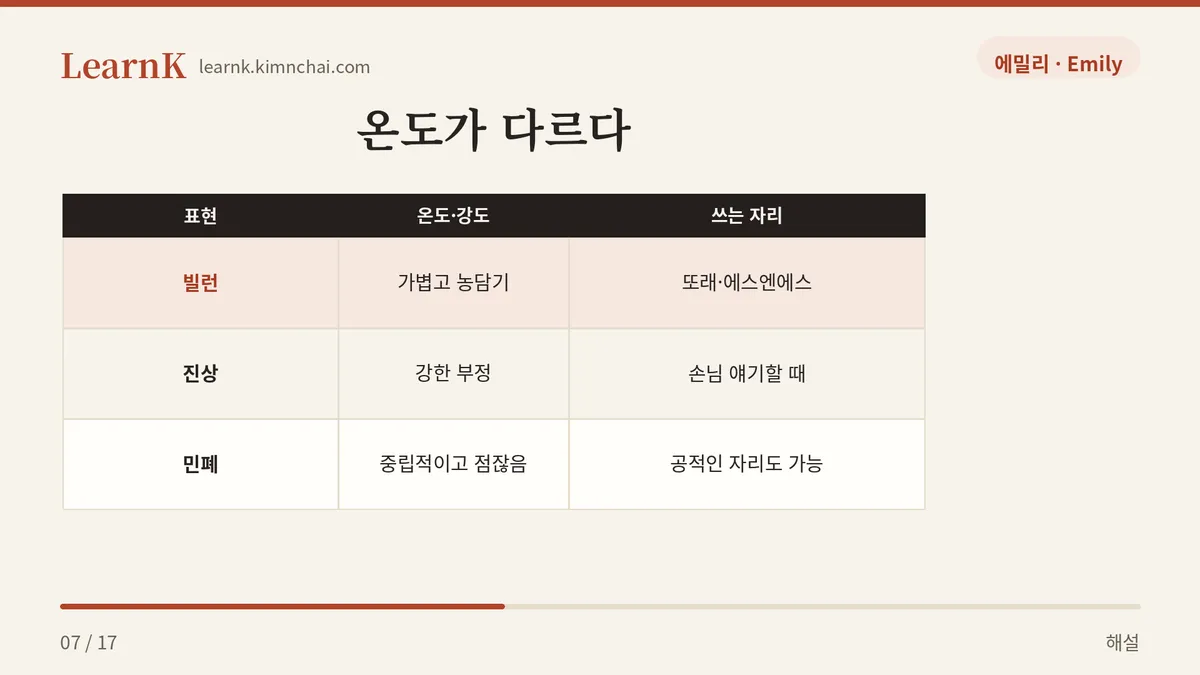
| Expression | Temperature / intensity | Where it’s used |
|---|---|---|
| 빌런 (billeon) | Light, joking, turns the person into a character | Among peers, on social media and forums. Not said directly to anyone senior |
| 진상 (jinsang) | Strongly negative; genuinely unpleasant | Service-industry settings, talking about a customer |
| 민폐 (minpye) | Neutral to negative, well-mannered | Anywhere, including formal settings |
| 또라이 (ttorai) | Very rough, close to a swear word | Only between very close friends |
Even for the same person, the word you pick changes. Talking to a friend about someone having a loud phone conversation in a café, it’s “저 사람 카페 빌런이야 (jeo saram kape billeon-iya).” Reporting it to your manager, it becomes “고객님 한 분이 민폐를 끼치셔서요 (gogaengnim han bun-i minpye-reul kkichisyeoseoyo).” Once you feel the distance between 빌런 and 민폐, your sense of register in Korean goes up a level.
Cultural Background — A Word Marvel Left Behind
We can pin down fairly precisely when this word spread in Korea. In the mid-to-late 2010s, as the Marvel series and other Hollywood superhero movies scored one huge hit after another in Korea, movie talk like “이번 편은 빌런이 매력적이다 (this installment’s villain is really compelling)” flooded the internet. That’s when the English villain hardened into the Korean sound ‘빌런’.
What happened next is the interesting part. As the word crossed over from movie talk into internet communities, it shrank dramatically. A 빌런 was no longer a bad guy out to conquer the world — it was more like the person watching videos without earphones on the subway. That exaggeration, slapping an enormous word onto a tiny everyday annoyance, is exactly where the humor lives. Saying “저 사람 나빠 (that person is bad)” starts a fight; saying “저 사람 빌런이야” demotes them to a supporting character in a movie, which actually defuses your anger.
The word now turns up constantly in the subtitles of Korean dramas and variety shows. You’ve probably seen it especially on observational variety programs: when a cast member does something ridiculous, a caption reading ’○○ 빌런 등장’ (“Enter the ○○ villain”) pops up in the corner of the screen. It’s the production team’s way of signaling to viewers, “Don’t take this seriously and hate them — just laugh along.”
One last thing to add: lately the negative sense has faded even further, so it also gets used for someone who’s excessively enthusiastic about something. The friend who packs twenty bags for a trip is a ‘짐 빌런’ (luggage villain); the friend who takes thirty photos at a restaurant is a ‘사진 빌런’ (photo villain). There’s almost no dislike in this — it’s closer to affection. So if a Korean friend grins at you and says “너 완전 ○○ 빌런이다,” that’s generally a good sign.
Today’s Quiz
Emily went hiking with friends, and on the way to the summit she was the only one asking for a break — more than ten times. After coming back down, what would be the most natural thing for Emily to laughingly call herself?
① 저는 오늘 휴식 빌런이셨습니다 (jeoneun oneul hyusik billeon-isyeotseumnida) ② 나 오늘 완전 휴식 빌런이었어 (na oneul wanjeon hyusik billeon-ieosseo) ③ 그분은 휴식 빌런이십니다 (geubun-eun hyusik billeon-isimnida)
See the answer
Answer: ②
빌런 lives in casual, spoken Korean, so ② is the natural way to say it. ① attaches the honorific ending ‘-이셨습니다’ to yourself, which is grammatically wrong from the start, and ③ refers to someone else in polite speech, which sounds off. And remember — 빌런 is safest and wittiest when you use it on yourself.