불고기 (bulgogi) — Why Isn't It Spicy If It Has '불' (Fire) in the Name?
불고기
불고기 (bulgogi) means a traditional Korean dish of thinly sliced, marinated beef or pork cooked over fire. For a Korean, this word is less a line on a menu than a whole scene. On an evening when guests are expected, the kitchen fills with the smell of soy sauce and sugar cooking down, meat and onions sizzle in the pan — and the family knows without having to ask. Ah, it’s bulgogi tonight.
When a Korean is choosing a restaurant to take a foreign friend to, the first name that comes to mind is usually 불고기 (bulgogi). It isn’t spicy, the aroma isn’t overpowering, and even someone picking up chopsticks for the very first time can’t really go wrong with it. That’s why bulgogi is the gateway dish of Korean food — and the safest, kindest card to play when you’re hosting someone.
One nuance worth pinning down. The dictionary says “pork or beef,” but when a Korean simply hears 불고기 (bulgogi), what comes to mind first is beef. When it’s made with pork, it usually gets the ingredient attached to the front and becomes its own thing: 돼지불고기 (dwaeji-bulgogi). One more thing — 불고기 (bulgogi) is the name of the finished dish and, at the same time, the name of the meat used to make it. At a butcher shop, asking for 불고기감 (bulgogi-gam) means asking for thinly sliced meat.
Checking the National Institute of Korean Language dictionary

불고기 「명사」 얇게 썰어 양념한 돼지고기나 쇠고기를 불에 구운 한국 전통 음식. [en] bulgogi — barbequed beef: Traditional Korean food made by roasting seasoned slices of pork or beef. [ja] プルゴギ — 焼肉:薄切りして味付けした豚肉や牛肉を火にかけて焼いた韓国の伝統料理。 [es] bulgogi, asado coreano, barbacoa coreana — Plato tradicional de Corea que se prepara asando la carne de cerdo o res, previamente condimentadas y cortadas finamente. [zh] 烤牛肉,烤肉 — 韩国传统料理之一,切薄后加入作料烤制出来的猪肉或牛肉。 — National Institute of Korean Language, Basic Korean Dictionary (krdict.korean.go.kr)
This dictionary doesn’t carry a Portuguese definition. So let us be clear that the line below is not a dictionary quotation but our own translation. bulgogi — prato tradicional coreano feito com fatias finas de carne bovina ou suína, temperadas e grelhadas. (our own translation)
Below are the dictionary’s real usage examples, quoted exactly as they appear, each with a note on the kind of situation it comes from.
저녁 반찬으로 불고기를 만들었단다. — National Institute of Korean Language, Basic Korean Dictionary (krdict.korean.go.kr)
jeonyeok banchaneuro bulgogireul mandeureotdanda. (“I made bulgogi as a side dish for dinner.”) This is the tone a mother uses with her child. What’s worth noticing here is that bulgogi is being called a 반찬 (banchan), a side dish. In Korea, bulgogi can absolutely be the main event of a meal, but it also slips quite comfortably into the side-dish slot next to a bowl of rice.
여기는 불고기가 정말 맛있어. 그리고 물냉면도 강추야. — National Institute of Korean Language, Basic Korean Dictionary (krdict.korean.go.kr)
yeogineun bulgogiga jeongmal masisseo. geurigo mullaengmyeondo gangchuya. (“The bulgogi here is really good. And I highly recommend the cold buckwheat noodles too.”) This is casual speech, recommending a restaurant to a friend. The pairing of bulgogi with 냉면 (naengmyeon) is very Korean. Eating sweet, hot meat and then rinsing your mouth with cold noodles is a sequence that still plays out exactly this way in Korean barbecue restaurants today.
저녁 때 손님이 오신다고 불고기에다가 잡채까지 준비하게요? — National Institute of Korean Language, Basic Korean Dictionary (krdict.korean.go.kr)
jeonyeok ttae sonnimi osindago bulgogiedaga japchaekkaji junbihageyo? (“Guests are coming for dinner, so you’re making japchae on top of bulgogi?”) This is the slightly surprised tone of someone watching another person set out a spread for guests. Notice that 불고기 (bulgogi) and 잡채 (japchae) are sitting right next to each other. In Korea these two come out as a pair when you’re hosting, which is why this sentence carries the meaning that the other person is going to real trouble.
외국인 친구가 불고기 맛이 좋다며 엄지손가락을 곧추세워 보였다. — National Institute of Korean Language, Basic Korean Dictionary (krdict.korean.go.kr)
oegugin chinguga bulgogi masi jotdamyeo eomjisongarageul gotchuseweo boyeotda. (“My foreign friend gave a thumbs-up, saying the bulgogi tasted great.”) It’s rather fun that a foreign friend shows up even in the dictionary’s own example sentence. That’s how long bulgogi has been the dish Koreans reach for first when introducing their food to someone from abroad.
A real conversation
Situation: Saturday afternoon, the butcher counter at a neighborhood supermarket. Emily is picking out food for next week’s housewarming party.
Emily: 오빠, 삼겹살 열 명이면 몇 근 사야 돼? Hey, if I go with samgyeopsal for ten people, how much should I buy?
Jun-kyung: 집들이에 삼겹살은 좀… 온 집에 냄새 배. 그냥 불고기 해. Samgyeopsal at a housewarming is kinda… the smell gets into everything. Just make bulgogi.
Emily: 아 맞다, 애들도 온다 그랬지. 맵지도 않고 딱이네. Oh right, they said the kids are coming too. It’s not spicy either, so it’s perfect.
Jun-kyung: 전날 양념에 재워 놨다가 당일엔 볶기만 하면 되고. 사장님, 이거 불고기감으로 얇게 썰어 주세요! And you marinate it the night before and just stir-fry it on the day. Excuse me, could you slice this thin, for bulgogi?
Emily: 양념은 뭐 넣어? 간장이랑 설탕만 넣으면 돼? What goes in the marinade? Is soy sauce and sugar enough?
Jun-kyung: 배 하나 갈아 넣어. 그거 하나로 고기가 달라져. Grate in a pear. That one thing changes the meat completely.
This is where it sounds off
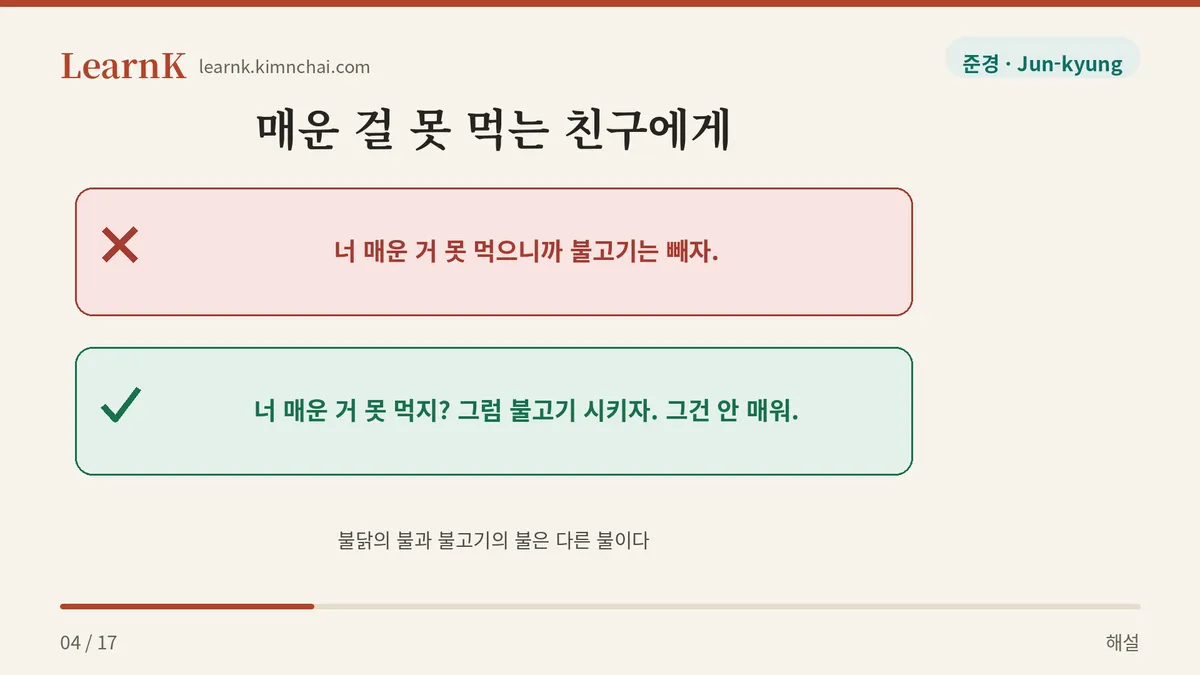
✗ (to a friend who can’t handle spicy food) 너 매운 거 못 먹으니까 불고기는 빼자. (“You can’t eat spicy food, so let’s skip the bulgogi.”) ✓ (to a friend who can’t handle spicy food) 너 매운 거 못 먹지? 그럼 불고기 시키자. 그건 안 매워. (“You can’t eat spicy food, right? Then let’s order bulgogi. That one isn’t spicy.”) → In modern dish names like 불닭 (buldak), 불족발 (buljokbal), and 불막창 (bulmakchang), the 불 (bul) on the front is a marker for “spicy.” So it’s extremely common for learners to assume bulgogi must be spicy too. But the 불 (bul) in 불고기 (bulgogi) points to the cooking method, not the flavor, and the base marinade is soy sauce and sugar — which makes it, if anything, the dish you recommend to someone who can’t take heat.
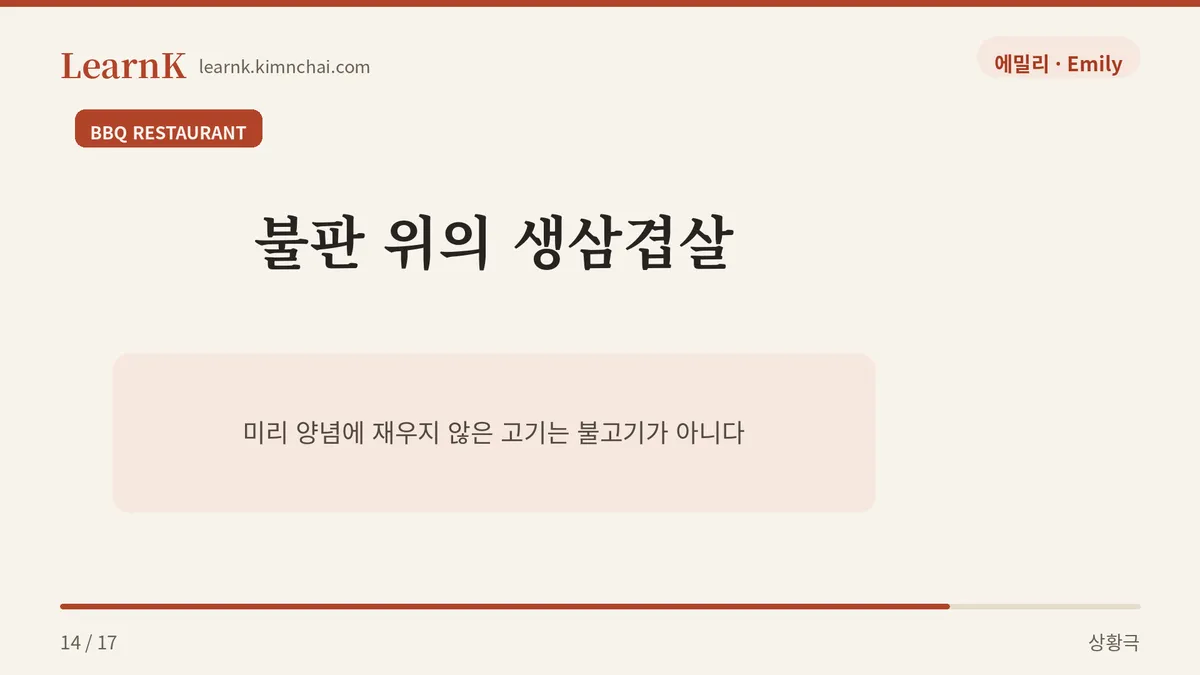
✗ (with raw pork belly on the grill at a barbecue restaurant) 와, 이 불고기 잘 익었다. (“Wow, this bulgogi is cooked perfectly.”) ✓ 와, 이 삼겹살 잘 익었다. / 여기 불고기도 맛있대. 하나 시켜 볼까? (“Wow, this samgyeopsal is cooked perfectly.” / “They say the bulgogi here is good too. Should we order one?”) → 불고기 (bulgogi) is not a blanket term for grilled meat. It has to be thinly sliced meat that was marinated in advance. If you put raw meat on the grill and dip it in nothing but salt, that’s 삼겹살구이 (samgyeopsal-gui) or 소금구이 (sogeum-gui), not bulgogi. Translating the English “Korean BBQ” straight across as 불고기 is exactly where it breaks down.
Example sentences by situation
Situation 1. Texting on your way to a Korean colleague’s home for dinner
오늘 저녁 메뉴가 불고기라고 들었어요. 제가 뭐 사 갈 거 있을까요?
oneul jeonyeok menyuga bulgogirago deureosseoyo. jega mwo sa gal geo isseulkkayo? (“I heard tonight’s dinner is bulgogi. Is there anything I should bring?”) Simply saying that you know what’s on the menu is itself a sign of interest. And if the answer is bulgogi, it usually means the rice and side dishes are all taken care of — so if you’re asking what to bring, fruit or drinks is the natural answer.
Situation 2. Ordering at a restaurant when someone in your group can’t eat spicy food
저희 일행 중에 매운 걸 못 드시는 분이 있어서요. 불고기로 3인분 주세요.
jeohui ilhaeng junge maeun geol mot deusineun buni isseoseoyo. bulgogiro sam-inbun juseyo. (“One of us can’t eat spicy food. We’ll have three servings of bulgogi, please.”) Giving the reason first and attaching the order after it sounds far softer in Korean. It’s also worth learning that meat is ordered by the unit 인분 (inbun), “servings,” rather than by the plate.
Situation 3. At a butcher shop or the meat counter
불고기감으로 얇게 썰어 주실 수 있을까요?
bulgogi-gameuro yalpge sseoreo jusil su isseulkkayo? (“Could you slice it thin, for bulgogi?”) This is a genuinely practical sentence, used constantly in Korean butcher shops. Instead of naming the cut you want, you name the dish you’re going to make, and they’ll match the cut and the thickness for you. 국거리로 주세요 (gukgeoriro juseyo), “give me some for soup,” and 찌개용으로 주세요 (jjigaeyongeuro juseyo), “give me some for stew,” work exactly the same way.
Polite and casual speech, and related expressions
불고기 (bulgogi) is the name of a thing, so the word itself doesn’t shift into honorific or humble forms. What changes instead is the verb you use with it. To a friend you’d say 오늘 불고기 먹을래? (oneul bulgogi meogeullae?, “Want bulgogi today?”), while to an elder or a guest you’d say 오늘 불고기 드실래요? (oneul bulgogi deusillaeyo?) or 불고기 좀 드세요 (bulgogi jom deuseyo, “Please have some bulgogi”). If you miss the spot where 먹다 (meokda) has to be raised to 드시다 (deusida), the sentence will sound off no matter how grammatical it is.
Setting it against similar meat dishes makes bulgogi’s place clearer.
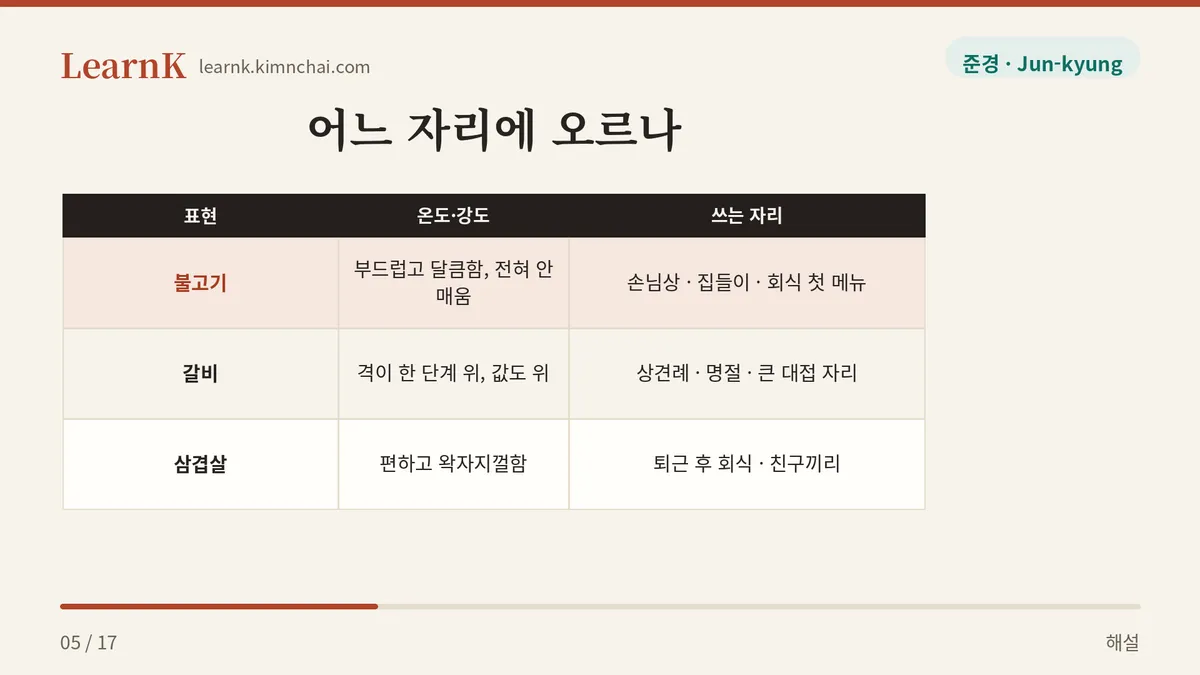
| Expression | Temperature / intensity | Where it’s used |
|---|---|---|
| 불고기 (bulgogi) | Soft and lightly sweet, not spicy at all | Guest tables, housewarmings, the opening dish at a work dinner. Kids to grandparents |
| 돼지불고기 (dwaeji-bulgogi) | A bit bolder; a gochujang marinade is common too | Lunch at a home-style diner, a lunchbox side dish |
| 갈비 (galbi) | A notch more prestigious, and pricier | Meeting the in-laws, holidays, occasions where you’re really hosting |
| 삼겹살 (samgyeopsal) | Easy-going and rowdy | After-work dinners, hanging out with friends |
Cultural background — the fire that stayed in the name
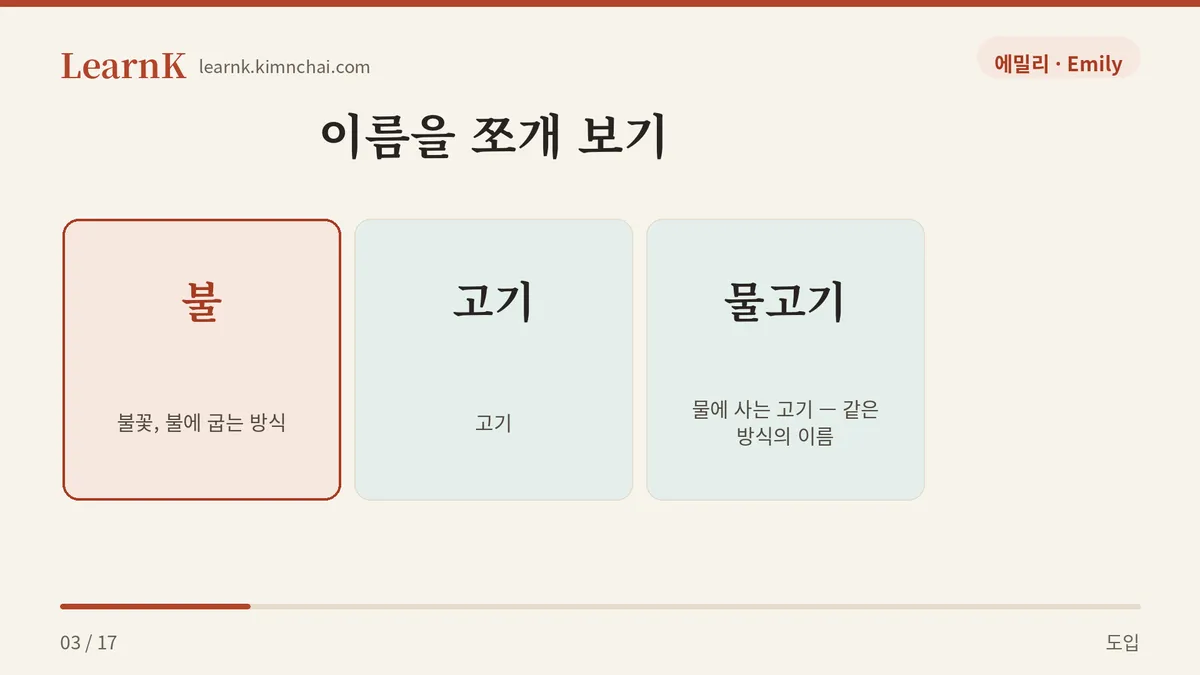
Take the name apart and the meaning is right there. It’s a compound of 불 (bul, fire) and 고기 (gogi, meat). It’s built exactly the way 물고기 (mulgogi), “water meat,” is built for the creatures that live in water. Korean has this habit of building names by attaching the material or the environment to the front, which means that even with a word you’ve never seen before, splitting it in two will often get you halfway to the meaning.
Bulgogi looks quite different from region to region. What you commonly see in Seoul is a hot-pot style with a shallow pool of broth, perfect for stirring rice into; around Eonyang, near Ulsan, the famous method is grilling it hard on a wire rack. Same name, different picture on the plate — so if the first bulgogi you order doesn’t match what you imagined, it doesn’t mean the wrong thing came out.
The scenes where bulgogi appears on the table in Korean dramas are more or less fixed. The evening a child who hasn’t been in touch for years comes home; the meal laid out for someone paying their first formal visit; the occasion someone arranged, with difficulty, in order to make peace. Whichever it is, the common thread is the wish to take care of someone. So when a Korean asks 오늘 불고기 할까? (oneul bulgogi halkka?, “Shall we do bulgogi today?”), that’s a sentence about deciding the menu and, at the same time, a sentence that means I want to feed you well.
These days the name has traveled outside the kitchen. The bulgogi burger at a fast-food chain, bulgogi as a pizza topping — the whole family of sweet-savory soy sauce flavors gets called “bulgogi flavor.” When you see the word 불고기 on a Korean convenience store shelf, you can generally read it as a signal for “not spicy, sweet, soy-sauce-based.”
Today’s quiz
You’ve gone to a Korean restaurant with foreign friends who aren’t good with spicy food. Which of the following sounds the most natural?
- 여기는 삼겹살이 불고기로 유명하대. (“They say the samgyeopsal here is famous as bulgogi.”)
- 얘들아, 매운 거 못 먹지? 그럼 불고기 시키자. 그건 안 매워. (“Guys, you can’t eat spicy food, right? Then let’s order bulgogi. That one isn’t spicy.”)
- 불고기는 매우니까 오늘은 빼자. (“Bulgogi is spicy, so let’s skip it today.”)
The answer is 2. Number 1 mixes up 삼겹살 (samgyeopsal) and 불고기 (bulgogi) and doesn’t make sense; number 3 is the classic case of assuming it’s spicy because of the 불 (bul) at the front of the name. The 불 (bul) in 불고기 (bulgogi) refers to cooking over fire, not to spiciness.
Definitions and example sentences are from the National Institute of Korean Language’s Basic Korean Dictionary (krdict.korean.go.kr); that portion of this post, including our translations, is licensed under CC BY-SA 2.0 KR.