창피하다 (changpihada) — The Word Koreans Blurt Out When Their Face Burns and Their Pride Takes a Hit
창피하다 (changpihada)
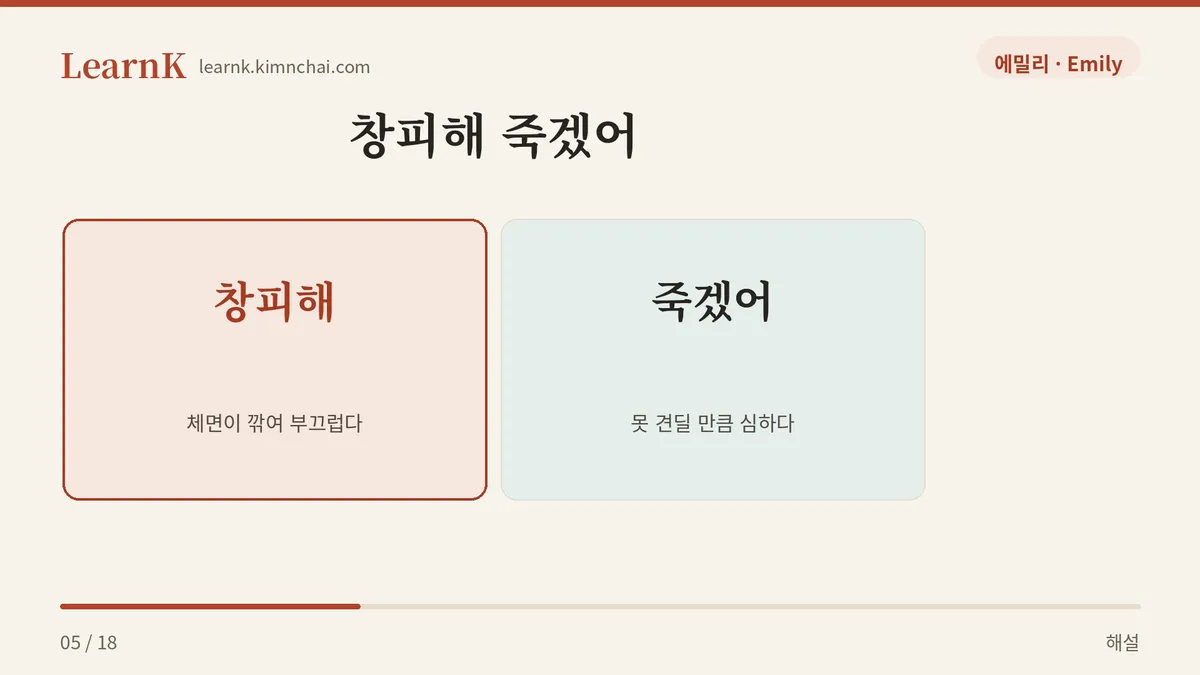
창피하다 (changpihada) means to feel deeply embarrassed because of something that costs you face. The moment you doze off on the subway and realize you’ve been sleeping on the shoulder of the person next to you. The moment you drop your entire drink at a café. The moment you send a message meant for a friend into the company group chat. This is the word Koreans reflexively blurt out while covering their face with both hands.
The heart of this word is other people’s eyes. Take the exact same fall: trip at home with nobody around and it simply hurts, but trip at a crowded crosswalk and it’s 창피하다 (changpihada). Korean has the word 체면 (chemyeon) — the face, the presentable version of yourself you want to keep up in front of others. 창피하다 is the emotion that switches on the moment that 체면 gets a scratch on it.
It runs hot, too. Rather than “a little 창피하다,” you’ll far more often hear exaggerated forms like 창피해 죽겠다 (changpihae jukgetda), “I could die of embarrassment,” or 창피해서 얼굴이 화끈거린다 (changpihaeseo eolguri hwakkeungeorinda), “I’m so embarrassed my face is burning.” If you’re only mildly sheepish, Korean uses a different word (see the comparison table below).
There are just two things to remember about the grammar. First, 창피하다 is an adjective, so the subject is usually “I.” To say it about someone else, you need to switch to the verb form to sound natural — 동생이 창피해했다 (dongsaengi changpihaehaetda), “my younger sibling felt embarrassed.” Second, the noun 창피 gives you 창피를 주다 (changpireul juda, to make someone else feel embarrassed**)** and 창피를 당하다 (changpireul danghada, to go through something embarrassing**)**. Both of these forms turn up constantly in news reports and drama dialogue.
Checking it in the National Institute of Korean Language dictionary
The National Institute of Korean Language’s Basic Korean Dictionary defines the word like this.
창피하다 「형용사」 체면이 깎이는 어떤 일이나 사실 때문에 몹시 부끄럽다. — National Institute of Korean Language, Basic Korean Dictionary (krdict.korean.go.kr)
(“Adjective. To be very ashamed because of some event or fact that costs you face.”)
Here are the multilingual definitions the same dictionary provides.
[English] embarrassed; ashamed — Being very ashamed due to a disgraceful event or fact. [Japanese] はずかしい【恥ずかしい】 — 面目を失う出来事や事実のために非常に恥ずかしさを感じる。 [Spanish] avergonzado — Que se siente mucha vergüenza por alguna falta cometida, o por alguna acción deshonrosa y humillante. [Chinese] 丢脸,丢人,难为情,寒碜 — 因为有失体面的某件事或事实而感到非常羞愧。 — National Institute of Korean Language, Basic Korean Dictionary (krdict.korean.go.kr)
A Portuguese definition is not included in this dictionary. For reference, our own rendering would be envergonhado — sentir muita vergonha por causa de um fato que faz perder a honra, and we note that this one line is our own translation, not the dictionary’s original text.
Below are four real usage examples from the dictionary, quoted exactly as they appear, each with a note on the kind of situation it belongs to.
들까불어 창피하다. — National Institute of Korean Language, Basic Korean Dictionary (krdict.korean.go.kr)
들까불어 창피하다 (deulkkabureo changpihada) — 들까불다 means to bounce and jerk your body around, to carry on in a silly, restless way. Picture someone goofing off in a place that’s supposed to be quiet, and you, sitting right there with them, cringing. This example shows that the cause of your embarrassment doesn’t have to be your own behavior — it can be the behavior of the person next to you.
모양이 창피하다. — National Institute of Korean Language, Basic Korean Dictionary (krdict.korean.go.kr)
모양이 창피하다 (moyangi changpihada) — 모양 here means your outward shape, the way you look to other people. You’d use it when your clothes are a mess or your situation looks shabby. This tiny example holds the whole point that 창피하다 travels hand in hand with 체면.
창피하다는 생각. — National Institute of Korean Language, Basic Korean Dictionary (krdict.korean.go.kr)
창피하다는 생각 (changpihadaneun saenggak) — this isn’t an exclamation but a form that modifies a noun. It continues into phrases like 창피하다는 생각이 들었다 (“the thought that it was embarrassing came over me”) or 창피하다는 생각에 고개를 못 들었다 (“I couldn’t lift my head, thinking how embarrassing it was”). It has the written-language feel of calmly describing the emotion after it has passed, so you’ll see it often in diaries and essays.
정말 창피하다. — National Institute of Korean Language, Basic Korean Dictionary (krdict.korean.go.kr)
정말 창피하다 (jeongmal changpihada) — the most basic and most frequently used form. You raise the intensity by putting adverbs like 정말, 진짜, or 너무 in front. Keep it exactly like this when muttering to yourself; when speaking to another person, change it to 정말 창피해 or 정말 창피해요.
See it in a real conversation
Setting: They’ve just gotten off the subway on the way home from work. Emily is walking fast down the platform with both hands over her face.
Emily: 아 진짜 창피해 죽겠어. 나 방금 옆에 앉은 아저씨 어깨에 기대서 잤어. Ugh, I could die of embarrassment. I just fell asleep on that guy’s shoulder.
Jun-kyung: 봤어 봤어. 근데 아저씨가 끝까지 안 깨우시더라. 착하시더라고. I saw, I saw. But he didn’t wake you up the whole time. That was nice of him.
Emily: 그게 더 창피하지! 내릴 때 나도 모르게 안녕히 가세요 했다니까. That makes it even more embarrassing! And I said goodbye to him without even thinking.
Jun-kyung: 야, 그 정도는 아무것도 아니야. 나는 지난주에 스크린도어한테 인사했어. Hey, that’s nothing. Last week I bowed to the platform screen door.
Emily: …그건 좀 심하다. 갑자기 위로가 되네. …Okay, that’s worse. Weirdly, that makes me feel better.
Jun-kyung: 그치? 남의 창피한 얘기 들으면 내 건 별거 아니게 돼. Right? Hearing someone else’s embarrassing story makes yours feel like nothing.
This is where it sounds off
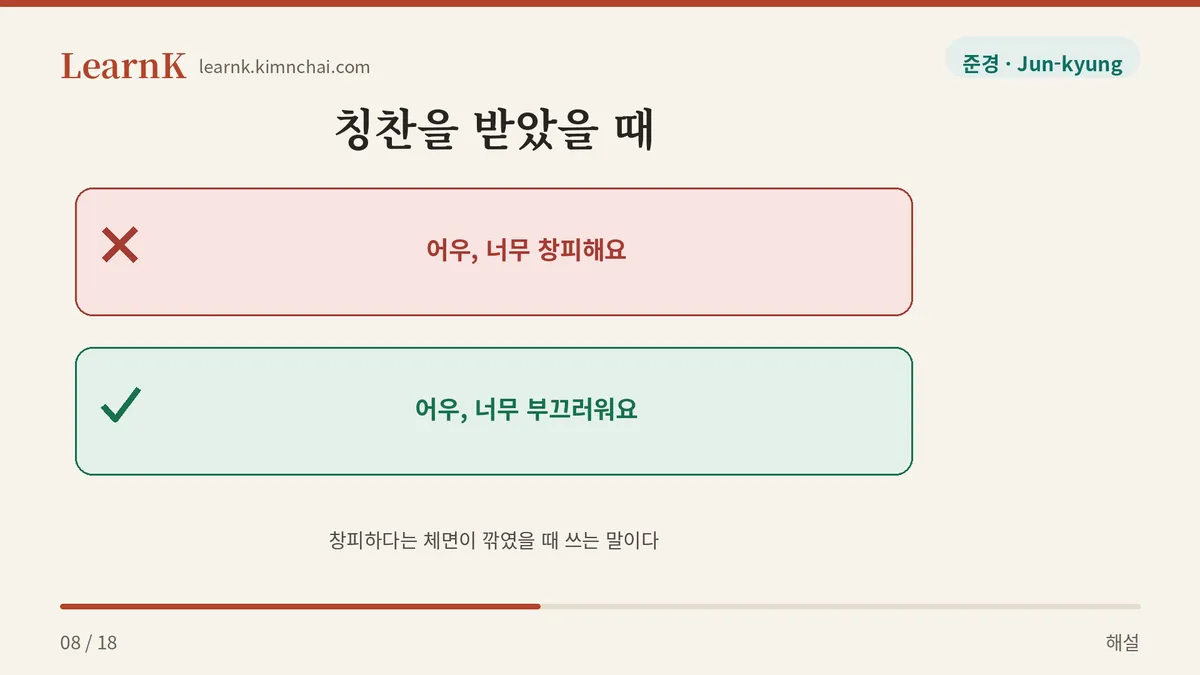
✗ (on receiving a compliment) 어우, 제가 뭘요. 너무 창피해요. ✓ (on receiving a compliment) 어우, 제가 뭘요. 너무 부끄러워요. → 창피하다 is for when your 체면 has been damaged. A compliment does the opposite — it builds your face up — so the direction is reversed. To express bashfulness modestly, use 부끄럽다 (bukkeureopda) or 쑥스럽다 (ssukseureopda).
✗ (to your boss, who slipped up during a presentation) 부장님, 아까 그거 진짜 창피하셨겠어요. ✓ (to your boss, who slipped up during a presentation) 부장님, 아까 그거 아무도 눈치 못 챘어요. (“Nobody even noticed that.”) → The grammar is perfectly fine, but you’d be using your own mouth to confirm the loss of face the other person is hoping to hide. Your attempt at comfort becomes a second helping of embarrassment. In moments like this, the safe move is to shrink the incident itself.
Example sentences by situation
1. When you share the wrong screen in a video meeting
아까 화면 공유하다가 개인 메신저 창이 그대로 떴어요. 진짜 창피해서 얼굴이 다 화끈거렸어요. (Akka hwamyeon gongyuhadaga gaein mesinjeo changi geudaero tteosseoyo. Jinjja changpihaeseo eolguri da hwakkeungeoryeosseoyo.) My private messenger window popped right up when I was sharing my screen earlier. I was so embarrassed my whole face was burning.
Attaching -아서/어서 makes the embarrassment the cause of whatever happens next. 창피해서 your face goes red, 창피해서 you can’t speak, 창피해서 you run away — this connection is the most common use of all.
2. When your kid lies down on the supermarket floor
애가 장난감 사 달라고 마트 바닥에 드러눕는데, 창피해 죽는 줄 알았어. (Aega jangnankam sa dallago mateu badage deureonunneunde, changpihae jukneun jul arasseo.) My kid lay down on the supermarket floor demanding a toy — I thought I’d die of embarrassment.
Even when you did nothing wrong, if someone tied to you loses face in front of others, the embarrassment lands on you. This situation shows nicely how, in Korean, 창피함 spreads across a family or a team.
3. When you hesitate to speak Korean
발음이 틀릴까 봐 창피해서 계속 영어로만 물어봤어요. 이제는 그냥 해 보려고요. (Bareumi teullilkka bwa changpihaeseo gyesok yeongeoroman mureobwasseoyo. Ijeneun geunyang hae boryeogoyo.) I was embarrassed about getting the pronunciation wrong, so I kept asking in English only. From now on I’m just going to give it a try.
This is where Korean learners will use the expression most. And when you say this, Koreans will almost always answer with 창피하긴요, 잘하시는데요 (“Embarrassed? You’re doing great”). Hearing that reply is the real reason to memorize this sentence.
Polite and casual forms, and similar expressions
The shift between polite and casual speech is regular. In the most formal settings it’s 창피합니다 (changpihamnida), everyday polite speech is 창피해요 (changpihaeyo), and with friends or people younger than you it’s 창피해 (changpihae). The bare dictionary form, 창피하다 (changpihada), isn’t for addressing someone — it’s the form for talking to yourself or for writing. To talk about something in the past, change it to 창피했어요 (changpihaesseoyo).
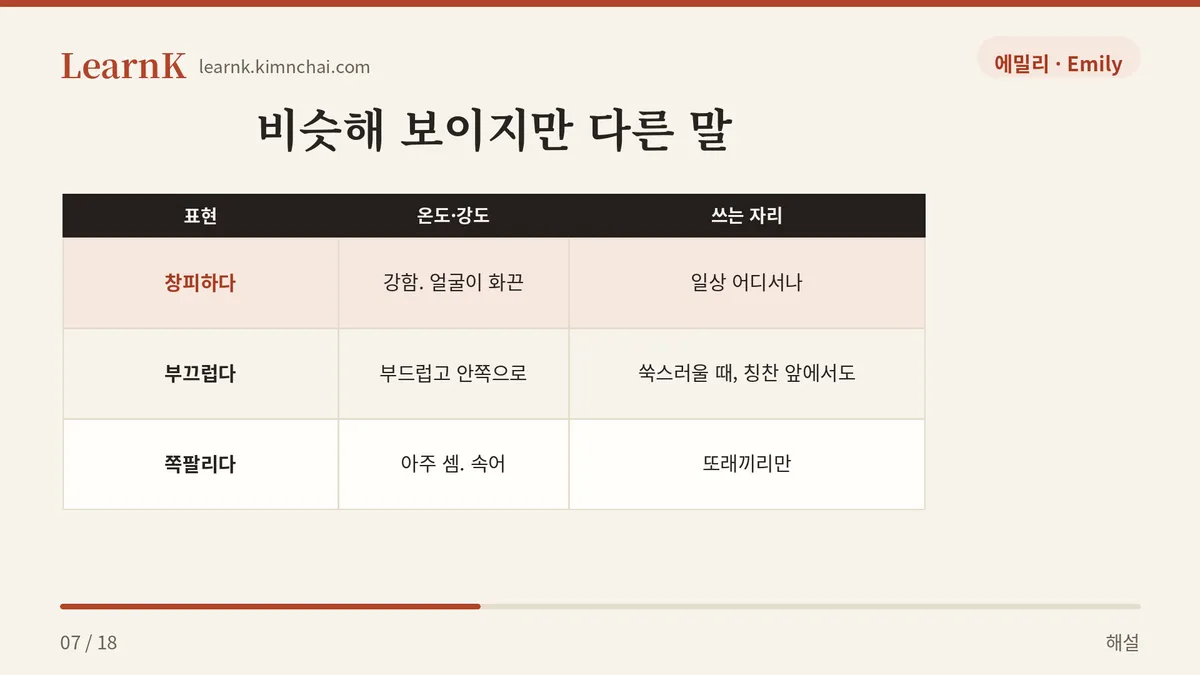
Several words look similar, but each has its own temperature and its own room.
| Expression | Temperature / intensity | Where it fits |
|---|---|---|
| 창피하다 (changpihada) | Strong. Face lost, cheeks burning | Anywhere in daily life. Works in both polite and casual speech |
| 부끄럽다 (bukkeureopda) | Soft, turned inward | When you’re bashful, or when your conscience stings. Also fine in response to praise |
| 민망하다 (minmanghada) | Mild. Sheepish and awkward | Also used watching someone else’s slip-up. Safe in public or formal settings |
| 쪽팔리다 (jjokpallida) | Very strong. Slang | Among peers only. Never in front of someone senior |
| 낯 뜨겁다 (nat tteugeopda) | So much you can hardly watch | Mostly for commenting on someone else’s behavior |
When you trip and fall, it’s 아 쪽팔려 to a friend, 아 창피해요 to a coworker, and 좀 민망하네요 in a meeting — one event, and the word changes clothes depending on the room.
Cultural background — the night of the 이불킥 (ibulkik)
Korean has a word: 이불킥 (ibulkik). It’s 이불 (blanket) + “kick,” and it names the moment you’ve lain down to sleep when an embarrassing memory from years ago suddenly surfaces and you kick at your blanket. It captures, in one very specific physical gesture, the feeling that embarrassment doesn’t end where it happened but comes back to life night after night. It started as internet slang, but these days it appears in TV subtitles as is.
The reason this emotion gets such heavy treatment in Korea has everything to do with the culture of 체면. In a society where how you look to others sets the temperature of a relationship, an event that costs you face isn’t a simple mistake — it’s closer to an accident involving the relationship itself. That’s why embarrassment is so often the engine of the story in Korean dramas. Think of the scenes in Reply 1988 (응답하라 1988, tvN, 2015) where a character, terrified their feelings will be found out, says something completely beside the point and tangles the situation further. The characters take episodes’ worth of detours not because they can’t confess their love, but because confessing might leave them 창피한.
There’s another side to it, though. Just like Jun-kyung bringing up the platform screen door in the conversation above, embarrassing experiences make excellent conversational material in Korea. Offering your own embarrassing story first, to lighten someone else’s, is a common and warm-hearted social skill. So if you slip up while speaking Korean, try bringing that story out with a laugh the next time you meet. In that moment, embarrassment turns into a key that opens the relationship.
Today’s quiz
A colleague has won a prize at the in-house presentation contest. When you congratulate him, he smiles bashfully and replies. What fits most naturally in the blank?
에이, 제가 뭘요. 너무 ______.
① 창피해요 (changpihaeyo) ② 부끄러워요 (bukkeureowoyo) ③ 쪽팔려요 (jjokpallyeoyo)
Answer: ②
창피하다 is a word for things that cost you face, so it points in the opposite direction from receiving an award. Option ③ gets the meaning across, but it’s slang, so using it at work sounds flippant. When expressing modest bashfulness in the face of praise, 부끄러워요 (bukkeureowoyo) is the accurate choice. For what it’s worth, 쑥스러워요 (ssukseureowoyo) would sound just as natural here.
Definitions and example sentences are from the National Institute of Korean Language’s Basic Korean Dictionary (krdict.korean.go.kr); that portion of this post, including our translations, is licensed under CC BY-SA 2.0 KR.