Doenjangjjigae — Another Way of Saying "Now I'm Really Home"

된장찌개
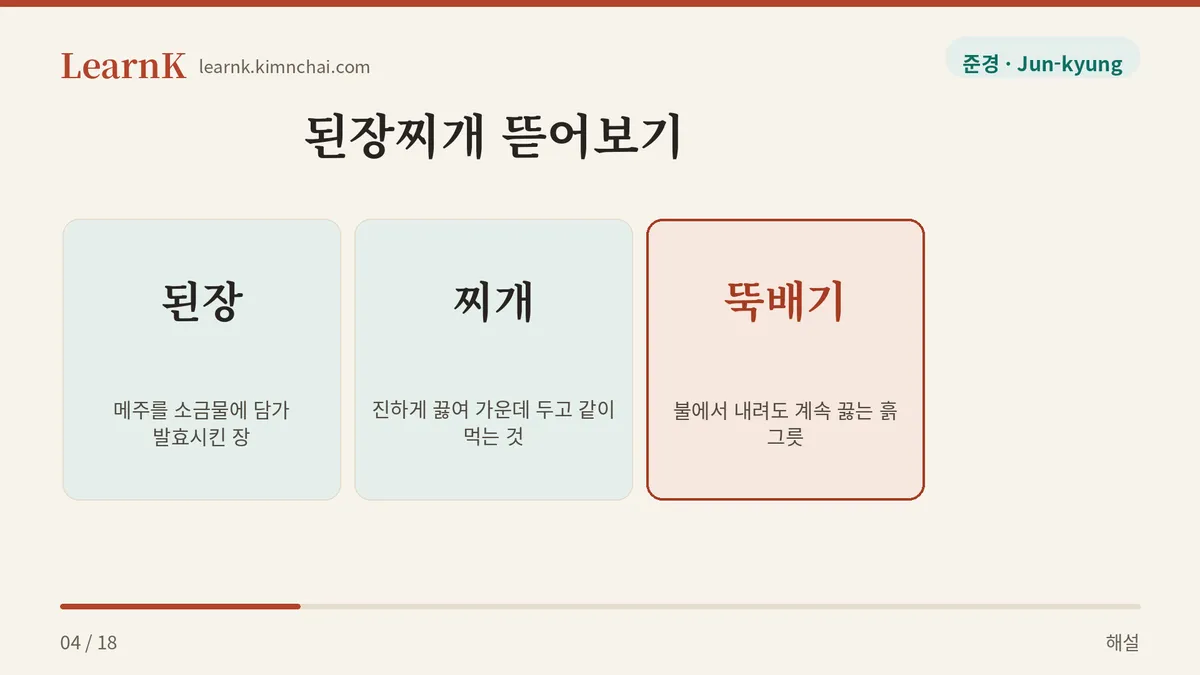
된장찌개 (doenjangjjigae) means a jjigae — a stew — made by dissolving doenjang, fermented soybean paste, in water and simmering it with ingredients like scallions, Korean zucchini, and tofu. It’s the dish name you’ll see most often on a Korean restaurant menu, and at the same time it’s the first food a Korean thinks of after coming home from a long stretch away. A 뚝배기 (ttukbaegi), the thick earthenware pot, arrives at the table still bubbling; three or four spoons go in at once; and somewhere in between, the rice bowls quietly empty without anyone saying much. That’s the scene 된장찌개 belongs to.
For someone learning Korean, this word matters for more than its flavor. 된장찌개 goes past being a menu item and works as a symbol for “nothing flashy, but you feel the gap when it’s missing.” If someone calls a person 된장찌개 같은 사람 (doenjangjjigae gateun saram), “a doenjangjjigae kind of person,” that’s praise, not a dig. It means someone who may not jump out at you but whom you want to keep close for a long time. Memorize the definition and miss this warmth, and you’ll never understand why Koreans head straight for a 백반집 (baekbanjip) — a home-style set-meal place — the moment they step out of the airport.
Let’s first draw a line between this and the words that look similar. 국 (guk) is the kind you drink, so it’s thin, light on solid ingredients, and set in front of each person in their own bowl. 찌개 (jjigae) makes the solid ingredients the main character, so the broth is thick and salty, and several people spoon it up together from a single 뚝배기 placed in the middle. That’s why 된장찌개 carries the character of “food you share” from the very beginning. If you’re a learner who thought of Japanese miso soup, it’s worth remembering that the thickness, the saltiness, and the place it occupies on the table are all completely different.
Checking it in the National Institute of Korean Language dictionary
How does a dictionary published by a government institute write this word up? Here are the definition and each language’s translation, carried over exactly as they appear.
된장찌개 「noun」 된장을 물에 넣고 파, 호박, 두부 등을 넣고 끓인 찌개. A jjigae made by putting doenjang into water and boiling it with scallions, squash, tofu, and so on. [en] doenjangjjigae; soybean paste jjigae — Jjigae, stew, made by boiling fermented doenjang, soybean paste, with scallions, zucchini, bean curd, etc., added to water. [ja] テンジャンチゲ — テンジャンを水に入れて、ネギ、エホバク(ズッキーニに似た野菜)、豆腐などを入れて煮込んだチゲ料理。 [es] doenjangjjigae, estofado de pasta de soja — Estofado hecho con doenjang o pasta de soja fermentada y otros ingredientes, como cebollín, calabacín, tofu, etc. [zh] 韩式大酱汤 — 将大酱拌入水中,并放入葱、西葫芦、豆腐等食材后煮制而成的浓汤。 — National Institute of Korean Language, Basic Korean Dictionary (krdict.korean.go.kr)
A Portuguese translation isn’t included in the dictionary, so the following is our own rendering based on the dictionary definition (it is not a dictionary quotation): doenjangjjigae; ensopado de pasta de soja — Ensopado (jjigae) feito fervendo pasta de soja fermentada (doenjang) em água, com cebolinha, abobrinha, tofu e outros ingredientes.
Now let’s look at the real usage examples the dictionary lists. Example sentences tell you more than definitions do.
승규야, 된장찌개 간 좀 봐 줄래? Seung-gyu, could you taste the doenjangjjigae for me? — National Institute of Korean Language, Basic Korean Dictionary (krdict.korean.go.kr)
This is someone cooking in the kitchen calling out to the person next to them. 간을 보다 (gan-eul boda) means “to taste something to check whether it’s salty or bland,” and it’s an expression that travels almost glued to 된장찌개. That’s because doenjang varies in saltiness from brand to brand, so you always have to check the seasoning at the end.
된장찌개에 멸치와 다시마를 넣어 감칠맛을 더했다. Anchovies and kelp were added to the doenjangjjigae to deepen its savory flavor. — National Institute of Korean Language, Basic Korean Dictionary (krdict.korean.go.kr)
This is a written-style sentence explaining a cooking method. 감칠맛 (gamchilmat) refers to that deep flavor that clings to your tongue, and it never sits out a conversation about Korean cooking. The most common order is to steep the broth with anchovies and kelp first, then stir in the doenjang.
부엌에서 구수한 된장찌개 냄새가 풍겨 와 내 입맛을 돋우었다. The comforting smell of doenjangjjigae drifted in from the kitchen and whetted my appetite. — National Institute of Korean Language, Basic Korean Dictionary (krdict.korean.go.kr)
구수하다 (gusuhada) describes the smell and taste that comes off fermented or toasted things — doenjang, 숭늉 (sungnyung, scorched-rice water), 누룽지 (nurungji, crisped rice) — the kind that puts your nose at ease. It overlaps with English “savory” but isn’t quite the same; about half of it is the feeling of “homey and endearing.” Koreans even use it for the way a person talks: 말이 구수하다 (mari gusuhada).
된장찌개에 고추가 많이 들어갔는지 너무 매워서 땀이 나요. There must be a lot of chili in this doenjangjjigae — it’s so spicy I’m sweating. — National Institute of Korean Language, Basic Korean Dictionary (krdict.korean.go.kr)
This is polite speech, something you’d say to the person beside you in the middle of a meal. 된장찌개 isn’t a spicy dish by nature, but it changes completely depending on how many 청양고추 (cheongyang gochu, Korean hot peppers) go in. “너무 매워서 땀이 나요” is a sentence you can use in a restaurant exactly as it is.
옛날에 시골에서 해 먹던 꽁보리밥에 된장찌개나 먹었으면 좋겠구나. I wish I could just have some plain barley rice with doenjangjjigae, the way we used to make it out in the countryside. — National Institute of Korean Language, Basic Korean Dictionary (krdict.korean.go.kr)
This is an older person’s way of speaking, and it’s the most important example in this post. 된장찌개 sits in the place where someone misses not a fancy dish but the thing they always used to eat. A single dictionary example shows the emotional line of this word exactly.
In a real conversation
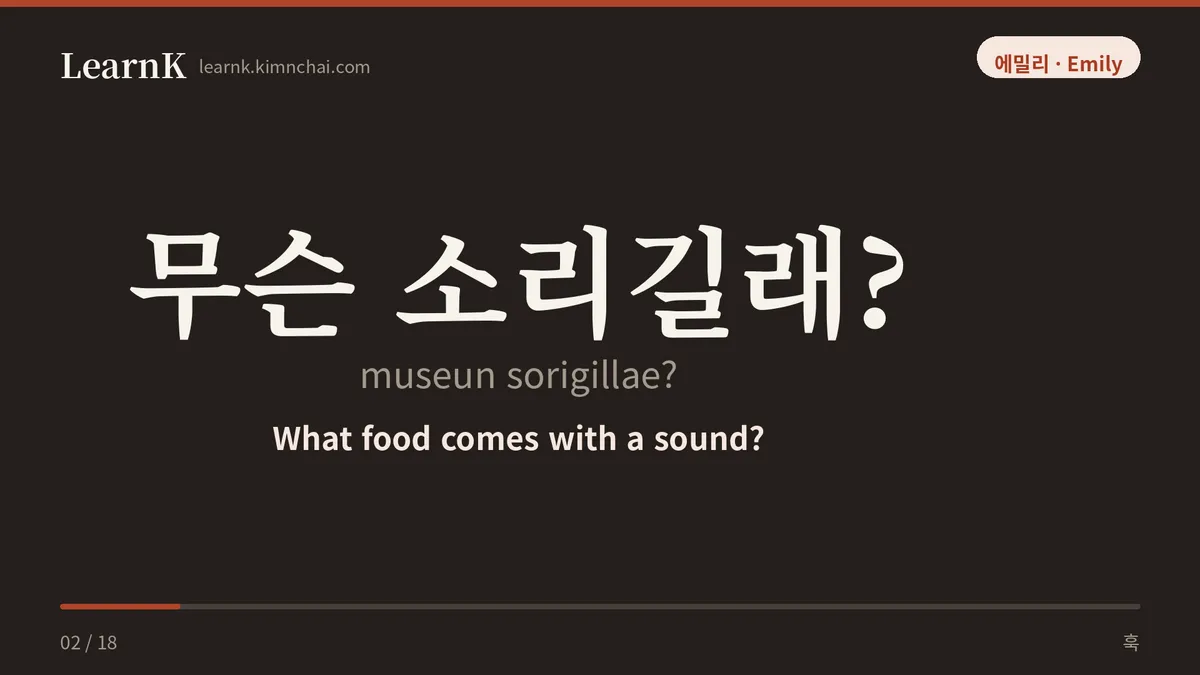
The situation: the evening Emily gets back from two weeks in Canada. She came straight from the airport to the neighborhood set-meal place without even unpacking.
Jun-kyung: 캐리어 아직 안 풀었지? 뭐 먹을래, 고기? You haven’t even unpacked yet, have you? What do you want — meat?
Emily: 아니, 나 된장찌개. 비행기에서 열두 시간 내내 그 생각만 했어. No, doenjangjjigae for me. I thought about nothing else for twelve hours on the plane.
Jun-kyung: 야, 캐나다에도 한식당 있잖아. 없는 것도 아니고. Come on, there are Korean restaurants in Canada too. It’s not like they don’t exist.
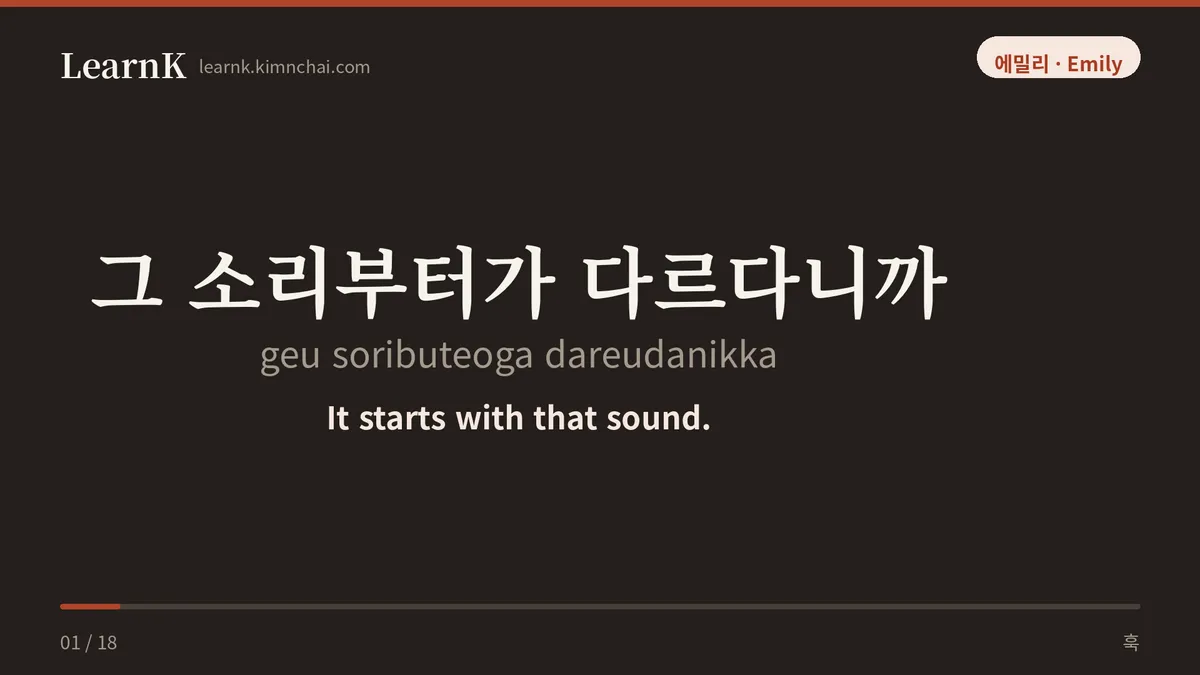
Emily: 있지. 근데 뭔가 달라. 여기 된장찌개는 뚝배기가 상에 올라와서도 계속 끓잖아. 그 소리부터가 다르다니까. They do. But something’s different. Here the doenjangjjigae keeps bubbling even after the pot hits the table. It starts with that sound.
Jun-kyung: 하긴, 그건 그래. 이모, 여기 된장찌개 둘이요! Fair enough, that’s true. Ma’am — two doenjangjjigae over here!
Emily: 아, 이제 진짜 집에 온 것 같다. Ah. Now it really feels like I’m home.
This is where it sounds off
✗ (Out with your department head) 부장님, 오늘 점심은 된장찌개나 드시죠. ✓ (Out with your department head) 부장님, 오늘 점심은 된장찌개 어떠세요? → The particle -나 (-na) adds the sense of “well, at least that, if nothing better.” It sounds modest when you’re talking about what you’ll eat yourself, but attach it while offering something to someone else and it turns into “go ahead and have this sorry little thing,” which is rude. When you’re hosting, drop the -나 and ask with 어떠세요 (eotteoseyo), “how about it?”
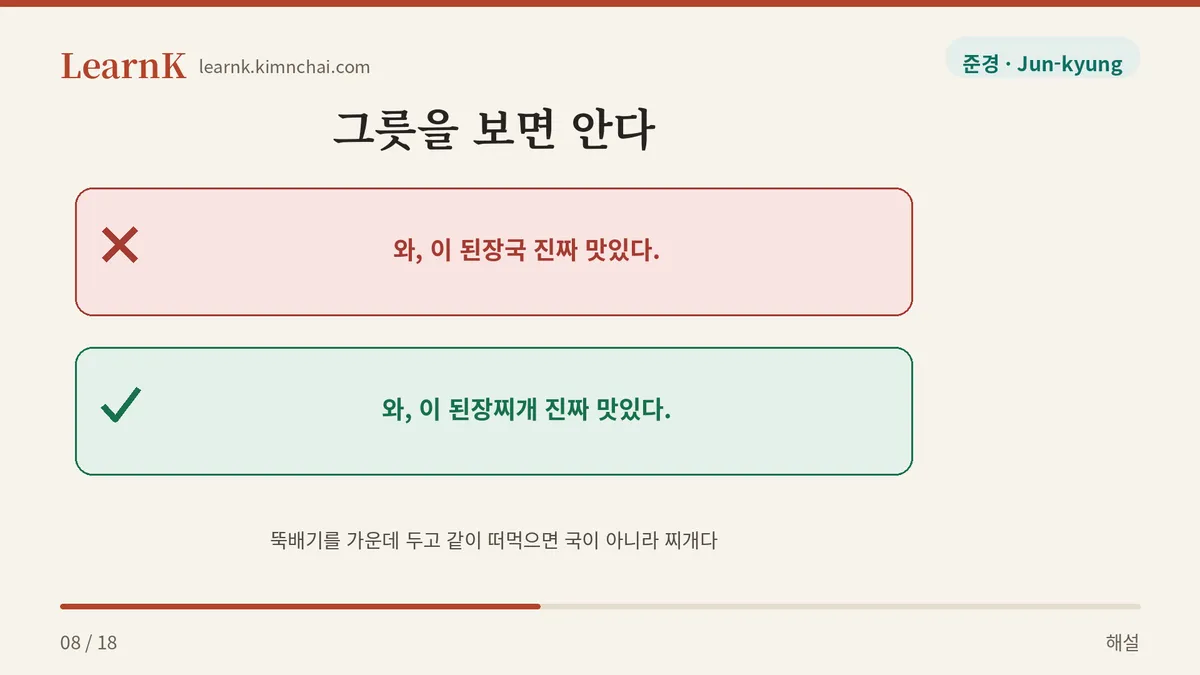
✗ (Looking at a thick stew that arrived in an earthenware pot) 와, 이 된장국 진짜 맛있다. ✓ (Looking at a thick stew that arrived in an earthenware pot) 와, 이 된장찌개 진짜 맛있다. → The grammar is perfectly fine, but the dish changes. 국 is simmered thin and set in front of each person in their own bowl; 찌개 is simmered thick, placed in the middle, and spooned up together. If there’s a 뚝배기 sitting in the center, it’s 된장찌개.
Example sentences by situation
1. To a friend visiting your studio apartment (casual speech, close relationship)
된장찌개 끓여 놨어. 밥만 퍼서 먹으면 돼. (doenjangjjigae kkeuryeo nwasseo. bamman peoseo meogeumyeon dwae.) “I’ve got doenjangjjigae going. Just scoop yourself some rice and eat.”
This is close to the most common greeting there is when you invite someone over in Korea. -아/어 놓다 (-a/eo nota) means “to have done something in advance,” so the sentence also carries the feeling of having gotten everything ready and waited for them.
2. Ordering at a restaurant (polite speech, someone you’re meeting for the first time)
여기 된장찌개 둘이랑 계란말이 하나 주세요. (yeogi doenjangjjigae durirang gyeranmari hana juseyo.) “Two doenjangjjigae and one rolled omelet over here, please.”
In Korean restaurants, using 둘 (dul) and 셋 (set) straight out is far more natural than saying “된장찌개 2인분” (two portions of doenjangjjigae). One note: plenty of places still won’t take single-serving orders for stews, so if you’re by yourself, look for a “1인 가능” (single serving available) mark on the menu.
3. On a day you’re worn out and don’t want to do anything (talking to yourself, or in a message)
오늘은 그냥 된장찌개에 밥 말아 먹고 싶다. (oneureun geunyang doenjangjjigae-e bap mara meokgo sipda.) “Today I just want to mix some rice into doenjangjjigae and eat it.”
밥을 말다 (bab-eul malda) means to put rice into broth and stir it in as you eat. This sentence isn’t really saying you’re hungry — it’s closer to “I don’t want anything complicated; I want to be comforted by something familiar.” Send it to a Korean friend and you’ll usually get back “나와, 밥 사 줄게” (Come out, I’ll buy you dinner).
Polite vs. casual speech, and similar expressions
된장찌개 itself is the name of a thing, so it has no honorific form; the speech level splits in the verb you use with it. To a friend, 된장찌개 먹을래? (doenjangjjigae meogeullae?); to someone senior to you, 된장찌개 드실래요? (doenjangjjigae deusillaeyo?); and more politely still, 된장찌개로 하시겠어요? (doenjangjjigae-ro hasigesseoyo?). If you’re offering to cook it for them, 제가 된장찌개 끓여 드릴까요? (jega doenjangjjigae kkeuryeo deurilkkayo?) is the natural choice.
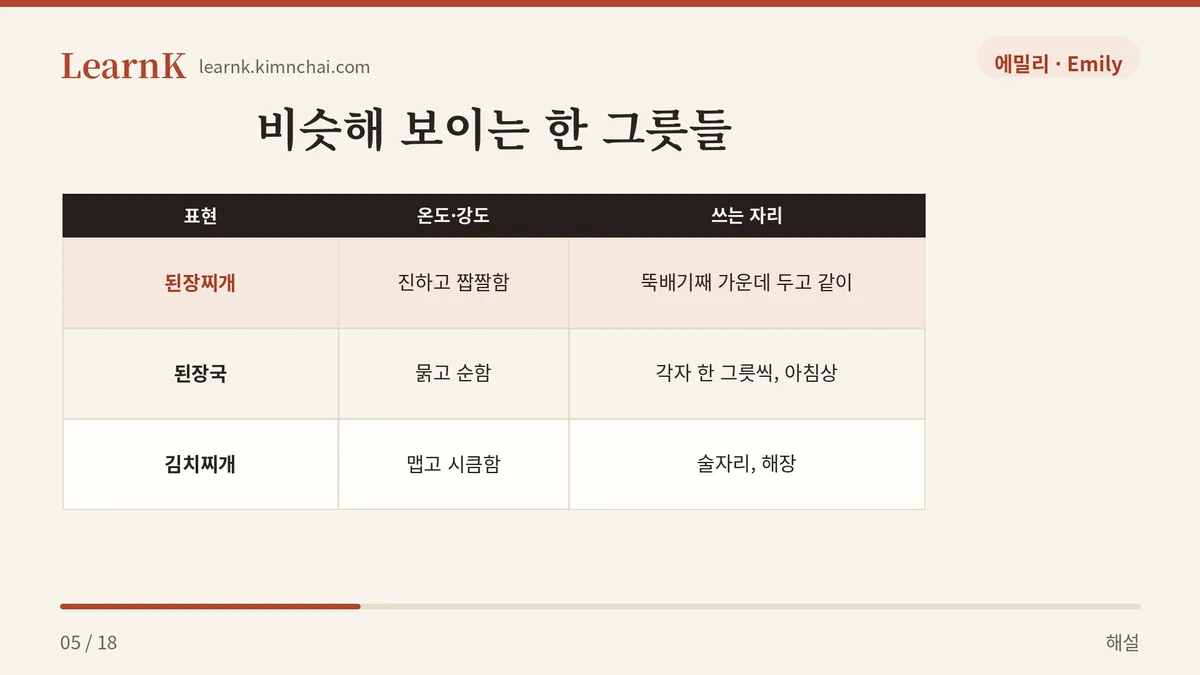
Even among similar dish names, the character is distinctly different.
| Expression | Texture & intensity | Where it’s used |
|---|---|---|
| 된장찌개 (doenjangjjigae) | Thick and salty. Ingredient-forward | Set in the middle in its own ttukbaegi and shared. A staple at set-meal restaurants |
| 된장국 (doenjangguk) | Thin and mild. Broth-forward | One bowl per person. Breakfast tables, rice-and-soup shops |
| 김치찌개 (kimchijjigae) | Spicy and tangy. Strong kick | Drinking gatherings, hangover meals. Younger people pick it more often |
| 청국장 (cheonggukjang) | The thickest, with the strongest smell | People either love it or hate it, so it’s rarely offered to a first-time guest |
This is exactly why 된장찌개 is the safer choice over 청국장 when you’re taking a foreign guest out for the first time.
Cultural background — why the ttukbaegi doesn’t cool down
된장찌개 is a compound of 된장 (doenjang) and 찌개 (jjigae). Doenjang is made by soaking 메주 (meju) — blocks of boiled, pressed soybeans left to ferment — in salt water; the liquid is strained off to become soy sauce, and what’s left behind is aged into doenjang. Which is to say soy sauce and doenjang are siblings that split off from the same crock. That’s where the saying that every household’s jang tastes different comes from, and why, as in the dictionary example, you always end up asking “간 좀 봐 줄래?” (Could you taste this for me?).
In Korean dramas, 된장찌개 is almost always placed at the moment a conflict gets resolved. In the family dramas set in 1980s alleyways, you see the same scenes over and over — neighbors passing side dishes back and forth, setting the table together — and what’s usually at the center of that table is a ttukbaegi. Not because the dialogue is dazzling, but because the picture of people eating together without saying anything itself means “we’re not strangers.”
The vessel isn’t an accident either. A ttukbaegi is a thick clay pot, so it keeps boiling long after it comes off the flame. Koreans treat that sound — still bubbling away after it reaches the guest’s table — as part of the food. When Emily said in the conversation that “it starts with that sound,” she wasn’t exaggerating; a lot of people genuinely feel that way.
Today’s quiz
You’ve taken your department head out to a set-meal restaurant. Which is the most appropriate way to suggest something from the menu?
- 부장님, 된장찌개나 드시죠.
- 부장님, 된장찌개 어떠세요?
- 부장님, 된장찌개 먹을래요?
Answer: 2. Number 1, because of the particle -나, comes out sounding like “go ahead and have this humble little thing,” which doesn’t suit an occasion where you’re hosting. Number 3, even with -요 attached, uses 먹다 and -을래요, whose temperature is close to casual speech, so it feels off toward someone senior. With a superior, use 드시다, and when you’re offering something, leaving room with 어떠세요 is the safest approach.
Definitions and example sentences are from the National Institute of Korean Language’s Basic Korean Dictionary (krdict.korean.go.kr); that portion of this post, including our translations, is licensed under CC BY-SA 2.0 KR.