뒷담화 (dwitdamhwa) — The Word for What Starts Three Seconds After Someone Walks Out
뒷담화
뒷담화 (dwitdamhwa) means running someone down behind their back when they aren’t in the room — and it also means the talk itself. That conversation that kicks off right after somebody gets up and leaves, when everyone still at the table drops their voice half a tone — Korean has one word for it.
The scene is usually the same. The work dinner wraps up and the boss takes the first taxi home. At the after-party for a hobby club, one person says “나 먼저 갈게 (na meonjeo galge)” — “I’m heading out first” — and grabs their bag. Someone quietly leaves the group chat. And about three seconds later, somebody opens with “근데 아까 그건 좀 심하지 않았어? (geunde akka geugeon jom simhaji anasseo?)” — “But honestly, wasn’t that a bit much earlier?” From that moment on, it’s 뒷담화 (dwitdamhwa).
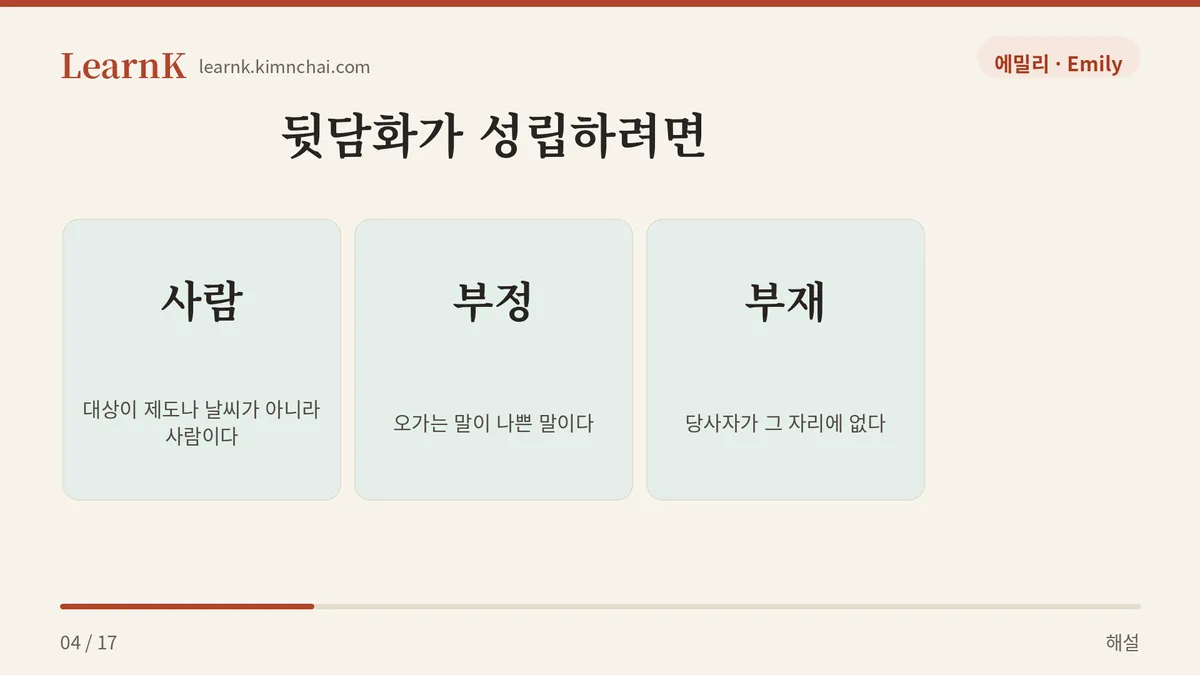
For the word to actually fit, three things have to be true at once. First, the target is a person. Complaining about your company’s policies or the rainy season isn’t 뒷담화 (dwitdamhwa) — that’s just griping. Second, the content is negative. Third, the person in question isn’t there. Take away any one of the three and you’ve got a different word. Say it to their face and it isn’t 뒷담화 (dwitdamhwa), it’s criticism; if only nice things were said, it isn’t 뒷담화 (dwitdamhwa), it’s praise.
The temperature is clearly negative. What makes the word interesting, though, is that the speaker uses it knowing full well what they’re doing. That’s why you hear sentences like “우리 지금 뒷담화하는 거지? (uri jigeum dwitdamhwahaneun geoji?)” — “We’re gossiping right now, aren’t we?” — and “이건 뒷담화 아니고 팩트야 (igeon dwitdamhwa anigo paekteuya)” — “This isn’t gossip, it’s just facts.” In other words, 뒷담화 (dwitdamhwa) isn’t only for calling other people out; it’s also a label you slap on your own behavior. Once you’ve picked up this self-aware, self-mocking usage, you’ll slide into conversations with Korean friends much more naturally.
It’s worth memorizing the forms together. As a plain noun phrase, 뒷담화를 하다 (dwitdamhwareul hada); run together as a verb, 뒷담화하다 (dwitdamhwahada); and when the talk is making the rounds, 뒷담화가 돌다 (dwitdamhwaga dolda).
A Real Conversation
Setting: Friday night, badminton club has just finished. Minsu has already left, and Jun-kyung and Emily are the only ones left under the parasol outside the convenience store, cracking open cans of beer.
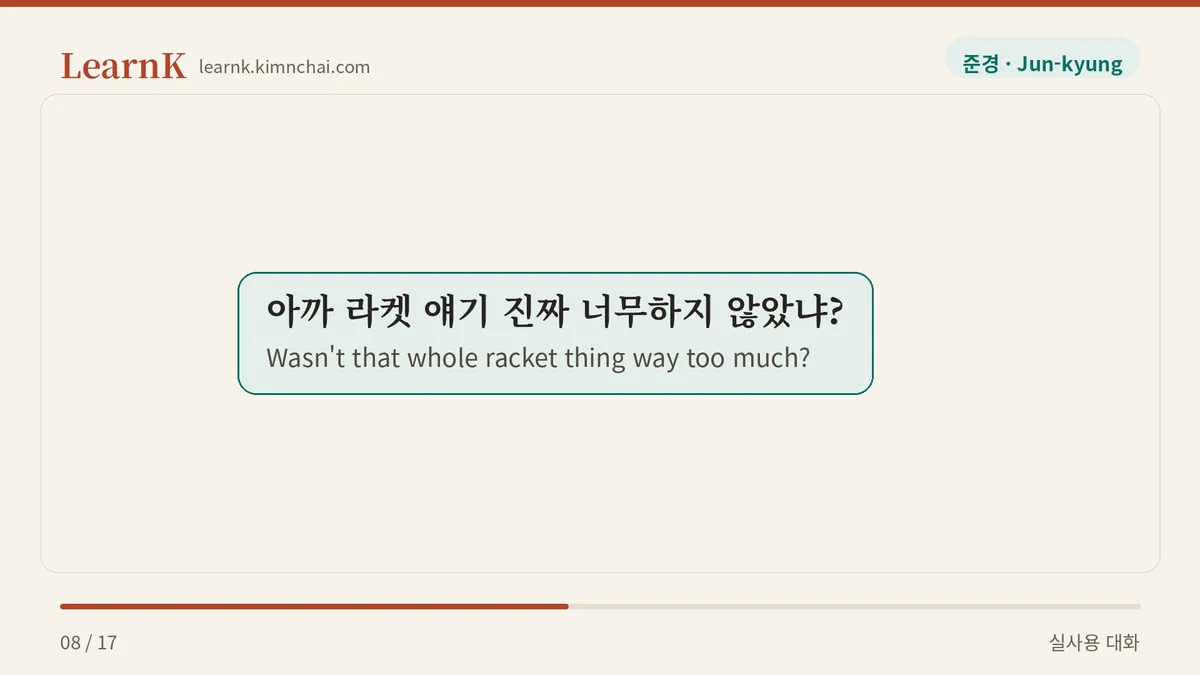
준경: 야, 민수 형 갔지? 아까 라켓 얘기 진짜 너무하지 않았냐? Hey, Minsu’s gone, right? Wasn’t that whole racket thing way too much?
에밀리: 잠깐만. 지금 이거 뒷담화 시작이잖아. Hold on. This is you starting to talk behind his back.
준경: 아니지, 이건 뒷담화가 아니라 팩트지. No way, this isn’t talking behind his back, these are just facts.
에밀리: 다들 그렇게 말하고 뒷담화해. 본인 없을 때 하면 다 똑같아. Everyone says that and then gossips anyway. If the person isn’t there, it’s all the same thing.
준경: …맞네. 그럼 다음에 형 있을 때 직접 말할게. …Fair enough. I’ll just tell him to his face next time.
에밀리: 그래, 그게 낫지. 뒤에서 한 말은 꼭 돌아서 본인 귀에 들어가더라. Yeah, that’s better. Things said behind someone’s back always find their way back to them.
These Uses Sound Off
✗ (joking, to a senior colleague’s face) 선배, 저희 방금 선배 뒷담화 하고 있었어요. “Sunbae, we were just talking behind your back.” ✓ (to a senior colleague) 선배, 저희 방금 선배 얘기 하고 있었어요. “Sunbae, we were just talking about you.” → Even with a big grin, the only thing the other person takes away is that you really did it. This word is a label you put on your own behavior when it’s just your group — not a joke to pull out in front of the person concerned.
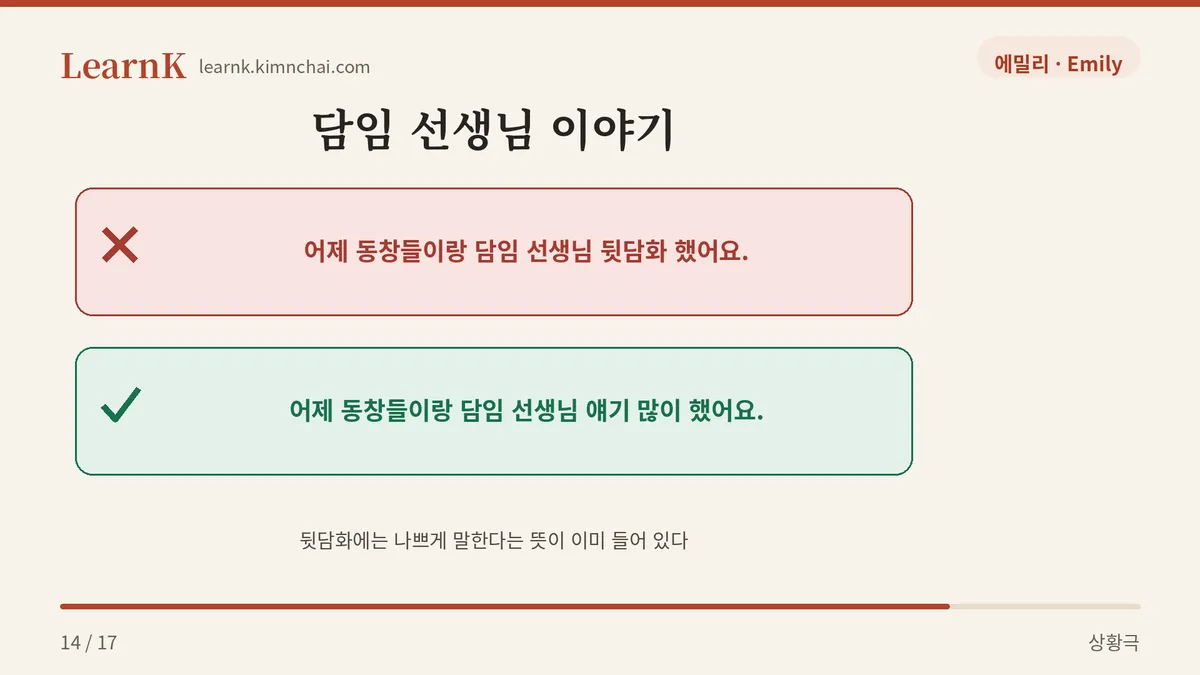
✗ 어제 동창들이랑 담임 선생님 뒷담화 했어요. 다들 선생님 보고 싶대요. “Yesterday I gossiped about our homeroom teacher with my old classmates. Everyone says they miss him.” ✓ 어제 동창들이랑 담임 선생님 얘기 많이 했어요. 다들 선생님 보고 싶대요. “Yesterday I talked a lot about our homeroom teacher with my old classmates. Everyone says they miss him.” → 뒷담화 (dwitdamhwa) already carries “speaking ill of.” Attach it to a warm, nostalgic conversation and it crashes head-on into the sentence that follows.
Example Sentences by Situation
1. When you find out people are talking about you You’re standing outside the office pantry and you hear your own name come up. You’re angry, but you don’t want to shout — you want one line that ends the situation.
나 다 들었어. 내 뒷담화 그만해. (na da deureosseo. nae dwitdamhwa geumanhae.) I heard everything. Stop talking about me behind my back.
2. When you’re drawing a line for yourself The mood at the drinks table is tilting one way, and you want to change the subject without killing the vibe. Putting 우리 (uri, “we”) in front means you’re not blaming anyone — you’re suggesting you all stop together.
우리 뒷담화는 여기까지 하자. (uri dwitdamhwaneun yeogikkaji haja.) Let’s stop the gossip here.
3. When you’re advising a junior colleague (polite form) A gentle way to cut off a junior who keeps badmouthing a coworker. The word itself is strong, but adding a solution afterward keeps it from sounding like nagging.
뒷담화하지 마시고 본인한테 직접 말씀해 보세요. (dwitdamhwahaji masigo boninhante jikjeop malsseumhae boseyo.) Rather than talking behind their back, try telling them directly.
Polite vs. Casual, and Similar Expressions
Since 뒷담화 (dwitdamhwa) is a noun, the polite/casual split happens in the verb attached to it. Casual: 뒷담화하지 마 (dwitdamhwahaji ma). Polite: 뒷담화하지 마세요 (dwitdamhwahaji maseyo). That said, you’ll rarely hear anyone use this word directly at someone older or senior — the rebuke lands pretty hard.
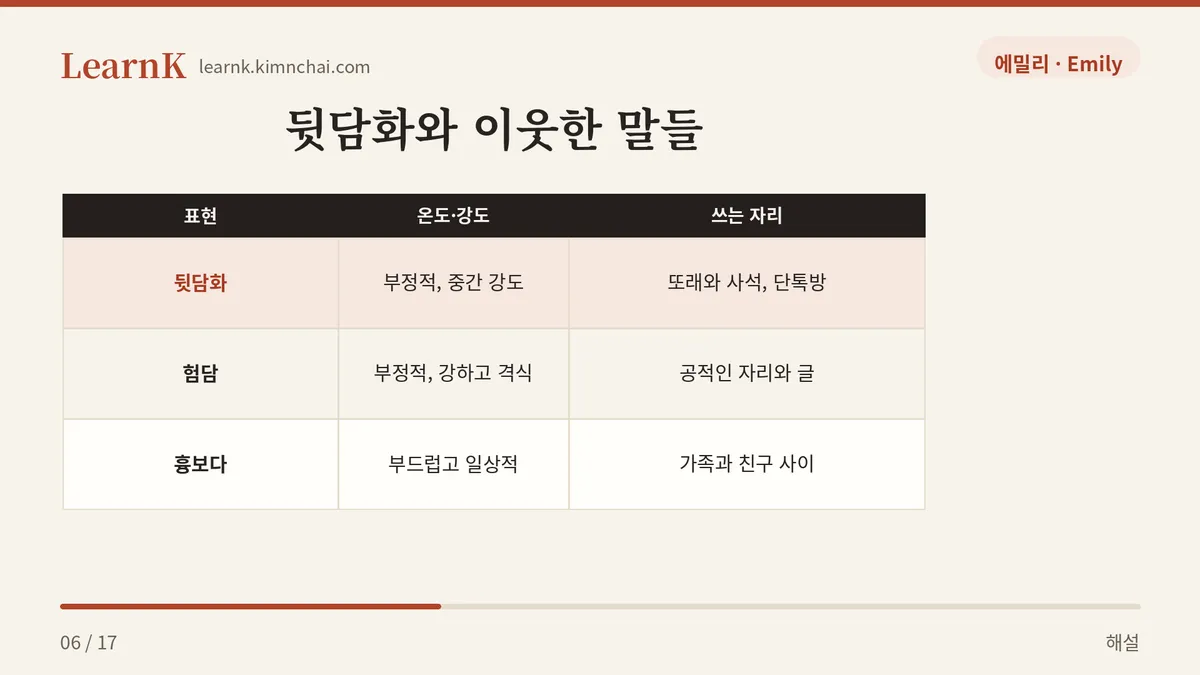
| Expression | Tone & Intensity | Where It’s Used |
|---|---|---|
| 뒷담화 (dwitdamhwa) | Negative, medium intensity. Also used self-mockingly | Among peers, in private, in group chats. Not in official documents |
| 험담 (heomdam) | Negative, strong and formal | Public settings and writing. “험담을 삼가 주십시오 (heomdameul samga jusipsio)” — “Please refrain from speaking ill of others” |
| 흉보다 (hyungboda) | Soft and everyday, even a little endearing | Family and friends. “엄마가 또 아빠 흉봤어 (eommaga tto appa hyungbwasseo)” — “Mom was picking on Dad again” |
| 뒷담 까다 (dwitdam kkada) | Rough, heavy slang | Only among very close peers |
| 수군거리다 (sugungeorida) | Descriptive, paints a hushed, secretive scene | For describing a situation rather than a person |
The key difference is formality. A company notice can say “동료 험담을 자제해 주십시오 (dongnyo heomdameul jajehae jusipsio)” — “Please refrain from speaking ill of colleagues” — but “동료 뒷담화를 자제해 주십시오 (dongnyo dwitdamhwareul jajehae jusipsio)” sounds off somehow. Flip it around: say “너 지금 험담하는 거야? (neo jigeum heomdamhaneun geoya?)” to a friend and it lands so heavily that it stops being a joke and starts being a real accusation.
Cultural Background — Three Seconds After They Walk Out
The word formation is simple: 뒤 (dwi), “behind,” plus the Sino-Korean 담화 (damhwa, 談話), “talk” — a relatively recent addition to spoken Korean. Younger speakers shorten it further to just 뒷담 (dwitdam), or pair it with a slang verb as in 뒷담 까다 (dwitdam kkada).
There’s a reason this word gets so much mileage in Korea. University entrance year, training cohort, neighborhood, company — the social web is so tightly woven that there are far too many people who know someone who knows you. So what you say behind someone’s back almost always comes back around. The proverb 발 없는 말이 천 리 간다 (bal eomneun mari cheolli ganda) points at exactly this: words have no feet, and yet they travel a thousand li. These days there’s even hard evidence in the form of group-chat screenshots, and leaked 뒷담화 (dwitdamhwa) turning a company or school upside down occasionally makes the news.
At the same time, some people see 뒷담화 (dwitdamhwa) as a kind of shock absorber in Korean society. Because there’s such strong reluctance to make someone lose face to their own front, dissatisfaction with nowhere to go leaks out the back instead. You can see the structure clearly in Misaeng (tvN, 2014), a drama about office life. Without quoting any lines, just describing the situation: the few minutes of quick assessment that pass while a new hire has stepped away shape that person’s next six months more than anything formally decided in the meeting room. That’s the point that matters for learners — the moment you can catch the word 뒷담화 (dwitdamhwa), you can see half of what’s actually going on inside a Korean organization.
Today’s Quiz
Which of the following uses 뒷담화 naturally?
- 어제 동기들이랑 팀장님 뒷담화 했어. 다들 팀장님 승진 축하한대. Yesterday I gossiped about the team leader with my cohort. Everyone says congrats on his promotion.
- (팀장님을 마주 보며) 팀장님, 저 지금 팀장님 뒷담화 하는 중이에요. (face to face with the team leader) Boss, I’m talking behind your back right now.
- 걔 나가자마자 다들 뒷담화 시작하더라. 나는 그냥 듣고만 있었어. The second she left, everyone started gossiping about her. I just sat there listening.
Answer: 3
The person left, the ones still there started up, and what they said was negative — all three conditions are met. In 1, the negative meaning of 뒷담화 (dwitdamhwa) collides with “축하한대 (chukhahandae),” “they say congrats.” In 2, the person is standing right there, so it doesn’t qualify as 뒷담화 (dwitdamhwa) in the first place — and even if it did, it’s not something you’d say out loud in that moment.
All definitions and example sentences in this post are our own original work. Where a post draws on the National Institute of Korean Language’s Basic Korean Dictionary (krdict.korean.go.kr), that portion — including our translations — is used and distributed under the CC BY-SA 2.0 KR license; this post contains no dictionary quotations.