어묵 (eomuk) — The One Word You Learn in Front of a Winter Street Stall, and How Far It Sits from '오뎅 (oden)'
어묵 (eomuk)
어묵 (eomuk) means a food made by mashing fish flesh, kneading it with salt, flour, and the like, and then cooking it. On a Korean winter evening, when you come up out of a subway exit, there’s a street cart standing there fogged over with steam, and inside it, folded onto long wooden skewers, swaying in a row in the hot broth — that’s 어묵 (eomuk).
There’s no emotion loaded into this word. It’s simply the name of a food. And yet it rarely shows up in the first chapter of a Korean textbook, even though it’s one of the words a learner who has just landed in Korea needs fastest. It’s beside the convenience store register, it’s on top of the 떡볶이 (tteokbokki) at the snack shop, it’s in the refrigerated aisle of the supermarket, and it’s in the fridge on an evening when there’s nothing obvious to make soup with.
And there are two places where learners almost always trip over this word. One is how you count it, and the other is how far it sits from the word ‘오뎅 (oden)’. Today, let’s not stop at memorizing the meaning — let’s sort out both of those too.
Checking It in the National Institute of Korean Language Dictionary
First, let’s look at exactly how the national institution’s dictionary has written this word down.
어묵 (eomuk) 「Noun」 A food made by mashing fish flesh, kneading the paste with salt, flour, and so on, and cooking it. — National Institute of Korean Language, Basic Korean Dictionary (krdict.korean.go.kr)
Equivalents in several languages are listed alongside it.
[en] fish cake — Fish paste or fish cake, a dish made by mashing fish flesh, kneading the paste with salt, flour, etc., and cooking it. [ja] かまぼこ【蒲鉾】 — 魚のすり身に塩や小麦粉などを加えて練り、蒸し煮した食品。 [es] croqueta de pescado — Comida que se hace de la cocción de una masa de pescado triturado, mezclada con sal y harina entre otros ingredientes. [zh] 鱼丸,鱼糕,鱼饼 — 将鱼肉捣碎后放入盐、面粉等搅拌并煮熟的食物。 — National Institute of Korean Language, Basic Korean Dictionary (krdict.korean.go.kr)
A Portuguese equivalent isn’t listed in this dictionary. For reference, it would come out to something like bolinho de peixe — a food made by mashing fish flesh, mixing it with salt and flour, and cooking it — but let us be clear that this is our own translation, not a dictionary headword.
Let’s also look at the real usage examples the same dictionary carries. They tell you far more than the definition does.
- 국거리가 마땅치 않을 때 저는 집에 있는 어묵을 활용하여 국을 끓여요. (gukgeoriga mattangchi anheul ttae jeoneun jibe inneun eomugeul hwaryonghayeo gugeul kkeullyeoyo.) — When I don’t have anything suitable for soup, I use the eomuk I have at home to make soup.
- 어묵 다섯 꼬치를 먹었는데 모두 얼마죠? (eomuk daseot kkochireul meogeonneunde modu eolmajyo?) — I had five skewers of eomuk; how much is that altogether?
- 이 분식집에서는 떡볶이를 시키면 어묵과 계란도 함께 넣어 준다. (i bunsikjibeseoneun tteokbokkireul sikimyeon eomukgwa gyerando hamkke neoeo junda.) — At this snack shop, if you order tteokbokki they put eomuk and egg in with it.
- 어묵 국물이 이제 좀 식었니? (eomuk gungmuri ije jom sigeonni?) — Has the eomuk broth cooled down a bit now?
- 어묵을 튀기다. (eomugeul twigida.) — to fry eomuk — National Institute of Korean Language, Basic Korean Dictionary (krdict.korean.go.kr)
Here’s what situation each one belongs to.
- 국거리가 마땅치 않을 때 저는 집에 있는 어묵을 활용하여 국을 끓여요. — This is the kitchen on a day when you didn’t get to the market. In Korean homes, 어묵 (eomuk) is filed under “cooking ingredient.” It rolls around the freezer still in its bag and then gets resurrected as a soup.
- 어묵 다섯 꼬치를 먹었는데 모두 얼마죠? (eomuk daseot kkochireul meogeonneunde modu eolmajyo?) — This is the sentence you use word for word when paying at a street cart. With Korean street 어묵 (eomuk), you eat first and settle up afterward by the number of skewers. That’s why this sentence is common enough to make it into the dictionary.
- 이 분식집에서는 떡볶이를 시키면 어묵과 계란도 함께 넣어 준다. — This shows that 어묵 (eomuk) isn’t a standalone menu item so much as a default member of the 떡볶이 (tteokbokki) lineup.
- 어묵 국물이 이제 좀 식었니? (eomuk gungmuri ije jom sigeonni?) — Once you’ve fished out and eaten the 어묵 (eomuk), the broth that’s left is treated as a thing in its own right. ‘어묵 국물 (eomuk gungmul)’ gets used as though it were a single word.
- 어묵을 튀기다. — There’s more than one way to make 어묵 (eomuk). It’s fried, steamed, and grilled. The flat brown kind we all know is generally the fried one.
Seeing It in a Real Conversation
Situation: Nine o’clock on a December night. An eomuk street cart in front of a subway exit. Both of them are holding paper cups in gloved hands.
Jun-kyung: 야, 손 시렵지? 어묵 국물부터 한 컵 마셔. Hey, your hands are freezing, right? Have a cup of the eomuk broth first.
Emily: 아 살 것 같다. 나 진짜 이거 하나 때문에 겨울 기다렸어. Ah, that brings me back to life. I honestly waited all year for winter just for this.
Jun-kyung: 많이 먹어. 나 세 개 먹을 건데 너는? Eat up. I’m having three — what about you?
Emily: 세 개 아니고 세 꼬치거든. 나 여기 십오 년 살았어. It’s not “three pieces,” it’s “three skewers.” I’ve lived here fifteen years, you know.
Jun-kyung: 아 맞다. 이모님, 어묵 여섯 꼬치요! Oh, right. Ma’am — six skewers of eomuk, please!
Emily: 국물은 셀프야. 내 컵도 좀 채워 줘. The broth is self-serve. Fill mine up too, would you.
This Is Where It Sounds Off
어묵 (eomuk) isn’t a word carrying emotion — it’s the name of an object — so there’s no misuse that turns “rude.” Instead, let’s point out the two misunderstandings learners actually make most often.
✗ (in a broadcast interview) 저는 겨울에 오뎅을 제일 좋아해요. (jeoneun gyeoure odengeul jeil joahaeyo.) ✓ (in a broadcast interview) 저는 겨울에 어묵을 제일 좋아해요. (jeoneun gyeoure eomugeul jeil joahaeyo.) → ‘오뎅 (oden)’ comes from the Japanese おでん, so in public settings, in writing, and on menus, the standard choice is ‘어묵 (eomuk)’. Saying ‘오뎅 먹자 (oden meokja)’ to a friend in front of a street cart is still perfectly common, but in front of a camera or in writing like a résumé, ‘어묵 (eomuk)’ is the safe option.
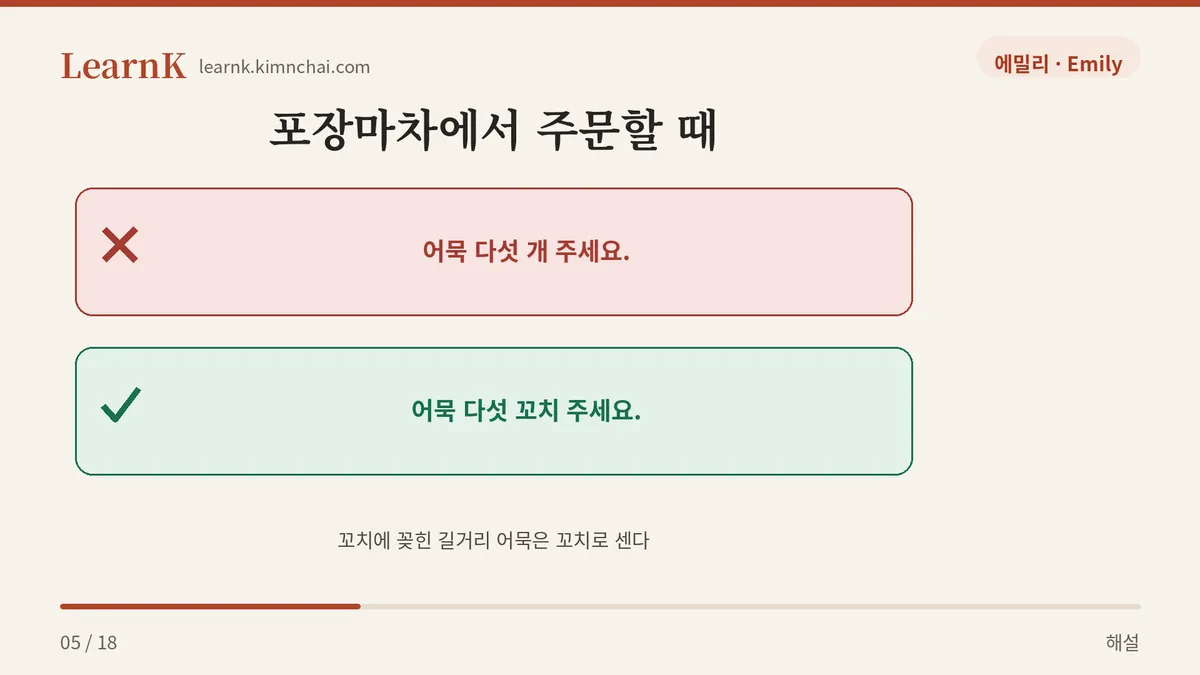
✗ 어묵 다섯 개 주세요. (eomuk daseot gae juseyo.) ✓ 어묵 다섯 꼬치 주세요. (eomuk daseot kkochi juseyo.) → It isn’t grammatically wrong, and it gets the message across. It’s just that street 어묵 (eomuk) on a skewer is counted with ‘꼬치 (kkochi)’. The wide rectangular sheets sold at the supermarket are ‘한 장 (han jang)’, and a bagged pack is ‘한 봉지 (han bongji)’. The counter follows the shape of the object.
Example Sentences by Situation
Situation 1 — Ordering at a snack shop. Ordering only 떡볶이 (tteokbokki) feels a little empty. 어묵 (eomuk) almost always comes as its partner.
- 떡볶이 일 인분이랑 어묵 두 꼬치 주세요. (tteokbokki il inbunirang eomuk du kkochi juseyo.)
- This is used in exactly the same spot as the dictionary’s ‘어묵 두 꼬치 (eomuk du kkochi)’. Just add ‘주세요 (juseyo)’ on the end and you have a complete order.
Situation 2 — Making soup in the evening. The moment 어묵 (eomuk) shows up most often in a Korean home is actually not on the street but in the kitchen.
- 냉장고에 어묵 남았지? 그걸로 국 끓이자. (naengjanggoe eomuk namatji? geugeollo guk kkeurija.)
- This is casual speech. Use it with family or people you’re very close to. To someone older, it becomes ‘어묵으로 국 끓일까요? (eomugeuro guk kkeurilkkayo?)’
Situation 3 — To a friend heading to Busan. 어묵 (eomuk) can also be a gift.
- 부산 가면 어묵 좀 사 와. (busan gamyeon eomuk jom sa wa.)
- To a Korean, this sentence needs no explanation. Busan is known as the home of 어묵 (eomuk), enough that there are dedicated eomuk shops inside the station.
Polite vs. Casual Speech, and Similar Expressions
어묵 (eomuk) itself is a noun, so it has no honorific level. The politeness is decided by what comes after it.
- Polite: 어묵 두 꼬치 주세요. (eomuk du kkochi juseyo.)
- More relaxed polite: 어묵 두 꼬치요. (eomuk du kkochiyo.) — This is the form you’ll actually hear most at street carts.
- Casual: 어묵 두 개만 집어 줘. (eomuk du gaeman jibeo jwo.)
Here’s how it compares with words that are similar but not the same.
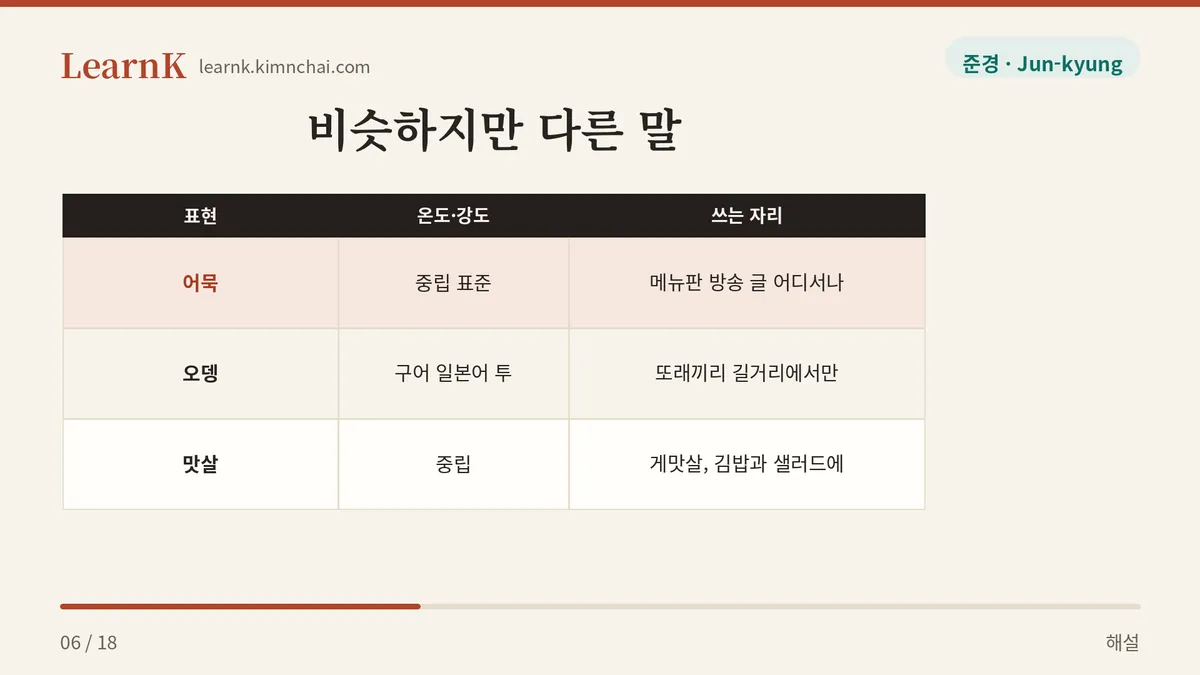
| Expression | Tone / intensity | Where it’s used |
|---|---|---|
| 어묵 (eomuk) | Neutral, standard | Anywhere. Menus, broadcasts, writing, official documents |
| 오뎅 (oden) | Casual and colloquial, Japanese-flavored | Among peers on the street. Avoided in writing or on broadcast |
| 어묵탕 (eomuktang) | Neutral | The name of the soup dish made by simmering eomuk. A drinking-snack menu item |
| 맛살 (matsal) | Neutral | Imitation crab stick. Similar ingredients to eomuk, but a different thing |
That last row matters. 맛살 (matsal) is the one with the red stripe that goes into 김밥 (gimbap) or salad, and it can’t be swapped in for 어묵 (eomuk). If you say ‘맛살 두 꼬치 주세요 (matsal du kkochi juseyo)’ at a snack shop, nobody will know what you mean.
Cultural Background — The Paper Cup at the Winter Street Stall
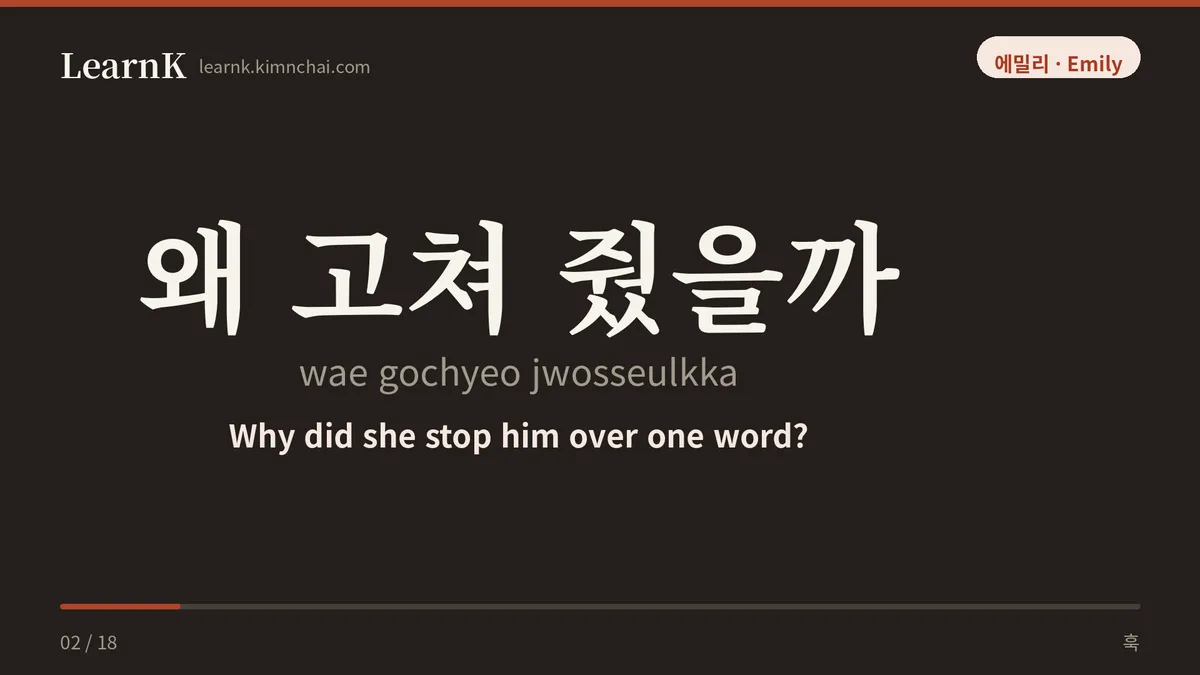
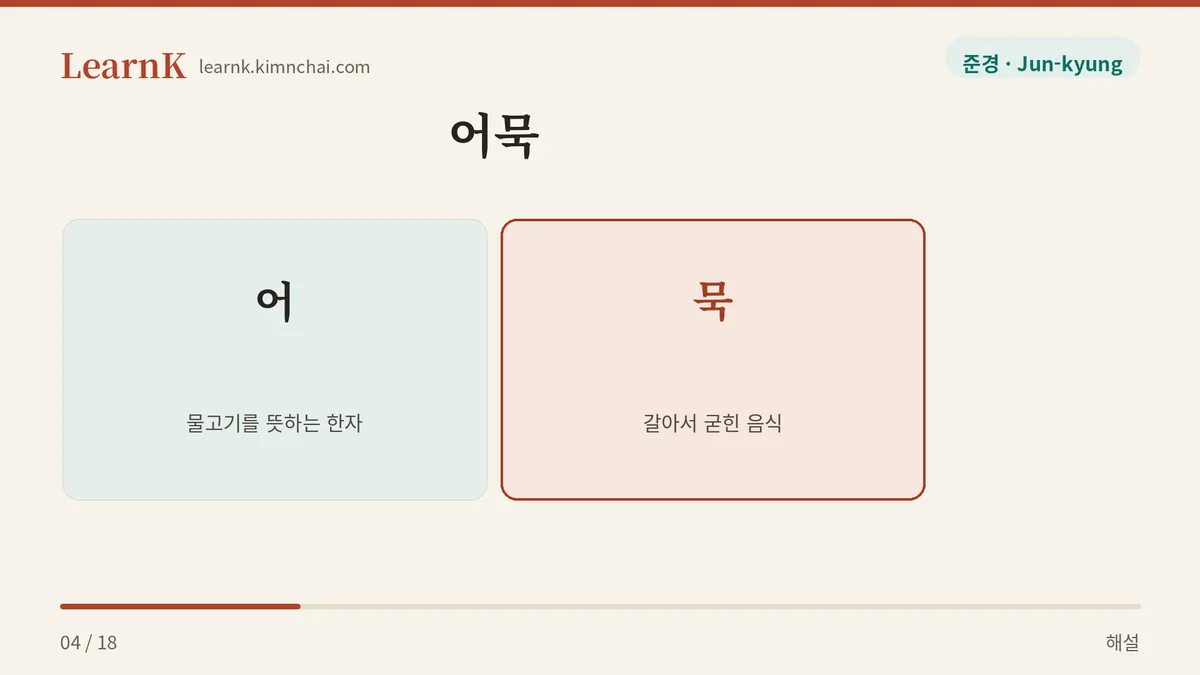
With the word 어묵 (eomuk), you can see how it was built. ‘어 (魚)’ is fish, and ‘묵 (muk)’ is the 묵 of 도토리묵 (dotorimuk, acorn jelly) and 메밀묵 (memilmuk, buckwheat jelly) — that is, food that’s been ground and set. Put together, it’s ‘muk made from fish.’ The cooking method is right there inside the name. 오뎅 (oden), on the other hand, comes from the Japanese おでん, and in Japan that word originally refers not to the fish cake itself but to the name of a dish — fish cake, radish, egg and so on simmered in broth. As it crossed into Korea, the meaning shifted over onto the ingredient. So ‘오뎅 (oden)’ and ‘어묵 (eomuk)’ are less a simple standard/non-standard pair than two words whose referents drifted slightly apart in the crossing.
The place 어묵 (eomuk) holds in Korean food culture isn’t ‘upscale’ — it’s ‘close by.’ Fish being plentiful in Busan, with its well-developed port, was the backdrop for the eomuk industry, and Busan eomuk is still sold as a gift that represents the region. But when people picture 어묵 (eomuk), what they draw is usually not a factory but a street. A student just out of cram school, an office worker pausing on the way home, someone who’s brought along a friend who bombed an exam — the scene of them standing side by side, drinking broth without a word.
This is also why street carts show up so often in Korean dramas. Sitting across a table means you have to look each other in the eye, but at a street cart both of you face forward, standing side by side. There’s no better posture for bringing up something difficult. And so the reconciliation scenes, the scenes right before a confession, the scenes where nobody says anything and they just drink the broth — those happen in front of 어묵 (eomuk). Even if you don’t take the lines with you, this arrangement is worth remembering — 어묵 (eomuk) is less a food that fills your stomach than a stretch of time for warming your hands before you speak.
One practical note. The broth at a street eomuk stand is generally free and self-serve. You take a paper cup yourself and ladle out some broth to drink. It’s best not to throw away the skewers you’ve finished — collect them in a cup or container. That’s because those skewers are what gets counted when you pay. The sentence in the dictionary, ‘어묵 다섯 꼬치를 먹었는데 모두 얼마죠? (eomuk daseot kkochireul meogeonneunde modu eolmajyo?)’, exists for exactly this moment.
Today’s Quiz
It’s a winter evening, and you want to order three pieces of skewered eomuk at a street cart. Which sounds the most natural?
- 어묵 세 개요. (eomuk se gaeyo.)
- 어묵 세 꼬치요. (eomuk se kkochiyo.)
- 어묵 세 장이요. (eomuk se jangiyo.)
The answer is 2. Street eomuk on a skewer is counted with ‘꼬치 (kkochi)’. Number 1 will get through, but it’s less natural, and the ‘장 (jang)’ in number 3 is the counter for the wide rectangular sheets sold at the supermarket. The counter follows the shape of the object — remember just that, and you’ve pocketed half of today’s lesson.
Definitions and example sentences are from the National Institute of Korean Language’s Basic Korean Dictionary (krdict.korean.go.kr); that portion of this post, including our translations, is licensed under CC BY-SA 2.0 KR.