어색하다 (eosaekhada) — The Word for the Five Minutes When Words Won't Come
어색하다 (eosaekhada)
어색하다 (eosaekhada) means to feel uncomfortable and unnatural when you’re face to face with someone you don’t know well, or didn’t especially want to run into. This is the feeling learners who come to Korea pick up with their bodies long before they find it in a dictionary. Stuck alone with a neighbor in the apartment elevator. The first ten minutes across the table from a blind date, fiddling with your water glass. The three-second gap after you finally manage a 잘 지냈어? (jal jinaesseo?) to a friend you haven’t contacted in years — that air, in Korean, is 어색하다.
The first thing to understand is that 어색하다 doesn’t blame anyone. It isn’t 싫다 (silta, “I don’t like it”) and it isn’t 나쁘다 (nappeuda, “it’s bad”). Both people are being perfectly polite and nobody has made a mistake — the relationship just isn’t rolling smoothly yet. That’s why in Korean, awkwardness is something you break, but also something that 풀리는 (pullineun, “comes untied”). It’s treated like a knot that loosens on its own if you give it time.
The second thing to know is that 어색하다 isn’t only used between people. It applies just as well to a machine-translated sentence, an over-strained performance, or heavy trend-chasing makeup worn with a 한복 (hanbok). Nothing is grammatically wrong, but something isn’t sitting in its proper place — the word covers that whole sensation. Push a little further and it even covers “a claim that doesn’t hold together because the grounds are thin.” Say 변명이 좀 어색한데? (byeonmyeongi jom eosaekhande?) and you mean “that excuse doesn’t add up.”
One picture runs through all three senses: something that should flow smoothly catches once. Catch it between two people and you get silence. Catch it in a sentence and you get translationese. Catch it in the logic of a statement and you get a flimsy excuse.
Checking It in the National Institute of Korean Language Dictionary
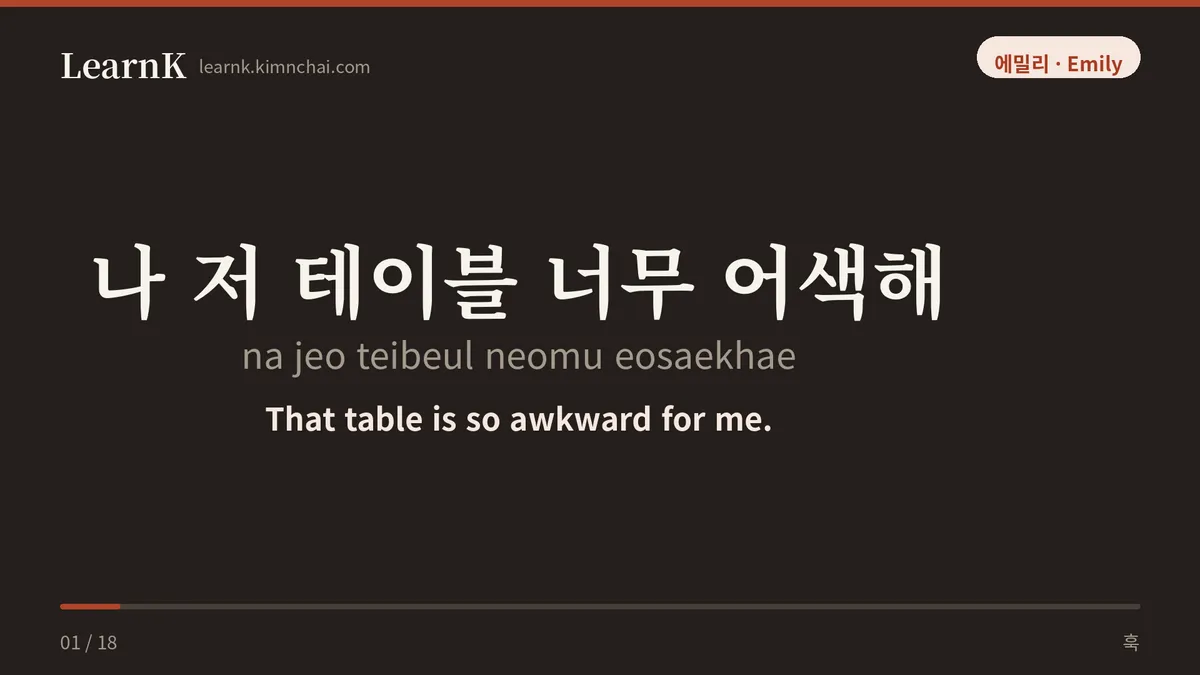
The National Institute of Korean Language’s Basic Korean Dictionary lists 어색하다 as an adjective and divides it into three senses.
어색하다 (eosaekhada) 「Adjective」 ① Uncomfortable and unnatural because one is facing a person one does not know well or did not want to meet. [en] awkward; embarrassing; uneasy — Uncomfortable and not natural because one is facing another person whom one does not know well or has not wanted to see. [ja] きまずい【気まずい】 — よく知らない人やあまり会いたくない人に会って、互いに気持ちがしっくりせず、不自然である。 [es] incómodo, molesto — Que se siente molesto o incómodo por haberse encarado con una persona que no le conoce bien o con la que no deseaba encontrarse. [zh] 尴尬,拘束 — 和不了解或并不想见的人相对而不舒服或不自然。 — National Institute of Korean Language, Basic Korean Dictionary (krdict.korean.go.kr)
② Lacking sufficient grounds and illogical. [en] awkward; unreasonable; absurd — Not having sufficient grounds and illogical. [ja] くるしい【苦しい】 — 言っていることの根拠が貧弱で非論理的である。 [es] ilógico, incoherente, disparatado, irracional — Dicho de un comentario, que carece de fundamento o lógica. [zh] 不合逻辑 — 话语根据不足而缺乏逻辑。 — National Institute of Korean Language, Basic Korean Dictionary (krdict.korean.go.kr)
③ Unnatural because it doesn’t fit a certain formality, norm, custom, and so on. [en] awkward — Not natural because it is against a certain rule, norm, custom, etc. [ja] ぎこちない。ふしぜんだ【不自然だ】 — 格式や規範、慣習などに合わなくて自然でない。 [es] torpe, embarazoso, desmañado — Que no es natural porque no concuerda con la formalidad, la norma, la costumbre, etc. [zh] 别扭 — 不符合格式、规范或习惯等而显得不自然。 — National Institute of Korean Language, Basic Korean Dictionary (krdict.korean.go.kr)
※ A Portuguese translation isn’t included in this dictionary. The one below is our own: [pt] constrangedor, sem jeito — desconfortável e pouco natural diante de alguém que mal se conhece.
Below are the real usage examples the dictionary supplies, quoted as they are, each with a note on the kind of situation it belongs to.
첫 만남이 어색하다. — National Institute of Korean Language, Basic Korean Dictionary (krdict.korean.go.kr)
→ 첫 만남이 어색하다 (cheot mannami eosaekhada), “the first meeting is awkward.” A textbook case of sense ①. Think of a blind date, your first day at a new job, or the two families meeting before a wedding — situations where you don’t even know what to call each other yet.
사이가 어색하다. — National Institute of Korean Language, Basic Korean Dictionary (krdict.korean.go.kr)
→ 사이가 어색하다 (saiga eosaekhada), “things are awkward between us.” This one runs the opposite direction. It’s not about meeting for the first time — it’s what you say after two close friends have had a falling-out. You’re still talking, but it isn’t the way it used to be.
영화 내용은 재미있는데, 주인공의 연기가 어색하다는 비난이 많더라. — National Institute of Korean Language, Basic Korean Dictionary (krdict.korean.go.kr)
→ 연기가 어색하다 (yeon-giga eosaekhada), “the acting is awkward.” This is sense ③. The actor didn’t flub a line — the complaint is that real people don’t actually talk that way. It’s one of the phrases Korean viewers reach for most often when reviewing a drama.
번역문이 어색하다. — National Institute of Korean Language, Basic Korean Dictionary (krdict.korean.go.kr)
→ 번역문이 어색하다 (beonyeongmuni eosaekhada), “the translation is awkward.” This is the one learners will hear most. Even with zero grammar errors, if a Korean wouldn’t say it in that order, the verdict comes back 어색하다.
한복을 입을 때 지나치게 유행을 따라가는 화장을 하면 어색하다. — National Institute of Korean Language, Basic Korean Dictionary (krdict.korean.go.kr)
→ It’s used for visible things like clothing and makeup too. Each piece is fine on its own; put them together and they don’t match.
See It in a Real Conversation
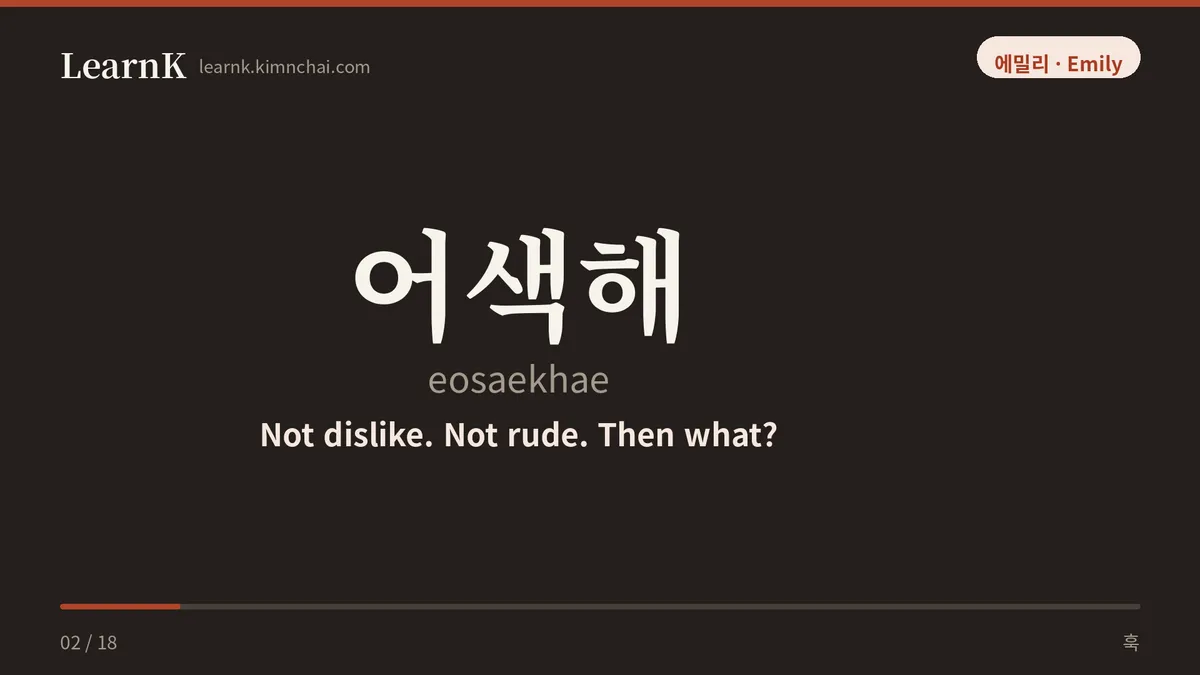
Situation: The wedding of one of Jun-kyung’s university classmates. At the reception they were seated at a table full of strangers, and Emily has stepped out to the lobby first.
Jun-kyung: 왜 나와 있어? 밥도 안 먹고. Why are you out here? You haven’t even eaten.
Emily: 아, 나 저 테이블 너무 어색해. 다들 20년 지기인데 나만 오늘 처음 보잖아. Ah, that table is so awkward for me. They’ve all known each other twenty years and I’m the only new face.
Jun-kyung: 미안. 내가 옆에 붙어 있었어야 했는데 자꾸 불려 다녀서. Sorry. I should’ve stayed next to you, but people kept calling me over.
Emily: 아니야, 네 친구 결혼식인데. 근데 아까 그분이 나한테 갑자기 영어로 말 거셨을 때 진짜… No, it’s your friend’s wedding. But when that guy suddenly switched to English on me…
Jun-kyung: 아 맞다, 그거. 나도 공기 어색해지는 거 느꼈어. 너 한국말이 나보다 낫구먼. Oh right, that. I felt the air go awkward too. Your Korean is better than mine, honestly.
Emily: 나쁜 뜻 아닌 거 아는데, 그래도 좀 그렇더라. 10분만 있다 들어갈게. I know he didn’t mean anything by it, but still. I’ll go back in ten minutes.
Use It Like This and Things Get Awkward
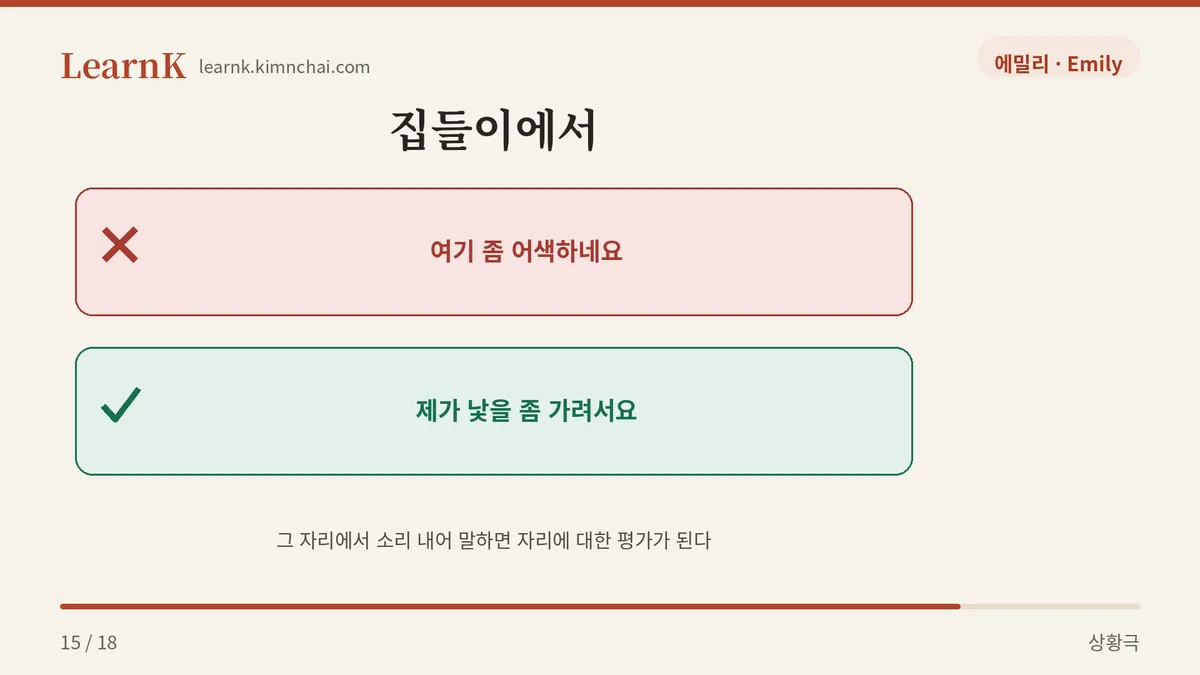
✗ (To the friend who invited you to their housewarming) 여기 좀 어색하네요. (yeogi jom eosaekhaneyo.) ✓ (Back home, to the person who went with you) 나 아까 좀 어색했어. (na akka jom eosaekhaesseo.) → 어색하다 sounds like you’re describing your own state, but said out loud in the room, it turns into a verdict on the gathering: “this place is uncomfortable.” In front of your host, it’s safer to put the cause on yourself, with something like 제가 낯을 좀 가려서요 (jega natcheul jom garyeoseoyo) — “I’m just a bit shy around new people.”
✗ (To a friend with a fresh haircut) 어? 너 머리 어색하다. (eo? neo meori eosaekhada.) ✓ (Same situation) 오, 느낌 확 달라졌네. 아직 좀 낯설다 (natseolda). (o, neukkim hwak dallajyeonne. ajik jom natseolda.) → Attached to a person’s appearance, 어색하다 lands as “it doesn’t suit you.” If what you mean is that your eyes just haven’t adjusted yet, use 낯설다 — that’s the version that reads as a compliment.
Example Sentences by Situation
Situation 1 — A class reunion after ten years. You remember the names, but the faces are hazy. 처음 5분은 좀 어색했는데, 급식 얘기 나오니까 바로 풀렸어. (cheoeum obuneun jom eosaekhaenneunde, geupsik yaegi naonikka baro pullyeosseo.) — “The first five minutes were a little awkward, but once school lunches came up it loosened right away.” In Korean it’s far more common to say the awkwardness 풀렸다 (pullyeotda, “came untied”) than that someone “broke” it. Baked into the word is the sense that a single shared memory is enough to undo the knot.
Situation 2 — You’re getting a passport photo taken and the photographer tells you to smile naturally. 자연스럽게 웃으라고 하시니까 더 어색해져요. (jayeonseureopge useurago hasinikka deo eosaekhaejyeoyo.) — “Being told to smile naturally just makes me more awkward.” 어색해지다 (eosaekhaejida) means to gradually become awkward. When you can feel yourself stiffening up right this second, this is more precise than 어색해요.
Situation 3 — You’ve asked a Korean friend to look over your cover letter. 틀린 데는 없는데 이 문장이 좀 어색해요. (teullin deneun eomneunde i munjangi jom eosaekhaeyo.) — “There’s nothing wrong with it, but this sentence is a little awkward.” This is the 어색하다 learners will hear most. It isn’t a criticism — it’s information: “Koreans don’t say it in that order.” Take it as a signal to go look up real usage examples rather than reopening your grammar book.
Politeness Levels and Similar Expressions
The speech levels shift regularly: 어색해 (eosaekhae, casual) → 어색해요 (eosaekhaeyo) → 어색합니다 (eosaekhamnida, formal). When you want to acknowledge that someone else feels awkward, you ask it as a question: 좀 어색하시죠? (jom eosaekhasijyo?) — “This is a bit awkward, isn’t it?” At a first meeting, whoever says that line first is usually the one who unties the room.
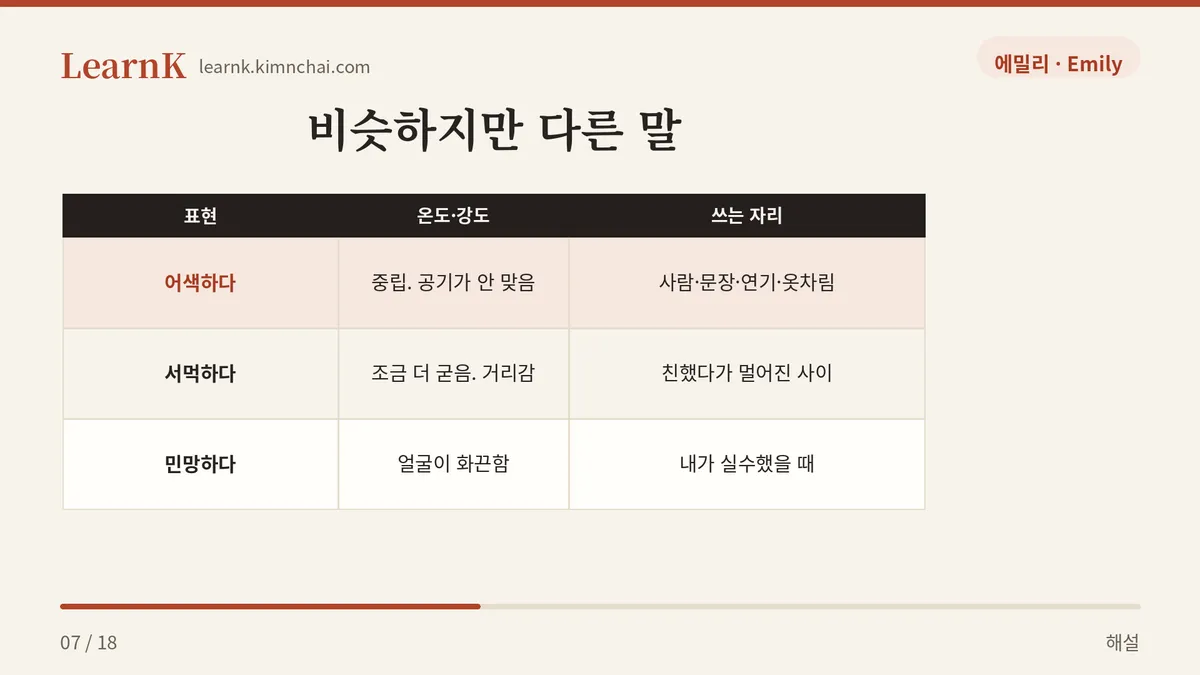
| Expression | Temperature / intensity | Where it’s used |
|---|---|---|
| 어색하다 (eosaekhada) | Neutral. The feeling that the air doesn’t fit | Between people, in sentences, in acting, even in outfits |
| 서먹하다 (seomeokhada) | A bit more frozen. Distance | Only between people who were once close and have drifted |
| 쑥스럽다 (ssukseureopda) | Bashful, ticklish | When you’re paid a compliment, when you confess your feelings |
| 민망하다 (minmanghada) | Your face goes hot | When you slipped up. The cause is on you |
| 부자연스럽다 (bujayeonseureopda) | Stiff and analytical | Evaluating translations or acting. Closer to written language |
The pair that trips people up most is 어색하다 and 민망하다. 어색하다 is when nobody did anything wrong and the air still doesn’t fit; 민망하다 is when you did something and your face heats up. The person who got the name wrong feels 민망하다 — and the silence that follows is 어색하다.
Cultural Background — The Place Where Words Get Stuck
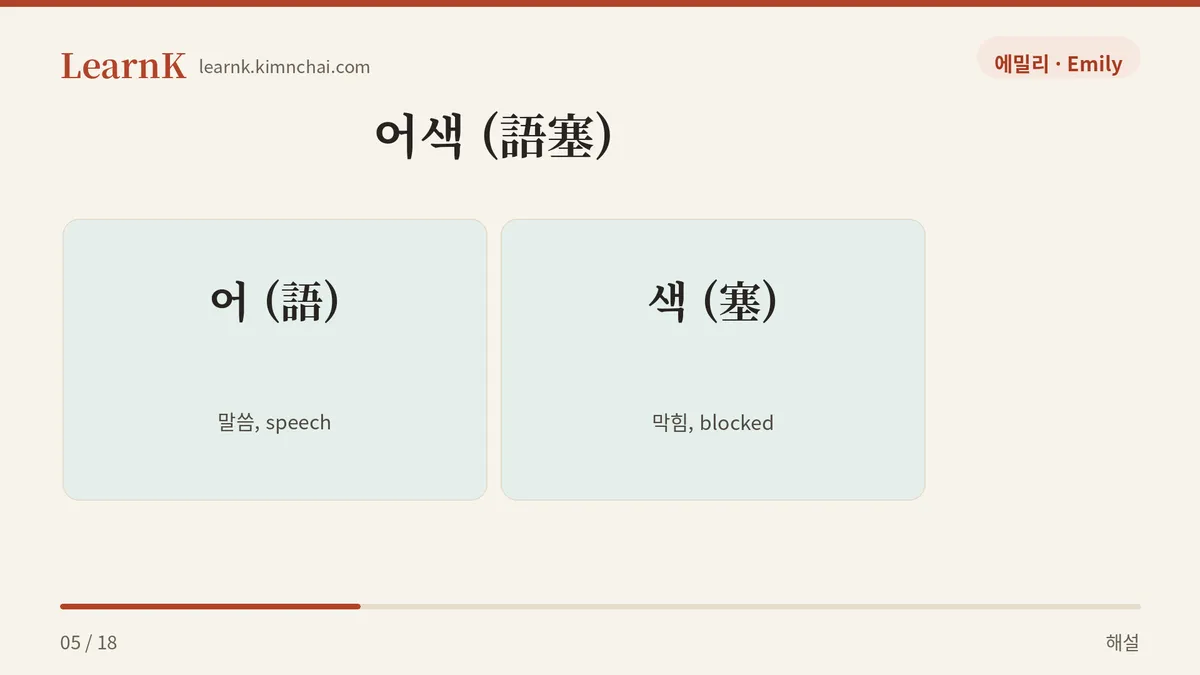
The hanja behind 어색하다 is 어색(語塞): 말씀 어(語, “speech”) plus 막힐 색(塞, “blocked”) — literally, speech getting blocked. Once you have that picture, all three senses thread onto a single string. Words getting stuck in front of a stranger is sense ①. Words getting stuck because you have no grounds is sense ②. Something not flowing naturally because it doesn’t match the expected form is sense ③.
There’s a linguistic reason awkwardness registers so sharply in Korean. In Korean, it’s hard to even finish a sentence until the other person’s age and relationship to you are settled. Casual speech or polite speech? 형 (hyeong), 선배 (seonbae), or just their name? The conversation can’t roll until that’s decided. It’s also why asking about age or affiliation at a first meeting survives as a custom rather than a rudeness — it’s a procedure for fixing everyone’s coordinates fast so the awkward stretch stays short. Clinking that first round of drinks together at a company dinner does the same job.
In dramas, awkwardness is staged through silence rather than dialogue. Two people who have just started to like each other suddenly going quiet and failing to meet each other’s eyes; exes who end up seated at the same table — the camera erases the lines and holds the stillness. Variety shows go further and simply flash subtitles like “어색” or “정적” (jeongjeok, “silence”) on screen, converting the air into a laugh. So when you’re watching Korean content and the dialogue cuts out cold, leaving only background music, the emotion the screen is painting right then is exactly this word.
Today’s Quiz
In which of these three situations should you not put 어색하다 in the blank?
① The first ten minutes sitting across from your blind date — “좀 ______.” ② Reading a machine-translated sentence — “이 문장 ______.” ③ Wanting to compliment a friend’s new haircut — “머리 ______.”
The answer is ③. Situation ① fits sense ① exactly and ② fits sense ③ exactly, but attach 어색하다 to a person’s appearance and it becomes the verdict “it doesn’t suit you.” If you want to compliment them, switch to 아직 좀 낯설다 (ajik jom natseolda), “I’m still getting used to it,” or 느낌 확 달라졌다 (neukkim hwak dallajyeotda), “the whole vibe has changed.” 어색하다 is generous toward situations and objects, but it has an edge when pointed at a person’s face.
Definitions and example sentences are from the National Institute of Korean Language’s Basic Korean Dictionary (krdict.korean.go.kr); that portion of this post, including our translations, is licensed under CC BY-SA 2.0 KR.