갑질 (gapjil) — The Moment Status Turns Into Rudeness
갑질
갑질 (gapjil) means the behavior of a person in a relatively superior position acting rudely toward someone else, or bossing them around and doing whatever they please. A customer who yells at a server because the side dishes were slow, a boss who sends a subordinate on personal errands, a client who demands work that was never in the contract — when a scene like that turns up on Korean news, the anchor will almost always reach for these two syllables. The moment the side with power hands that power back to the other person as rudeness, Korean calls it 갑질 (gapjil).
The core of this word isn’t rudeness — it’s the gap in status. The exact same shouting, coming from a friend, just makes them a rude person; coming from a boss or a customer, it becomes 갑질 (gapjil). Where there is no up and down, the word simply doesn’t apply. That’s why a sentence pointing out 갑질 always brings both people into the picture — boss and subordinate, customer and server, landlord and tenant, conglomerate and subcontractor.
It’s also worth knowing the range of intensity. It doesn’t have to be as extreme as verbal abuse or violence to count. Making someone fetch coffee every single day, sending personal requests over KakaoTalk to someone who has already gone home, dropping hints that you’d like a holiday gift — each one looks trivial on its own, but repeated inside a relationship where the other person can’t refuse, it gets called 갑질 (gapjil). Conversely, no matter how rude someone is, if the two of you are equals, this word doesn’t come out.
The grammar is simple. It’s a noun, so it’s used as 갑질을 하다 (gapjireul hada) — to commit gapjil, 갑질을 당하다 (gapjireul danghada) — to be subjected to gapjil, and 갑질이 심하다 (gapjiri simhada) — the gapjil is severe. It also attaches in front of a person or a situation, as in 갑질 고객 (gapjil gogaek), a gapjil customer, or 갑질 상사 (gapjil sangsa), a gapjil boss. Remember just one thing — you don’t use this word about yourself. It’s only for calling someone else out, or for speaking up about harm done to you.
Checking it in the National Institute of Korean Language dictionary
갑질 「명사」 상대적으로 우월한 지위에 있는 사람이 상대방에게 무례하게 행동하거나 이래라저래라 하면서 멋대로 구는 행동. (noun) The behavior of a person in a relatively superior position acting rudely toward the other person, or bossing them around and doing as they please. — National Institute of Korean Language, Basic Korean Dictionary (krdict.korean.go.kr)
Notice that the definition sets two behaviors side by side: 무례하게 행동하거나 (muryehage haengdonghageona, “acting rudely”) and 이래라저래라 하면서 멋대로 구는 (iraerajeoraera hamyeonseo meotdaero guneun, “bossing people around and doing as one pleases”). In other words, both a rude manner and an unfair order delivered in a perfectly polite tone fall under 갑질.
The equivalents in other languages listed in the dictionary help pin down the nuance too.
[en] gapjil — The behavior of a person in a relatively superior position acting rudely toward the other person or telling them to do something like that. [ja] パワハラ。パワーハラスメント — 相対的に優越な地位にある人が相手に無礼な行動をしたり、ああしろこうしろと言いながら勝手に振舞う行動。 [es] dárselas de jefecito — Comportamiento de una persona en una posición relativamente superior que actúa de manera grosera hacia la otra persona o se comporta rebelde pidiendole lo que quiera. [zh] 盛气凌人,霸凌行为,仗势欺人 — 处于相对优越地位的人对他人做出无礼的行为,或颐指气使的行为。 — National Institute of Korean Language, Basic Korean Dictionary (krdict.korean.go.kr)
The English side carried gapjil over untranslated. That means there’s no single English word you can swap in. Japanese takes it as パワハラ (workplace power harassment), but that’s narrower in scope — it stays inside the company, whereas Korean 갑질 also covers what a customer does to a part-timer. The Spanish dárselas de jefecito paints the picture of “playing the little boss,” so it carries a strong note of mockery. For reference, no Portuguese equivalent is listed in the dictionary. If you had to render it, abuso de poder (abuse of power) comes closest — but that translation is ours, not the dictionary’s.
Let’s look at the dictionary’s real usage examples one by one.
상사의 갑질. (sangsaui gapjil.) A boss’s gapjil. — National Institute of Korean Language, Basic Korean Dictionary (krdict.korean.go.kr)
This is the most typical pairing. Putting 상사의 (sangsaui, “a boss’s”) out front nails down the status gap first. With 갑질, whose 갑질 it is almost always comes attached.
맞아. 요즘 직장 내에서의 갑질 문제가 뉴스에 많이 나오더라. (maja. yojeum jikjang naeeseoui gapjil munjega nyuseue mani naodeora.) Yeah. These days the problem of gapjil in the workplace is all over the news. — National Institute of Korean Language, Basic Korean Dictionary (krdict.korean.go.kr)
This is friends talking in casual speech. The phrase 뉴스에 많이 나오더라 (“it’s been all over the news”) shows that the word also works as a public term for a social problem.
내일 회사에서 직장 내 갑질을 근절하기 위한 예방 교육을 한대. (naeil hoesaeseo jikjang nae gapjireul geunjeolhagi wihan yebang gyoyugeul handae.) Apparently tomorrow the company is holding prevention training to stamp out workplace gapjil. — National Institute of Korean Language, Basic Korean Dictionary (krdict.korean.go.kr)
If you actually work at a Korean company, this is an announcement you’ll hear about once a year. The fact that 갑질 sits comfortably beside stiff words like 근절 (geunjeol, eradication) and 예방 교육 (yebang gyoyuk, prevention training) shows it has already made its way into official documents.
식당에서 손님들이 종업원에게 무리한 요구를 하며 갑질을 하는 경우가 종종 있다. (sikdangeseo sonnimdeuri jongeobwonege murihan yogureul hamyeo gapjireul haneun gyeonguga jongjong itda.) At restaurants there are often cases of customers making unreasonable demands of the staff and committing gapjil. — National Institute of Korean Language, Basic Korean Dictionary (krdict.korean.go.kr)
This is 갑질 outside the workplace. The moment someone decides that paying makes them the superior party, a customer becomes the 갑 (gap). Note that 무리한 요구 (murihan yogu, unreasonable demands) is the substance of the 갑질 here.
삼촌이 직장 상사의 갑질 때문에 힘들어 하신다. (samchoni jikjang sangsaui gapjil ttaemune himdeureo hasinda.) My uncle is having a hard time because of his boss’s gapjil at work. — National Institute of Korean Language, Basic Korean Dictionary (krdict.korean.go.kr)
This one is spoken from the victim’s side. It pairs with ~때문에 힘들어하다 (~ttaemune himdeureohada, “to have a hard time because of ~”) extremely often, because 갑질 tends to be talked about not as a single incident but as an ongoing condition.
See it in a real conversation
Scene: A neighborhood 분식집 (bunsikjip, snack-food joint). You’re having a late dinner, and the next table has been loud for a while now.
Jun-kyung: 저 아저씨 아까부터 계속 저러네. 반찬 늦게 나왔다고 소리를 지르냐. That guy’s been at it for a while now. Yelling just because the side dishes were late?
Emily: 어우, 딱 갑질이네. 알바생 얼굴 빨개진 거 봐. Ugh, that’s textbook gapjil. Look, the part-timer’s face has gone red.
Jun-kyung: 진짜. 돈 냈으니까 뭐든 해도 된다고 생각하는 거지. Seriously. He thinks paying for food lets him do anything.
Emily: 나도 카페 알바할 때 저런 손님한테 갑질 당해 봤어. 그날 집에 가서 울었잖아. I got treated like that too — got gapjil’d by a customer back when I worked at a café. I went home and cried that day.
Jun-kyung: 아 맞다, 너 홍대에서 일했었지. 사장님한테 말은 했어? Oh right, you worked in Hongdae. Did you tell your boss?
Emily: 말해도 뭐. “손님이니까 참아” 그러지. 요즘은 좀 나아졌다는데. What would be the point? He’d just say “he’s a customer, put up with it.” They say it’s gotten a bit better these days, though.
This is where it sounds off
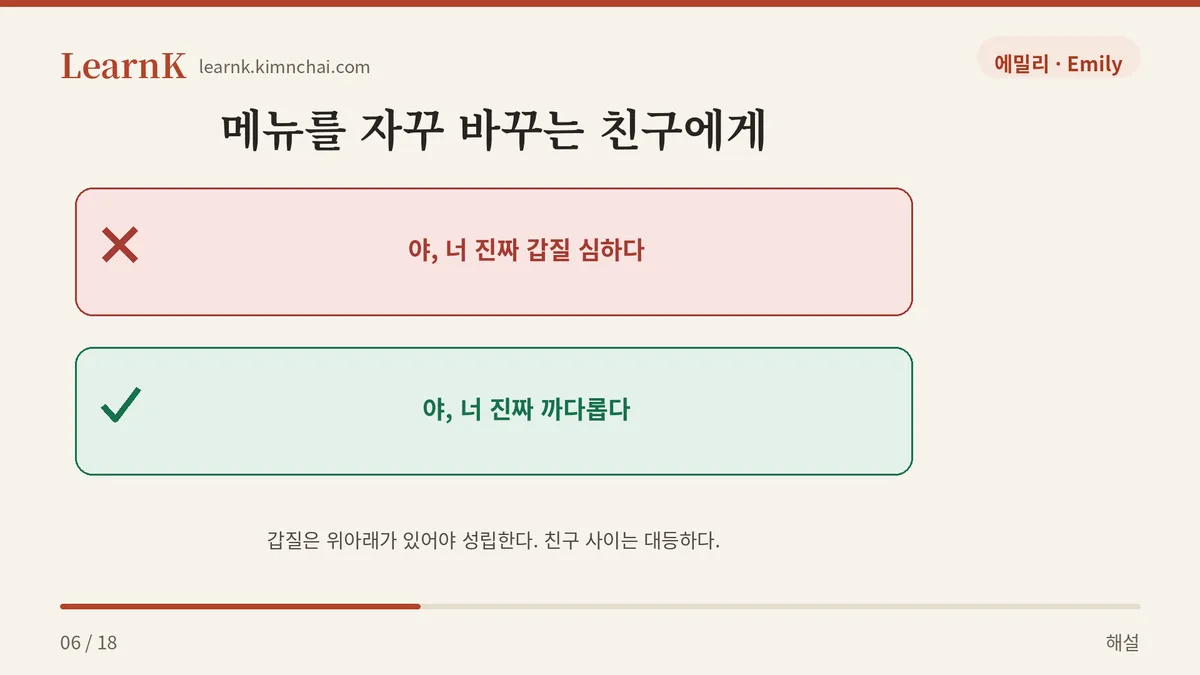
✗ (to a friend who keeps changing their order) 야, 너 진짜 갑질 심하다. (ya, neo jinjja gapjil simhada.) ✓ (to a friend) 야, 너 진짜 까다롭다. (ya, neo jinjja kkadaropda.) — Wow, you are seriously picky. → 갑질 only works when there’s a difference in status. You don’t use it for fussiness between equals. 까다롭다 (kkadaropda, picky) or 유별나다 (yubyeollada, particular) is what belongs here.
✗ (to the boss’s face) 부장님, 그거 갑질 아닌가요? (bujangnim, geugeo gapjil aningayo?) ✓ (quietly, to a coworker) 부장님 저건 좀 갑질 아니야? (bujangnim jeogeon jom gapjil aniya?) — Isn’t what the manager just did kind of gapjil? → 갑질 is an accusation. Used to the person’s face, it isn’t a critique — it’s a declaration of war. Normally it’s used when talking with a third party, or in an official report or news article.
Example sentences by situation
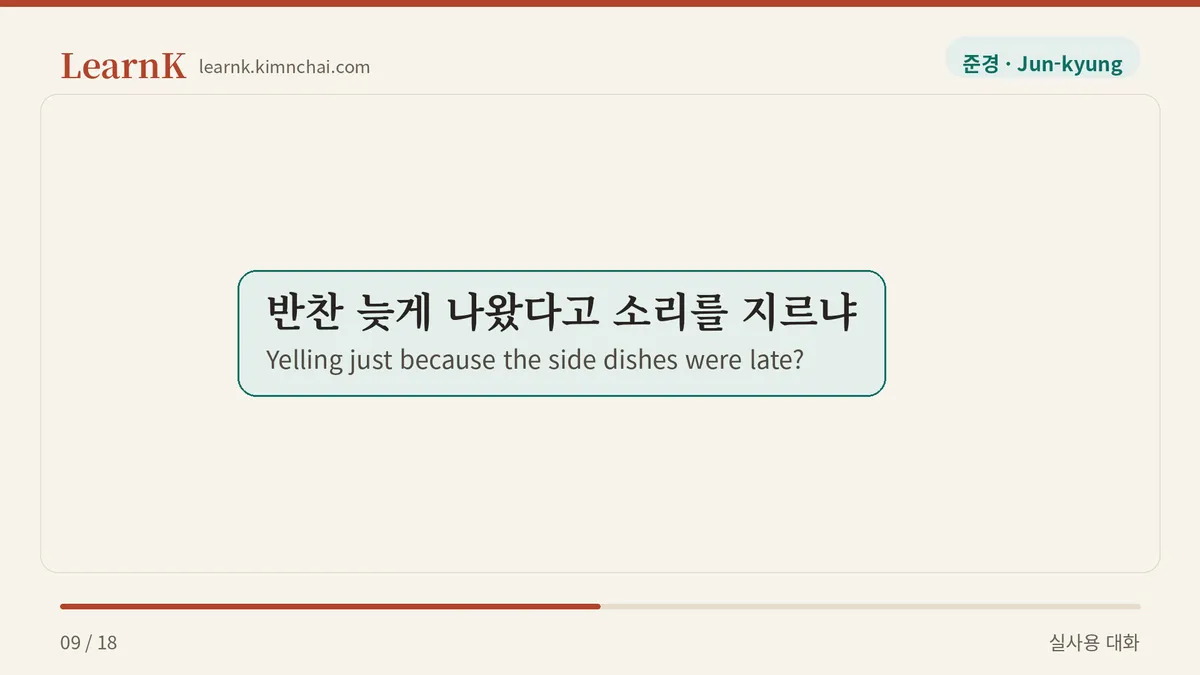
1. When a friend working part-time at a convenience store vents to you
저 손님 갑질이 진짜 심해. 카드를 던지듯이 놓고 가. (jeo sonnim gapjiri jinjja simhae. kadeureul deonjideusi noko ga.) That customer’s gapjil is really bad. He practically throws his card down and walks off. 저 손님은 갑질이 정말 심해. 카드를 던지는 것처럼 놓고 가더라. — the same thing in fuller, more standard phrasing
The customer didn’t swear and didn’t shout. Just the way he tosses the card down is enough for the word 갑질 to come out. 갑질이 심하다 (gapjiri simhada) is the most common pairing for talking about degree.
2. Talking about your team leader with a coworker on the way home
팀장이 주말에 자기 이삿짐 나르라고 했다니까? 이건 그냥 갑질이야. (timjangi jumare jagi isatjjim nallarago haetdanikka? igeon geunyang gapjiriya.) The team leader told me to haul his moving boxes on the weekend, I’m telling you. This is just plain gapjil. 팀장이 주말에 자기 이사 짐을 옮기라고 했어. 이건 그냥 갑질이지. — the same thing in fuller, more standard phrasing
The key point is that he assigned a private task with nothing to do with work. 이건 그냥 갑질이야 (igeon geunyang gapjiriya) is a verdict-delivering phrase, used to sum up the situation you just described in a single line.
3. In a formal setting, explaining company policy
저희 회사는 직장 내 갑질을 익명으로 신고할 수 있어요. (jeohui hoesaneun jikjang nae gapjireul ingmyeongeuro singohal su isseoyo.) At our company you can report workplace gapjil anonymously. 우리 회사에는 직장 내 갑질을 익명으로 신고하는 제도가 있습니다. — the same thing in fuller, more standard phrasing
갑질 is not slang. It goes straight into polite speech and formal explanations of company policy like this. It’s a newly coined word, but it has already settled into official documents and legal notices.
Politeness levels and similar expressions
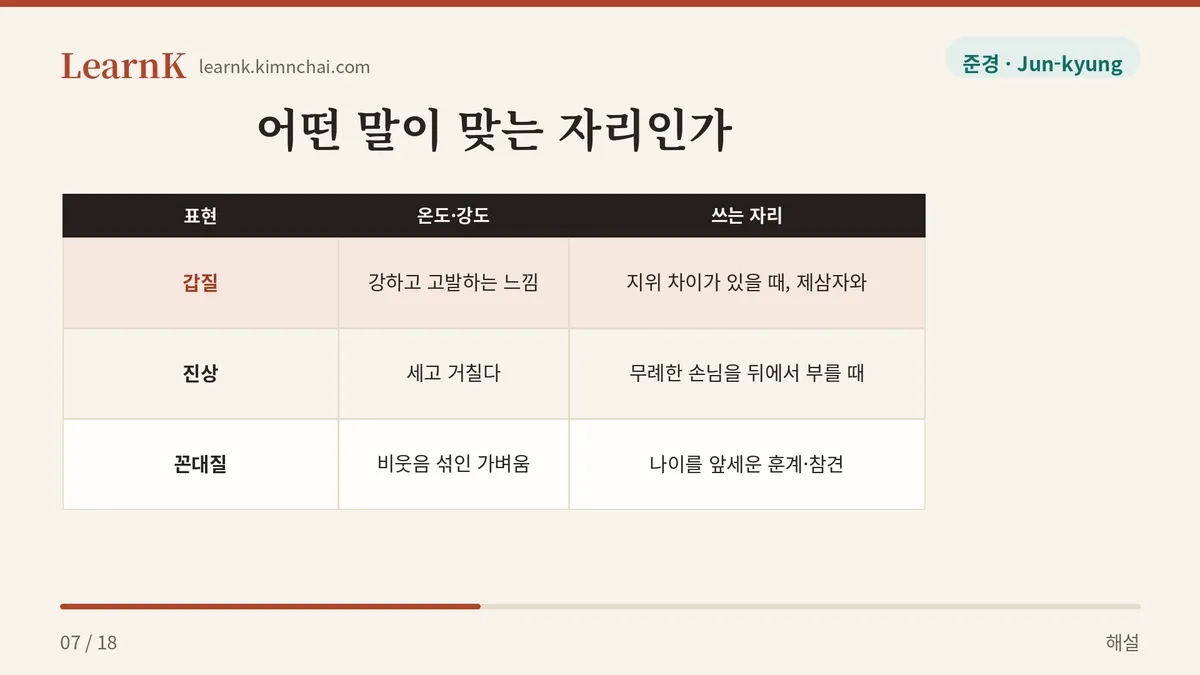
갑질 itself doesn’t discriminate between casual and polite speech. You can say 갑질이야 (gapjiriya) or 갑질입니다 (gapjirimnida). The one constraint, as we saw above, is that you don’t use it directly in front of the person when that person is your superior. Comparing it with similar words makes its place clearer.
| Expression | Temperature / intensity | Where it’s used |
|---|---|---|
| 갑질 (gapjil) | Strong, accusatory | News, formal complaints, conversation with a third party. Never to the person’s face |
| 진상 (jinsang) | Harsh and coarse, close to a vulgar word | For calling a rude customer something behind their back. Used even with no status gap |
| 횡포 (hoengpo) | Heavy and literary | Large-scale wrongdoing by corporations or the powerful. Headlines and commentary |
| 꼰대질 (kkondaejil) | Light, with a note of mockery | Lecturing and meddling on the strength of age. More nagging than rudeness |
With the very same boss: repeated unfair orders make it 갑질, while nothing but lectures about the good old days makes it 꼰대질. A rude customer is doing 갑질, and when you refer to that customer behind their back, they’re a 진상. When a conglomerate does it systematically to its subcontractors, the newspapers write 횡포.
Cultural background — 甲 (gap) and 乙 (eul) in contracts
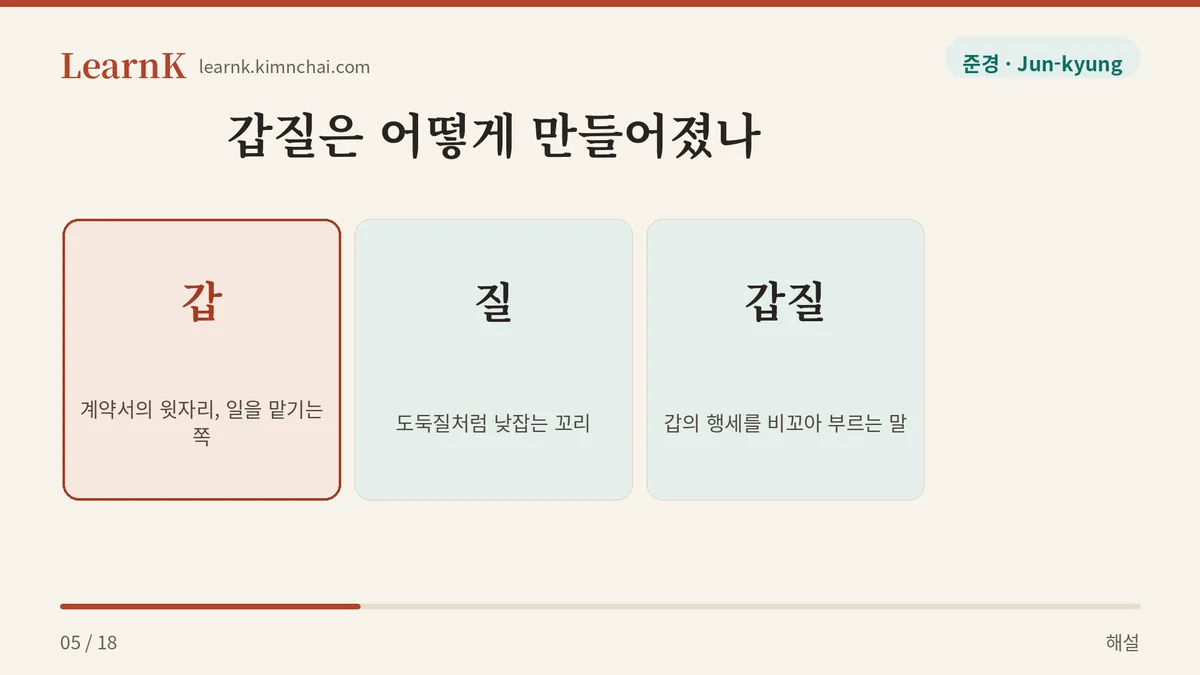
Korean contracts usually open with 갑과 을은 다음과 같이 계약한다 (gapgwa eureun daeumgwa gachi gyeyakanda), “Party A and Party B hereby contract as follows.” 갑 (gap, 甲) and 을 (eul, 乙) are the first and second of the ten heavenly stems — originally nothing more than symbols for putting things in order. By convention, though, the side paying the money and handing out the work took the 갑 slot, and the side receiving the work took the 을 slot. So 갑을 관계 (gabeul gwangye, “the gap-eul relationship”) came to mean a hierarchy rather than two equal contracting parties, and 을의 입장 (eurui ipjang, “the eul’s position”) came to point at the weaker party’s situation.
갑질 is what you get when the suffix -질 (-jil) is attached to that. -질 indicates an action; it can be neutral, as in 손질 (sonjil, trimming or prepping) and 바느질 (baneujil, sewing), but far more often it adds a belittling tone, as in 도둑질 (dodukjil, thievery). In other words, 갑질 is a dismissive name for “acting the 갑.” The blame is already built into how the word is formed, so the moment you use it, you’ve given up on being neutral.
The word spread widely in the 2010s. As disputes between conglomerates and their dealerships, and between head offices and subcontractors, drew heavy news coverage, it appeared in print constantly; and from July 2019, when the ban on 직장 내 괴롭힘 (jikjang nae goerophim, workplace harassment) took effect under the Labor Standards Act, companies set up prevention training and reporting channels. The 예방 교육 (prevention training) in the dictionary example above is exactly that system. These days a growing number of contracts label the parties with company names, or with 고객사·수행사 (gogaeksa·suhaengsa, client company and performing company), instead of 갑 and 을 — an experiment in whether changing the word might change the relationship.
Watch Korean dramas and you’ll often find this structure used as the skeleton of the story. 《미생》 (Misaeng, tvN, 2014), which portrays the everyday life of office workers, followed a protagonist who joins as a contract worker and endures from the 을 position, and it struck a deep chord with viewers; dramas about the 횡포 of chaebol owners have become practically a genre of their own. If you’re a Hallyu fan, the next time you meet this word in the subtitles, check first who is above and who is below in the scene. 갑질 is made by that relationship before it’s made by the line of dialogue.
Today’s quiz
Which of the following situations can be called 갑질 (gapjil)?
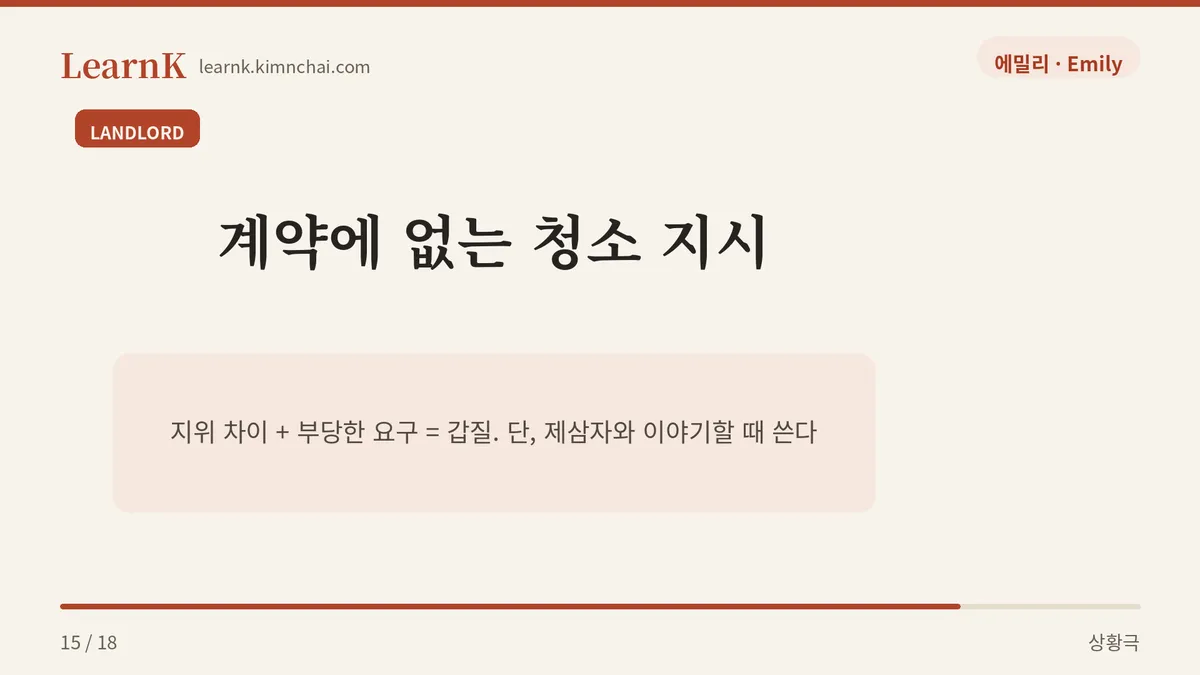
① A friend showed up 30 minutes late to your meetup. ② The landlord of a studio apartment made the tenant clean the building, which wasn’t in the contract. ③ My younger sibling went out wearing my clothes without saying a word.
Answer: ②
A landlord and a tenant are 갑 and 을 under a contract, and the landlord demanded something the contract didn’t cover — so both “status gap” and “unfair demand” are in place. ① and ③ are rude or inconsiderate, but there’s no up and down between the people involved, so they aren’t 갑질. For those you’d reach for 예의가 없다 (yeuiga eopda, “has no manners”) or 매너가 없다 (maeneoga eopda, “has no manners”).
Definitions and example sentences are from the National Institute of Korean Language’s Basic Korean Dictionary (krdict.korean.go.kr); that portion of this post, including our translations, is licensed under CC BY-SA 2.0 KR.