'헷갈리다 (hetgallida)' — The One Word for When Your Head Is a Jumbled Mess
Have you ever missed your stop on the subway? Or called a friend by the wrong name? When your head gets all jumbled up and you can’t get your bearings, Korean people reach for this one word. Today’s expression is 헷갈리다 (hetgallida).
헷갈리다 (hetgallida)
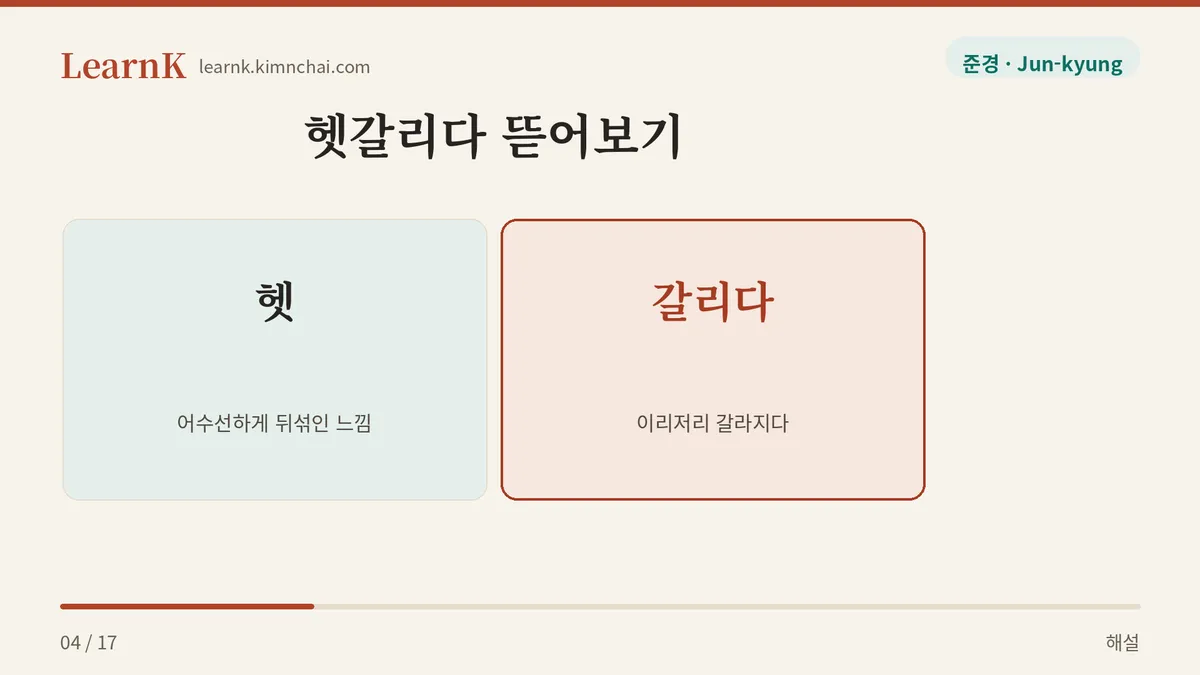
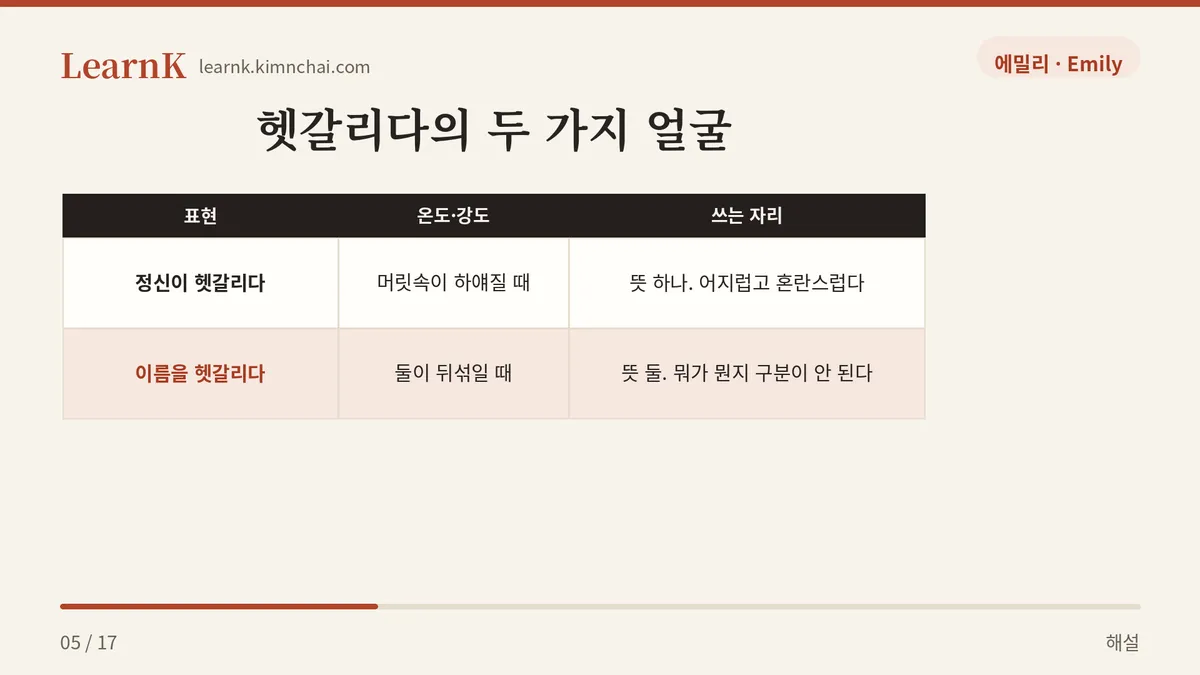
헷갈리다 (hetgallida) is used in two main situations. One is when your mind feels foggy and confused; the other is when several things get mixed together so you can’t tell what’s what. The closest English equivalents are “I’m confused” or “I get mixed up.”
The key point is that this word describes your own state. Someone can make you confused, but usually you use it to express what’s going on in your own head, as in “(내가) 헷갈려 — I’m confused” or “(나는) 헷갈렸어 — I got confused.” When test questions all look alike, when two people’s faces resemble each other, when the roads are complicated — it’s a verb that pops out several times a day in everyday life, so it really comes in handy.
Checking with the National Institute of Korean Language dictionary
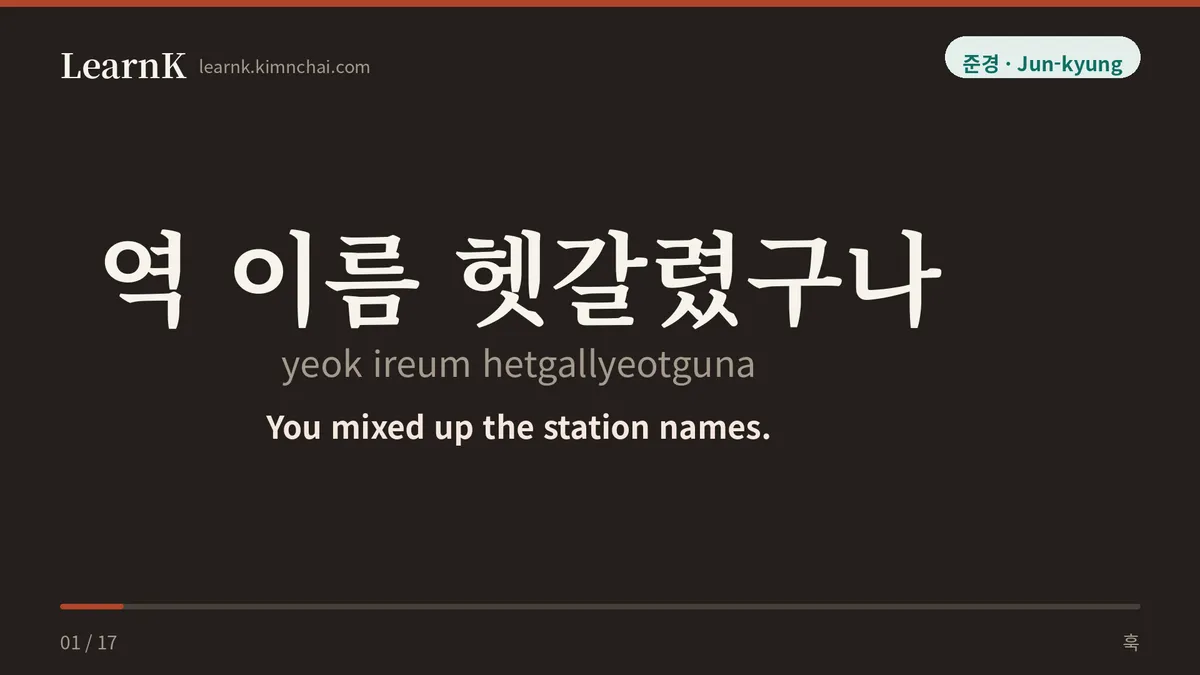
The National Institute of Korean Language’s Basic Korean Dictionary defines this word like this.
헷갈리다 (verb)
- To become mentally dizzy and confused. [en] get confused; become disordered; descend into chaos — To feel dizzy and confused. [es] confundirse — Sentirse mareado y confundido. [zh] 错乱,不集中 — 精神变得混乱。 — National Institute of Korean Language, Basic Korean Dictionary (krdict.korean.go.kr)
헷갈리다 (verb) 2. To fail to find the direction of things because many things are mixed together. [en] get confused; become mixed up; be jumbled — To fail to set a direction of a task as many things are mixed up. [ja] こんがらがる — 色々なものが入り混じって、物事の方向が決められない。 [zh] 混淆,混杂,弄混 — 各种东西混在一起,找不到事情的方向。 — National Institute of Korean Language, Basic Korean Dictionary (krdict.korean.go.kr)
Let’s also take a look at the real usage examples the dictionary provides.
- 긴가민가 헷갈리다.
- 길이 헷갈리다.
- 이름을 헷갈리다.
- 방향을 헷갈리다.
- 정신이 헷갈리다. — National Institute of Korean Language, Basic Korean Dictionary (krdict.korean.go.kr)
- 긴가민가 헷갈리다 (gingaminga hetgallida): ‘긴가민가 (gingaminga)’ describes the state of not being sure whether it’s this one or that one. When you’re unsure whether this answer or that one is right, this is exactly the phrase.
- 길이 헷갈리다 (giri hetgallida): You use this when the alleys all look the same in a neighborhood you’re visiting for the first time and you can’t get your bearings.
- 이름을 헷갈리다 (ireumeul hetgallida): This is for when you keep swapping the names of twins or two people with similar names.
- 정신이 헷갈리다 (jeongsini hetgallida): When work piles up all at once and your mind goes blank, this fits meaning 1 (mind feeling foggy) perfectly.
By the way, a Portuguese translation isn’t included in the dictionary, so if we render it by meaning it comes out to something like ficar confuso(a). (This Portuguese gloss is not from the dictionary — we translated it ourselves.)
Seeing it in a real conversation
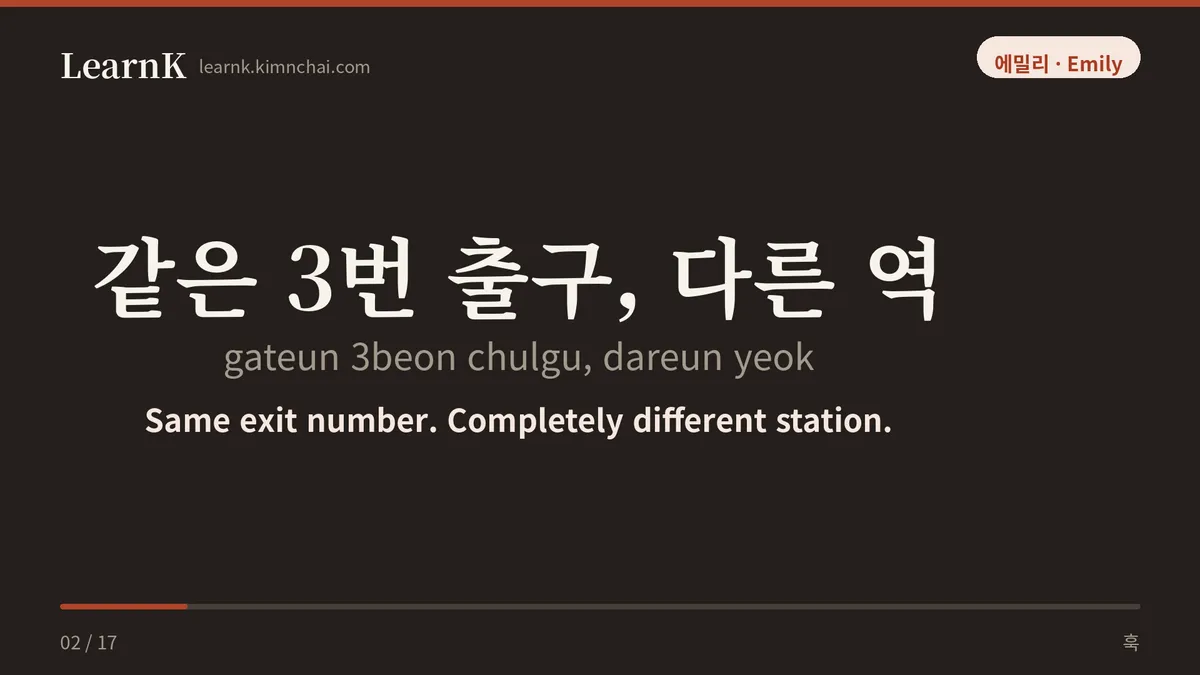
Situation: In front of the subway station exit where they agreed to meet. Jun-kyung has been waiting for 30 minutes, but Emily is nowhere to be seen. Just then, the phone rings.
Jun-kyung: 너 지금 어디야? 나 3번 출구 앞인데. Where are you right now? I’m in front of exit 3.
Emily: 어? 나도 3번 출구야… 아, 잠깐. 여기 ‘을지로3가’네. 우리 ‘을지로입구’에서 보기로 한 거 아니야? Huh? I’m at exit 3 too… wait. This is Euljiro 3-ga. Weren’t we supposed to meet at Euljiro Ipgu?
Jun-kyung: 아 진짜? 역 이름 헷갈렸구나. 하긴 이름이 비슷해서 나도 맨날 헷갈려. Oh, really? You mixed up the station names. Well, the names are similar so I always get confused too.
Emily: 아 완전 미안해ㅠㅠ 한 정거장만 더 가면 되지? Oh, I’m so sorry ㅠㅠ I just need to go one more stop, right?
Jun-kyung: 응, 금방이야. 천천히 와, 나 앞에 카페에서 기다릴게. Yeah, it’s close. Take your time, I’ll wait at the cafe up front.
Mixing things up because subway station names sound alike — it’s such a common thing in Korea that there’s no place where 헷갈리다 (hetgallida) feels more natural.
Example sentences by situation
- Before an exam: “이 문법이랑 저 문법이 자꾸 헷갈려서 계속 틀려.” (i munbeobirang jeo munbeobi jakku hetgallyeoseo gyesok teullyeo) — When you keep swapping two grammar points that look similar.
- While shopping: “검은색이랑 남색이 너무 비슷해서 헷갈리네요.” (geomeunsaegirang namsaegi neomu bisutaeseo hetgallineyo) — When the colors resemble each other so subtly that you can’t tell them apart, in polite speech.
- On the road: “여기 왔던 길 맞나? 방향이 헷갈린다.” (yeogi watdeon gil manna? banghyangi hetgallinda) — When your sense of direction gets fuzzy, said almost like talking to yourself.
Polite and casual speech, and similar expressions
- Casual: 헷갈려 / 헷갈렸어 (hetgallyeo / hetgallyeosseo)
- Polite: 헷갈려요 / 헷갈립니다 (hetgallyeoyo / hetgallimnida)
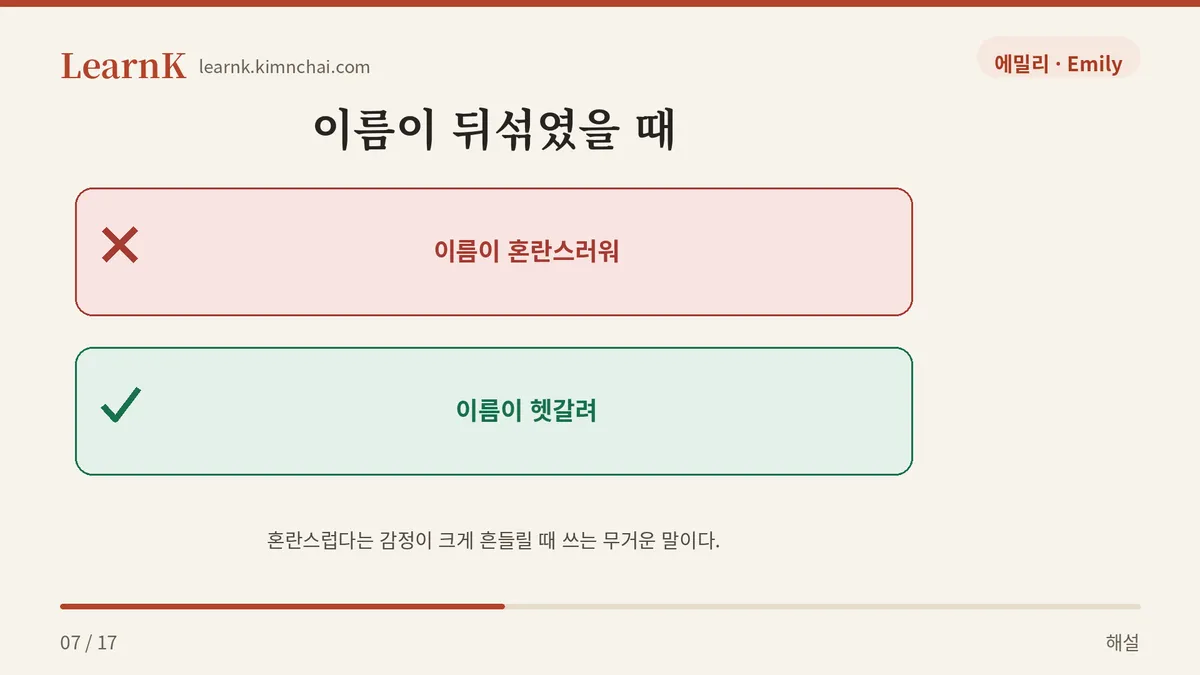
A similar word is 혼란스럽다 (hollanseureopda), but this one feels heavier and more serious, so it’s used when your emotions are deeply shaken. 헷갈리다 (hetgallida) is far lighter and more everyday. “이름이 혼란스러워” sounds awkward, but “이름이 헷갈려” is perfectly natural. Also, 아리송하다 (arisonghada) is used when you’re unsure of an answer, and 어리둥절하다 (eoridungjeolhada) is used when you suddenly can’t keep up with a situation.
A look at the cultural background
Watch a Korean drama and you’ll often see scenes where two characters mistake each other, or where the plot gets tangled because of twins or look-alikes. In those moments, you can hear a character press a hand to their head and blurt out “아, 헷갈려 — Ugh, I’m so confused.” It’s the same in daily life. When someone mixes up the date while making plans over KakaoTalk, loses their direction at a subway transfer station, or has their papers get jumbled during a meeting — instead of explaining at length, Korean people just wrap up the situation with one word: “헷갈려요.” Once you can use this word naturally, your Korean will sound a whole lot more ‘real.‘
Closing quiz
Two of your friends have similar names, so you keep swapping them. Which word fits the blank?
“미안, 내가 두 사람 이름을 자꾸 ______.”
① 헷갈려 ② 배고파 ③ 졸려
(Answer: ① 헷갈려 — because it’s a situation where the names get mixed up and you can’t tell them apart!)
Definitions and example sentences are from the National Institute of Korean Language’s Basic Korean Dictionary (krdict.korean.go.kr); that portion of this post, including our translations, is licensed under CC BY-SA 2.0 KR.