호떡 (hotteok) — The Hot Round You Take in Both Hands on the Day of the First Snow
On a winter evening, if a wave of frying-oil smell hits you outside a subway exit and five or six people are standing in line without saying a word, nine times out of ten that’s what they’re waiting for. 호떡 (hotteok) is defined as a Chinese-style tteok made by kneading wheat flour or glutinous rice flour, stuffing it with a sugar filling, and pan-frying it flat and round. They fold it in half into a paper cup and hand it over; you take it with both hands and, because it’s scalding, bite it from the edge a little at a time. Rush it and bite the middle first, and the melted brown sugar comes gushing out and burns the roof of your mouth — anyone who has spent even one winter in Korea has been through it at least once.
호떡 is the name of an object, so it has no built-in politeness level of its own — no honorific or casual form. What it does carry, and very strongly, is a sense of season. You rarely see a hotteok stall in summer. So when a Korean says 「호떡 먹고 싶다 (hotteok meokgo sipda)」, it isn’t simply “I’m hungry” — it’s closer to a weather report: “it’s gotten pretty cold.” The price is psychologically fixed too, so the word comes bundled with the feeling of a snack you buy with loose change, without ever really opening your wallet. For a learner, knowing where and when this word gets said matters far more than knowing what it means.
호떡
Checking it in the National Institute of Korean Language dictionary
호떡 (hotteok) 「noun」 밀가루나 찹쌀가루를 반죽하여 설탕으로 소를 넣고 프라이팬 등에 둥글고 넓적하게 구운 중국식 떡. (milgaruna chapssalgarureul banjukhayeo seoltangeuro soreul neoko peuraipaen deunge dunggeulgo neopjeokhage guun jungguksik tteok.) A Chinese-style tteok made by kneading wheat flour or glutinous rice flour, putting in a sugar filling, and frying it flat and round in a pan or the like. — National Institute of Korean Language, Basic Korean Dictionary (krdict.korean.go.kr)
The dictionary carries parallel translations in six languages alongside the entry.
[en] hotteok; Korean pancake with sweet fillings — A Korean pancake, which originated from China, made by pan-frying a flat, round dough kneaded with wheat or glutinous rice flour and stuffed with sweet fillings such as sugar. [ja] ホットク — 小麦粉やもち米粉をこねて真ん中に砂糖を入れて丸め、フライパンなどで平たく焼いた中国式のトク。 [es] hotteok, crepe relleno — Panqueque coreano con relleno dulce, originado en China, que se hace friendo masa de harina o de arroz glutinoso en forma redonda y chata. [zh] 油煎糖饼 — 在揉好的面团或糯米面团里放入少许砂糖,再放到煎锅等炊具上烤出的又圆又扁的中式饼。 — National Institute of Korean Language, Basic Korean Dictionary (krdict.korean.go.kr)
(The dictionary carries no Portuguese gloss, so we supply one for reference — hotteok, panqueca coreana recheada com açúcar. That one line is our own translation, not a dictionary quotation.)
Notice that the English gloss is pancake, not rice cake. The name ends in 떡 (tteok), but from the very first words of the definition the dictionary pins it down as something 「kneaded… and fried」.
Here are the actual usage examples the dictionary lists.
오늘따라 어머니가 끓여 주시던 된장국, 그리고 아버지가 가끔 만들어 주시던 호떡이 몹시 그립다. (oneulttara eomeoniga kkeullyeo jusideon doenjangguk, geurigo abeojiga gakkeum mandeureo jusideon hotteogi mopsi geuripda.) Today of all days, I badly miss the doenjang soup my mother used to make and the hotteok my father would fry up now and then. — National Institute of Korean Language, Basic Korean Dictionary (krdict.korean.go.kr)
This sentence shows that hotteok isn’t only food you buy — it’s also remembered as something a parent fried for you at home. It’s the kind of thing people say when they’re living far away or apart from family.
승규는 떡볶이나 호떡 같은 길거리 음식을 좋아한다. (Seungguneun tteokbokkina hotteok gateun gilgeori eumsigeul joahanda.) Seung-gyu likes street food such as tteokbokki and hotteok. — National Institute of Korean Language, Basic Korean Dictionary (krdict.korean.go.kr)
This one sorts hotteok into its category in a single stroke. It sits inside the big box labeled 「길거리 음식 (gilgeori eumsik)」, street food, right next to tteokbokki.
날씨가 추워지니깐 따끈한 호떡이 생각난다. (nalssiga chuwojinikkan ttakkeunhan hotteogi saenggangnanda.) Now that the weather has turned cold, I find myself thinking about warm hotteok. — National Institute of Korean Language, Basic Korean Dictionary (krdict.korean.go.kr)
Here’s that seasonal feeling laid out plainly. It’s no accident that 「추워지니깐 (chuwojinikkan)」 and 「호떡 (hotteok)」 keep showing up in the same sentence.
우리 어머니는 광장의 한 모퉁이에서 호떡 장사를 하신다. (uri eomeonineun gwangjangui han motungieseo hotteok jangsareul hasinda.) My mother sells hotteok on a corner of the plaza. — National Institute of Korean Language, Basic Korean Dictionary (krdict.korean.go.kr)
This sentence shines a light on another side: hotteok is also somebody’s livelihood. 「호떡 장사를 하다 (hotteok jangsareul hada)」, to sell hotteok for a living, is a chunk worth memorizing whole.
Seeing it in a real conversation
Situation: Friday evening, the first snow of the year, outside Exit 3 of the subway station on the way home from work. There’s a long line at the hotteok stall.
Jun-kyung: 야, 저 줄 봐. 첫눈 오니까 다들 똑같은 생각 하네. Hey, look at that line. First snow and everyone gets the same idea.
Emily: 나 이거 먹으려고 저녁 반만 먹었어. 아저씨, 호떡 두 개요! I only ate half my dinner to save room for this. Sir, two hotteok please!
Jun-kyung: 두 개? 하나는 내 거 아니야? 나도 호떡 좋아하는데. Two? Isn’t one of them mine? I like hotteok too, you know.
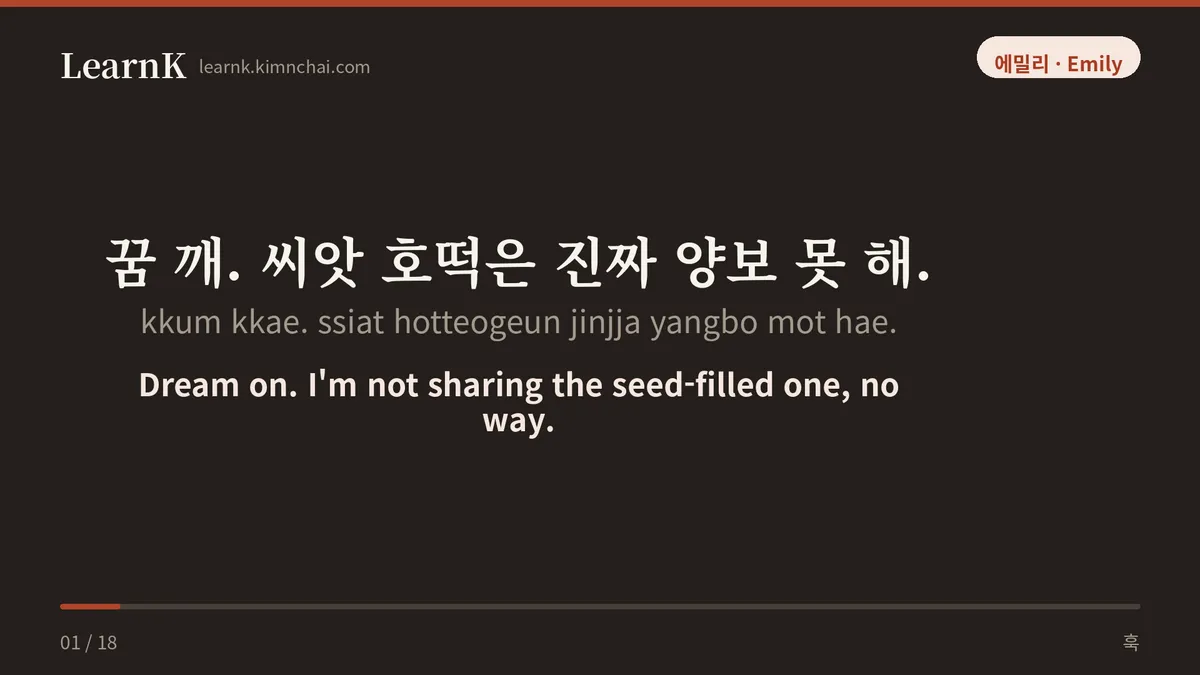
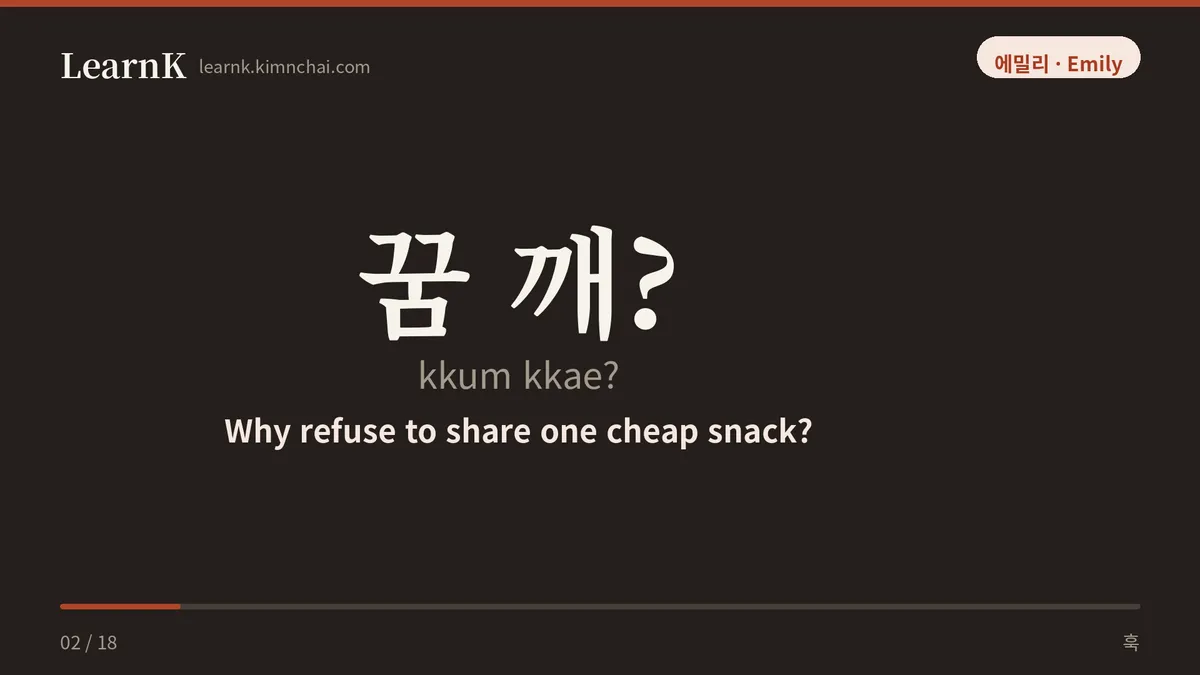
Emily: 꿈 깨. 씨앗 호떡은 진짜 양보 못 해. Dream on. I’m not sharing the seed-filled one, no way.
Jun-kyung: 아, 근데 아직 엄청 뜨거우니까 가운데부터 물지 마. 저번에 입천장 다 까졌잖아. Oh, but it’s still really hot, so don’t bite the middle first. You burned the roof of your mouth last time.
Emily: 알아, 알아. 근데 이건 뜨거울 때 먹어야 맛있단 말이야. I know, I know. But this only tastes right when it’s hot.
This is where it sounds off
호떡 is the name of an object, so it isn’t a word you adjust for whoever you’re talking to. Instead, here are two misunderstandings learners trip over most often.
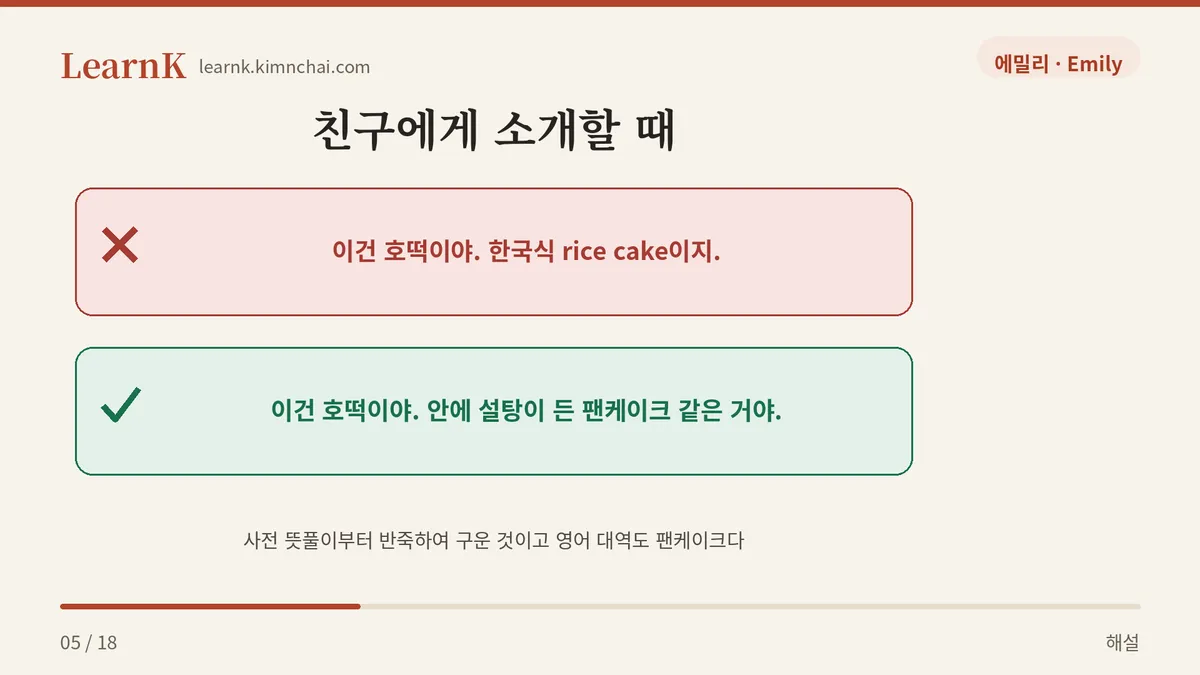
✗ (to a foreign friend) 이건 호떡이야. 한국식 rice cake이지. (igeon hotteogiya. hangungsik rice cake-iji.) This is hotteok. It’s a Korean-style rice cake. ✓ (to a foreign friend) 이건 호떡이야. 안에 설탕이 든 팬케이크 같은 거야. (igeon hotteogiya. ane seoltangi deun paenkeikeu gateun geoya.) This is hotteok. It’s like a pancake with sugar inside. → Because the name ends in 떡 (tteok), it’s easy to assume it’s a rice cake, but the dictionary definition says right up front that it’s 「kneaded… and fried」, and the English gloss is pancake. Both the ingredients and the method are different from tteok, which is made by steaming rice and pounding it.
✗ (noticing a commotion in the office) 밖에 호떡집에 불이 났나 봐요. 소방서에 전화할까요? (bakke hotteokjibe buri nanna bwayo. sobangseoe jeonhwahalkkayo?) Sounds like the hotteok shop outside is on fire. Should I call the fire station? ✓ (noticing a commotion in the office) 아침부터 왜 이렇게 호떡집에 불난 것처럼 시끄러워? (achimbuteo wae ireoke hotteokjibe bullan geotcheoreom sikkeureowo?) Why is it so loud in here first thing in the morning, like a fire broke out at a hotteok shop? → 「호떡집에 불난 것 같다 (hotteokjibe bullan geot gatda)」 is an idiom for a scene that’s chaotically noisy and buzzing. It isn’t describing an actual fire, so taking it literally sends the conversation somewhere strange.
Example sentences by situation
1. Ordering at the stall — when the line is long, it’s normal to keep it short for the people behind you.
호떡 두 개 주세요. 하나는 씨앗호떡으로요. (hotteok du gae juseyo. hananeun ssiat-hotteogeuro-yo.) Two hotteok, please. Make one of them a seed hotteok. 호떡 두 개 주세요. 하나는 씨앗 호떡으로 주세요. (the fuller version)
2. Grabbing a coworker on the way home — 「~이나 하나 (~ina hana)」 is a light, low-pressure way to suggest something.
날도 추운데 호떡이나 하나 먹고 갈까? (naldo chuunde hotteogina hana meokgo galkka?) It’s cold out — want to grab a hotteok before we head off? 날씨도 추운데 호떡이라도 하나 먹고 갈까요? (the politer version)
3. Saying you make them at home — these days supermarkets sell a mix with the dough and the sugar filling in one bag.
요즘은 마트에서 호떡 믹스를 팔아서 집에서도 구워 먹어요. (yojeumeun mateueseo hotteok mikseureul paraseo jibeseodo guwo meogeoyo.) These days the supermarket sells hotteok mix, so I fry them at home too.
Politeness levels and related expressions
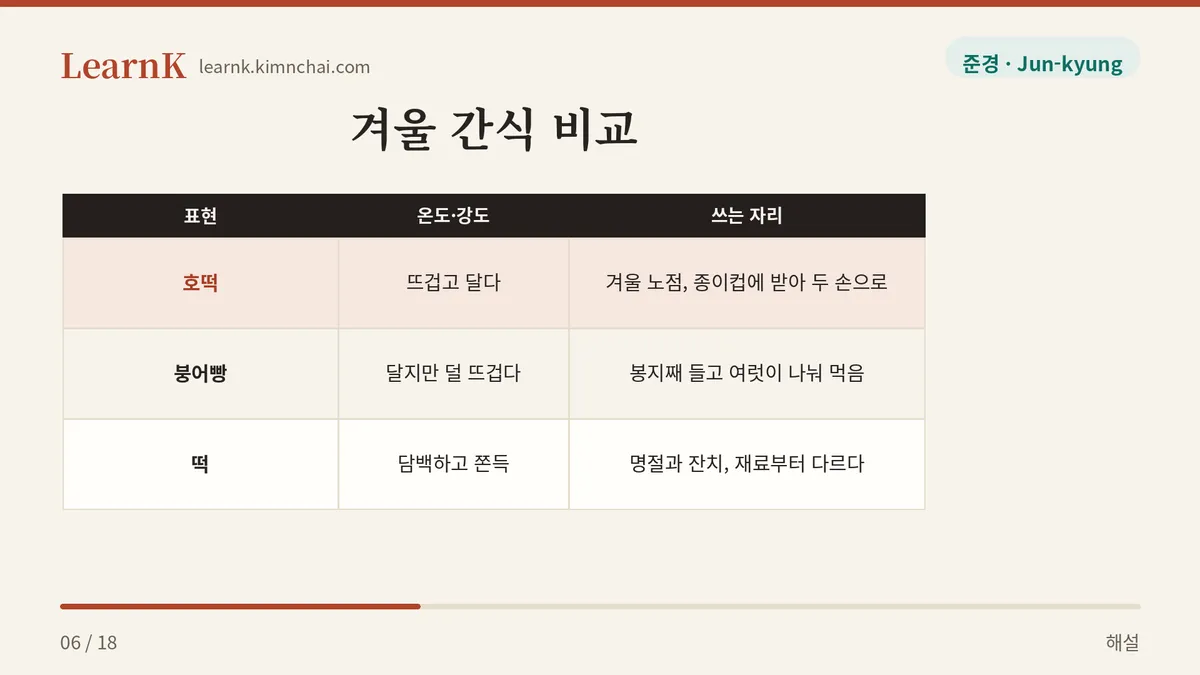
호떡 itself has no honorific form, but the end of your sentence changes depending on where you’re buying it. To the woman running the stall: 호떡 하나 주세요 (hotteok hana juseyo). To a friend: 호떡 하나 줘 (hotteok hana jwo). To count them you use 「개 (gae)」 — 호떡 한 개 (hotteok han gae), 두 개 (du gae).
| Expression | Heat & intensity | Where it belongs |
|---|---|---|
| 호떡 (hotteok) | Hot and sweet. Leaves your hands sticky | Winter street stalls, outside subway exits |
| 붕어빵 (bungeoppang) | Sweet but less scalding. Carried around by the bagful | The same winter stalls. You buy several and share |
| 떡 (tteok) | Mild and chewy | Holidays, celebrations, gifts. Different from hotteok right down to the ingredients |
| 전 (jeon) | Savory and oily | The dinner table, holidays, drinking snacks on a rainy day |
Cultural background — a border still sitting in the name
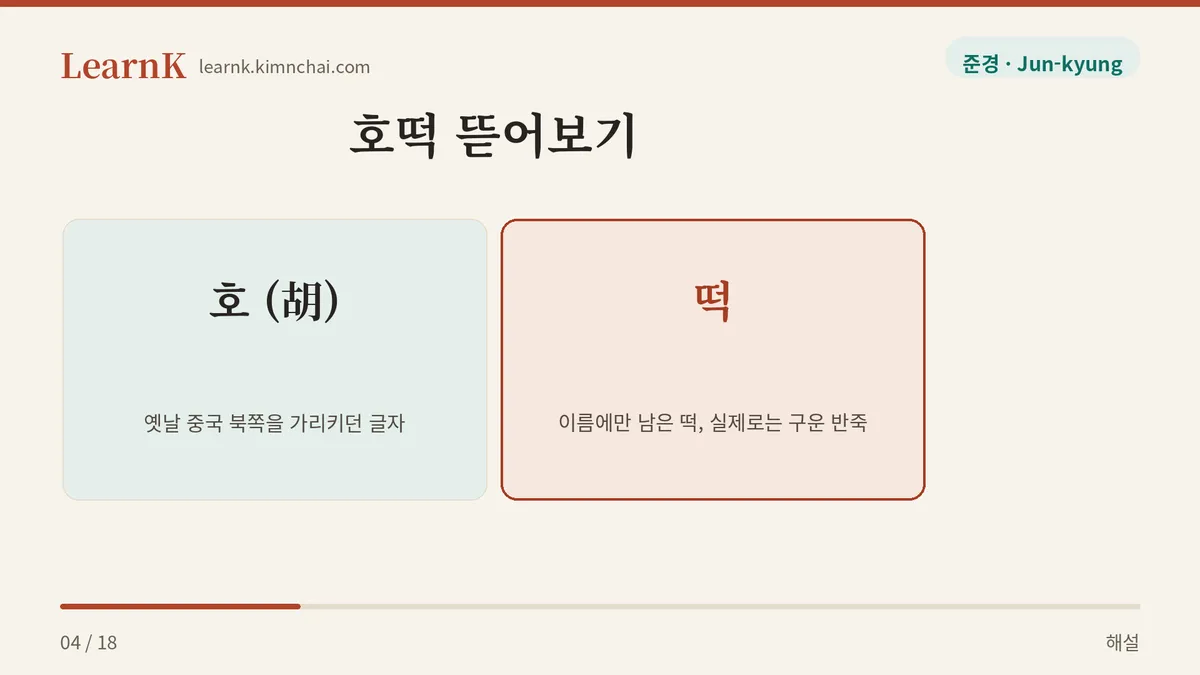
The 호 in 호떡 is the Chinese character 호 (胡), which in the old days pointed to the lands north of China. The same character shows up in 호두 (胡桃), walnut, and 후추 (胡椒), black pepper — all three carry a mark in their very names saying 「this came from outside」. That history is also why the dictionary bothers to write 「중국식 떡 (jungguksik tteok)」, Chinese-style tteok, into the definition. Hotteok is generally understood to have arrived through Chinese merchants after Korea opened its ports in the late nineteenth century, and to have settled into Korean street life from there.
Today it wears a different face region by region. Busan is famous for 씨앗호떡 (ssiat-hotteok), where the finished hotteok is sliced in half and a ladleful of nuts and seeds — sunflower seeds, peanuts — is poured inside; in Seoul stalls, the plain kind with a brown-sugar filling is the standard. And the reason winter dramas and variety shows keep giving us two people walking side by side, paper cups in hand, blowing on their hotteok, is that this food occupies exactly that spot: 「something you share with the person beside you on a cold day」. The fact that the idiom 「호떡집에 불난 것 같다 (hotteokjibe bullan geot gatda)」 is still alive tells you just how bustling hotteok shops once were.
Today’s quiz
Which of the following correctly describes 호떡 (hotteok)?
① A tteok made chewy by steaming rice ② Dough of wheat flour or glutinous rice flour with a sugar filling, fried flat and round in a pan ③ A cool snack that represents the summer season
Answer: ② — straight from the dictionary definition. ① is the most common misunderstanding, caused by the 떡 in the name; hotteok isn’t a steamed tteok but a fried food. ③ has the season backwards. 호떡 is a word that travels together with 「날씨가 추워지니깐 (nalssiga chuwojinikkan)」, “now that the weather has turned cold.”
Definitions and example sentences are from the National Institute of Korean Language’s Basic Korean Dictionary (krdict.korean.go.kr); that portion of this post, including our translations, is licensed under CC BY-SA 2.0 KR.