황당하다 (hwangdanghada) — The Moment Words Fail You, Right Before the Anger Arrives
황당하다
황당하다 (hwangdanghada) means that someone’s words or actions are insincere and downright absurd. You use it when something happens that makes no sense front to back — in that moment when, before you can even get angry, the words just stop coming.
Imagine it’s Saturday afternoon and you’ve gone out to meet a seller and pick up a bookshelf you bought secondhand. You’ve been standing there twenty minutes when a text arrives: “죄송해요, 제가 지금 부산이라서요.” (Sorry, I’m in Busan right now.) The first thing out of a Korean speaker’s mouth at a moment like this is “황당하네 (hwangdanghane).” It’s a little different from being angry. The anger comes next. 황당함 (hwangdangham) — that dumbfounded feeling — sits in front of it, in the spot where your brain can’t make the situation add up and you just stop for a second.
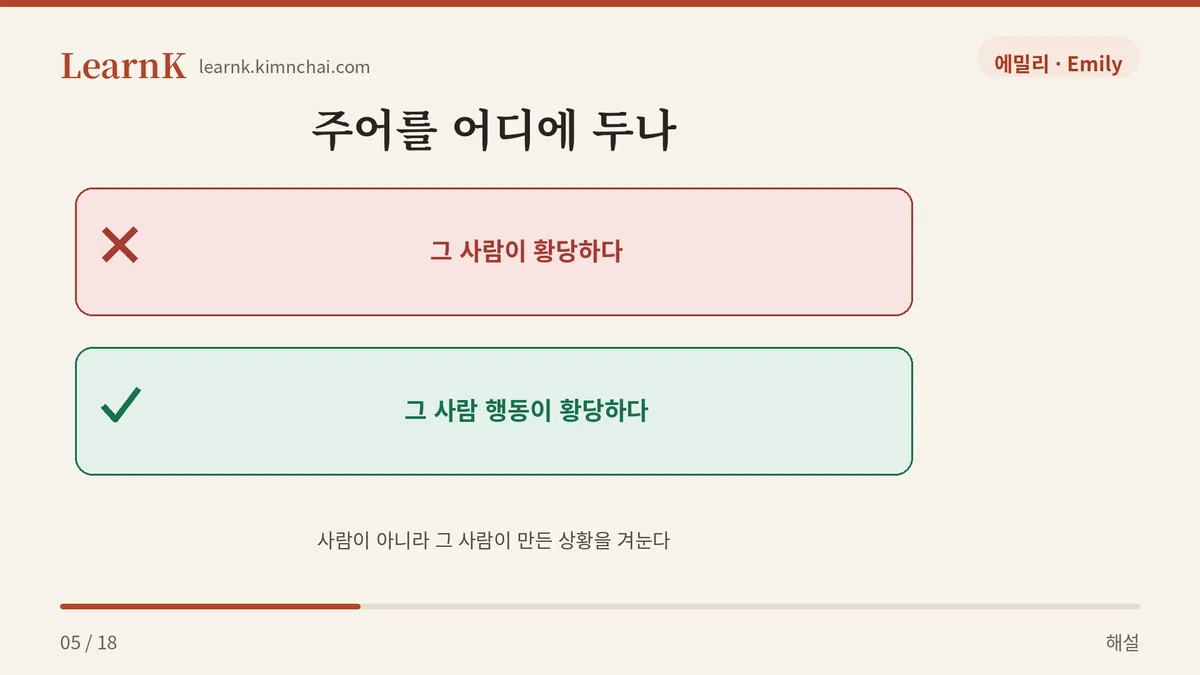
That’s why 황당하다 is used less like a word that delivers information and more like an interjection. When you say “야, 진짜 황당하다” (Wow, this is honestly absurd), the word is putting a state on display: “I don’t know how I’m supposed to take this right now.” The subject is usually not a person but an event, a situation, or a story. “그 사람이 황당하다” is much less natural than “그 사람 행동이 황당하다” (that person’s behavior is absurd) or “이야기가 황당하다” (the story is absurd). In Korean this word leans toward pointing at the situation someone has created rather than at the person directly. That said, to the listener it still lands as a verdict — “what you’re saying is nonsense” — which is where the usage restriction below comes from (don’t use it toward someone senior to you).
Learn the forms together too: 황당해 (hwangdanghae, casual) / 황당해요 (hwangdanghaeyo, polite) / 황당합니다 (hwangdanghamnida, formal) / 황당했다 (hwangdanghaetda, past) / 황당한 일 (hwangdanghan il, modifier form) / 황당하다는 반응 (hwangdanghadaneun baneung, a set phrase that turns up constantly in news articles).
Checking it in the National Institute of Korean Language dictionary
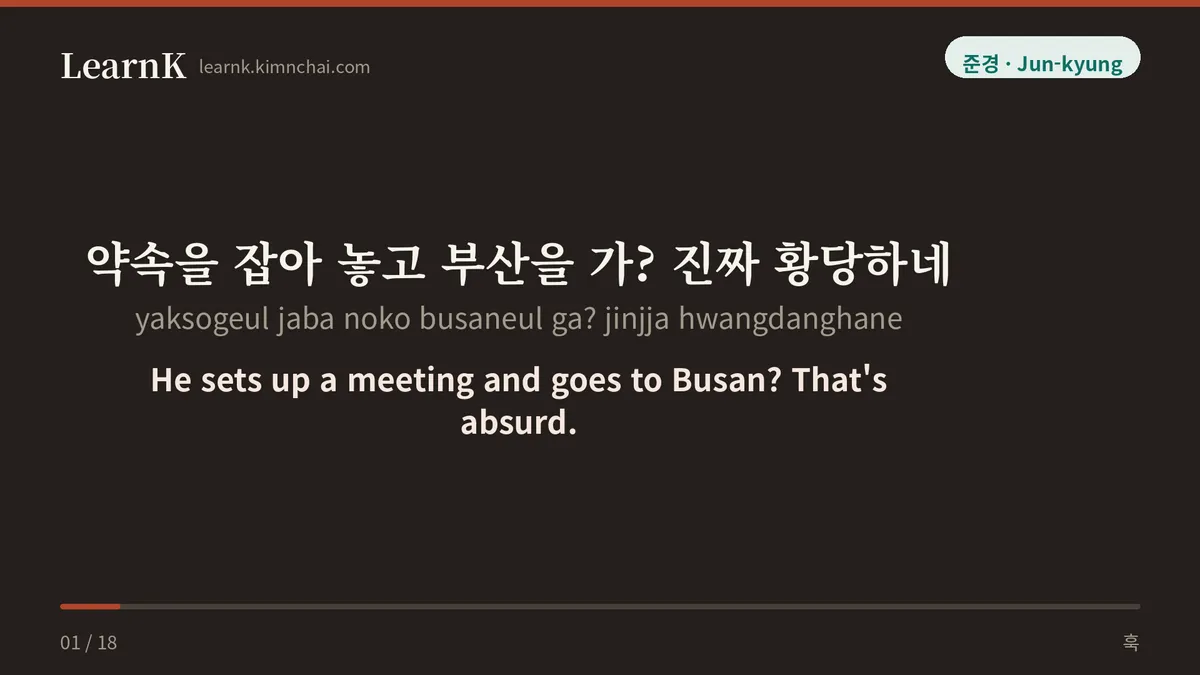
Let’s confirm the meaning in a dictionary published by a national institution. The National Institute of Korean Language’s Basic Korean Dictionary lists this word as an adjective.
황당하다 「Adjective」 말이나 행동 등이 진실하지 않고 터무니없다. (One’s words or actions are insincere and absurd.) [English] absurd; nonsensical; ridiculous — One’s words or acts being insincere and absurd. [Japanese] こうとうだ【荒唐だ】 — 言動に根拠がなく、でたらめである。 [Spanish] absurdo, ridículo — Que habla o actúa de manera poco sincera y absurda. [Chinese] 荒唐 — 话语、行为等不真实,莫名其妙。 — National Institute of Korean Language, Basic Korean Dictionary (krdict.korean.go.kr)
All four languages point in the same direction. English absurd, Spanish absurdo, Chinese 莫名其妙, Japanese でたらめ — every one of them means “this doesn’t add up.” No Portuguese gloss is listed in the dictionary; for reference it would come out to something like absurdo, sem sentido, ridículo, and we should note that this Portuguese rendering alone is ours, not dictionary material.
Here are the real usage examples from the same dictionary.
무지 황당하다. (muji hwangdanghada — It’s incredibly absurd.) 무지하게 황당하다. (mujihage hwangdanghada — It’s incredibly absurd.) 그렇게 큰돈을 들여 지은 건물인데 딱히 쓸 데가 없다니 황당하다. (geureoke keundoneul deuryeo jieun geonmurinde ttakhi sseul dega eopdani hwangdanghada — It’s absurd that a building put up with that much money has no particular use.) 그는 최근 불거진 은퇴설에 대해서 사실이 아니라며 황당하다는 반응을 보였다. (geuneun choegeun bulgeojin euntoeseore daehaeseo sasiri anirageo hwangdanghadaneun baneungeul boyeotda — Regarding the recent retirement rumors, he said they weren’t true and reacted with disbelief.) 이야기가 황당하다. (iyagiga hwangdanghada — The story is absurd.) — National Institute of Korean Language, Basic Korean Dictionary (krdict.korean.go.kr)
Here’s what situation each example is holding.
- 무지 황당하다 / 무지하게 황당하다 — There’s a reason these two sit side by side. The adverb 무지 (muji) is a colloquial word meaning ‘very, extremely,’ and the pair shows that both 무지 and 무지하게 are used. In actual conversation, the shorter “무지 황당하다” is the one you’ll hear more often.
- 그렇게 큰돈을 들여 지은 건물인데 딱히 쓸 데가 없다니 황당하다. — This sentence lays out the skeleton of 황당하다 exactly. The first half (a fortune was spent) and the second half (it’s useless) contradict each other. That mismatch is the condition for 황당함. You don’t use this word for things that are merely sad or unfortunate.
- 그는 최근 불거진 은퇴설에 대해서 사실이 아니라며 황당하다는 반응을 보였다. — This is a sentence pattern that appears wholesale in entertainment news. Because the press uses it almost automatically when a celebrity denies a rumor, memorizing “황당하다는 반응을 보였다 (reacted with disbelief) / 황당하다는 입장을 밝혔다 (stated that it was absurd)” as fixed chunks makes reading Korean articles a good deal easier.
- 이야기가 황당하다. — The subject isn’t a person, it’s a story. When a novel’s or a film’s plot rolls along with no plausibility, you say things like “스토리가 황당하다” (the story is absurd). Remember that this makes a completely natural sentence without ever being aimed at a person.
Seeing it in a real conversation
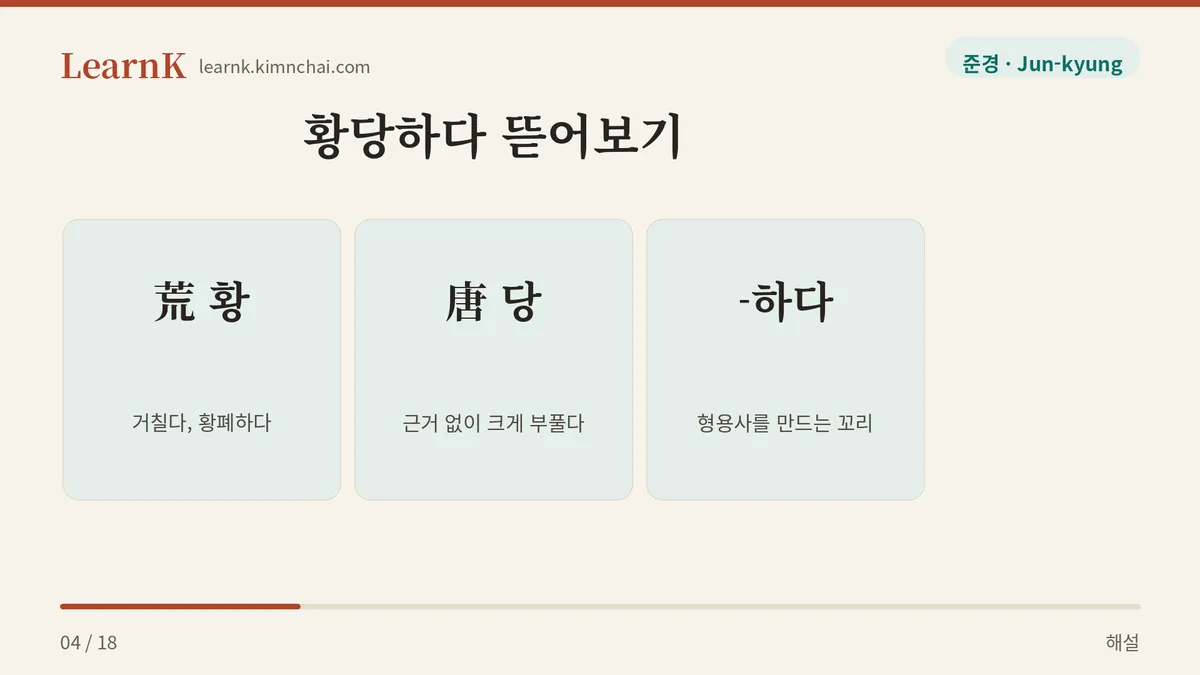
Situation: Saturday afternoon, the meetup spot in front of an apartment complex for a secondhand handoff. Emily has been standing there for twenty minutes.
Jun-kyung: 어? 너 왜 아직 여기 있어? 물건 못 받았어? Huh? Why are you still here? Didn’t you get the item?
Emily: 이십 분째 기다리는 중. 방금 문자 왔는데, 그 사람 지금 부산이래. I’ve been waiting twenty minutes. He just texted — he says he’s in Busan right now.
Jun-kyung: 부산? 아니, 약속을 잡아 놓고 부산을 가? 진짜 황당하네. Busan? He sets up a meeting and goes to Busan? That’s honestly absurd.
Emily: 그치. 나 너무 황당해서 답장도 못 했어. Right? I was so dumbfounded I couldn’t even reply.
Jun-kyung: 야, 그냥 잊어버려. 별점 하나 주고 떡볶이나 먹으러 가자. Hey, just forget it. Leave a one-star review and let’s go get tteokbokki.
Emily: 그래야겠다. 근데 이거 나중에 생각하면 더 황당할 것 같아. I guess so. But I think this’ll feel even more ridiculous later.
Using it this way sounds off
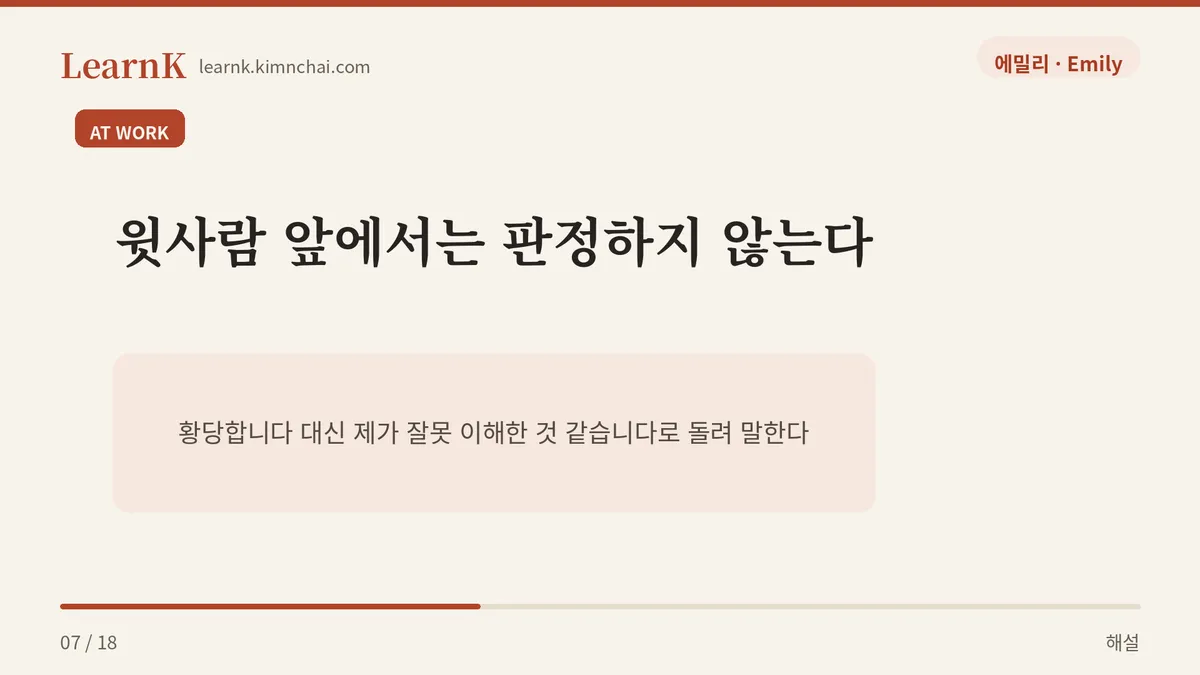
✗ (to your manager) 부장님, 그렇게 지시하시니까 정말 황당합니다. (Sir, the way you’re instructing me is truly absurd.) ✓ (to your manager) 부장님, 제가 잘못 이해한 것 같은데 한 번만 더 설명해 주실 수 있을까요? (Sir, I think I’ve misunderstood — could you explain it one more time?) → 황당하다 delivers a verdict on the other person’s words or actions: “that’s nonsense.” The grammar is fine and the honorific ending is correct, but aimed at someone senior it comes across as close to a protest. In front of someone above you, it’s safer not to hand down a verdict and instead to phrase it as “I don’t quite understand.”
✗ 십 년 만에 길에서 친구를 딱 만나서 진짜 황당했어. (I ran into a friend on the street after ten years and it was so absurd.) ✓ 십 년 만에 길에서 친구를 딱 만나서 진짜 깜짝 놀랐어. (I ran into a friend on the street after ten years and I was so startled.) → You don’t use it for a welcome surprise. 황당하다 has to carry a judgment that “this doesn’t make sense.” If something is merely surprising and doesn’t violate reason, 깜짝 놀라다 (kkamjjak nolrada) is the right choice.
Example sentences by situation
① When the food delivery is entirely the wrong order — You ordered chicken and there’s jokbal sitting at your door. It’s the kind of situation where a laugh comes out before the anger does.
아니, 치킨을 시켰는데 족발이 왔어. 진짜 황당해서 사진부터 찍었어. (ani, chikineul sikyeonneunde jokbari wasseo. jinjja hwangdanghaeseo sajinbuteo jjigeosseo.) → I ordered chicken and jokbal showed up. It was so absurd I took a photo first.
② When your paperwork keeps getting rejected — You’ve resubmitted the same documents three times to a government office or your company, and word comes back that it failed again. This is a place for holding the emotion down with polite speech.
서류를 세 번이나 다시 냈는데 또 안 됐대요. 좀 황당하네요. (seoryureul se beonina dasi naenneunde tto an dwaetdaeyo. jom hwangdanghaneyo.) → I resubmitted the documents three times and they say it still didn’t go through. It’s a bit absurd.
③ When a friend’s excuse for being late makes no sense — You’re not actually angry; you’re laughing because it’s ridiculous. This is the classic spot for the modifier form 황당한.
알람을 세 개 맞췄는데 세 개 다 껐대. 황당한 변명이지. (allameul se gae matchwonneunde se gae da kkeotdae. hwangdanghan byeonmyeongiji.) → He says he set three alarms and turned all three off. What an absurd excuse.
Polite and casual forms, and similar expressions
The casual form is 황당해 (hwangdanghae), and when you toss it out almost to yourself, you use 황당하네 (hwangdanghane). The polite form is 황당해요 (hwangdanghaeyo), and in a meeting or an official setting it becomes 황당합니다 (hwangdanghamnida). But as we saw above, switching to polite speech does not turn this into a word you can use toward someone senior. The restriction on this word comes not from its politeness level but from its verdict-passing nature.
Comparing it with similar words makes its position clearer.
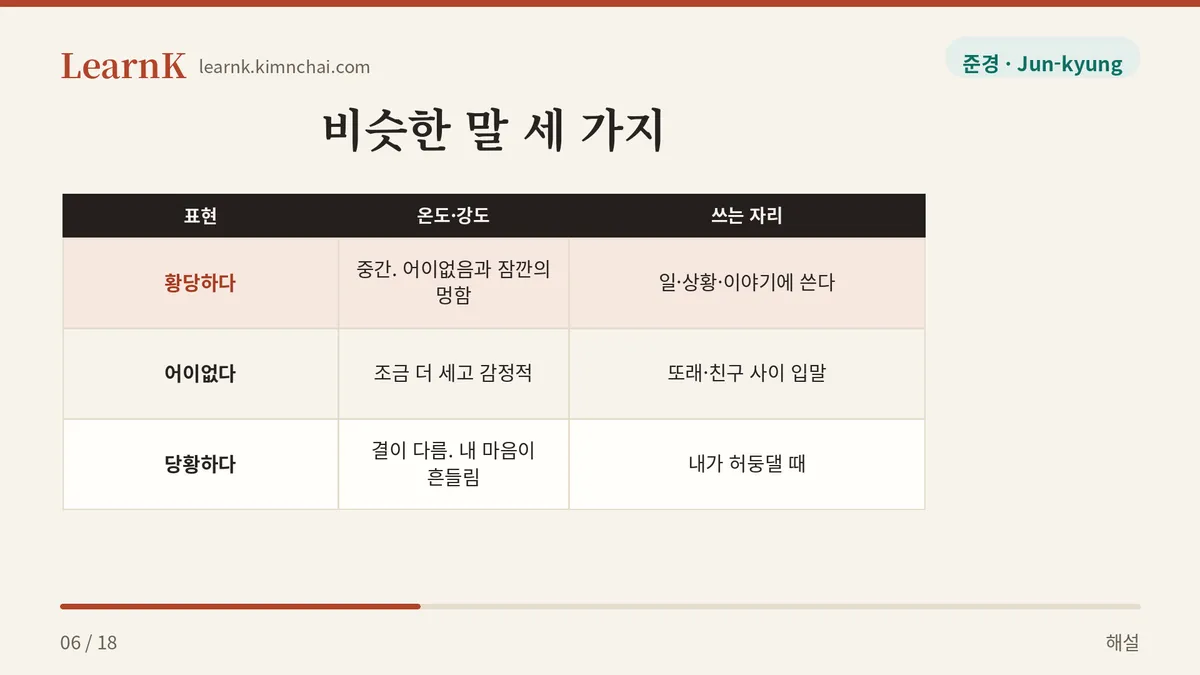
| Expression | Temperature / intensity | Where it’s used |
|---|---|---|
| 황당하다 (hwangdanghada) | Medium. Ridiculousness + a brief blankness | Anywhere, everyday speech and news alike. But not used directly on the words of someone senior |
| 어이없다 (eoi-eopda) | A bit stronger and more emotional; mixed with irritation | Among peers and friends. The most common in speech |
| 어처구니없다 (eocheoguni-eopda) | Strongest. Close to anger | Written language and emphasis. In speech, 어이없다 is used more often |
| 당황하다 (danghwanghada) | A different grain. My own mind is shaken | When I’m flustered. Not a word that passes judgment on a situation |
| 기가 막히다 (giga makhida) | Strong. A lamenting tone | The speech style of older generations. Also used positively (“맛이 기가 막히다” — the taste is incredible) |
황당하다 and 당황하다 in particular look like nothing more than a reshuffling of the same Hangul syllables, which makes them the pair learners mix up most. The test is simple. If the thing being judged is outside you, it’s 황당하다; if what’s shaking is inside you, it’s 당황하다. A text saying the seller is in Busan is a 황당한 일 (an absurd thing), and my state of not knowing what to do as I stand there fidgeting after reading it is 당황한 것 (being flustered).
Cultural background — secondhand deals and ‘황당 사연’
황당 (荒唐) is a Sino-Korean word. 荒 means ‘rough, wild, desolate.’ The picture inside the characters is of speech that has sprawled out wildly with no grounding. Add 稽 (계, ‘to have grounds’) in the negative and you get the four-character word 황당무계 (hwangdangmugye, 荒唐無稽), meaning ‘completely groundless and nonsensical.’ That’s why people call a novel or a conspiracy theory a “황당무계한 이야기” (a preposterous story). As a side note, the widely circulated origin story for 어처구니없다 involving a millstone handle doesn’t have solid evidence behind it, so we won’t get into it here.
The place this word turns up most often in Korea these days is secondhand trading. Sellers who don’t show up at the meeting spot, items that look nothing like the photos, accounts that vanish the instant the money lands — when people who’ve been through this post about it in online communities, the title almost always carries the word “황당한.” Phrases like ‘황당 사연’ (absurd stories) and ‘황당한 후기’ (absurd reviews) have hardened by now into something like genre names on message boards.
In dramas and variety shows, this word arrives through facial expressions and on-screen captions before it ever arrives as dialogue. When someone says something that doesn’t hang together, the camera cuts to the listener’s face, and over that face — frozen and silent for a few seconds — the two characters “황당” appear as a caption. The reason you can read the situation from the caption alone without hearing a word is that this word points not to a type of emotion but to the frozen state just before an emotion arrives. If you watch for the moment this caption appears while you’re watching Korean variety shows, you’ll pick up the temperature of this word far faster than any dictionary definition can teach you.
Today’s quiz
Which of the following is the most natural situation for using 황당하다?
① When a friend you’re meeting after ten years recognizes you instantly on the street ② When you open the box of a used laptop you paid 300,000 won for and find a brick inside ③ When the presentation order suddenly changes to you and your heart races and your hands shake
Answer: ② ① is simply a happy surprise and doesn’t violate reason, so “깜짝 놀랐다” (I was startled) is correct. ③ isn’t passing judgment on a situation but describing my own inner state being shaken, so you use “당황했다” (I was flustered). Only in a case like ②, where you paid money and a brick arrived — where nothing lines up front to back — does 황당하다 land in its proper place.
Definitions and example sentences are from the National Institute of Korean Language’s Basic Korean Dictionary (krdict.korean.go.kr); that portion of this post, including our translations, is licensed under CC BY-SA 2.0 KR.