Hyeong, Nuna — Why Koreans Don't Call Each Other by Name
형/누나 (hyeong/nuna) is a pairing of two words: 형 (hyeong), what a man calls a man older than himself, and 누나 (nuna), what a man calls a woman older than himself. Both are Korean forms of address used in place of the other person’s name. Spend just a few days in Korea and you’ll notice something strange — people hardly ever call each other by name. In restaurants, on soccer fields, in club rooms, standing beside a moving truck, what you hear isn’t names but words like 형, 누나, 오빠 (oppa), and 언니 (eonni). It isn’t that they don’t know the name. If anything, the closer people become, the more the name disappears and only the title remains.
Originally these two words belonged inside the house. 형 is what a younger brother calls his older brother, and 누나 is what a younger brother calls his older sister. But in Korean, these titles walked out the front gate a long time ago. The older guy in your neighborhood you don’t share a drop of blood with is 형. The student three years ahead of you at university is 형. The man you played beside for the first time yesterday at the morning soccer club is, if he’s older than you, 형 from that day on. So 형 and 누나 name a family relationship and, at the same time, make a declaration: “I’m going to treat you like family.”
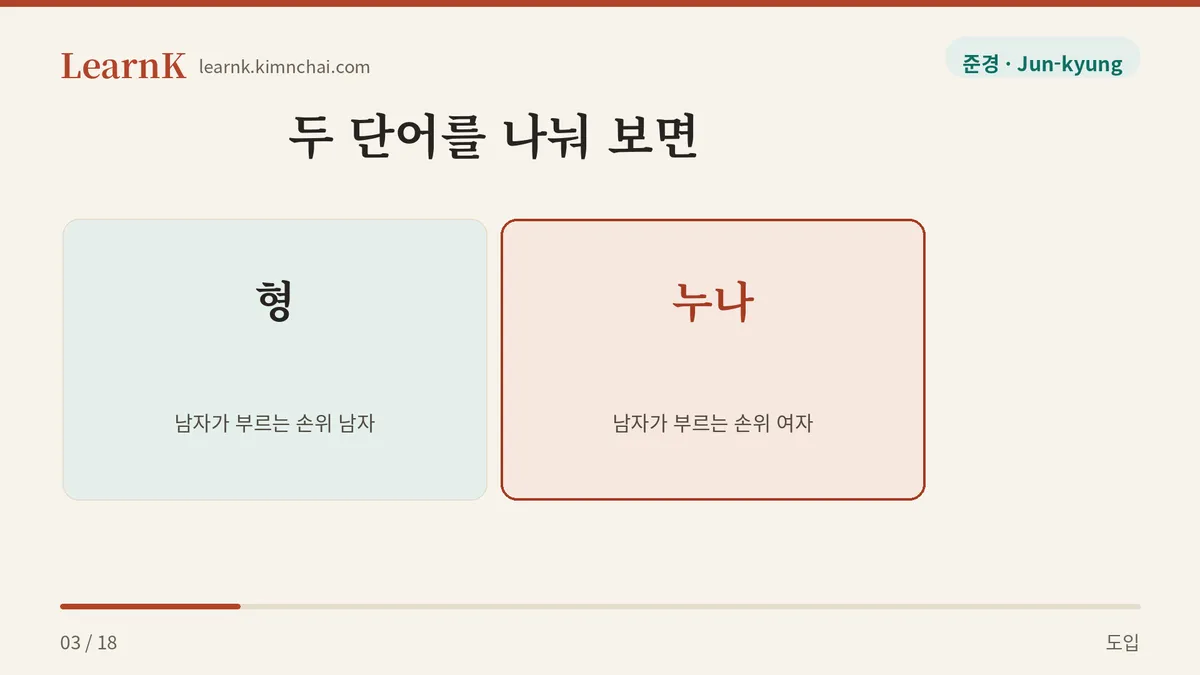
The first thing a learner has to grab hold of here isn’t the meaning — it’s the condition. 형 and 누나 are used only when the speaker is male. It isn’t the other person’s gender but the speaker’s gender that decides the word. A man calls an older man 형 and an older woman 누나. A woman calls an older man 오빠 and an older woman 언니. The four words lock together like a 2×2 grid. English “brother” and “sister” have no such mechanism, which is why English-speaking learners land in the wrong box at least once, almost without exception.
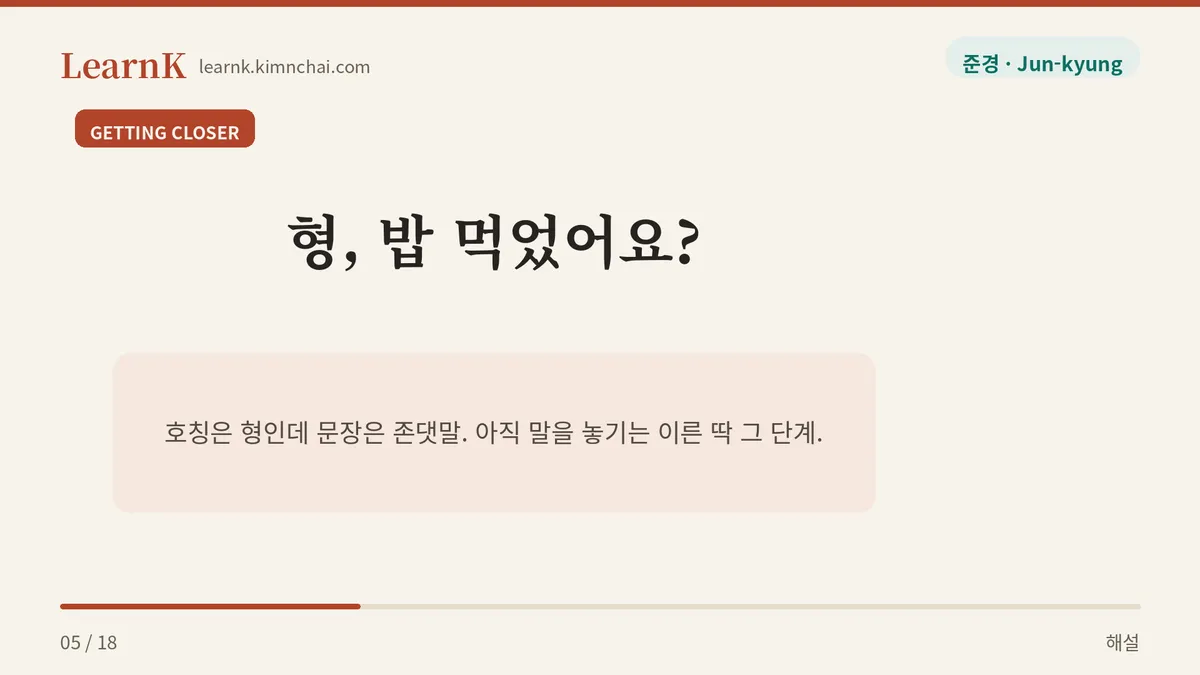
The second thing to know is temperature. 형 and 누나 are neither 존댓말 (jondaenmal), polite speech, nor 반말 (banmal), casual speech. The title itself leans friendly, but the speech style attached to it shifts depending on the relationship. With a friend of ten years you drop formality entirely — 「형, 밥 먹었어?」 (hyeong, bap meogeosseo?), “Hyeong, did you eat?” With a senior you met two months ago, you land in the awkward in-between of 「형, 밥 먹었어요?」 (hyeong, bap meogeosseoyo?), where the title is 형 but the sentence is polite. That in-betweenness isn’t a mistake — it’s the real temperature of Korean, because it means the relationship is in the middle of getting closer. In the other direction, when 「형」 suddenly turns into 「선배님」 between two people who used to be very close, it reads as a signal that they’ve drifted apart.
Seeing It in Real Conversation
Scene: Saturday morning, the pickup soccer game has just ended. They’re sitting under the parasol outside the convenience store next to the field, drinking sports drinks.
Jun-kyung: 아까 골 넣은 사람 봤지? 우리 동네 형이야. 나보다 다섯 살 위. Did you see the guy who scored earlier? He’s a hyeong from my neighborhood. Five years older than me.
Emily: 아, 그래서 계속 「형, 여기!」 하고 소리쳤구나. 난 그게 이름인 줄 알았잖아. Ah, that’s why you kept shouting hyeong, over here. I thought that was his name.
Jun-kyung: 하하, 이름 불렀으면 큰일 나지. 다섯 살 위인데. Haha, calling him by name would’ve been trouble. He’s five years older.
Emily: 그럼 나도 저 사람한테 형이라고 하면 돼? Then can I call him hyeong too?
Jun-kyung: 아니, 넌 오빠. 형이랑 누나는 남자가 쓰는 말이야. No, for you it’s oppa. Hyeong and nuna are what guys say.
Emily: 아 맞다. 저번에 미용실에서 실장님한테 누나라고 했다가 다들 뒤집어졌잖아. Oh right. Last time at the salon I called the stylist nuna and everyone lost it.
Usage That Sounds Off
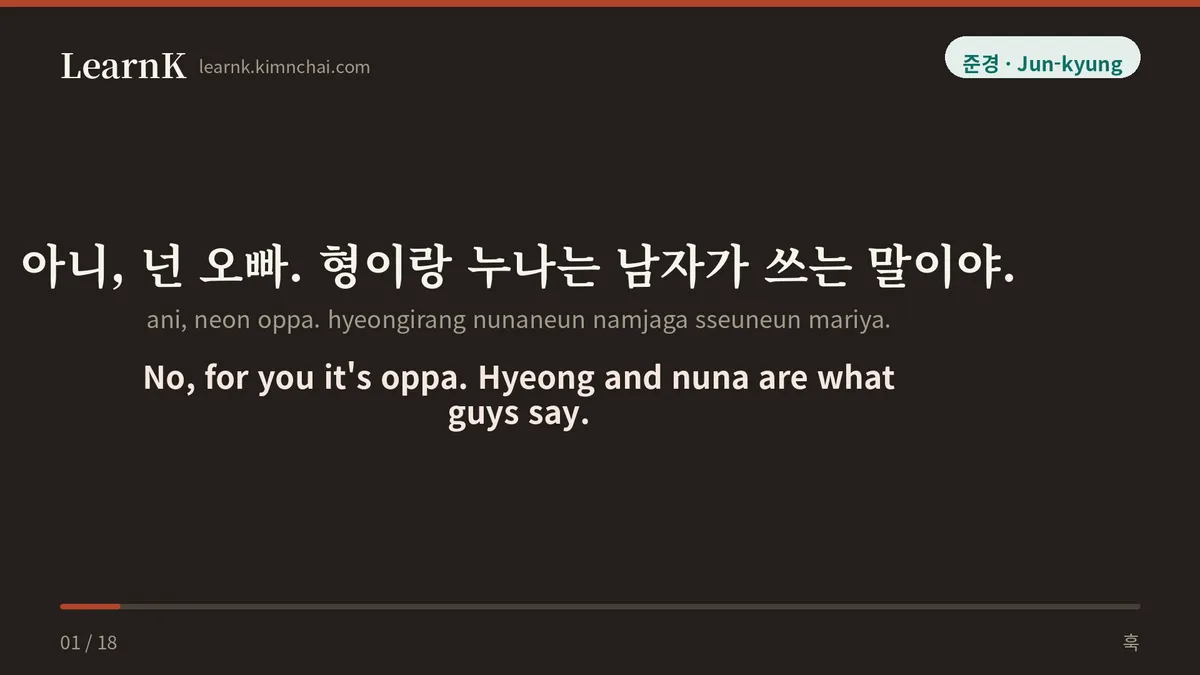
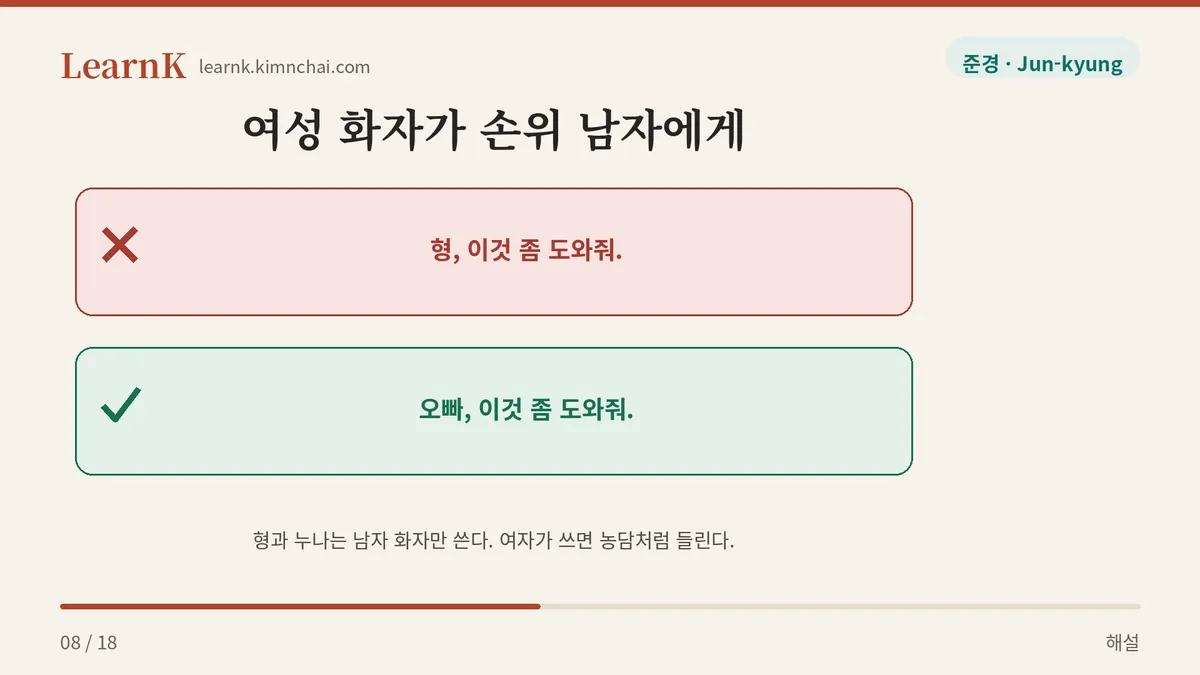
✗ (female speaker, to an older man) 형, 이것 좀 도와줘. ✓ (female speaker, to an older man) 오빠, 이것 좀 도와줘. — “Oppa, give me a hand with this.” → 형 and 누나 are titles only men use. When a woman uses them, the problem isn’t that the meaning fails to land — it’s that it sounds like a joke, so a serious request turns into a punchline.
✗ (first week on the job, to a team leader ten years older) 형, 이 파일 어디에 있어요? ✓ (first week on the job, to a team leader ten years older) 팀장님 (timjangnim), 이 파일 어디에 있어요? — “Team leader, where is this file?” → 형 and 누나 are words you use after the relationship has already grown close. Calling someone with a job title 형 from the very start means you’ve closed the distance all by yourself, and it comes across as rude. Until the other person tells you over dinner and drinks, 「그냥 형이라고 불러」 (“just call me hyeong”), the job title is the right answer.
Example Sentences by Situation
1. A university club’s welcome party for new members — to a senior you met two days ago
형, 저도 이번 학기에 그 수업 들으려는데 어때요? (hyeong, jeodo ibeon hakgie geu sueop deureuryeoneunde eottaeyo?) Hyeong, I’m thinking of taking that class this semester — how is it?
The title is 형, but the sentence is polite. This is exactly the Korean of that stage where you want to get closer but it’s still too early to drop formality. It’s also the sentence pattern first-year university students use more than any other.
2. The neighborhood snack shop you’ve been going to for five years — the owner is a woman about ten years older than you
누나, 오늘도 그거 주세요. 곱빼기로요. (nuna, oneuldo geugeo juseyo. gopppaegiro yo.) Nuna, the usual today please. Make it a large.
This is a customer and a shop owner, and yet he calls her 누나. It’s an extremely common scene in Korea’s small-business districts. That one word says the whole thing: “I’m not a customer passing through — I’m a regular.”
3. Moving day — after all the boxes are in, to the head mover, who’s more than twenty years older
형님, 오늘 정말 고생 많으셨습니다. (hyeongnim, oneul jeongmal gosaeng manheusyeotseumnida.) Hyeongnim, thank you for all your hard work today.
When the age gap is large, or when you’ve met through work, you use 형님 (hyeongnim) instead of 형. If 형 is ease, 형님 is courtesy and weight. They grow from the same root, but the moment one syllable is added, the seating changes.
Related Expressions and Their Register
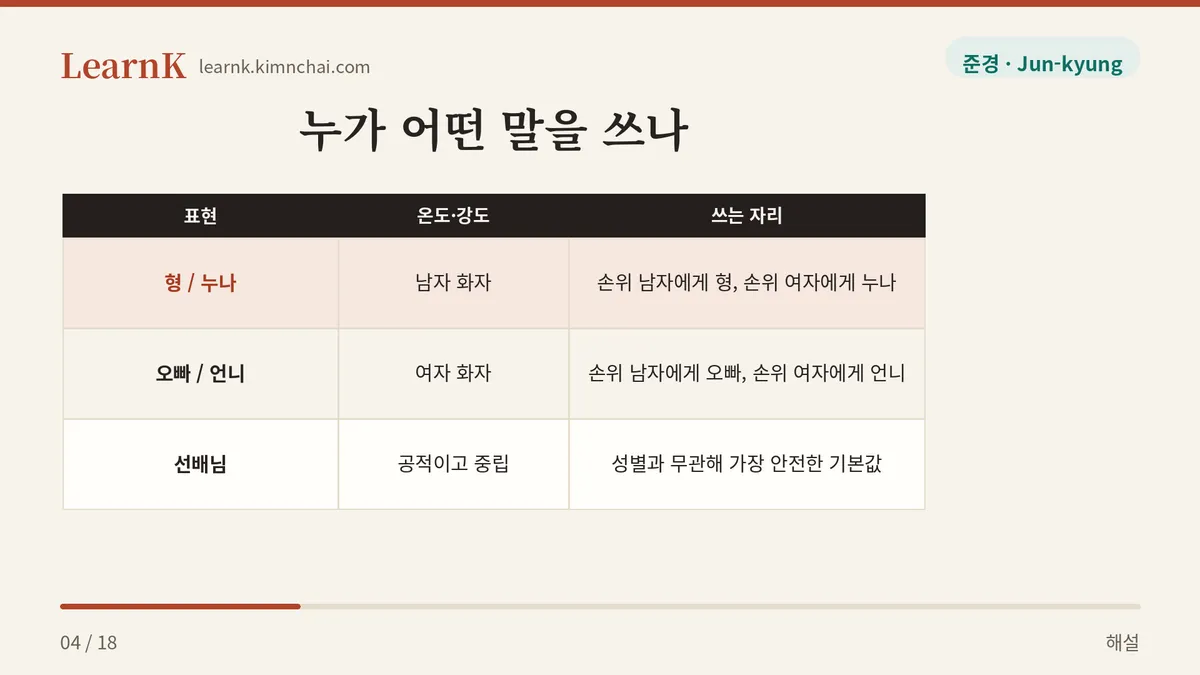
| Expression | Warmth · intensity | Where it’s used |
|---|---|---|
| 형 (hyeong) | Close and easy | Man → older man. A real older brother, a school senior, an older guy from the neighborhood |
| 누나 (nuna) | Close and affectionate | Man → older woman. A real older sister, a school senior, the owner of a shop you frequent |
| 형님 (hyeongnim) | Weight, with courtesy | A big age gap, or a relationship formed through work. Also used by a married woman for the wife of her husband’s older brother |
| 오빠 (oppa) / 언니 (eonni) | The same temperature as 형 and 누나 | Woman → older man / older woman |
| 선배님 (seonbaenim) | Neutral and public | School or workplace. It doesn’t depend on the speaker’s gender, which makes it the safest default |
Read the table from top to bottom and one rule shows up. The further down you go, the more public the relationship becomes; the further up, the more personal. If you’re not sure where you stand yet, start at the bottom. In Korean you can close the distance at any time, but re-opening a distance you’ve already closed is hard.
Cultural Background — A Country Where Names Go Unspoken
In Korean, calling someone older than you by their bare name isn’t simply rude — it’s closer to denying the relationship itself. So titles move in to fill the space the name leaves empty. 형 and 누나 are the two warmest words for filling that space.
What’s interesting is that these titles didn’t just broaden in meaning as they left the family — they also moved into unexpected seats inside the family. 형님 isn’t a word only men use. A married woman also says 형님 to the wives of her husband’s brothers who rank above her. This is why learners get thrown when they see two women in a holiday kitchen calling each other 형님. In that setting, 형님 points not to age but to order within the family.
Watch enough Korean dramas and you’ll often see a relationship changing, marked by nothing but a single title. Two people who called each other 「대리님」 as colleagues sit down one night at a street food tent, glasses in front of them, and trade the line 「그냥 형이라고 불러」 — “just call me hyeong.” The dialogue itself is short and ordinary, but the viewer knows the relationship has shifted one seat over. In Korean dramas, the scene where a title changes is a turning point used about as often as a confession scene — and it’s information the subtitles almost never carry across. The moment you can hear those two syllables, 형, another layer of the story hiding behind the subtitles starts to come into view.
In real life, too, Koreans check each other’s age when they first meet. The reason 「몇 년생이세요?」 (“what year were you born?”) isn’t rude is that the answer is what lets both people decide what to call each other. They’re not asking your age — they’re asking for the title.
Today’s Quiz
Emily is a woman from Canada. She’s grown quite comfortable with a male colleague two years older, someone she’s worked with on the same team for three years now. At a company dinner, he said, 「우리 이제 편하게 하자」 — “let’s be casual with each other now.” What should Emily call him?
- 형 (hyeong)
- 누나 (nuna)
- 오빠 (oppa)
- 언니 (eonni)
Answer: 3. 오빠 (oppa)
What decides the title isn’t the other person’s gender but the speaker’s. Emily is a woman, so she uses 오빠 for an older man and 언니 for an older woman. 형 and 누나 are Jun-kyung’s words. And if 오빠 feels like too much at work, remember this too: 「선배님」 is always a safe alternative.
Definitions and example sentences are from the National Institute of Korean Language’s Basic Korean Dictionary (krdict.korean.go.kr); that portion of this post, including our translations, is licensed under CC BY-SA 2.0 KR.