Jjajangmyeon — A Bowl of Black Noodles Eaten Off a Stack of Moving Boxes
짜장면
짜장면 (jjajangmyeon) means a dish in which noodles are mixed with a sauce made by stir-frying meat, vegetables and other ingredients in Chinese-style soybean paste. The thick black sauce is poured over white noodles, and the person who receives it flips the noodles from the bottom up with chopsticks until the whole bowl is mixed. Walk into any Chinese restaurant in Korea and it sits on the very top line of the menu; open a delivery app and it is the first name that appears.
But the reason this word is fun for Korean learners has less to do with flavor than with occasion. 짜장면 is a food remembered not for what you ate but for what day you ate it on. Moving day. Graduation day. The day the exams finally ended. The day everyone sat on the floor holding a black bowl. That is why, for a Korean, ‘짜장면 먹자 (jjajangmyeon meokja)’ means both ‘let’s just grab something easy today’ and ‘today is kind of a special day.’ It is not often that a single word pulls off both at once.
There are three keys to the nuance. It is cheap, it comes out fast, and when the bowl is empty you set it outside your door and the restaurant comes to collect it. Those three things made 짜장면 the Korean ‘default meal.’ When you are hungry and do not feel like thinking, the name that comes out is 짜장면. Turned around, that also means it rarely shows up at occasions that require a lot of thought — a formal business dinner, an anniversary dinner. If you miss this difference in temperature, your sentence will be correct but the setting will be off.
Checking it in the National Institute of Korean Language dictionary
The National Institute of Korean Language’s Basic Korean Dictionary defines the word like this.
짜장면 (jjajangmyeon) 「noun」 중국식 된장에 고기와 채소 등을 넣어 볶은 양념에 면을 비벼 먹는 음식. A dish made by making sauce by stir-frying chopped meat, vegetables, etc., with Chinese soybean paste and then mixing noodles with the sauce. — National Institute of Korean Language, Basic Korean Dictionary (krdict.korean.go.kr)
Here are the multilingual equivalents and definitions the same dictionary provides.
[English] jajangmyeon — A dish made by making sauce by stir-frying chopped meat, vegetables, etc., with Chinese soybean paste and then mixing noodles with the sauce. [Japanese] ジャージャーめん【ジャージャー麺・炸醤麺】 — 中華風の豆味噌に肉や野菜などを入れて炒めたソースをゆでた麺にかけて混ぜて食べる料理。 [Spanish] jjajangmyeon, fideos con salsa negra de soja — Comida que se sirve tras mezclar fideos con una salsa de carne y verduras salteadas en una pasta de soja de color negro al estilo chino. [Chinese] 韩式炸酱面 — 将肉类、蔬菜等食材伴着春酱炒成调料酱,再浇在面条上拌着吃的食物。 — National Institute of Korean Language, Basic Korean Dictionary (krdict.korean.go.kr)
The dictionary does not carry a Portuguese equivalent. The line below is not a dictionary quotation but our own rendering. jajangmyeon — Prato coreano de macarrão misturado com um molho escuro de pasta de soja chinesa refogada com carne e legumes.
Now let’s look at the actual usage examples the dictionary carries. They tell you more than the definition does.
이 가게 짜장면이 그렇게 맛있다면서? (i gage jjajangmyeoni geureoke masitdamyeonseo?) I hear the jjajangmyeon at this place is amazing? — National Institute of Korean Language, Basic Korean Dictionary (krdict.korean.go.kr)
This is a line for checking a rumor. ‘-다면서? (-damyeonseo?)’ is used to ask someone about something you heard from a third party. It is the sentence you toss out while standing in line in front of the restaurant, or when you run into a friend who lives in that neighborhood. It shows just how often 짜장면 is the subject of a rumor.
어제 새로 생긴 중국집에 갔는데 짜장면이 맛있더라. (eoje saero saenggin jungguk-jibe ganneunde jjajangmyeoni masitdeora.) 그래? 나도 짜장면 먹으러 한 번 가야겠네. (geurae? nado jjajangmyeon meogeureo han beon gayagenne.) I went to that Chinese place that just opened yesterday, and the jjajangmyeon was good. Really? I should go eat jjajangmyeon there too, then. — National Institute of Korean Language, Basic Korean Dictionary (krdict.korean.go.kr)
A short two-line exchange. ‘-더라 (-deora)’ is a casual ending used to report something you experienced firsthand, so the listener immediately answers with ‘나도 가야겠네 (nado gayagenne)’ — ‘I should go too.’ Whenever a newly opened Chinese restaurant comes up, the conversation goes to 짜장면 almost without exception.
그 집 짜장면 양이 얼마나 많은지 반 그릇 먹었더니 배가 부르더라니까는. (geu jip jjajangmyeon yangi eolmana maneunji ban geureut meogeotdeoni baega bureudeoranikkaneun.) The portions of jjajangmyeon at that place are so huge that I was full after half a bowl, I’m telling you. — National Institute of Korean Language, Basic Korean Dictionary (krdict.korean.go.kr)
This example tells you that the counter for 짜장면 is 그릇 (geureut), ‘bowl.’ You do not count it as ‘한 개 (han gae)’ but as ‘한 그릇 (han geureut)’ or ‘반 그릇 (ban geureut).’ ‘-더라니까는 (-deoranikkaneun)’ is a colloquial ending used to insist on your own experience — you can practically hear the speaker’s intonation in it.
나는 점심으로 먹은 짜장면이 너무 느끼해서 속이 느글느글 뒤집어지는 듯했다. (naneun jeomsimeuro meogeun jjajangmyeoni neomu neukkihaeseo sogi neugeulneugeul dwijibeojineun deuthaetda.) The jjajangmyeon I had for lunch was so greasy that my stomach felt queasy, like it was turning over. — National Institute of Korean Language, Basic Korean Dictionary (krdict.korean.go.kr)
The dictionary does not leave out 짜장면’s shadow side either. 느끼하다 (neukkihada) describes the heavy feeling in your stomach after eating oily food, and it follows 짜장면 around almost like a partner. That is exactly why a Chinese restaurant table in Korea always comes with 단무지 (danmuji), pickled yellow radish, and raw onion.
See it in a real conversation
Situation: the afternoon of moving day. The boxes are still stacked in the living room, and the Chinese delivery they ordered earlier has just arrived.
Jun-kyung: 박스 치우지 마. 그 위에 그냥 놓고 먹자. 이사하는 날엔 짜장면이지. Don’t move the boxes. Just put it on top and let’s eat. Moving day means jjajangmyeon.
Emily: 나 이거 진짜 좋아하는데, 왜 하필 이사하는 날이야? I really love this, but why jjajangmyeon on moving day specifically?
Jun-kyung: 그릇을 안 꺼내도 되잖아. 먹고 문 앞에 내놓으면 끝이야. Because you don’t have to unpack any dishes. Eat, leave it outside the door, done.
Emily: 아, 똑똑하다. 어어, 나 짜장면 국물 셔츠에 튀었어. Ah, that’s smart. Uh-oh, I got jjajangmyeon sauce on my shirt.
Jun-kyung: 그건 뭐, 이사 신고식이지. 단무지 더 줄까? Well, that’s your moving-in initiation. Want more pickled radish?
Emily: 응. 나 짜장면 먹을 때마다 옷에 튀어. 십오 년째 이래. Yeah. I splash it every single time I eat jjajangmyeon. Fifteen years running.
This is where it sounds off
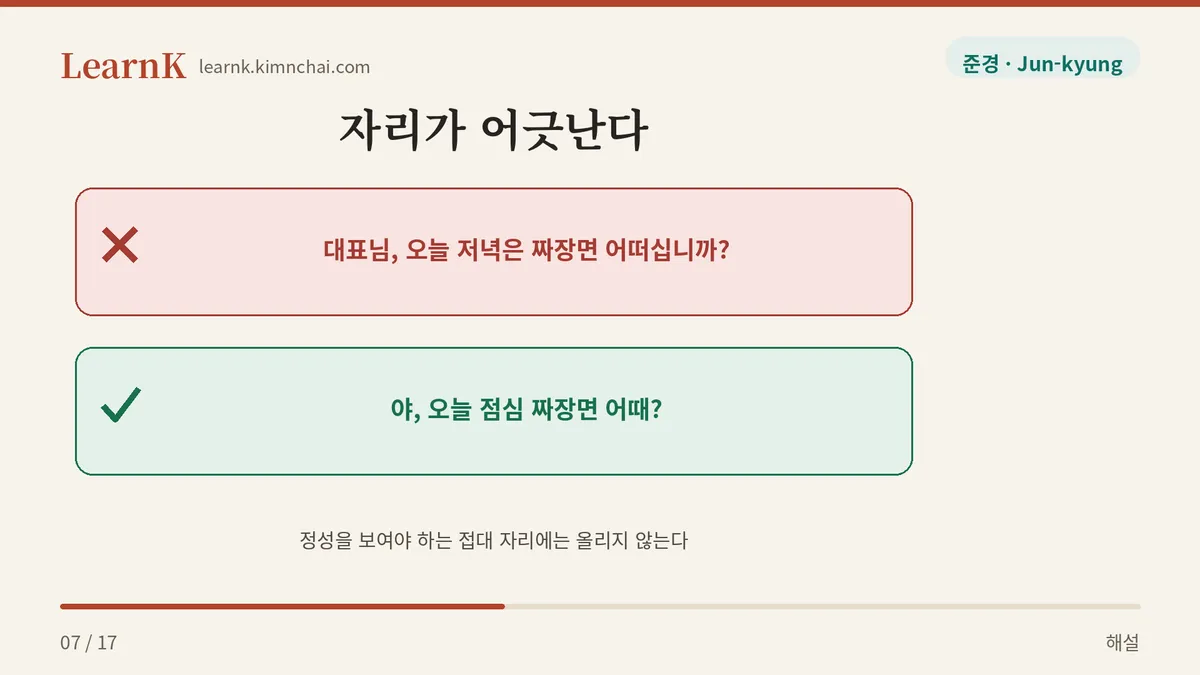
✗ (at a dinner hosting a client) 대표님, 오늘 저녁은 짜장면 어떠십니까? (daepyonim, oneul jeonyeogeun jjajangmyeon eotteosimnikka?) — Sir, how about jjajangmyeon for dinner tonight? ✓ (to a coworker around lunchtime) 야, 오늘 점심 짜장면 어때? (ya, oneul jeomsim jjajangmyeon eottae?) — Hey, how about jjajangmyeon for lunch today? → The grammar is perfect but the setting is wrong. 짜장면 is the poster child of the ‘fast and cheap’ meal, so proposing it at an occasion where you are supposed to show effort makes you look careless. Conversely, eating it together for lunch the day after a company dinner is completely natural.
✗ ‘짜장면’은 틀린 말이니까 ‘자장면’이라고 써야 해요. (‘jjajangmyeon’eun teullin marinikka ‘jajangmyeon’irago sseoya haeyo.) — ‘Jjajangmyeon’ is incorrect, so you have to write ‘jajangmyeon.’ ✓ ‘짜장면’도 ‘자장면’도 둘 다 표준어예요. (‘jjajangmyeon’do ‘jajangmyeon’do dul da pyojuneoyeyo.) — Both ‘jjajangmyeon’ and ‘jajangmyeon’ are standard. → This is a misunderstanding learners often pick up from older textbooks or old TV programs. In the past only ‘자장면 (jajangmyeon)’ was recognized as standard, but in 2011 the National Institute of Korean Language reflected actual usage and accepted ‘짜장면 (jjajangmyeon)’ as a co-standard form. Today, both in speech and in writing, 짜장면 is overwhelmingly the more common one.
Example sentences by situation
1. Ordering after you sit down at a Chinese restaurant
The moment you and your group sit down, the server comes over. There is no need to study the menu for long.
여기 짜장면 둘, 탕수육 작은 거 하나요. (yeogi jjajangmyeon dul, tangsuyuk jageun geo hanayo.) Two jjajangmyeon here, and one small sweet-and-sour pork.
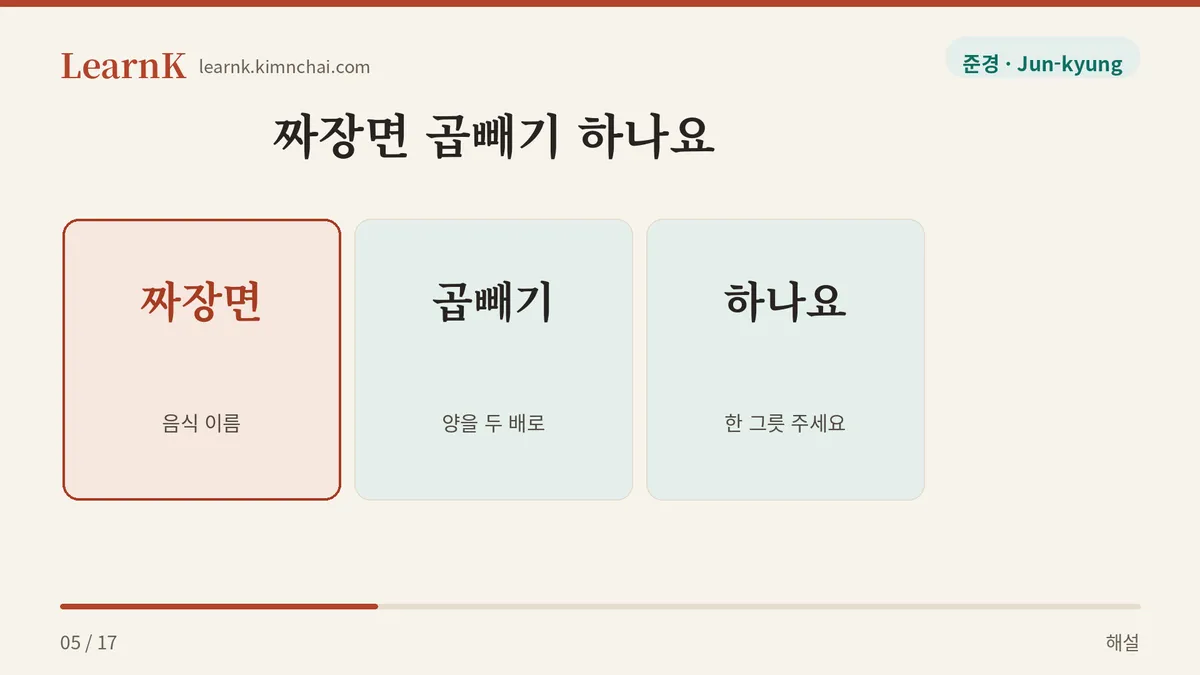
At a Chinese restaurant, counting it short like ‘둘이요 (durieyo)’ sounds far more natural than ‘두 그릇 주세요 (du geureut juseyo).’ Just attaching ‘-요 (-yo)’ after the number makes it polite. If you want a double portion, add 곱빼기 (gopppaegi) and say ‘짜장면 곱빼기 하나요 (jjajangmyeon gopppaegi hanayo).’
2. Suggesting delivery to a coworker who is working late
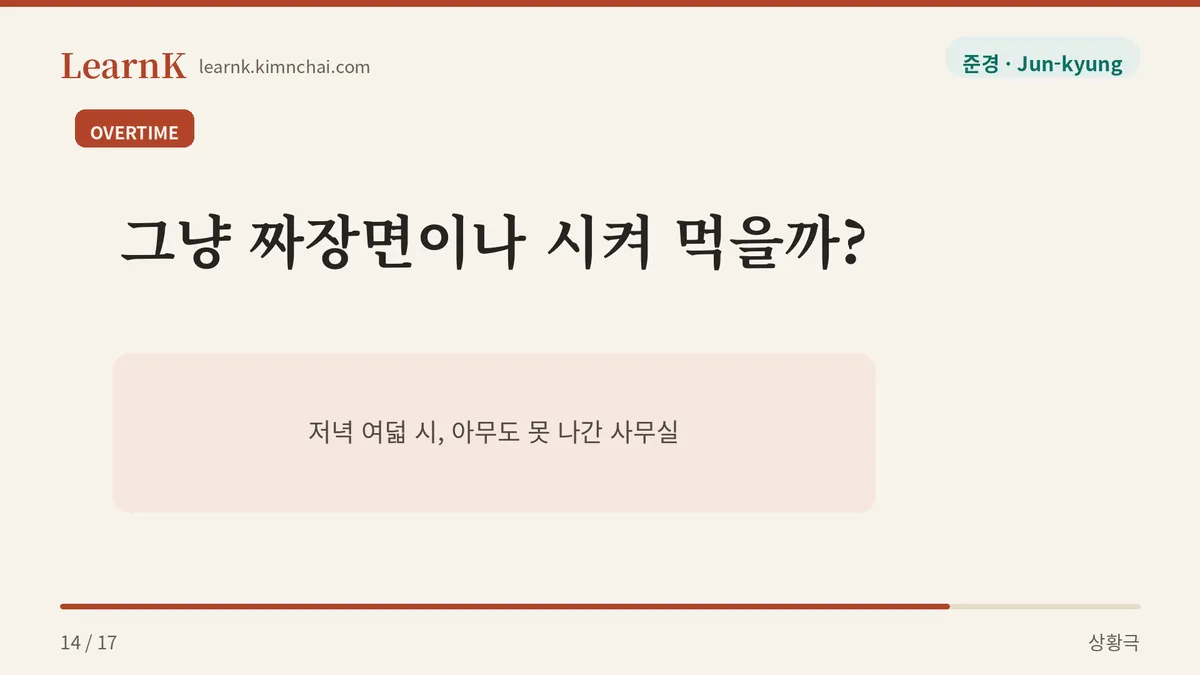
Eight in the evening, and nobody has managed to leave yet. This is the sentence that comes out then.
그냥 짜장면이나 시켜 먹을까? 나 곱빼기로 시킬 건데. (geunyang jjajangmyeonina sikyeo meogeulkka? na gopppaegiro sikil geonde.) Should we just order jjajangmyeon or something? I’m getting the double portion.
‘-이나 (-ina)’ creates the nuance of ‘not the best option, but let’s go with it.’ It attaches to 짜장면 especially well, and it is not a put-down — it is a device that makes the decision feel light.
3. When you can’t decide what to order
This is the question Koreans agonize over longest in front of a Chinese restaurant.
오늘은 짜장면 먹을까, 짬뽕 먹을까? (oneureun jjajangmyeon meogeulkka, jjamppong meogeulkka?) Should I get jjajangmyeon today, or jjamppong?
The dilemma was so common that a menu item called 짬짜면 (jjamjjamyeon) was invented — half of each served in one divided bowl. Throw this sentence at a Korean friend and you will almost certainly get their opinion.
Polite and casual speech, and neighboring expressions
짜장면 is the name of a thing, so the word itself carries no honorific level. The politeness is decided by the verb you use with it. To a friend you say ‘짜장면 먹자 (jjajangmyeon meokja)’ or ‘짜장면 시킬까? (jjajangmyeon sikilkka?)’; to an elder or a guest you use 드시다 (deusida) and say ‘짜장면 드시겠어요? (jjajangmyeon deusigesseoyo?)’ or ‘짜장면 드실래요? (jjajangmyeon deusillaeyo?)’ When ordering at a restaurant, ‘짜장면 하나 주세요 (jjajangmyeon hana juseyo)’ is the basic form.
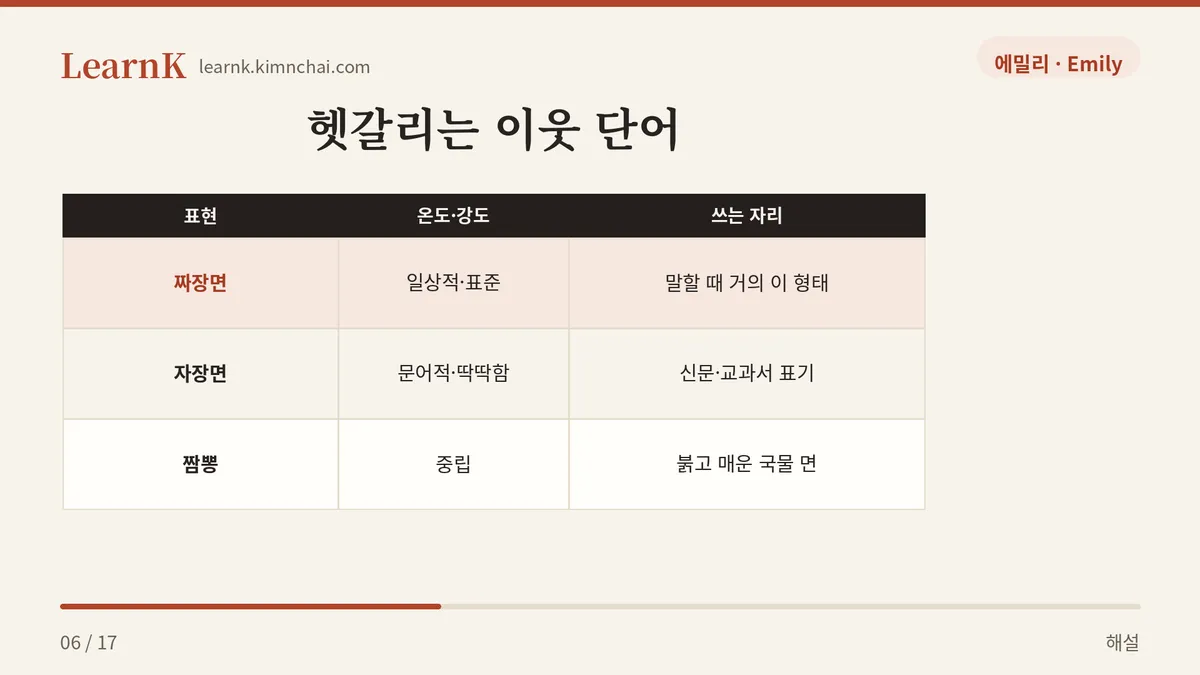
Here are the easily confused neighboring words side by side.
| Expression | Temperature / strength | Where it’s used |
|---|---|---|
| 짜장면 (jjajangmyeon) | everyday, standard | anywhere. This is the form almost everyone uses in speech |
| 자장면 (jajangmyeon) | literary, slightly stiff | still found in newspaper and textbook spelling. Co-standard alongside 짜장면 since 2011 |
| 짜장 (jjajang) | short and friendly | ordering at a Chinese restaurant, among peers. ‘짜장 하나, 짬뽕 하나’ |
| 간짜장 (ganjjajang) | neutral, slightly fancier | the sauce is stir-fried separately and served on its own plate. Many people prefer it because the noodles stay firmer |
| 짬뽕 (jjamppong) | neutral | 짜장면’s eternal rival. Red, spicy noodle soup |
Cultural background — the days a black bowl gets set down
The name came from Chinese. 炸醬麵 (zhájiàngmiàn) means ‘noodles topped with fried bean paste,’ and the dish was brought over by Chinese immigrants who settled in Incheon during the port-opening era. That said, the 짜장면 eaten in Korea today is quite different from that original dish. In Korea, caramel-blended 춘장 (chunjang) came into use, which made the color far blacker and gave it a hint of sweetness. This is why travelers from China who try Korean 짜장면 often say ‘this is not the taste I know.’ The name is Chinese; the flavor is Korean.
What made 짜장면 special was its price. In the 1970s and ’80s it was the cheapest meal out a family could splurge on. After a graduation ceremony you went to the Chinese restaurant still holding your bouquet, and if a plate of sweet-and-sour pork got added, that was a big day. That is why, for Koreans in their forties and older, the smell of 짜장면 touches a memory.
Moving-day 짜장면 is a slightly more practical tradition. You do not have to unpack any dishes, delivery is fast, and when the bowl is empty you leave it outside the door for the restaurant to collect. The image of people sitting on a half-unpacked living room floor, using a box as a table, has become a cliché in Korean dramas and films. Show that scene with no dialogue at all and viewers know: this person moved today.
It even has a place on the calendar. April 14 is called Black Day, the day when people who received nothing on Valentine’s Day in February or White Day in March eat black 짜장면. It is less a serious observance than a joke people make at their own expense, but Chinese restaurants really do get busy that day.
One last piece of table etiquette. When the 짜장면 arrives, put your chopsticks in right away and flip it from the bottom up several times to mix it. If you eat it without mixing, only the noodles on top get any sauce. And brace yourself for your clothes — even Koreans avoid 짜장면 on days they are wearing a white shirt.
Today’s quiz
A Korean friend has just moved. You went over today to help sort out their stuff, and it’s lunchtime. Which is the most natural thing to say?
- 오늘 같은 날엔 짜장면이지. 시킬까? (oneul gateun naren jjajangmyeoniji. sikilkka?)
- 이사 기념으로 짜장면 코스 요리 예약해 뒀어. (isa ginyeomeuro jjajangmyeon koseu yori yeyakhae dwosseo.)
- 짜장면 한 개만 주문해 줄래? (jjajangmyeon han gaeman jumunhae jullae?)
Answer: 1. Delivery 짜장면 on moving day is close to an official formula in Korea, so this one sentence gives the impression that you are reading the situation exactly right. Option 2 does not match 짜장면’s temperature — it is not a food you put on a formal occasion, it is the food of occasions where formality is skipped. Option 3 uses the wrong counter: 짜장면 is counted as ‘한 그릇 (han geureut)’ or simply ‘하나 (hana)’, not ‘한 개 (han gae)’.
Definitions and example sentences are from the National Institute of Korean Language’s Basic Korean Dictionary (krdict.korean.go.kr); that portion of this post, including our translations, is licensed under CC BY-SA 2.0 KR.