존함 (jonham) — The Word That Lifts a Person's Name, and How High You Can Take It
존함 (jonham)
존함 (jonham) is the word used to refer to another person’s name with respect. Judging by meaning alone it’s no different from 이름 (ireum), “name” — but in order to elevate the owner of that name, Korean swaps out the entire word. The reception desk at a wedding hall, the hallway outside a hospital director’s office, the stage of a lecture hall, the living room of an elder you’re meeting for the first time — in that brief moment of asking for a name and giving one, Korean goes to the trouble of changing a word.
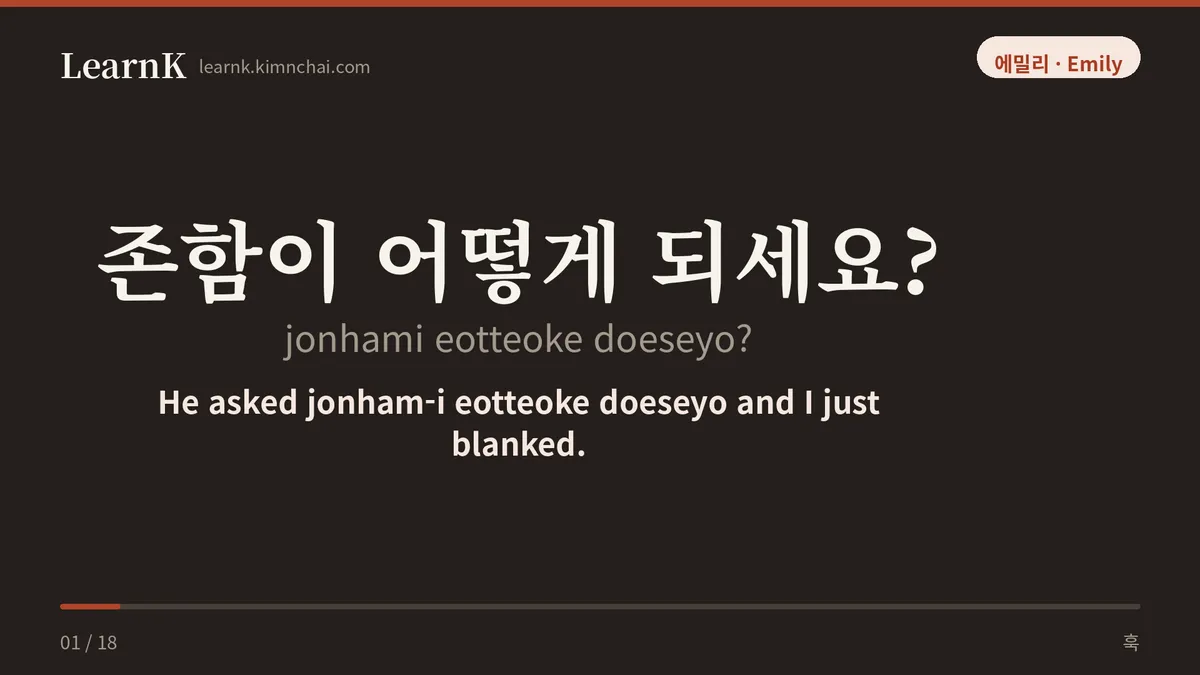
Even learners with pretty solid Korean hesitate for a beat in front of this one. You learned 이름이 뭐예요? (ireumi mwoyeyo?) — “What’s your name?” — on page one of your textbook, and you’ve probably heard 성함이 어떻게 되세요? (seonghami eotteoke doeseyo?) plenty of times at a hospital reception desk. But then one day someone asks you 존함이 어떻게 되십니까? (jonhami eotteoke doesimnikka?) — clearly the same question, and yet you can feel the air pull one notch tighter. That tightness is what today’s post is about.
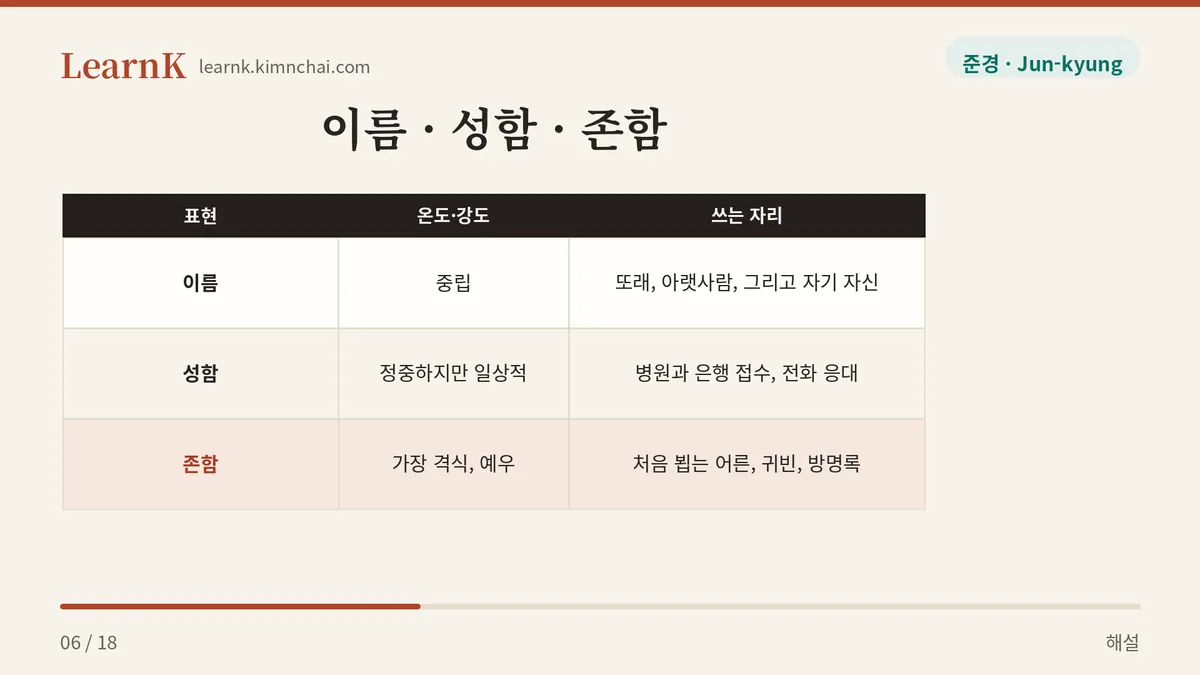
Let’s set the temperature first. Korean words that point at a name fall into roughly three layers. At the bottom, 이름 (ireum) — neutral, usable anywhere. Above it, 성함 (seongham) — polite but everyday, the word bank tellers, delivery drivers, and phone reps use dozens of times a day. At the very top, 존함 (jonham) — the most formal, and by the same token not used all that often. If 성함 (seongham) is “business-grade politeness,” 존함 (jonham) is closer to “paying honor.”
So 존함 (jonham) has two uses. One is when you ask for someone’s name. With an elder you’re meeting for the first time, with a guest of honor, in a formal setting, you say 존함이 어떻게 되십니까? (jonhami eotteoke doesimnikka?). The other — and this one is actually more common — is when you refer to the name of a third person under discussion. As in 교수님 존함은 익히 알고 있습니다 (gyosunim jonhameun iki algo itseumnida), “I’ve long known the professor’s name,” or 그분 존함만 대면 다 안다 (geubun jonhamman daemyeon da anda), “Just say his name and everyone knows him” — using the honorific form for a name you already know. Once you’re aware of this second usage, it becomes clear why 존함 (jonham) gives off a whiff of praise or deference: the very fact that you know someone’s name becomes a mark of respect for that person.
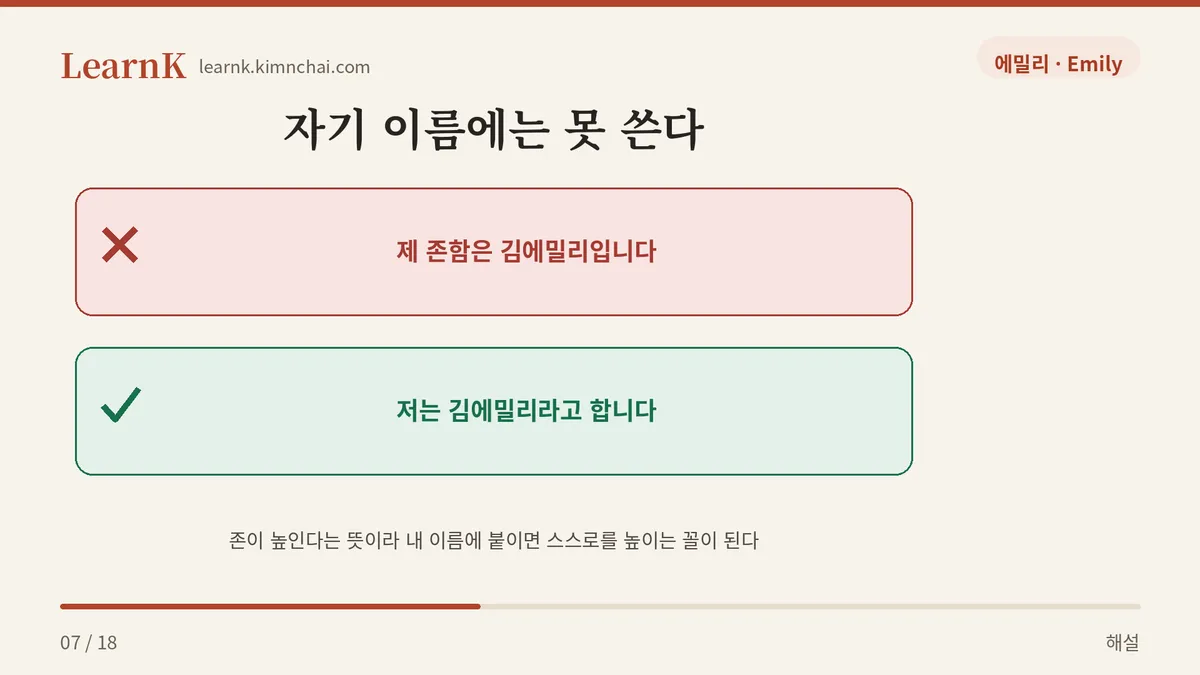
There is one restriction that matters above all. 존함 (jonham) is never used for yourself. 존(尊) means “to elevate,” so attaching it to your own name amounts to elevating yourself. This is not a grammatical error but an error of attitude, which is exactly why it grates on a native ear far more loudly.
Checking the National Institute of Korean Language dictionary
존함 (jonham) 「noun」 (honorific) The name of another person. — National Institute of Korean Language, Basic Korean Dictionary (krdict.korean.go.kr)
The entry also carries definitions in other languages.
[en] name — (honorific) The name of another person. [ja] そんめい【尊名】。ほうめい【芳名】。おなまえ【お名前】 — 他人の名前を敬っていう語。 [es] nombre — (EXPRESIÓN DE RESPETO) Nombre de la otra persona. [zh] 尊姓大名,尊名 — (敬语)别人的名字。 — National Institute of Korean Language, Basic Korean Dictionary (krdict.korean.go.kr)
All four languages say the same thing in chorus. English leads with (honorific) in parentheses, Spanish with (EXPRESIÓN DE RESPETO), Chinese with (敬语). Which means the register label comes before the meaning. It’s also interesting that the Japanese gloss lines up 尊名 and 芳名 side by side. Japanese 芳名 (hōmei) is likewise a word that has survived in formal settings such as guest books and memorial halls, so its habitat overlaps almost exactly with that of 존함 (jonham). For the record, this dictionary does not carry a Portuguese definition. If we had to render one, it would come out roughly as “nome — (forma de tratamento respeitosa) o nome de outra pessoa” — but that line is our translation, not the dictionary’s.
Here are the actual usage examples listed in the dictionary.
존함을 익히 알다. (jonhameul iki alda.) — to know someone’s name well 존함을 여쭈다. (jonhameul yeojjuda.) — to ask (humbly) for someone’s name 선생님, 존함이 어떻게 되십니까? (seonsaengnim, jonhami eotteoke doesimnikka?) — Sir, may I ask your name? 전부터 교수님의 존함은 익히 알고 있었습니다. (jeonbuteo gyosunimui jonhameun iki algo isseotseumnida.) — I have known the professor’s name for a long time. 김 사장님은 존함만 대면 누구라고 알 수 있을 만큼 크게 성공한 기업인이십니다. (gim sajangnimeun jonhamman daemyeon nugurago al su isseul mankeum keuge seonggonghan gieobinisimnida.) — President Kim is such a hugely successful businessman that anyone knows who he is the moment you say his name. — National Institute of Korean Language, Basic Korean Dictionary (krdict.korean.go.kr)
Taking them one line at a time makes the natural habitat of 존함 (jonham) come into focus.
- 존함을 익히 알다 (jonhameul iki alda) — it pairs up with 익히 (iki). The sense is that you’ve known it for a long time, having heard it through several channels. 존함 (jonham) brings this particular adverb along with it unusually often.
- 존함을 여쭈다 (jonhameul yeojjuda) — the verb is 여쭈다 (yeojjuda), not 묻다 (mutda). The verb rises in register too. If a sentence contains 존함 (jonham) but the predicate stays casual, the whole sentence wobbles.
- 선생님, 존함이 어떻게 되십니까? (seonsaengnim, jonhami eotteoke doesimnikka?) — the most courteous way to ask for a name. The key point is that it’s 어떻게 되십니까 (eotteoke doesimnikka), not 무엇입니까 (mueosimnikka). When asking for information about a person, Korean doesn’t aim straight at it; it goes around by way of 되다 (doeda), “to become / to come out as.”
- 전부터 교수님의 존함은 익히 알고 있었습니다 (jeonbuteo gyosunimui jonhameun iki algo isseotseumnida) — the standard opening line for a first meeting. This one sentence also delivers “I already knew of you, and I consider that an honor.”
- 김 사장님은 존함만 대면 누구라고 알 수 있을 만큼… (gim sajangnimeun jonhamman daemyeon nugurago al su isseul mankeum…) — 존함을 대다 (jonhameul daeda) is an idiomatic pairing meaning “to state a name.” Here 존함 (jonham) carries almost the same weight as “reputation.”
See it in a real conversation
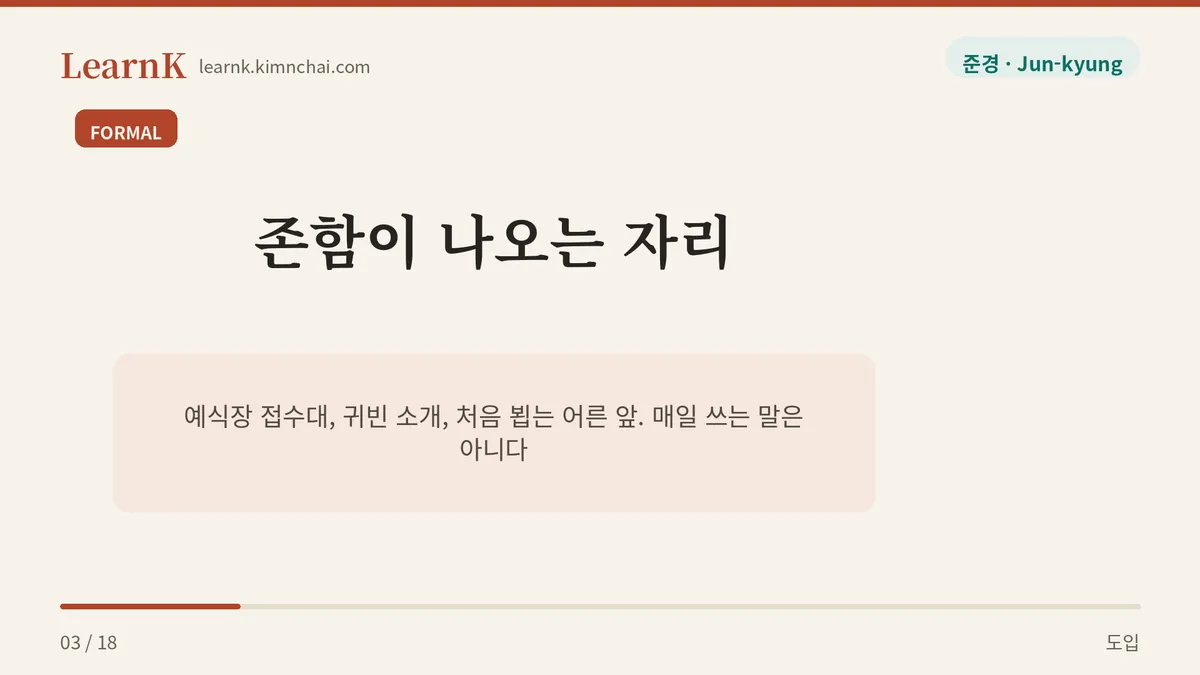
Setting: Saturday afternoon, in front of the reception desk on the second floor of a wedding hall. You’re holding a cash gift envelope, waiting your turn at the guest book.
Jun-kyung: 봉투 여기 내고, 저 방명록에 이름 쓰면 돼. Hand the envelope over here, then write your name in that guest book.
Emily: 아까 접수하시는 분이 나한테 “존함이 어떻게 되세요?” 그랬거든. 나 순간 멍때렸잖아. The guy at the desk asked me “jonham-i eotteoke doeseyo?” and I just blanked for a second.
Jun-kyung: 아, 성함보다 한 칸 더 높인 말이야. 그냥 이름 뭐냐는 뜻. Ah, that’s one notch politer than seongham. It just means “what’s your name?”
Emily: 어쩐지. 난 무슨 서류 이름인 줄 알고 두리번거렸네. That explains it. I thought it was the name of some form and started looking around.
Jun-kyung: 하하. 근데 너 신랑 아버님은 뵀어? 저기 검은 양복 입고 계신 분. Haha. By the way, did you meet the groom’s father? The man in the black suit over there.
Emily: 아직. 야, 그럼 아버님 존함도 미리 알려 줘. 인사드릴 때 어버버하기 싫어. Not yet. Hey, tell me his name in advance then. I don’t want to fumble when I greet him.
These would sound off
✗ (introducing yourself) 안녕하세요, 제 존함은 김에밀리입니다. (annyeonghaseyo, je jonhameun gim emilliimnida.) ✓ (introducing yourself) 안녕하세요, 저는 김에밀리라고 합니다. (annyeonghaseyo, jeoneun gim emillirago hamnida.) → 존함 (jonham) is a word for elevating someone else, so it can never be attached to your own name. Since it amounts to raising yourself up, in a setting where humility counts for a lot it doesn’t land as a mistake — it lands as rudeness. For your own name, come down to 이름 (ireum) or to ~라고 합니다 (~rago hamnida).
✗ (to a friend your own age) 야, 너 존함이 어떻게 되냐? (ya, neo jonhami eotteoke doenya?) ✓ (to a friend your own age) 야, 너 이름이 뭐야? (ya, neo ireumi mwoya?) → The grammar is perfectly fine, but the layer of honorification doesn’t match the person you’re talking to. Used on a peer, it reads not as sincere respect but as teasing or sarcasm. Korean speakers do in fact use it this way on purpose when they’re ribbing a friend. Unless that joke is what you’re going for, it’s better avoided.
Example sentences by situation
① When you’re put through to a new contact at a client company for the first time. The call has started without your knowing who’s on the other end, you need to ask for their name, and you don’t want to sound too clinical.
- 실례지만 존함이 어떻게 되실까요? (sillyejiman jonhami eotteoke doesilkkayo?)
- Excuse me, may I ask your name?
- The -ㄹ까요 (-lkkayo) in 어떻게 되실까요 (eotteoke doesilkkayo) softens the assertion by one more layer. It’s the safest form for a first phone call.
② When you finally meet in person someone you’ve only ever worked with by email. Your first words as you shake hands.
- 말씀 많이 들었습니다. 존함은 진작부터 익히 알고 있었어요. (malsseum mani deureotseumnida. jonhameun jinjakbuteo iki algo isseosseoyo.)
- I’ve heard so much about you. I’ve known your name for a long time.
- This sentence keeps the dictionary example’s 익히 알다 (iki alda) intact. It’s close to a formula for the Korean-style first greeting: turning the fact that you know someone’s name into an act of deference.
③ When you’re staffing the entrance of an exhibition hall or memorial museum. You’re asking visitors to sign the guest book.
- 여기 방명록에 존함 남겨 주시면 됩니다. (yeogi bangmyeongnoge jonham namgyeo jusimyeon doemnida.)
- If you could just leave your name in the guest book here.
- Guest books, condolence registers, and signing tables are where 존함 (jonham) still lives most naturally. This is where its character shows — a word that attaches itself to writing before speech.
Related expressions in polite and casual speech
| Expression | Temperature / intensity | Where it’s used |
|---|---|---|
| 존함 (jonham) | Most formal; a nuance of paying honor | An elder you’re meeting for the first time, introducing a distinguished guest, guest-book instructions. Not an everyday word |
| 성함 (seongham) | Polite but everyday | Hospital, bank, and store reception; phone service. The safest default whenever politeness is required |
| 함자 (hamja) | Highest formality + a special-purpose use | When asking for an elder’s name character by character. 아버님 함자가 어떻게 되십니까? (abeonim hamjaga eotteoke doesimnikka?) |
| 성명 (seongmyeong) | Neutral, bureaucratic | The label on a box in documents and forms. Asked of a person directly, it feels stiff and interrogation-like |
| 이름 (ireum) | Neutral | Peers, juniors, and yourself. The basic form for casual speech |
On the casual side there’s essentially no choice at all. There is no casual counterpart to 존함 (jonham); you simply drop down to 이름 (ireum). 너 이름이 뭐야? (neo ireumi mwoya?) and that’s the end of it. Honorific speech is stacked in layers while casual speech has only one rung — an asymmetry that captures the shape of Korean honorifics nicely. Stairs were only ever needed for looking upward.
The pair most easily confused is 존함 (jonham) and 함자 (hamja). 존함 (jonham) points at the name as a whole unit, while 함자 (hamja) points at the individual characters that make up that name. So when you ask for someone’s 함자 (hamja), the answer comes back character by character too. Something like 김 자, 영 자, 수 자입니다 (gim ja, yeong ja, su jaimnida) — attaching 자(字), “character,” to each syllable and enunciating them in distinct beats. It’s an etiquette rule — you don’t blurt out an elder’s name in one breath — that has hardened into a sentence pattern.
Cultural background — a country where names go unspoken
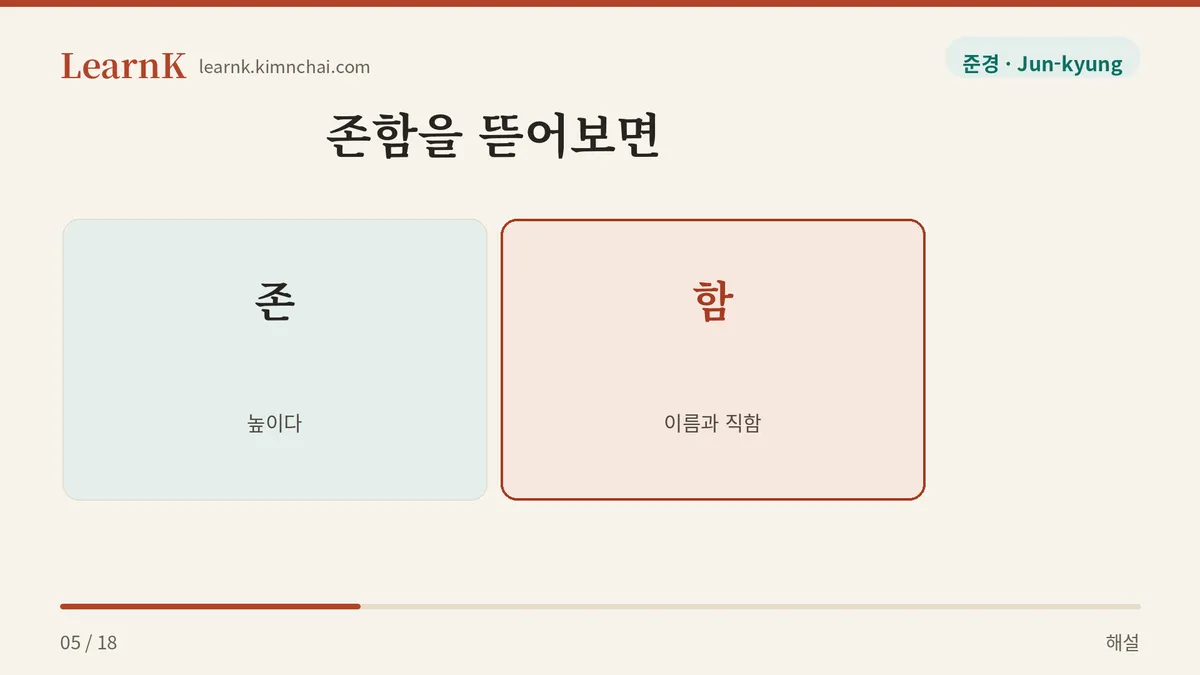
The 함 (ham) in 존함 (jonham) is the Chinese character 銜. That same character sits inside 명함 (名銜, myeongham), “business card,” 직함 (職銜, jikham), “job title,” 성함 (姓銜, seongham), and 함자 (銜字, hamja). Why the slip of paper you hand a person you’ve just met is called a 명함 (myeongham), and why titles like 부장 (bujang) or 팀장 (timjang) are called 직함 (jikham), all trace back to this one character. The sense that a name and a rank are handled as a single bundle is preserved inside these words like a fossil.
But the real reason 존함 (jonham) became necessary lies elsewhere. In Korea, you do not say an elder’s name out loud. No adult calls their father by his given name, and at the office people use titles instead of names: 부장님 (bujangnim), 선생님 (seonsaengnim), 원장님 (wonjangnim). So when a moment comes where the name absolutely has to be confirmed — filling out a form, making an introduction, writing on an envelope — it’s the speaker who ends up feeling apologetic. 존함 (jonham) and 함자 (hamja) are words carried in one register higher to ease that apology. It’s a prime example of honorific language working less as manners and more as cushioning.
The places you meet 존함 (jonham) in dramas are mostly like that too. In a historical drama, a scene where someone asks the name of a stranger of unknown rank; in a modern drama, the scene where a hospital director or company chairman first appears and is introduced; in a courtroom drama, the scene where a witness on the stand has their identity confirmed. They all share one thing: there is as yet no relationship between the two people, and the empty space has to be filled with deference. Conversely, between characters who have already grown close, the word cuts out entirely. The moment 존함 (jonham) disappears is the moment two people have grown closer — follow the dialogue alone and you can watch the distance between them change.
Today’s quiz
It’s your first day at a Korean company and you’re being introduced to your team leader. You already knew the team leader’s name, and you’d like to convey that politely. Which of the following sounds most natural?
- 팀장님, 제 존함은 에밀리입니다. (timjangnim, je jonhameun emilliimnida.)
- 팀장님 존함은 전부터 익히 알고 있었습니다. (timjangnim jonhameun jeonbuteo iki algo isseotseumnida.)
- 팀장님, 존함이 뭐예요? (timjangnim, jonhami mwoyeyo?)
- 팀장님 성명이 어떻게 되냐? (timjangnim seongmyeongi eotteoke doenya?)
Show the answer
Answer: 2
Number 1 attaches 존함 (jonham) to your own name and elevates yourself. Number 2 is the standard form, keeping the dictionary example’s 익히 알다 (iki alda) intact. Number 3 raises only the noun while leaving the predicate low, so the layers don’t line up — it has to be 존함이 어떻게 되십니까 (jonhami eotteoke doesimnikka) to match. Number 4 goes wrong twice, pairing the documentary term 성명 (seongmyeong) with a casual sentence ending.
Definitions and example sentences are from the National Institute of Korean Language’s Basic Korean Dictionary (krdict.korean.go.kr); that portion of this post, including our translations, is licensed under CC BY-SA 2.0 KR.