존잘/존예 (jonjal/jonye) — The Words That Jump Out Before You Can Think
존잘/존예
존잘 (jonjal) and 존예 (jonye) are Korean internet slang meaning “insanely handsome” and “insanely pretty,” respectively. The hundreds of comments that pile up within a minute under an idol fancam, the reply that comes back three seconds after a friend sends a selfie, the opening line of a fan-signing recap — the places these words live are pretty much fixed. They’re not a verdict you deliver after calmly taking something in; they’re the gasp that jumps out of your mouth the instant you see the screen.
That’s why 존잘/존예 carry so much force. If 잘생기다 (jalsaenggida) and 예쁘다 (yeppeuda) are flat descriptions, 존잘/존예 stack an exclamation on top and crank the volume to the max. Korean has a habit of attaching intensifying prefixes to blow up the size of a feeling — 개맛있다 (gaemasitda), 핵꿀잼 (haekkkuljaem), 왕큼 (wangkeum) — and 존잘/존예 sit at the strongest end of that lineup. Being strong, though, also means there are a lot of places you have to hold them back.
Another trait is how flexibly they move between parts of speech. They can stand in the adjective slot, as in 존예야 (jonye-ya, “you’re so pretty”), or become a noun pointing at a person, as in 우리 팀 존잘 (uri tim jonjal, “the best-looking guy on our team”). In fandom circles people add the honorific -님 and say 존잘님 (jonjal-nim) — and in that case it usually isn’t about a face at all, but about someone whose drawing or writing is outstanding. It’s the same move you see in 그림 존잘 (geurim jonjal, “someone who draws incredibly well”): the word crossing over from looks to skill.
One thing to flag up front. For all that these words look short and cute, their roots are rough. We’ll get into the details in the cultural background section below, but that single fact decides almost everything about where you can use them — and where you absolutely cannot.
See It in a Real Conversation
Setting: Saturday evening on the subway. Emily shoves her phone at Jun-kyung to show him video from the concert she went to yesterday.
Emily: 오빠, 이거 봐 봐. 나 어제 3열이었어. Look at this. I was in the third row yesterday.
Jun-kyung: 오, 화질 좋네. 근데 가운데 저 사람이 네가 말하던 그 사람이야? Oh, nice quality. But is the one in the middle the one you keep talking about?
Emily: 응, 우리 최애. 존예지? 실물은 더 존예야, 진짜로. Yeah, my bias. Isn’t she gorgeous? She’s even more gorgeous in person, seriously.
Jun-kyung: 인정. 옆에서 춤추는 남자애도 존잘인데? Agreed. The guy dancing next to her is crazy good-looking too.
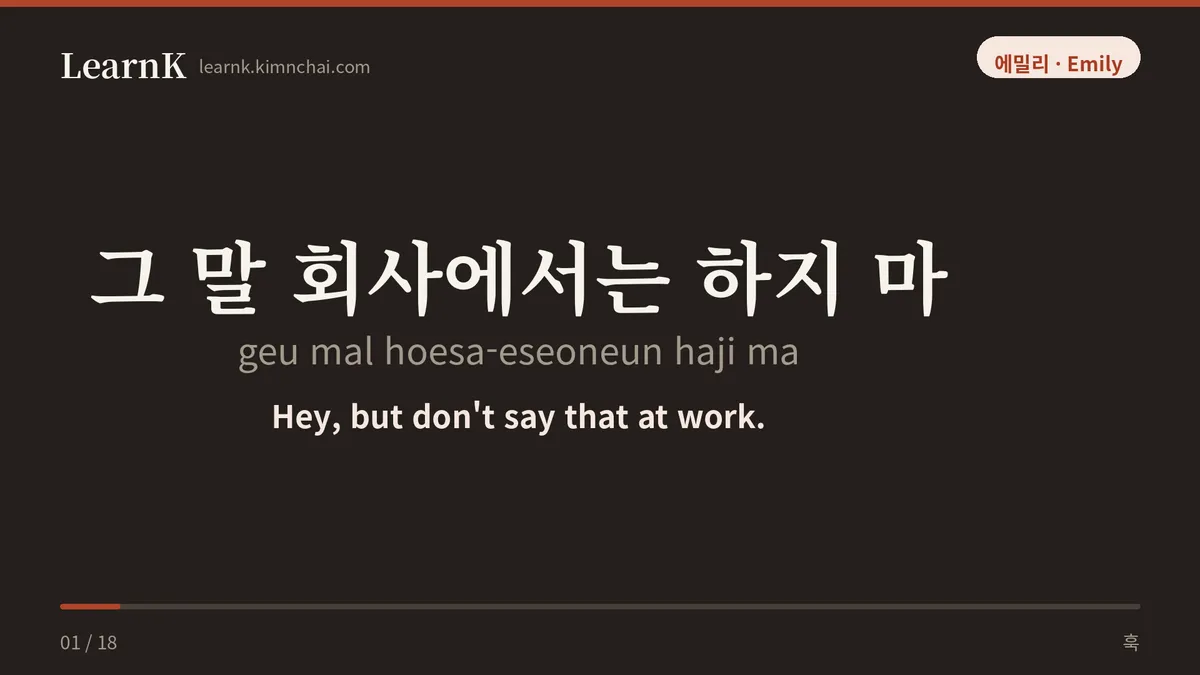
Emily: 야, 근데 그 말 회사에서는 하지 마. 너 지난주에 팀장님한테 존잘이시라고 했다며. Hey, but don’t say that at work. I heard you told the team lead he was ‘jonjal’ last week.
Jun-kyung: …그날 이후로 팀장님이 나만 보면 웃어. …Ever since that day, he smirks every time he sees me.
These Would Sound Off
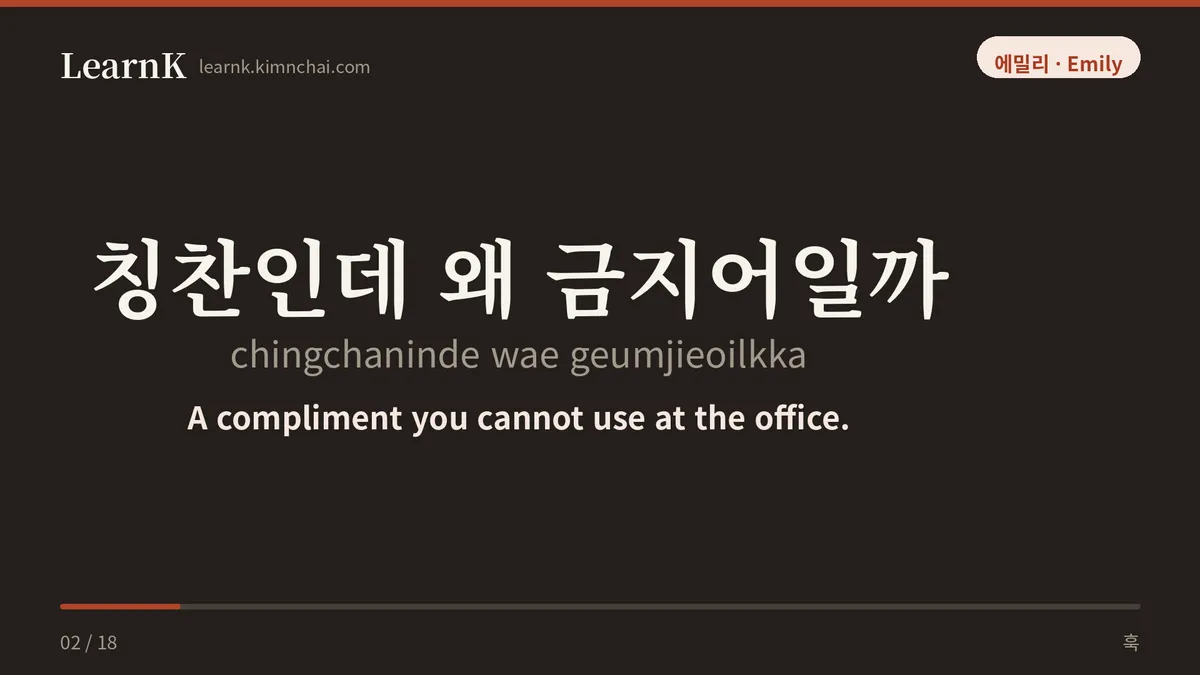
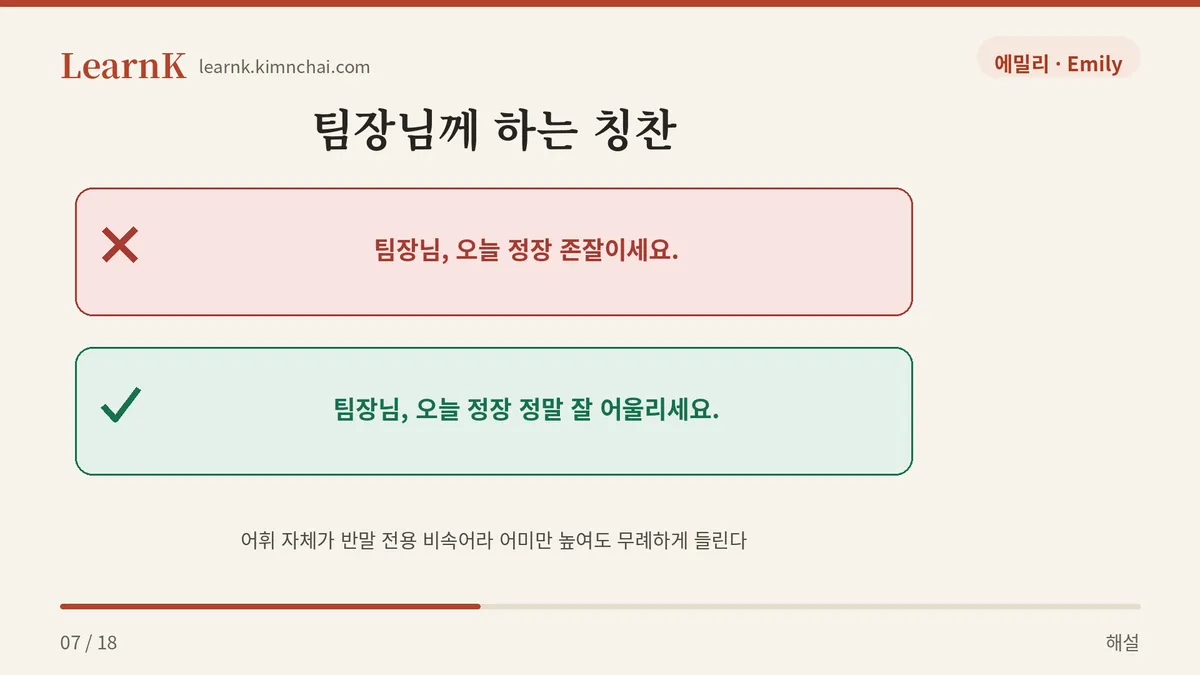
✗ (To your team lead) 팀장님, 오늘 정장 존잘이세요. ✓ (To your team lead) 팀장님, 오늘 정장 정말 잘 어울리세요. → “Sir, that suit really suits you today.” → Because 존잘/존예 come out of vulgar slang, sticking an honorific ending like -세요 on them doesn’t restore any politeness. If anything, the collision between a formal ending and rough vocabulary makes it stand out more. With someone senior to you, 멋있으세요 (meosisseuseyo) or 잘 어울리세요 (jal eoulliseyo) is the safe route.
✗ (On a first blind date) 사진보다 실물이 훨씬 존예시네요. ✓ (On a first blind date) 사진보다 실제로 뵈니까 더 좋으시네요. → “You’re even nicer in person than in your photos.” → Even if you meant it kindly, on a first meeting it comes across as though you looked the other person up and down and assigned them a score. 존잘/존예 are exclamations that burst out between people who are already close, not a greeting you hand to someone you’ve just met.
Example Sentences by Situation
Situation 1. Texting a friend who just got back from a concert A friend who went to last night’s show has dumped about ten photos into the group chat. When one of them comes out especially well, here’s the one-liner you’d trade with someone your own age.
어제 사진 봤어. 세 번째 거 진짜 존예 터졌더라. (eoje sajin bwasseo. se beonjjae geo jinjja jonye teojyeotdeora.) “I saw yesterday’s photos. The third one was absolutely stunning.”
존예 터지다 (jonye teojida) is an idiomatic pairing meaning the prettiness has exploded. 존잘/존예 often link up with verbs like 터지다 (teojida, “to burst”) and 미치다 (michida, “to go crazy”) to push the intensity up one more notch.
Situation 2. The bride’s waiting room at a wedding A college friend’s wedding. It’s the brief moment when only the bride’s friends are left in the room. You’d never use this out in the main hall where the older relatives are circulating, but behind that closed door, among people your own age, this word becomes the biggest congratulation there is.
야, 너 오늘 진짜 존예다. 화장 누가 해 준 거야? (ya, neo oneul jinjja jonye-da. hwajang nuga hae jun geoya?) “Hey, you look absolutely stunning today. Who did your makeup?”
Say the same thing to the bride’s mother and you’re in real trouble. For her, 따님이 오늘 정말 고우시네요 (ttanimi oneul jeongmal gousineyo, “your daughter looks truly lovely today”) is what belongs in that spot.
Situation 3. Commenting on fan art Some fan art shows up on social media, drawn so well that your hands move before your brain does. This is the classic use of 존잘 aimed at skill rather than a face.
존잘님 그림체 미쳤어요… 저장해 갈게요! (jonjal-nim geurimche michyeosseoyo… jeojanghae galgeyo!) “Your art style is insane… I’m saving this!”
Interestingly, here the -님 and the polite endings don’t feel awkward at all. That’s because inside fandom, 존잘님 has hardened into something close to a title of address — but this exception doesn’t travel outside fandom.
Similar Expressions, and Where They Land on the Politeness Scale
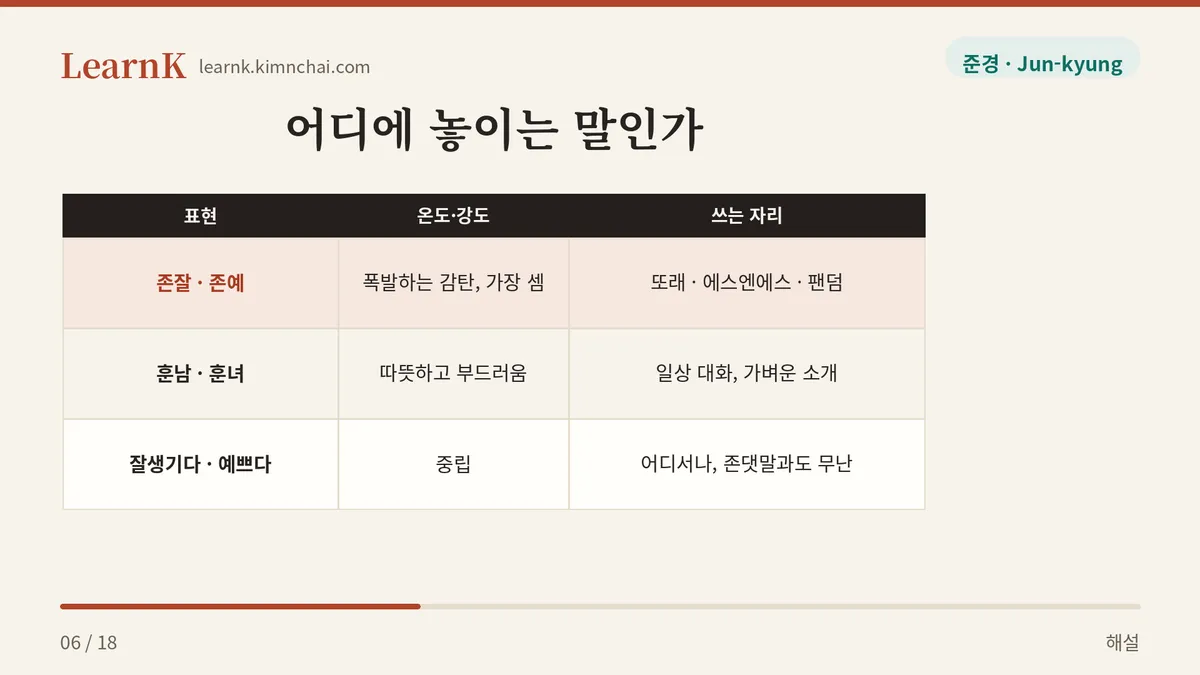
| Expression | Warmth & intensity | Where it’s used |
|---|---|---|
| 존잘/존예 (jonjal/jonye) | Explosive admiration; the strongest of the lot | Peers, social media, fandom. Never with seniors or in formal settings |
| 개잘생김/개예쁨 (gaejalsaenggim/gaeyeppeum) | Strong, but less rough than 존잘 | Speech and chat among friends |
| 훈남/훈녀 (hunnam/hunnyeo) | Warm and gentle | Everyday conversation, casual introductions |
| 잘생기다/예쁘다 (jalsaenggida/yeppeuda) | Neutral | Anywhere. Pairs with polite speech without any trouble |
| 미남/미녀 (minam/minyeo) | Formal and slightly old-fashioned | Articles and write-ups, older generations’ speech |
What’s worth noticing in the table is that 존잘/존예 have no proper honorific form. You can raise the ending and produce 존잘이세요 (jonjal-iseyo), and it will be a grammatical sentence — but it will not be polite speech. The very fact that some vocabulary is casual-speech-only is a great clue for understanding the Korean politeness system.
Cultural Background — Shrinking a Gasp Down and Down
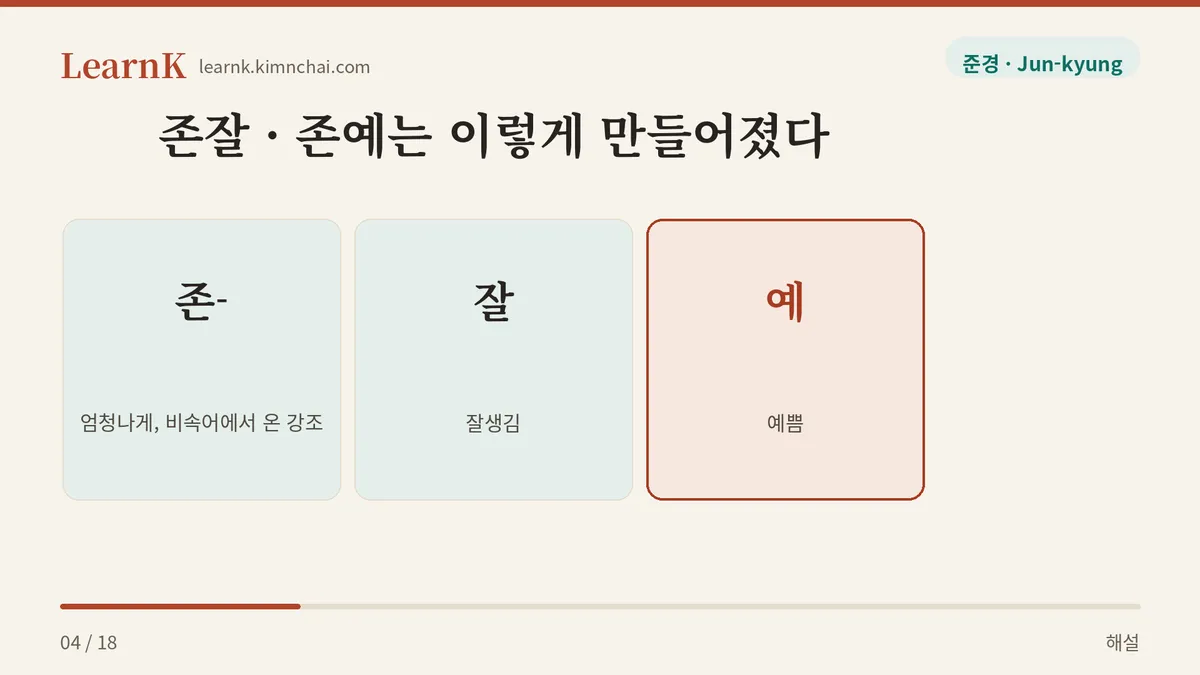
The word-building behind 존잘 and 존예 is simple. The vulgar intensifying prefix 존- (jon-) gets one syllable from 잘생김 (jalsaenggim, “handsomeness”) or 예쁨 (yeppeum, “prettiness”) attached to it, compressed down to two syllables. That 존- is a clipping of the slang word 존나 (jonna), and 존나 itself comes from a word you really can’t say out loud. Quite a few words are built on the same frame — 존맛 (jonmat), meaning “incredibly delicious,” and 존버 (jonbeo), meaning “holding out to the bitter end.” They look like adorable little two-syllable words on the surface, and this is exactly why you don’t use them in front of your elders.
So people swap out the intensifying prefix depending on the setting. If you want to tone it down a bit, you reach for 개- (gae-), 핵- (haek-), or 왕- (wang-); if you want to be completely safe, you drop the intensifier altogether and use 정말 (jeongmal) or 진짜 (jinjja). If you get into the habit of checking the one syllable in front of the root before anything else when you meet Korean slang, you can usually tell which settings that word is safe to bring out in.
The channels that spread these words were the fandoms and online communities of the 2010s. A culture of tossing short exclamations under stage videos, layered with a variety-show culture of putting viewers’ own speech patterns straight onto the screen as subtitles, turned 존잘/존예 into everyday vocabulary fast. That said, even in Korea the air around commenting on people’s looks is getting more cautious. The place these words sound most natural right now isn’t evaluation but celebration and awe — aimed at your bias on stage, or at your friend on her wedding day.
Today’s Quiz
At a company workshop, your team lead shows up in a newly tailored suit. Which of these can you actually say?
① 팀장님, 오늘 존잘이세요. ② 팀장님, 오늘 정말 멋있으세요. ③ 팀장님, 오늘 존예십니다.
The answer is ②. No matter how far you raise the ending in ① and ③ with -세요 or -십니다, the vocabulary itself is casual-only slang, so it lands as rude. On top of that, ③ has the added problem of using 존예 for a man. If we squeeze today’s lesson into a single line: 존잘/존예 are words you pull out based on the setting, not on the temperature of your feelings.
Definitions and example sentences are from the National Institute of Korean Language’s Basic Korean Dictionary (krdict.korean.go.kr); that portion of this post, including our translations, is licensed under CC BY-SA 2.0 KR.