까칠하다 (kkachilhada) — Why Is Every K-Drama Male Lead So Prickly?
까칠하다
까칠하다 (kkachilhada) means two things at once: that a body is thin and the skin or hair is rough, and that someone’s temperament is not gentle and very hard to please. It’s the feeling of a surface that catches on your fingertip instead of sliding smoothly under it — and Korean took that one sensation and pinned it onto a person’s face and onto their personality alike.
Watch a few Korean dramas and you’ll inevitably meet a certain character type: the man who speaks in clipped sentences, never smiles, and sighs instead of answering when the female lead asks him something. Viewers say of him, 저 남자 왜 저렇게 까칠해? (jeo namja wae jeoreoke kkachilhae?) — “Why is that guy so prickly?” And then, the next morning after an all-night binge, they look at themselves in the mirror and say exactly the same thing: 얼굴 완전 까칠하네. (eolgul wanjeon kkachilhane.) — “My face looks totally rough.” One word, covering somebody else’s personality and your own skin at the same time.
Let’s pin down the nuance first. 까칠하다 is not a flat-out insult. It isn’t like 못됐다 (motdwaetda) or 나쁘다 (nappeuda), which tear the person down as a person; it’s closer to an observation that the surface isn’t smooth. That’s why friends use it half-smiling, and why, applied to a drama character, it becomes the name of an attraction rather than a flaw. Say it to someone’s face, though, and it turns into a judgment about their character — the temperature shoots right up. That gap is the single most important thing to keep in mind with this word.
It helps to learn the forms in advance too. Casual is 까칠해 (kkachilhae), polite is 까칠해요 (kkachilhaeyo), and when you’re talking about someone older or senior you use 까칠하시다 (kkachilhasida). To describe a change — they weren’t like this before, but they are lately — use 까칠해지다 (kkachilhaejida). And when you want to make the texture really vivid, use the reduplicated form 까칠까칠하다 (kkachilkkachilhada).
Checking it in the National Institute of Korean Language dictionary
The National Institute of Korean Language’s Basic Korean Dictionary lists 까칠하다 as an adjective and splits it into two senses.
까칠하다 (kkachilhada) 「Adjective」
- 몸이 마르고 피부나 털이 거칠다. [en] haggard; emaciated — Having a lanky body with rough skin or hair. [ja] やつれる【窶れる】 — 体が乾燥して、肌や毛などが粗い。 [es] seco, áspero, demacrado, descarnado — Que la piel es poco suave, el pelo seco y el cuerpo demasiado flaco. [zh] 憔悴 — 身材干瘦,皮肤或毛质粗糙。 — National Institute of Korean Language, Basic Korean Dictionary (krdict.korean.go.kr)
까칠하다 (kkachilhada) 「Adjective」 2. 성질이 부드럽지 못하고 매우 까다롭다. [en] picky; harsh — Lacking amiability and very fastidious. [ja] あらい【荒い】 — 性格にやさしさがなく、とても気難しい。 [es] puntilloso, exigente, quisquilloso — Que tiene un carácter poco gentil y muy severo. [zh] 刻薄 — 性格不柔和,很挑剔。 — National Institute of Korean Language, Basic Korean Dictionary (krdict.korean.go.kr)
The dictionary carries no Portuguese gloss, so we translated one ourselves (this is not a dictionary quotation): 1. macilento, áspero — corpo magro, com a pele ou os pelos ásperos. 2. rabugento, exigente — de temperamento pouco gentil e muito exigente.
Here are the real usage examples the dictionary lists alongside the entry, exactly as given.
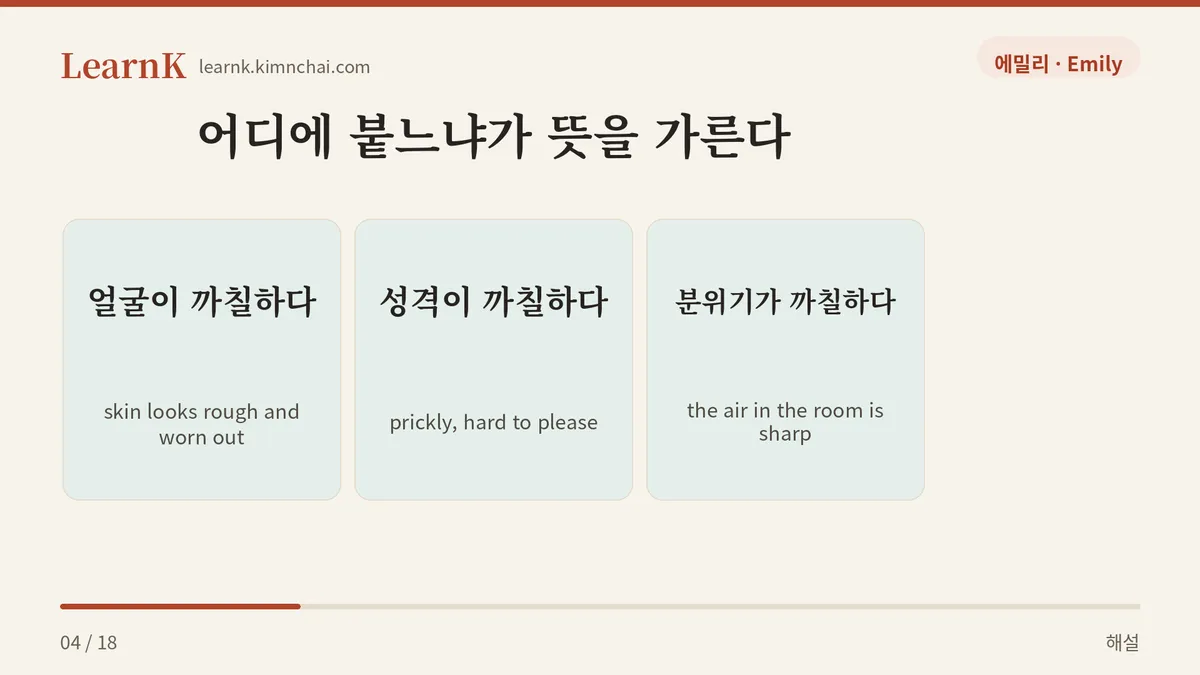
감촉이 까칠하다. (gamchok-i kkachilhada.) 얼굴이 까칠하다. (eolgul-i kkachilhada.) 입술이 까칠하다. (ipsul-i kkachilhada.) 성격이 까칠하다. (seonggyeok-i kkachilhada.) 분위기가 까칠하다. (bunwigi-ga kkachilhada.) — National Institute of Korean Language, Basic Korean Dictionary (krdict.korean.go.kr)
Line those five up side by side and you can see at a glance just how far this word reaches.
- 감촉이 까칠하다 (gamchok-i kkachilhada) — “The texture is rough.” This is the word’s original home. The way a brand-new towel feels if you use it before washing it, or the drag of an old blanket against your palm.
- 얼굴이 까칠하다 (eolgul-i kkachilhada) — “Your face looks rough.” This is where that texture moves onto the human body. Used after a few nights of bad sleep or after being ill, when the skin looks dull and dry and the person looks thinner. It’s one of the most common expressions of concern you’ll hear in Korea when meeting someone after a long time.
- 입술이 까칠하다 (ipsul-i kkachilhada) — “My lips are chapped.” The state of cracked, flaking lips from dry winter air or a fever. It reads as a signal that you’re not feeling well.
- 성격이 까칠하다 (seonggyeok-i kkachilhada) — “He has a prickly personality.” The flagship example of the second sense. It points to someone who gets irritated over small things and whose standards are so high they’re hard to satisfy.
- 분위기가 까칠하다 (bunwigi-ga kkachilhada) — “The mood was prickly.” Here it’s applied not to a person but to a whole setting. You walk into a meeting room, nobody is smiling, everyone’s sentences end sharply — that’s the air you’d describe this way.
A real conversation
Situation: 1 a.m. on a Saturday. Two friends are in Jun-kyung’s living room, binge-watching the final episode of a drama. The snack bag is already empty.
준경: 자, 이제 진짜 마지막 회다. 불 끌게. Okay, this is really the last episode. I’ll turn the lights off.
에밀리: 근데 저 남자 주인공 왜 저래? 12회 내내 까칠해. 웃는 걸 본 적이 없어. But what’s up with the male lead? He’s been prickly for twelve straight episodes. I’ve never seen him smile.
준경: 원래 저런 캐릭터가 인기 많아. 마지막에 딱 한 번 웃어 주거든. 그거 보려고 다들 보는 거야. That type is always popular. He smiles exactly once at the end. Everyone watches for that one moment.
에밀리: 한국 드라마 진짜 계산적이다… 야, 근데 너 얼굴도 지금 좀 까칠하다. 눈 밑에 다크서클 봐. Korean dramas are so calculated… Hey, by the way, your face looks rough right now too. Look at those dark circles.
준경: 어제 밤샜거든. 세수도 안 하고 앉아 있어서 그래. I pulled an all-nighter yesterday. And I’ve been sitting here without even washing my face.
에밀리: 그럼 자야지. 너 잠 모자라면 성격도 같이 까칠해지잖아. Then go to sleep. When you don’t get enough sleep your personality gets prickly too.
준경: 내가 언제. …한 회만 더 보고 잘게. When have I ever. …One more episode and then I’ll sleep.
The same word shows up three times, but with meanings that fork in two directions. The first is the drama lead’s personality, the second is the state of Jun-kyung’s skin, the third is personality again. Korean speakers sort them automatically, just by looking at whether the word in front is a face or a temperament.
This sounds off
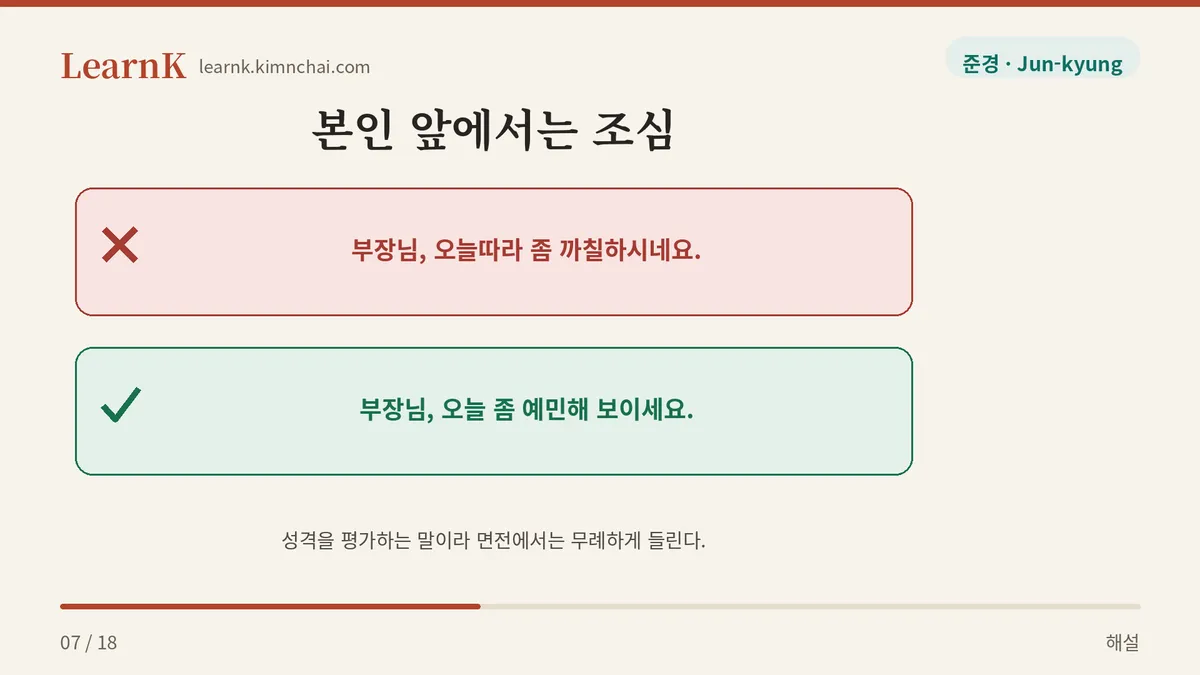
✗ (Directly to your department head) 부장님, 오늘따라 좀 까칠하시네요. ✓ (Quietly, to the coworker next to you) 부장님 오늘 좀 까칠하시다, 그치? → It’s a judgment about someone’s character, so said to their face it sounds rude. This word is fundamentally for talking about someone who isn’t in the room, or for tossing around as a joke between very close friends. If you have to say something directly to a superior, 오늘 좀 예민해 보이세요 (oneul jom yeminhae boyeoseyo, “You seem a bit on edge today”) is far safer.
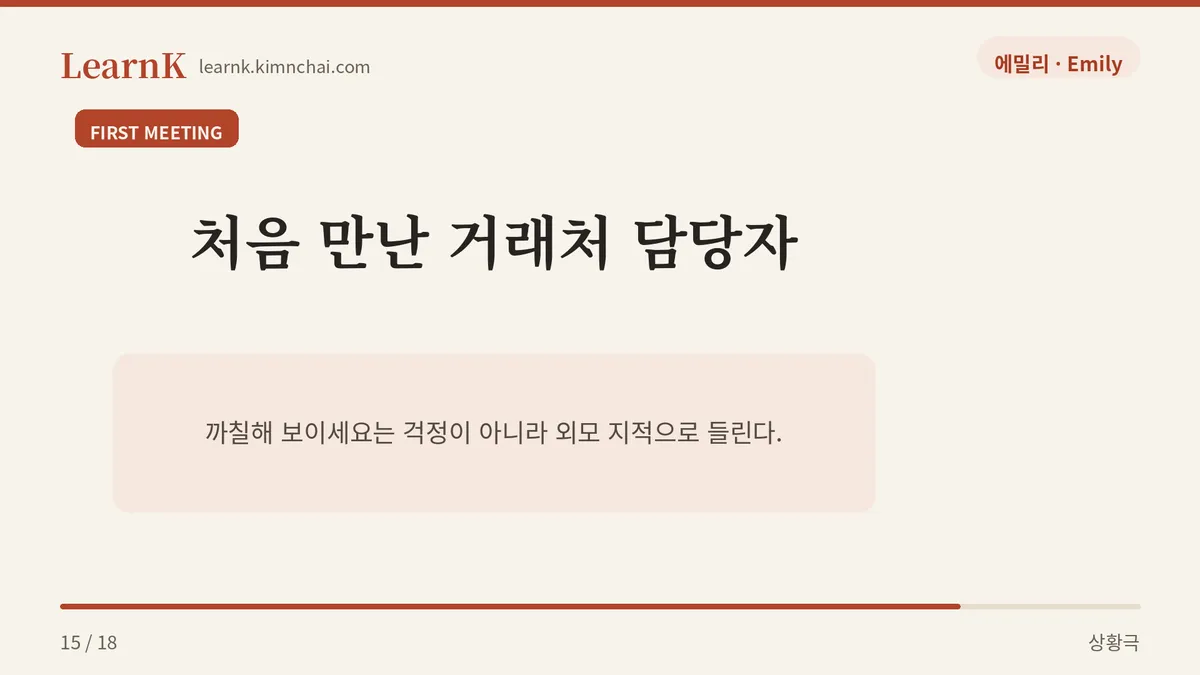
✗ (To a client contact you’re meeting for the first time) 얼굴이 까칠해 보이세요. 어디 아프세요? ✓ (To a client contact you’re meeting for the first time) 안색이 좀 안 좋아 보이시는데, 괜찮으세요? → 까칠하다 goes as far as scrutinizing the texture of someone’s skin, so between people who aren’t close it lands as a comment on their appearance rather than concern. 안색이 안 좋다 (ansaek-i an jotda, “you don’t look well”) conveys the same worry far more politely.
Example sentences by situation
1. A roommate during exam season (a temporary change)
요즘 시험 기간이라 그런지 룸메가 좀 까칠해졌어. (yojeum siheom gigan-ira geureonji rumme-ga jom kkachilhaejyeosseo.) “Maybe because it’s exam season, my roommate has gotten kind of prickly lately.”
This doesn’t say that’s who they are — it says that’s how they are right now. Attaching -아/어지다 (-a/eojida) turns it into a change of state, and in that instant the remark swings from criticism toward understanding. It’s a cushioning device Koreans reach for often when speaking carefully about someone else.
2. A secondhand-marketplace review (rating a service)
판매자분이 좀 까칠하시긴 했는데, 물건 상태는 정말 좋았어요. (panmaejabun-i jom kkachilhasigin haetneunde, mulgeon sangtae-neun jeongmal joasseoyo.) “The seller was a bit prickly, but the item was in really good condition.”
Binding the two halves with -긴 했는데 (-gin haetneunde) lets you voice a complaint while keeping the overall verdict positive. It means their manner was stiff — it absolutely does not mean they scammed you.
3. Skin on a winter morning (the first sense)
겨울만 되면 입술이 까칠까칠해져서 립밤을 달고 살아요. (gyeoul-man doemyeon ipsul-i kkachilkkachilhaejyeoseo ripbam-eul dalgo sarayo.) “Every winter my lips get so chapped that I live with lip balm on me.”
The reduplicated 까칠까칠 paints the texture in a way you can almost feel. It’s almost never used for personality — it goes with surfaces like skin, stubble, or fabric. 달고 산다 (dalgo sanda) is an idiom meaning to always have something on you.
Formality levels and similar expressions
Casual is 까칠해, polite is 까칠해요, and the formal form would be 까칠합니다 (kkachilhamnida) — but that last one is almost never used in practice, because there’s rarely an occasion to appraise someone’s personality in formal register. When speaking about a senior, insert -시- (-si-), as in 까칠하시다.
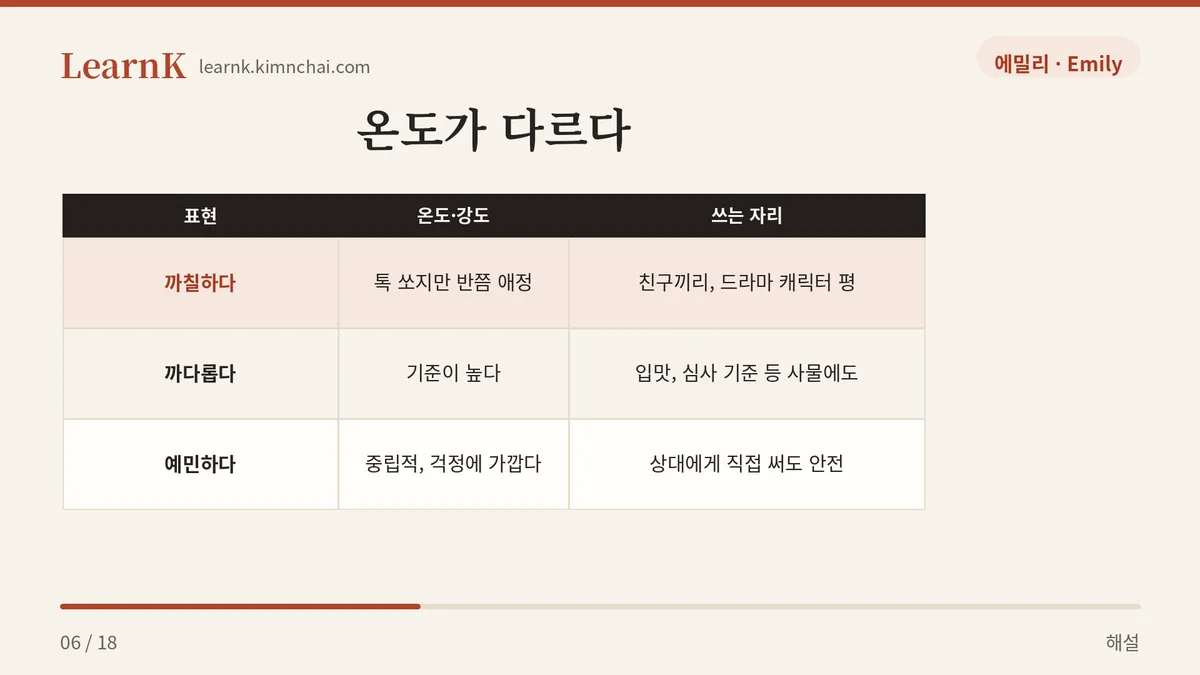
| Expression | Temperature / intensity | Where it’s used |
|---|---|---|
| 까칠하다 (kkachilhada) | Sharp, but half-affectionate | Between friends, rating drama characters. Careful to their face |
| 예민하다 (yeminhada) | Neutral, closer to concern | Describing a state. Relatively safe to say to the person directly |
| 까다롭다 (kkadaropda) | More about high standards | Not just people — also tastes, conditions, review criteria |
| 무뚝뚝하다 (muttukttukhada) | Cold but without malice | Someone of few words and no facial expression |
| 쌀쌀맞다 (ssalssalmatda) | Cold and unfeeling; most negative | When someone’s attitude is openly frosty |
The trickiest pair is 까칠하다 versus 까다롭다. 까다롭다 is a matter of conditions and standards, so it attaches to objects too: 입맛이 까다롭다 (immat-i kkadaropda, “to be a picky eater”), 심사 기준이 까다롭다 (simsa gijun-i kkadaropda, “the review criteria are strict”). 까칠하다 is the texture of the attitude a person sends outward, so it needs a tone of voice and a facial expression to exist at all. Which is why paperwork can be 까다롭다, but it can never be 까칠하다.
Cultural background — a country where prickliness becomes charm
As you can tell from the dictionary putting the texture of skin and hair first, this word originally described a sensation at the fingertips. It’s family with 거칠다 (geochilda, “rough”) and 까슬까슬하다 (kkaseulkkaseulhada, “scratchy”). The second sense was born when that tactile quality migrated onto a person’s manner. A surface that catches when you touch it → a person who catches when you deal with them. Korean has an unusual number of these sensory relocations: 목소리가 굵다 (moksori-ga gukda, “a thick voice”), 사람이 무겁다 (saram-i mugeopda, “a heavy person”), 반응이 미지근하다 (baneung-i mijigeunhada, “a lukewarm reaction”) — all of them things first felt with the body, then pinned onto people.
And we can’t avoid talking about dramas. Korean dramas have one very old formula. The male lead starts out cold, speaks in clipped sentences, and acts as though he’s brushing the heroine off — then, as the episodes pile up, it turns out he was more attentive than anyone. Viewers call this character type a 까칠남 (kkachillam), a “prickly guy.” Whether it’s the chaebol heir in Boys Over Flowers or the department-store CEO in Secret Garden, the first few episodes generally start from this same position. A character who’s warm from the very beginning leaves no room to show change, so the prickliness is really a device for making the moment his affection surfaces as dramatic as possible. Lately, more and more shows give this personality to the female lead instead.
So the temperature of this word is a little unusual within Korean. It’s a negative assessment, yet people use it with delight. Fans say of an actor they love, 실제로는 안 까칠하대 (siljero-neun an kkachilhadae, “apparently he’s not actually prickly”), and friends toss out 너 오늘 왜 이렇게 까칠해 (neo oneul wae ireoke kkachilhae, “why are you so prickly today?”) with a laugh. When someone is genuinely angry, there are other words for it — that’s when 짜증 내다 (jjajeung naeda, “to get irritated”), 화내다 (hwanaeda, “to get angry”), or 못됐다 come out. With 까칠하다, there’s still a relationship left intact.
At the same time, don’t forget that the first sense is used far more often in daily life. If a relative you haven’t seen in ages asks at a holiday gathering, 얼굴이 왜 이렇게 까칠하니, 밥은 먹고 다니니 (eolgul-i wae ireoke kkachilhani, bab-eun meokgo danini — “Why does your face look so rough? Are you eating properly?”), that’s not a comment on your personality, it’s a check-in. In Korea, remarking on someone’s complexion is often just another name for worrying about them.
Today’s quiz
In which of the following situations would 까칠하다 be the most out of place?
① To a friend who pulled an all-nighter — 너 얼굴 완전 까칠하다, 좀 자. (neo eolgul wanjeon kkachilhada, jom ja.) ② Telling a coworker how frosty the meeting was — 아까 분위기 좀 까칠했지. (akka bunwigi jom kkachilhaetji.) ③ To a client’s department head you’re greeting for the first time — 부장님, 오늘 좀 까칠해 보이세요. (bujangnim, oneul jom kkachilhae boyeoseyo.) ④ On a winter morning with chapped lips — 입술이 까칠까칠해서 립밤 발랐어. (ipsul-i kkachilkkachilhaeseo ripbam ballasseo.)
Answer: ③
① and ④ fit the dictionary’s first sense (skin and physical condition) precisely, and ② is the dictionary example 분위기가 까칠하다 verbatim. What makes ③ off isn’t grammar — it’s the setting. With a senior person you’ve just met, both appraising their skin and guessing at their personality cross a line. In that moment, 안색이 안 좋아 보이시는데 괜찮으세요 (ansaek-i an joa boisineunde gwaenchanseyo, “You don’t look well — are you all right?”) is all you need. With this word, distance comes before meaning.
Definitions and example sentences are from the National Institute of Korean Language’s Basic Korean Dictionary (krdict.korean.go.kr); that portion of this post, including our translations, is licensed under CC BY-SA 2.0 KR.