The Interjection '아아' (a-a) Fully Explained — Emotion, Surprise, Battle Cries, and How '아아' Became a Coffee
The Interjection ‘아아’ (a-a) Fully Explained
When you watch Korean dramas, you’ll come across scenes where a character gazes out at the night view beyond the window and lets out a soft, drawn-out 아아 (a-a), or where athletes charge onto the field roaring 아아 (a-a). It’s the same two syllables, yet depending on the situation it can be a sigh of deep emotion, a scream of surprise, or a rallying shout that fires everyone up. Today, let’s take a deep dive into this short but wonderfully expressive interjection.
아아
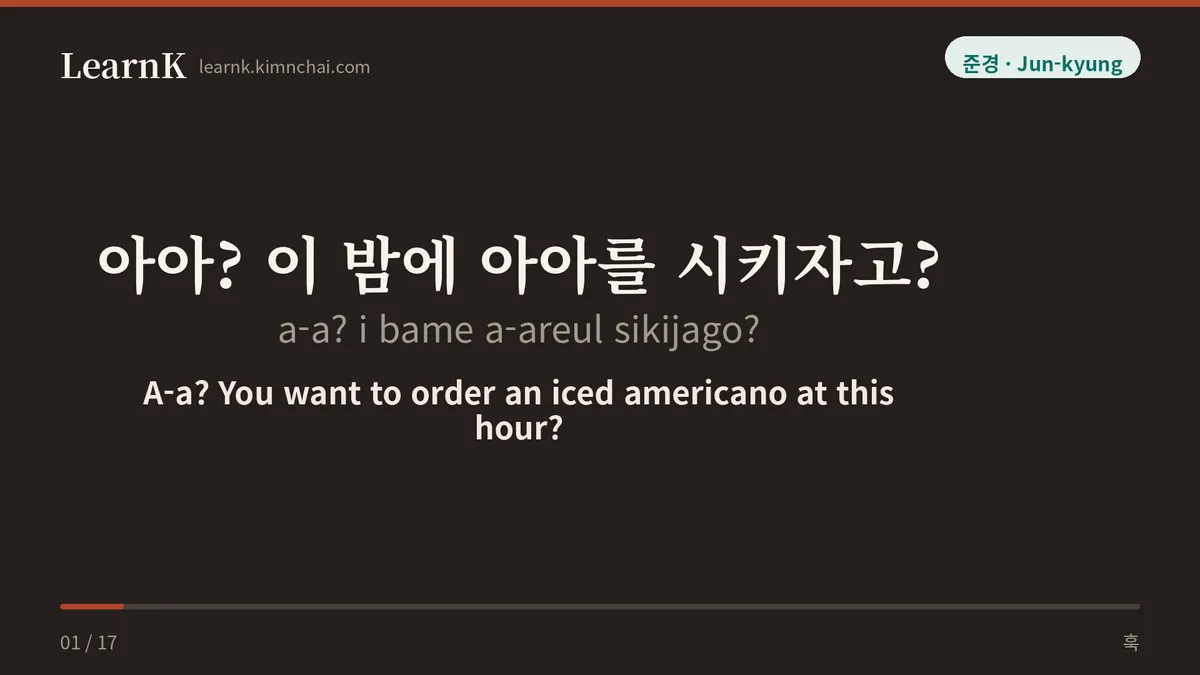
아아 (a-a) is, quite literally, a “sound.” Rather than a word with a concrete meaning, think of it as the speaker’s emotion bursting out as a voice. That’s why it splits into three branches depending on what feeling it carries: sighing out of deep emotion or distress, reacting to something surprising or unexpected, and rousing energy when a group pulls together. To really feel the nuance, you have to read it while imagining the intonation and the facial expression that go with it.
Checking with the National Institute of Korean Language dictionary
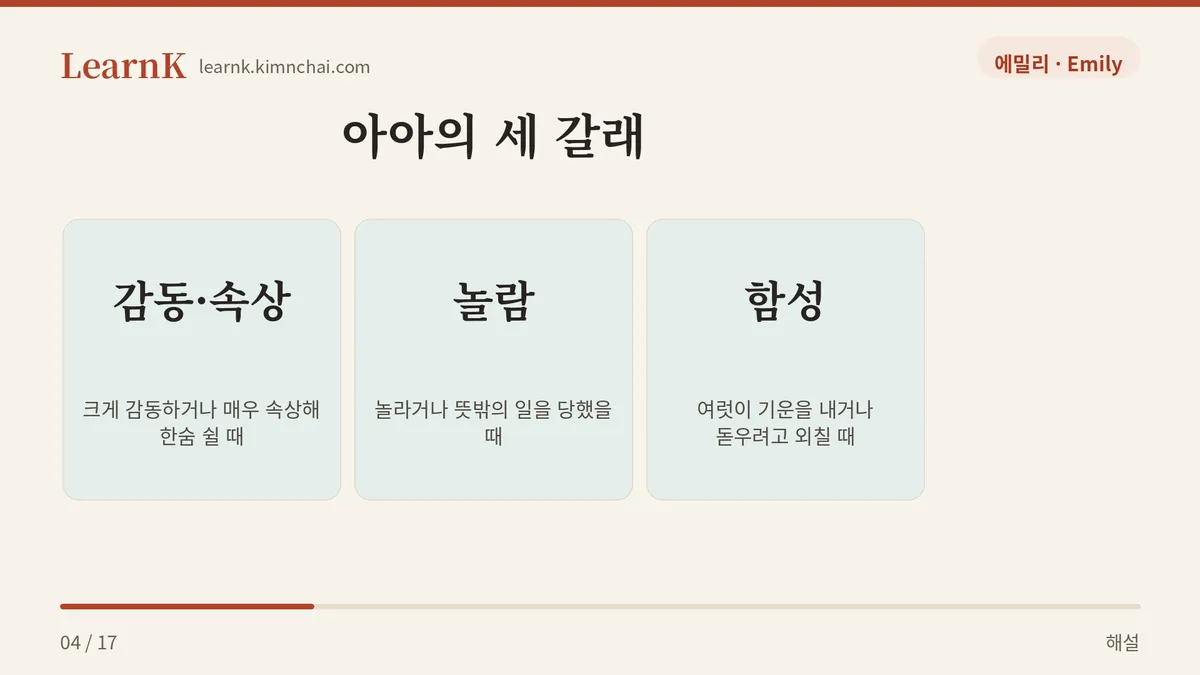
The National Institute of Korean Language’s Basic Korean Dictionary treats 아아 (a-a) as an interjection and gives three meanings.
- A sound made when sighing out of great emotion or deep distress. (ah; oh; wow)
- A sound that comes out when you are surprised or caught off guard by something unexpected. (oh no; oh my goodness)
- A sound made to summon or boost energy when fighting as a group or competing as a team. (ah; charge) — National Institute of Korean Language, Basic Korean Dictionary (krdict.korean.go.kr)
Let’s look at a few of the real usage examples the dictionary provides.
아아, 갈 데도 없이 떠도는 이 신세란. (a-a, gal dedo eopsi tteodoneun i sinseran.) — National Institute of Korean Language, Basic Korean Dictionary (krdict.korean.go.kr)
This is a scene of someone lamenting their own situation, wandering with nowhere to go. Here 아아 (a-a) is a deep sigh soaked in distress — that is, the first meaning.
아아! 정말 황홀한 광경이군. (a-a! jeongmal hwangholhan gwanggyeong-igun.) — National Institute of Korean Language, Basic Korean Dictionary (krdict.korean.go.kr)
This example, on the other hand, is about being moved. It’s the exclamation that escapes you when you’re overwhelmed by a beautiful sight before your eyes. It’s still the first meaning, but what’s interesting is that the direction of the emotion is the complete opposite.
아아!, 세상에서 이렇게 맛있는 음식은 처음 먹어 봐! (a-a!, sesang-eseo ireoke masinneun eumsigeun cheoeum meogeo bwa!) — National Institute of Korean Language, Basic Korean Dictionary (krdict.korean.go.kr)
This is a moment of being overcome because the food is so delicious. That sound that bursts out right after you swallow the first bite at a great restaurant — that’s exactly 아아 (a-a).
백만 명이 넘는 군사들이 일제히 “아아!” 함성을 지르며 적군을 향해 돌진했다. (baengman myeong-i neomneun gunsadeuri iljehi “a-a!” hamseong-eul jireumyeo jeokgun-eul hyanghae doljinhaetda.) — National Institute of Korean Language, Basic Korean Dictionary (krdict.korean.go.kr)
This is the third meaning — a rallying cry that boosts a group’s energy. It’s a sound shouted by many voices joined together, like a cheer.
For reference, the dictionary has no Portuguese translation, so we’ve added our own for learners (not based on the dictionary): ah; nossa; vamos.
Example sentences by situation (our own creations)
Let’s get a feel for how it’s used in real conversation with three example sentences we made ourselves.
- 아아, 드디어 방학이다! (a-a, deudieo banghagida!) — A sigh of deep feeling, a mix of relief and joy, that comes out when exams are finally over.
- 아아, 지갑을 집에 두고 왔네. (a-a, jigareul jibe dugo wanne.) — The fluster of the moment you realize at the checkout counter that you left your wallet behind — the second meaning.
- 아아! 우리 팀 파이팅! (a-a! uri tim paiting!) — A shout teammates let out together to psych themselves up right before a match begins — that’s the third meaning.
Formal vs. casual speech, and similar interjections
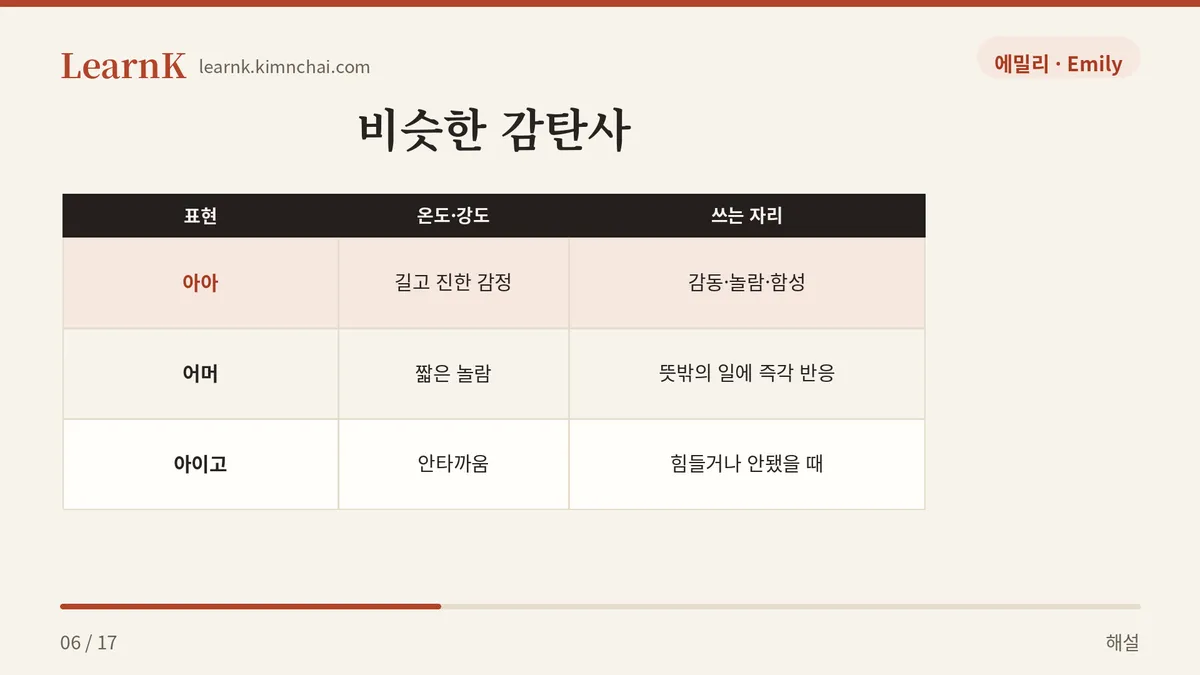
Since 아아 (a-a) is an interjection, it has no built-in distinction between polite and casual forms. Instead, you adjust the formality with the sentence that follows it. With a friend, it’s like 아아, 진짜 힘들다 (a-a, jinjja himdeulda); with an elder, 아아, 정말 감사합니다 (a-a, jeongmal gamsahamnida). Similar sounds include 어머 (eomeo) for surprise, 아이고 (aigo) for dismay, and 아 (a) for a light realization. What sets 아아 (a-a) apart is that the sound is drawn out longer, giving it a denser, more intense emotional charge.
Cultural background — how ‘아아’ became the name of a coffee
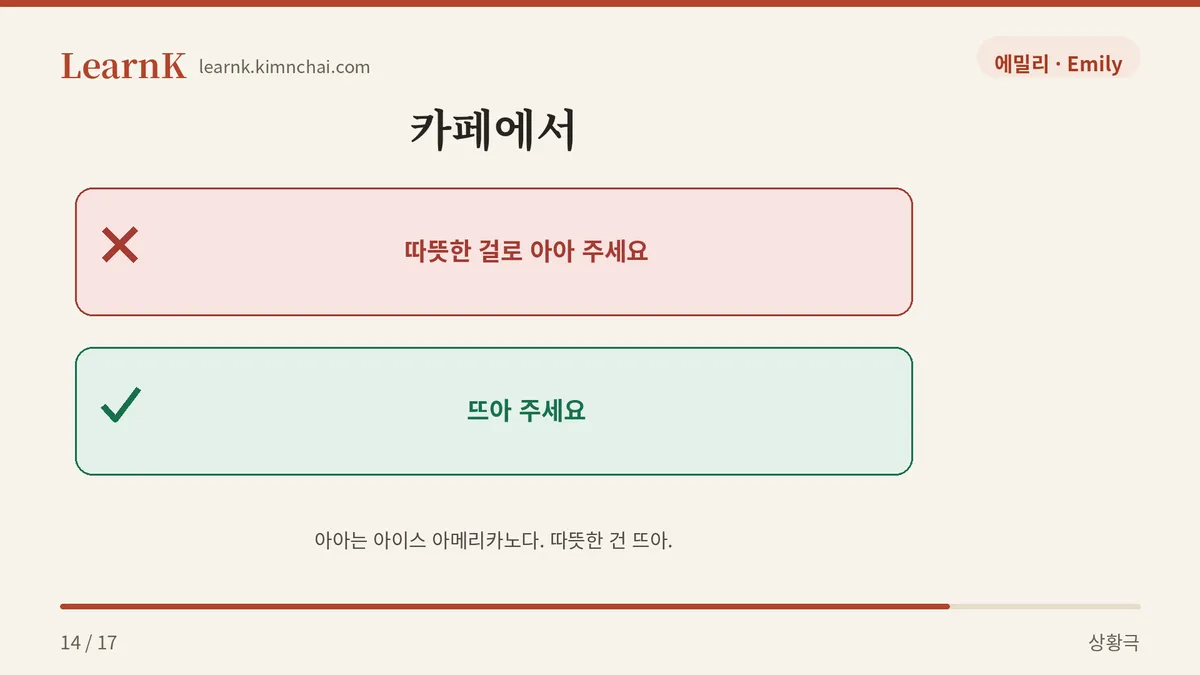
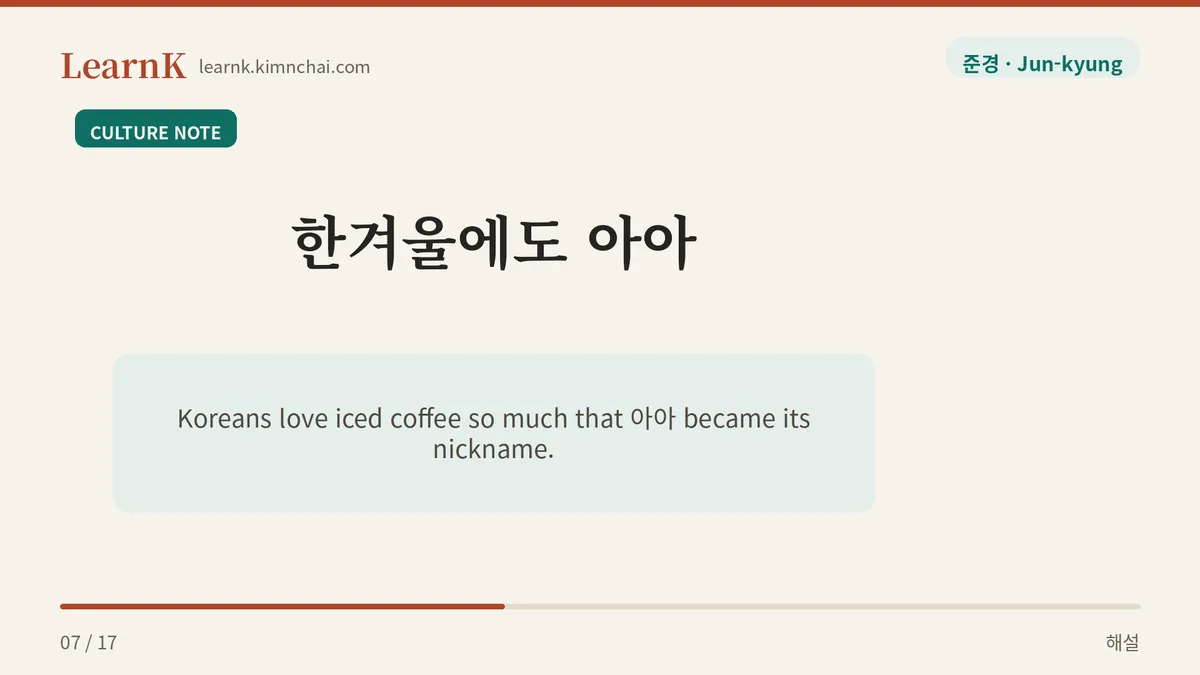
Interestingly, if you say 아아 (a-a) at a Korean café today, it isn’t taken as an interjection but as short for 아이스 아메리카노 (aiseu amerikano), an iced americano. It’s a coined term that shows off Koreans’ love of iced coffee. There’s even a saying: “아아 even in the dead of winter.” In dramas, too, there are frequent scenes where a character, reuniting with a first love, lets out a low sigh from an overflow of emotion — and this 아아 (a-a) is a uniquely Korean form of emotional expression, completed less by the dialogue than by the face and the breath.
Today’s quiz
A friend climbs to a mountaintop, sees an endless sea of clouds stretched out before them, and lets out a low “아아…” (a-a). Which of the dictionary’s three meanings is this 아아 (a-a)?
(Answer: No. 1 — a sound made when sighing out of great emotion)
Definitions and example sentences are from the National Institute of Korean Language’s Basic Korean Dictionary (krdict.korean.go.kr); that portion of this post, including our translations, is licensed under CC BY-SA 2.0 KR.