Today's Korean Expression: '배달 (baedal)' — The Two Magic Syllables That Changed Everyday Life in Korea

배달
Whether you’re traveling in Korea or watching Korean dramas, there’s one scene you’re bound to run into. It’s a rainy day, you’re sitting on the couch, you tap your smartphone a few times — and 30 minutes later, piping-hot chicken and 떡볶이 (tteokbokki) arrive right at your door. This is the culture of 배달 (baedal). Today, let’s take a deep dive into this expression that’s absolutely essential to life in Korea.
Meaning and Nuance
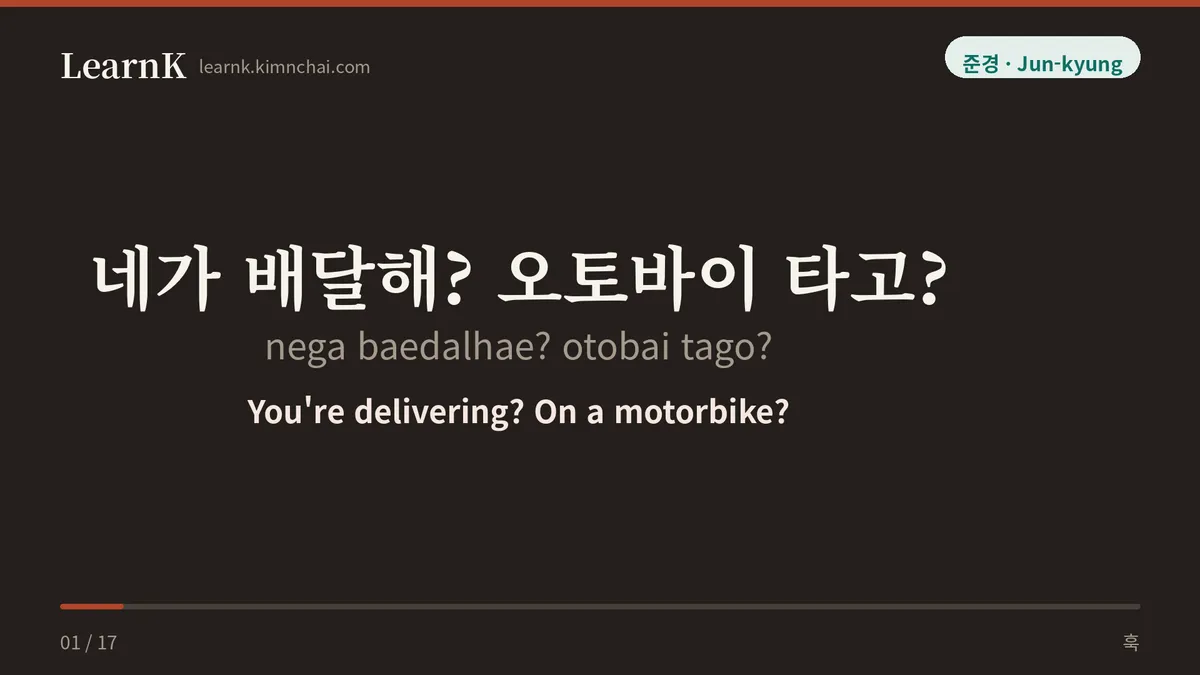
배달 (baedal) is a noun meaning “bringing and handing over mail, goods, food, and the like.” It corresponds to the English word delivery. Here’s the fun part: in Korea, when people hear “배달,” the first thing that comes to mind isn’t letters or parcels — it’s food delivery. That’s how strong the image of “배달 = food coming to your home” is.
When using it as a verb, remember these two forms:
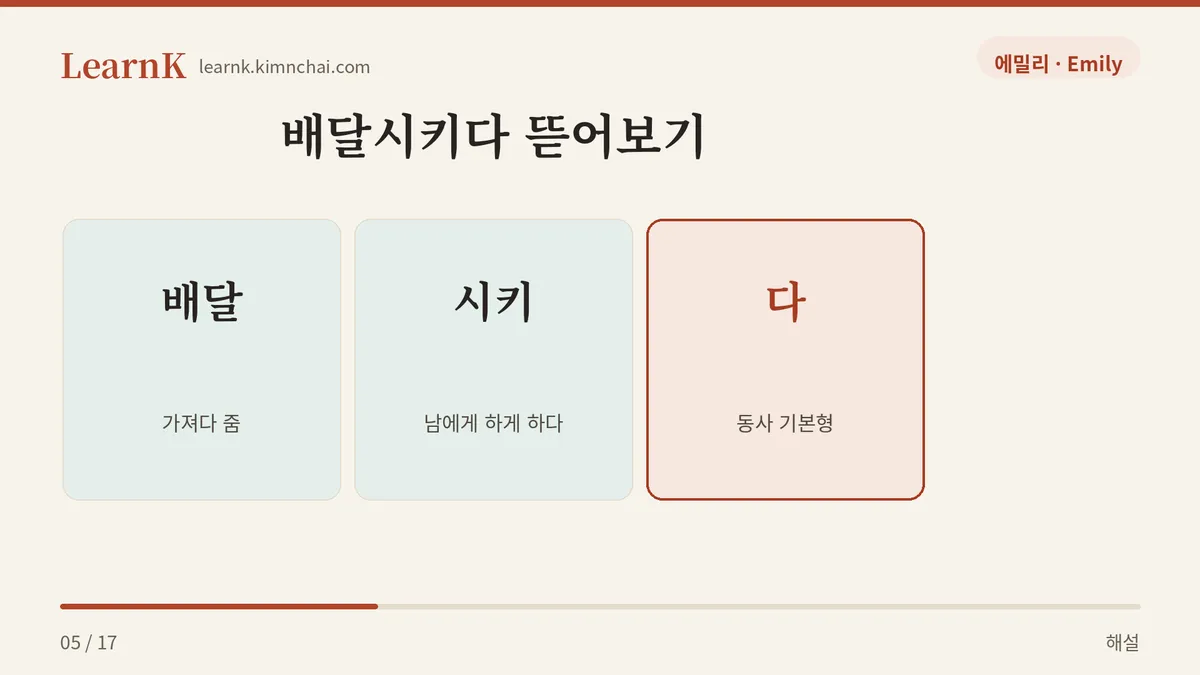
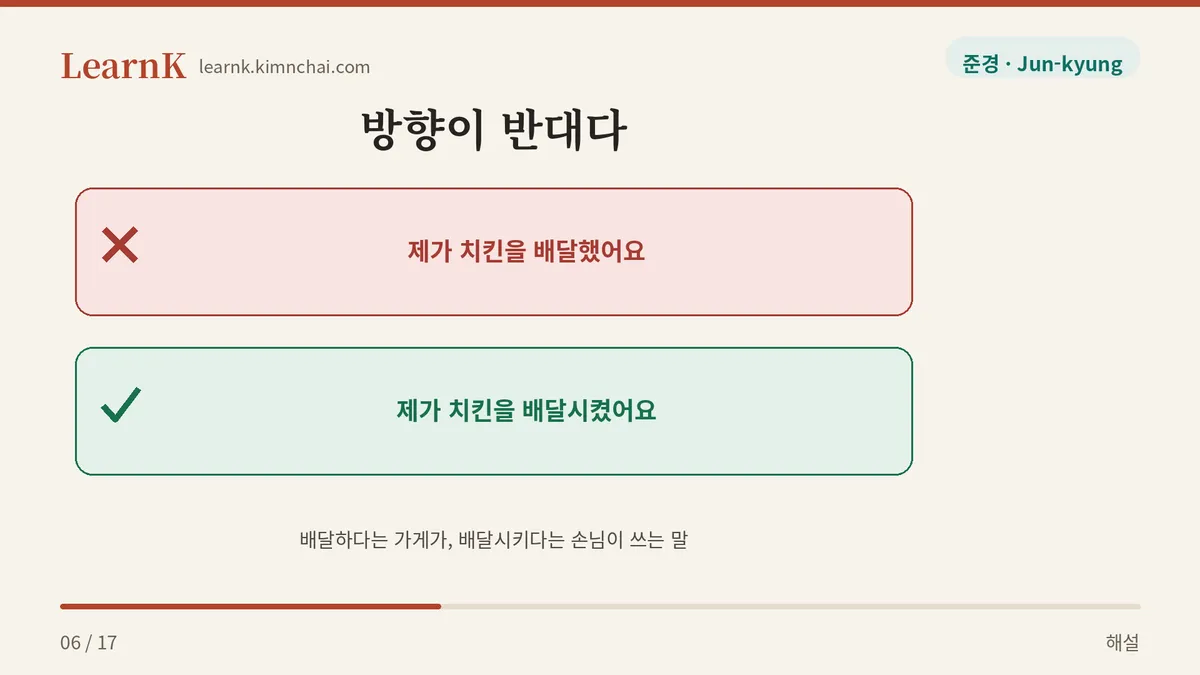
- 배달하다 (baedalhada): (for a shop) to bring and hand over — the action of the sender
- 배달시키다 (baedalsikida): (for me) to order and receive — the action of the person placing the order
For example, a restaurant says “음식을 배달합니다 (eumsigeul baedalhamnida)” (“We deliver food”), while a customer says “치킨을 배달시켰어요 (chikineul baedalsikyeosseoyo)” (“I ordered chicken for delivery”). The key point is that the direction is completely opposite.
Checking the National Institute of Korean Language Dictionary
The National Institute of Korean Language’s Basic Korean Dictionary defines ‘배달’ like this:
배달 (noun): the act of bringing and handing over mail, goods, food, etc. [en] delivery — The act of delivering mail, goods, food, etc. [es] entrega — Acción de llevar o entregar correo, objetos o comida a quien corresponda. [zh] 配送,投递,送货 — 把邮件或东西、食物等送到别人手中。 — National Institute of Korean Language, Basic Korean Dictionary (krdict.korean.go.kr)
(There is no Portuguese translation in the dictionary, so we’re adding our own: entrega — ato de levar correspondência, objetos ou comida até alguém.)
Let’s also look at some real usage examples the dictionary provides.
전화해서 가스통 배달해 달라고 하자. — National Institute of Korean Language, Basic Korean Dictionary (krdict.korean.go.kr)
Not just food, but even heavy items like a 가스통 (gastong, gas cylinder) can be the object of delivery. This is a situation where you make a single phone call to ask for something to be brought to your home.
대형 할인점의 배달 서비스가 개시되어 집에서 편하게 물건을 주문할 수 있게 되었다. — National Institute of Korean Language, Basic Korean Dictionary (krdict.korean.go.kr)
This means that big discount stores have started delivery services, so you can comfortably receive your goods at home without having to lug around heavy shopping bags.
배달시킨 점심을 다 먹기도 전에 아저씨가 빈 그릇을 거두러 오셨다. — National Institute of Korean Language, Basic Korean Dictionary (krdict.korean.go.kr)
In Korea in the old days, delivery food was served in real dishes, and once you finished eating, you’d set the empty dishes outside your door for them to be collected again. This example sentence captures that old-fashioned charm.
맞아요. 그래서 배달을 시켜 먹기가 무서워요. — National Institute of Korean Language, Basic Korean Dictionary (krdict.korean.go.kr)
This is a very everyday, conversational sentence expressing that someone hesitates to order delivery food out of worry about hygiene or cost.
Example Sentences by Situation
Let’s get a feel for it with some sentences we made ourselves.
-
When suggesting dinner options to a friend: 오늘 요리하기 귀찮은데 그냥 배달시켜 먹을까? (oneul yorihagi gwichanheunde geunyang baedalsikyeo meogeulkka?) → “I don’t feel like cooking today — should we just order delivery?”
-
When asking a restaurant over the phone: 여기도 배달 되나요? (yeogido baedal doenayo?) → An expression to check whether delivery is available all the way to your neighborhood.
-
When waiting for a delivery driver: 배달이 언제쯤 도착하나요? (baedari eonjejjeum dochakanayo?) → A polite expression to ask about the arrival time of something you ordered.
Comparing Polite/Casual Speech and Similar Expressions
Among friends, you’d speak casually with something like “배달 시키자! (baedal sikija!)” (“Let’s order delivery!”), while when calling a shop you’d use polite speech like “배달 되나요? (baedal doenayo?)” (“Do you deliver?”).
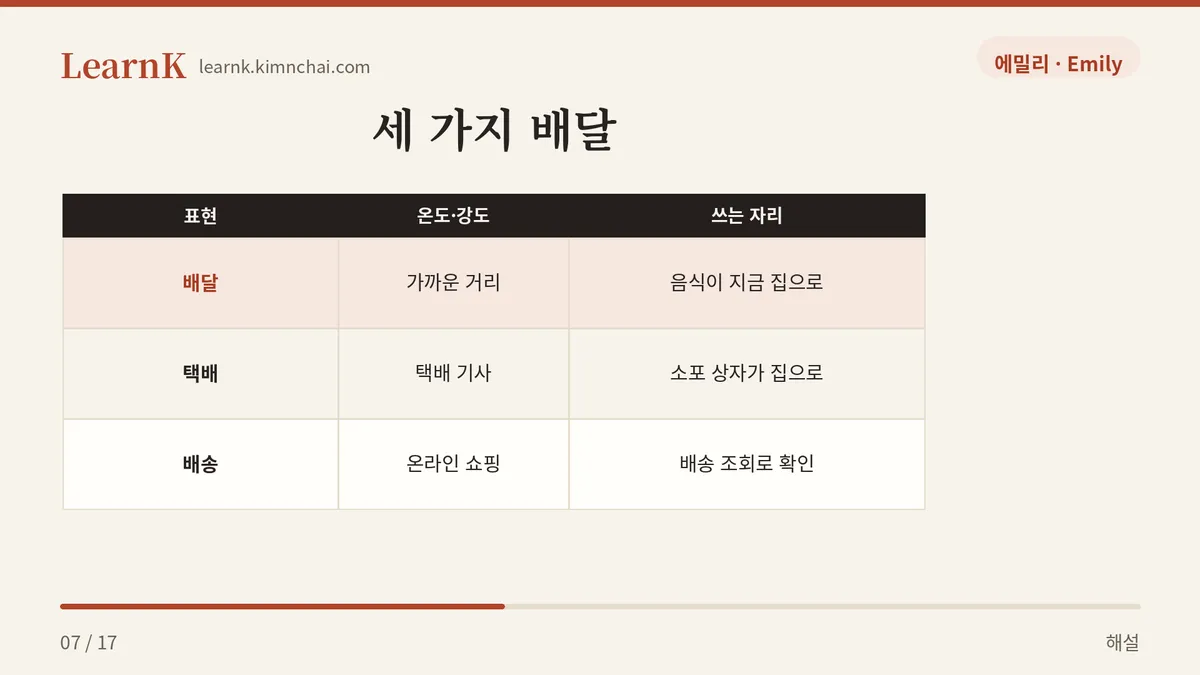
Also keep these similar-but-different words straight:
- 택배 (taekbae): mainly sending goods and parcels to your home (Coupang, the post office, etc.)
- 배송 (baesong): the process of shipping products in online shopping (“배송 조회 (baesong johoe),” i.e., tracking a shipment)
- 배달 (baedal): bringing food or goods to you immediately over a short distance
Food is 배달, and online shopping products are 배송/택배 — remember it this way and you won’t get confused.
Cultural Background
Korea’s delivery culture is famous around the world. It’s so well developed that you can receive food 24 hours a day, even in the middle of a riverside or at Han River Park. In dramas, too, you often see a scene where the main character, after a rough day, orders delivery food alone in their room and finds comfort in it.
힘들 땐 아무것도 하지 말고, 그냥 시켜 먹어. — Drama Another Miss Oh (tvN, 2016)
As you can see, ‘배달’ isn’t just a simple service — it’s also a Korean-style way of offering comfort that soothes a weary heart.
Closing Quiz
What’s the right word to fill in the blank below?
“비도 오는데 나가기 싫다. 우리 그냥 치킨 ______ 먹자!” (“It’s raining and I don’t want to go out. Let’s just get some chicken ______ and eat!”)
① 배송해서 (baesonghaeseo) ② 배달시켜서 (baedalsikyeoseo) ③ 택배해서 (taekbaehaeseo)
(Answer: ② 배달시켜서 — when you’re ordering food to be brought to your home, ‘배달시키다’ is the most natural choice!)
Definitions and example sentences are from the National Institute of Korean Language’s Basic Korean Dictionary (krdict.korean.go.kr); that portion of this post, including our translations, is licensed under CC BY-SA 2.0 KR.