The Nation's Favorite Winter Street Snack, '붕어빵 (bungeoppang)' — Even Used to Say Two People Look Alike
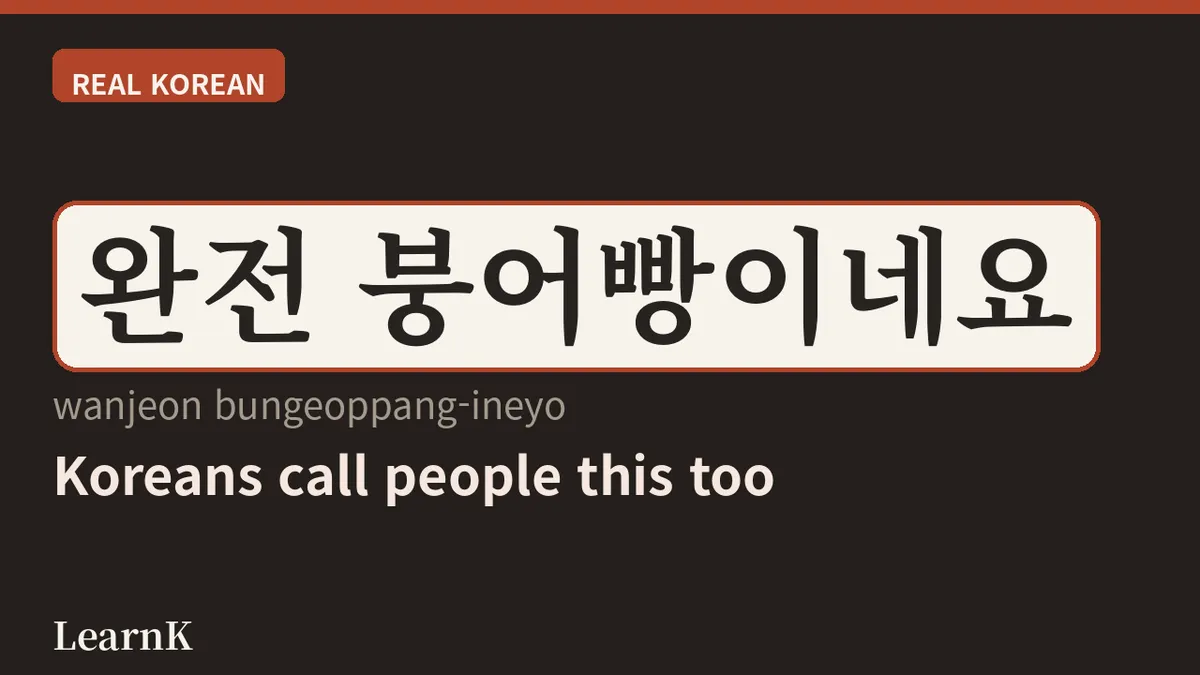
When winter arrives, a sweet smell always drifts through the streets of Korea. At subway exits, in the alleys of traditional markets, and at the food stalls in front of schools, people line up to buy this steaming-hot snack. It’s today’s expression: 붕어빵 (bungeoppang). The name comes from ‘붕어 (carp) + 빵 (bread)’ — in other words, ‘carp-shaped bread.’ But Koreans don’t only use this word when buying the snack. If someone says “우리 둘은 붕어빵이야 (uri dureun bungeoppang-iya)” it means something completely different! Today, let’s dig deep into this delicious and fun word.
붕어빵
붕어빵 (bungeoppang) is used with two main meanings.
First, the literal meaning — a winter snack made by pouring flour batter into a carp-shaped mold, adding red bean paste or cream, and baking it. Cheap and warm, it’s one of Korea’s most beloved ‘국민 간식 (gungmin gansik, national snacks).’
Second, the figurative meaning — it refers to people whose faces or looks are very similar. Just as bungeoppang pressed from the same mold all look identical, when a parent and child look just alike, people say “완전 붕어빵이네 (wanjeon bungeoppang-ine)”. It’s a fun expression similar to the English “They’re two peas in a pod.”
Checking with the National Institute of Korean Language Dictionary
First, let’s check the definition from an authoritative national institution’s dictionary.
붕어빵 (noun)
- Bread made by pouring thin flour batter into a carp-shaped mold, adding red bean paste or cream, and baking it. (bungeobbang; carp-shaped bread)
- (figurative) A person whose face is very similar to a person. — National Institute of Korean Language, Basic Korean Dictionary (krdict.korean.go.kr)
Let’s also look at the real usage examples the dictionary provides.
붕어빵 하나에 얼마씩 해요? — National Institute of Korean Language, Basic Korean Dictionary (krdict.korean.go.kr)
This is a situation of asking the price at a food stall. ‘하나에 얼마씩 (hana-e eolmassik, how much for each)’ is an expression you’ll definitely use when buying snacks sold by the piece.
아니, 붕어빵은 너무 달아서 별로야. 난 계란빵을 좋아해. — National Institute of Korean Language, Basic Korean Dictionary (krdict.korean.go.kr)
This is a scene of friends talking about their tastes in casual speech (반말, banmal). Bungeoppang is sweet because of the red bean paste, so people who find that too much sometimes go for the milder 계란빵 (gyeranppang, egg bread) instead.
어머. 아빠랑 아들이 완전 붕어빵이네. 엄청 닮았어. — National Institute of Korean Language, Basic Korean Dictionary (krdict.korean.go.kr)
Here it’s used with the second meaning, ‘looking alike.’ The hint is that it’s followed by “엄청 닮았어 (eomcheong dalmatseo, they look so much alike).”
엄마와 나는 붕어빵처럼 닮아서 모르는 사람들도 모녀 사이인 것을 알았다. — National Institute of Korean Language, Basic Korean Dictionary (krdict.korean.go.kr)
When you add ‘처럼 (cheoreom)’ to make 붕어빵처럼 (bungeoppang-cheoreom, like a bungeoppang), the comparison of ‘looking exactly alike’ becomes even clearer.
Example Sentences by Situation
Now let’s get a feel for it with some sentences we’ve made ourselves.
Situation 1 — Ordering at a food stall
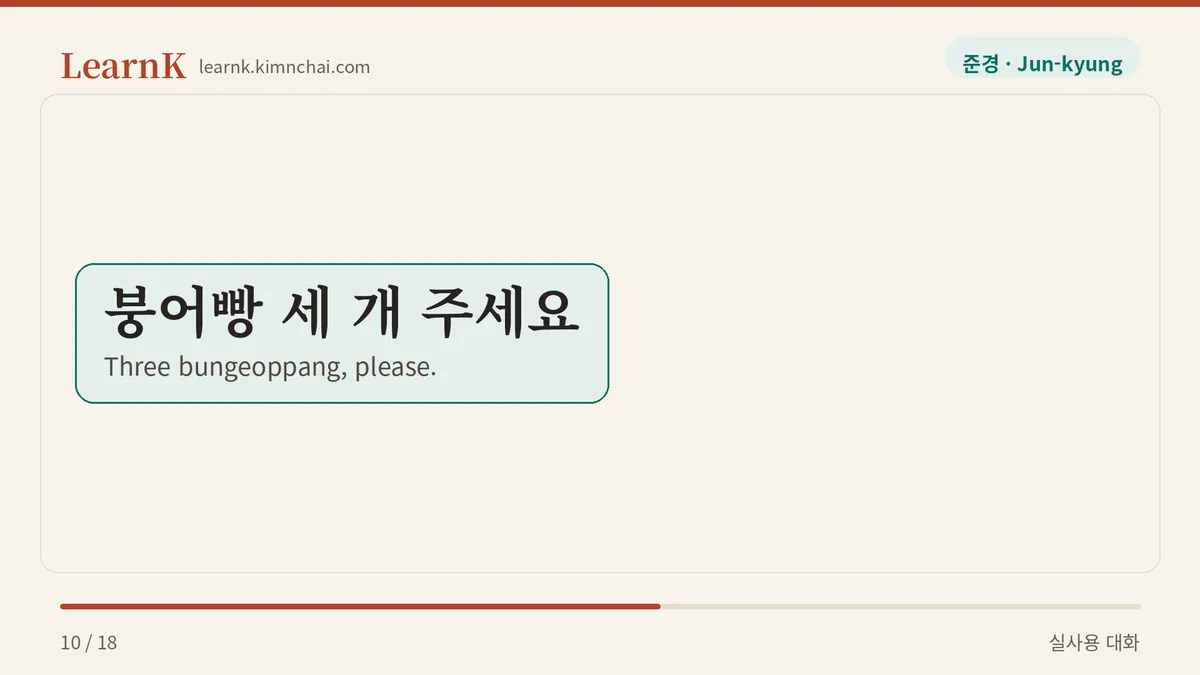
Customer: 붕어빵 세 개 주세요. (bungeoppang se gae juseyo.) Vendor: 네, 갓 구운 거예요. 따뜻할 때 드세요. (gat guun geoyeyo.) — Yes, they’re freshly baked. Eat them while they’re warm.
‘세 개 주세요 (se gae juseyo, three, please)’ is an all-purpose expression for counting out portions of snacks or food.
Situation 2 — On a winter date
추운데 우리 붕어빵 하나 사서 나눠 먹을까? (bungeoppang hana saseo nanwo meogeulkka?) — It’s cold, so should we buy one bungeoppang and share it?
‘나눠 먹다 (nanwo meokda, share and eat)’ is an expression full of 정 (情, jeong, warm affection), so it pairs perfectly with bungeoppang.
Situation 3 — Looking at a family photo (figurative meaning)
이 사진 봐. 너 어릴 때랑 네 딸이랑 완전 붕어빵이야! (wanjeon bungeoppang-iya!) — Look at this photo. You as a kid and your daughter are total bungeoppang!
You use it like this when you’re amazed at how alike two people look.
Comparing Polite and Casual Speech, and Similar Expressions
The same words have to change their level of politeness depending on who you’re talking to.
- Casual (반말, banmal): 붕어빵 먹을래? (bungeoppang meogeullae?) — to friends and family
- Polite (존댓말, jondaenmal): 붕어빵 드시겠어요? (bungeoppang deusigesseoyo?) — to elders and strangers
There are also similar expressions meaning ‘to look alike.’ 판박이 (panbagi) means almost the same thing as bungeoppang — as identical as if stamped with a seal. On the other hand, 닮은꼴 (dalmeunkkol) is a bit more neutral and gentle. In everyday conversation, bungeoppang is the most heartwarming and most frequently used.
Cultural Background
Bungeoppang is more than just a snack — it’s a ‘symbol of winter.’ In Korean dramas, too, scenes often appear where two people share a bag of bungeoppang in the cold season and open up their hearts. In a typical scene, one character quietly hands the other some freshly bought bungeoppang and says “이거 먹어, 따뜻할 때 (igeo meogeo, ttatteuthal ttae, have this, while it’s warm),” using it as a prop that conveys affection through action rather than dialogue. Recently, a new word even emerged — ‘붕세권 (bungsegwon),’ which tells you where bungeoppang is sold. It combines ‘붕어빵 (bungeoppang) + 역세권 (yeoksegwon, an area near a subway station),’ showing just how precious and beloved bungeoppang is in winter.
Closing Quiz
A friend looks at your family photo and says “어머, 너랑 동생이랑 완전 붕어빵이네! (eomeo, neorang dongsaeng-irang wanjeon bungeoppang-ine!)” What does ‘붕어빵’ mean in this sentence?
(a) A suggestion to buy snacks (b) That the two look very much alike (c) That they’re hungry
The answer is (b). It’s a compliment-tinged expression meaning the two people look just alike, like bungeoppang pressed from the same mold!
Definitions and example sentences are from the National Institute of Korean Language’s Basic Korean Dictionary (krdict.korean.go.kr); that portion of this post, including our translations, is licensed under CC BY-SA 2.0 KR.