Who's That K-Drama Lead? The Real Meaning of '재벌' (Chaebol) — Today's Korean Expression
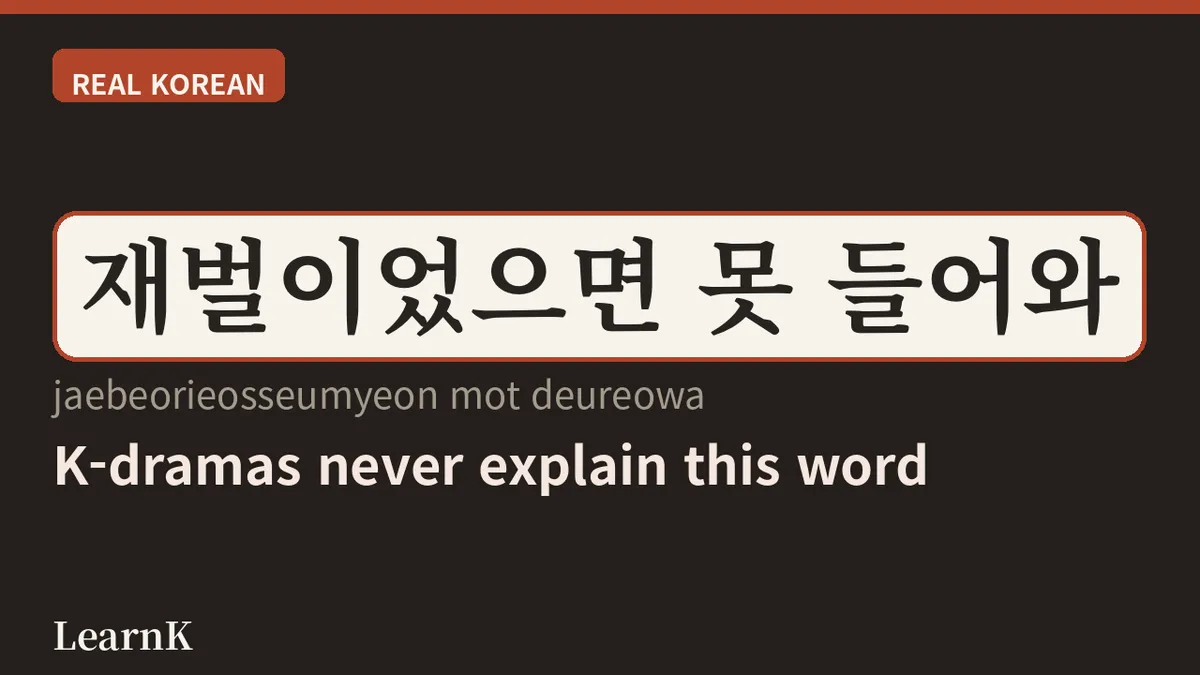
When you watch Korean dramas, there’s one character type that shows up over and over. Someone who owns a huge company, is trailed by a secretary and a chauffeur, and always appears in a flawless suit. Viewers have a name for this person. Today’s expression: 재벌 (jaebeol).
재벌
재벌 (jaebeol) doesn’t simply mean “a rich person.” An individual with a lot of money is called a 부자 (buja), but 재벌 (jaebeol) is a much bigger concept. It refers to a business conglomerate — and the family that controls it — where a single family owns and runs several large corporations, wielding enormous capital and power.
That’s why, even in English, it’s often written not as “rich man” but simply as chaebol. If you’ve heard names like Samsung, Hyundai, or LG, the families that own them are the very picture of a 재벌 (jaebeol). In other words, this word carries not just “economic wealth” but also nuances of “social power” and “family lineage.”
Checking the National Institute of Korean Language Dictionary
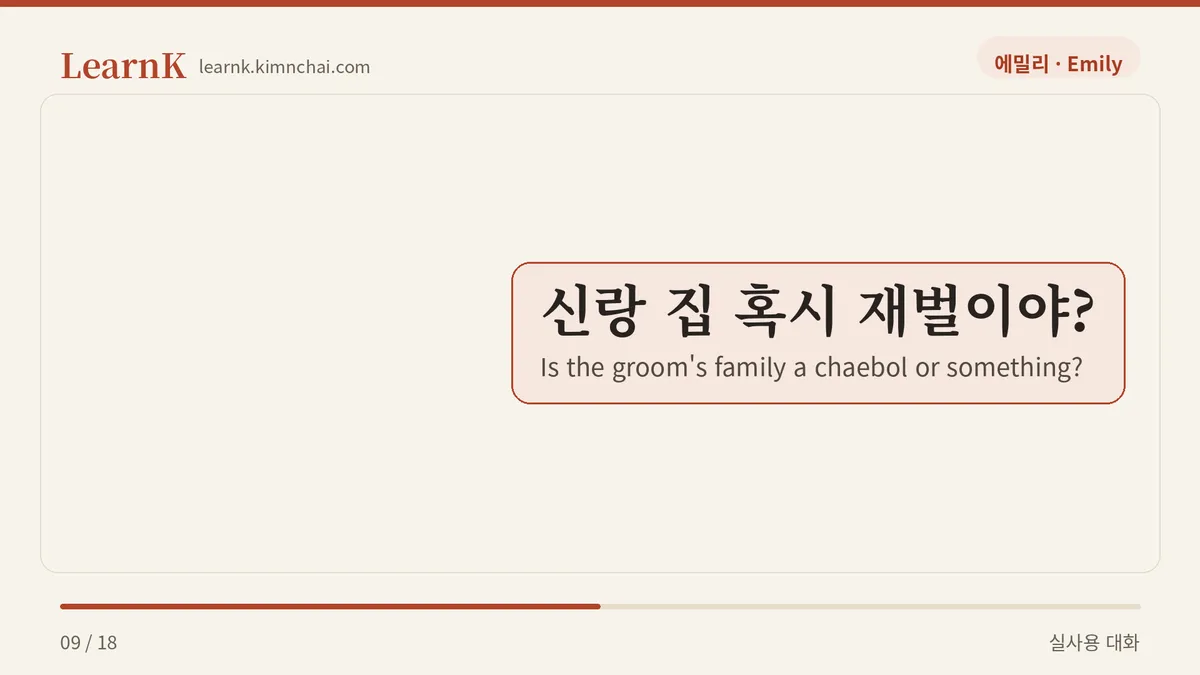
The National Institute of Korean Language’s Basic Korean Dictionary defines 재벌 (jaebeol) as follows.
재벌 「noun」 In the field of economic activity, a group of capitalists or entrepreneurs possessing enormous capital and powerful influence. [en] conglomerate; chaebol [zh] 财阀 — National Institute of Korean Language, Basic Korean Dictionary (krdict.korean.go.kr)
The key word here is “group.” The fact that it’s not one person but a group of capitalists and entrepreneurs is the decisive difference that sets a 재벌 apart from a simple rich person. Let’s also look at some real example sentences the dictionary provides.
글쎄, 한 유명 배우가 곧 재벌과 결혼을 한대요. (Well, I heard a famous actor is about to marry into a 재벌 family.) — National Institute of Korean Language, Basic Korean Dictionary (krdict.korean.go.kr)
This is a situation you often see in entertainment news. Here, “marrying a 재벌” means joining a family with tremendous wealth and status.
우리나라 최고 재벌가의 형제들 사이에서 싸움이 일어났다며? (I heard a fight broke out among the brothers of our country’s top 재벌 family?) — National Institute of Korean Language, Basic Korean Dictionary (krdict.korean.go.kr)
Here, 재벌가 (jaebeol-ga) means “a chaebol family.” The phrase “a fight among brothers” reveals that a 재벌 operates as a family unit.
재벌가 형제들이 유산 상속을 두고 법정 싸움까지 갔다며? (I heard the brothers of a 재벌 family even went to court over their inheritance?) — National Institute of Korean Language, Basic Korean Dictionary (krdict.korean.go.kr)
Battles over inheritance and management control are a staple of dramas — and of real news, too.
강 의원은 재벌과 정치 권력가들의 힘에 굴복하지 않고 맞서 싸웠다. (Assemblyman Kang did not yield to the power of the 재벌 and political powerbrokers, but fought back against them.) — National Institute of Korean Language, Basic Korean Dictionary (krdict.korean.go.kr)
In this example, the 재벌 is placed side by side with “political power.” It nicely shows that a 재벌 symbolizes not just money but power.
For reference, the dictionary doesn’t include a Portuguese translation, so here’s our own to help with understanding: in Portuguese, you might describe it as conglomerado familiar (chaebol) — that is, “a giant business group controlled by a family.” (This Portuguese explanation is our own translation, not dictionary material.)
Example Sentences by Situation
Let’s get a feel for the word with some sentences we made ourselves.
Situation 1 — Introducing a drama You recommend a new drama to a friend. 이 드라마 남자 주인공이 재벌 3세래. (i deurama namja jugongi jaebeol samsae-rae.) → “I heard the male lead in this drama is a third-generation chaebol.” 재벌 3세 (jaebeol samse) is a very common expression referring to the grandchild generation of a chaebol founder — in other words, a young heir of a chaebol family.
Situation 2 — Expressing surprise You belatedly learn about a colleague’s background. 그 사람 알고 보니 재벌 집안이더라고요. (geu saram algo boni jaebeol jibanideoragoyo.) → “Turns out that person is from a chaebol family.” It carries the nuance of a plot twist — they seemed ordinary on the surface, but were actually from an incredibly prominent family.
Situation 3 — Talking about society You share opinions while watching the news. 재벌의 경제력이 너무 커지는 것 같아요. (jaebeorui gyeongjeryeogi neomu keojineun geot gatayo.) → “I feel like the economic power of the chaebol is growing too large.” It’s also often used in serious contexts, worrying about the social influence of chaebol.
Formal vs. Casual Speech and Comparing Similar Words
재벌 (jaebeol) is a noun, so the word itself has no honorific form, but you can change the sentence’s predicate to make it formal or casual speech.
- Formal: 저분은 재벌이세요. (jeobuneun jaebeorisseyo.) — “That person is a chaebol.”
- Casual: 쟤 재벌이야. (jyae jaebeoriya.) — “That kid is a chaebol.”
Shall we sort out some similar but distinct words?
- 부자 (buja): A wealthy individual. Smaller in scale than a 재벌, with no sense of “family” or “business group.”
- 대기업 (daegieop): A large company itself. A 재벌 is a “family + group” that controls several such large corporations.
- 금수저 (geumsujeo): A newly coined word for someone born into a wealthy family (a “gold spoon”). A “재벌 3세” is a textbook geumsujeo.
Cultural Background — Chaebol in Dramas
Korean romance dramas have a classic formula: the meeting of a chaebol male lead + an ordinary female lead. The story of a cold chaebol heir meeting a plucky, down-to-earth woman and gradually changing has been a box-office formula repeated for decades.
A scene where a chaebol heir rather arrogantly invites the other person into his world is a common sight in these dramas. Such scenes, remembered as famous lines, distill a chaebol character’s “money and confidence” into a single moment.
In this way, 재벌 (jaebeol) is both a reality of Korean society and a core device in the fantasy that dramas so love. It’s no exaggeration to say that if you understand this word, you understand half of all K-dramas.
Today’s Quiz
Which word is the best fit when referring to “a single individual” with a great deal of money? ① 재벌 (jaebeol) ② 부자 (buja) ③ 대기업 (daegieop)
The answer is ② 부자 (buja). Be sure to remember: a 재벌 is not an individual, but a family or business group with enormous capital and power!
Definitions and example sentences are from the National Institute of Korean Language’s Basic Korean Dictionary (krdict.korean.go.kr); that portion of this post, including our translations, is licensed under CC BY-SA 2.0 KR.