The Taste That Comes to Mind When Summer Arrives: A Complete Guide to '냉면 (naengmyeon)'

On a sweltering summer day, there’s one thing Koreans shout out the moment they step into a restaurant. It’s 냉면 (naengmyeon). On a day when sweat is pouring down, the coolness of that moment—slurping up chewy noodles from an icy cold broth topped with floating slivers of ice—is the very way Koreans survive the summer. You’ve probably seen a scene at least once in a Korean drama where the characters, worn out by the heat, say, “Should we go grab some naengmyeon?” Today, we’re going to take a deep dive into this iconic summer dish, 냉면 (naengmyeon).
냉면
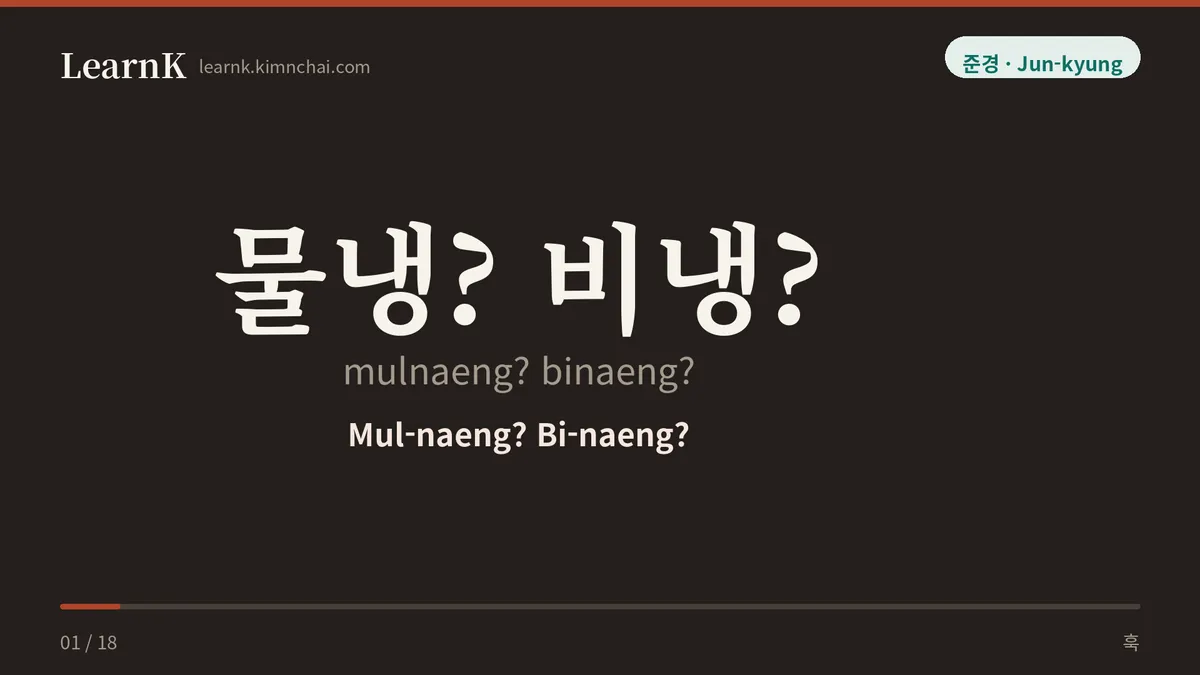
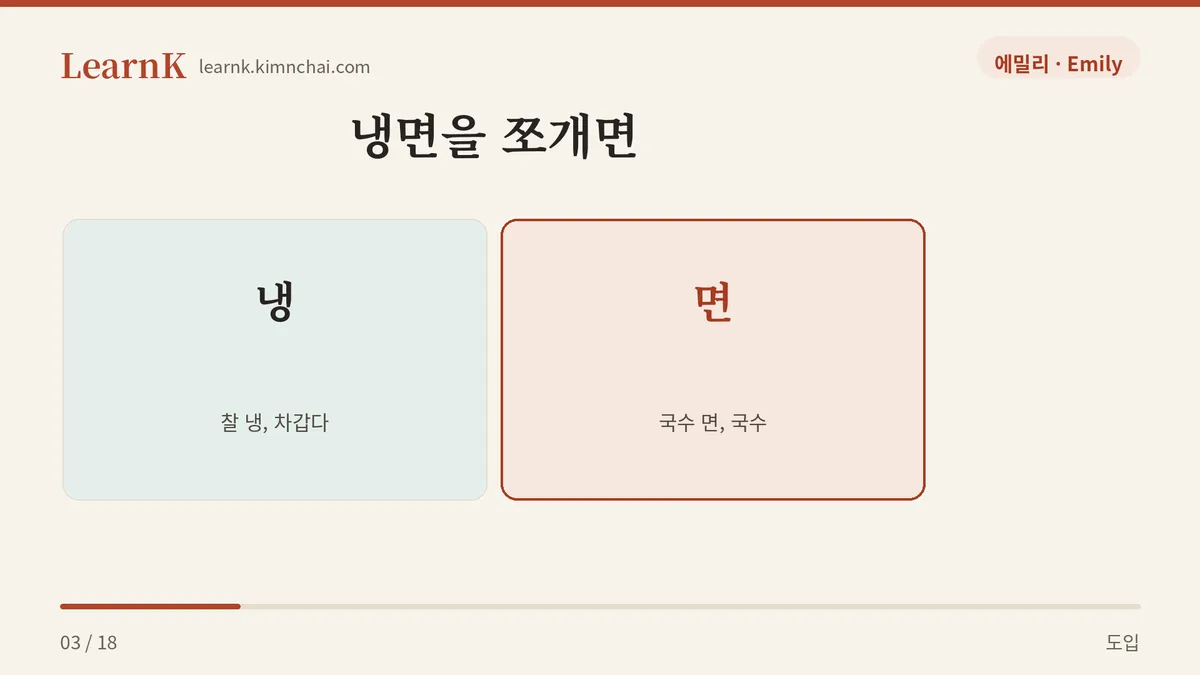
If you break down 냉면 (naengmyeon) according to its Chinese characters, it’s ‘찰 냉 (冷)’ (cold) plus ‘국수 면 (麵)’ (noodles)—in other words, cold noodles. It’s the exact opposite of noodles you eat piping hot. It’s broadly divided into two types: 물냉면 (mulnaengmyeon), served in a refreshing cold broth, and 비빔냉면 (bibimnaengmyeon), mixed with a sweet-and-spicy gochujang (red chili paste) sauce. If you shorten it and ask “물냉? 비냉? (mulnaeng? binaeng?),” it becomes a go-to question that gets the point across among Koreans.
Here’s a little pronunciation tip. In ‘냉면 (naengmyeon),’ the final consonant ‘ㅇ’ of the first syllable flows into the ‘ㅁ’ of the next syllable, so it’s pronounced smoothly and naturally as [냉면] just as it’s written. If you stretch out the first sound ‘냉’ just a little, it sounds much more like a native speaker.
Checking with the National Institute of Korean Language Dictionary
First, let’s look at the definition from the authoritative Basic Korean Dictionary by the National Institute of Korean Language.
냉면 (noun): A dish of noodles served in a cold broth, kimchi broth, or the like, or mixed with a gochujang sauce.
- [en] naengmyeon; cold buckwheat noodles
- [ja] れいめん【冷麺】
- [es] naengmyeon, plato de fideos fríos
- [zh] 冷面 — National Institute of Korean Language, Basic Korean Dictionary (krdict.korean.go.kr)
A Portuguese translation isn’t included in the dictionary, so to help with understanding, if we translate it ourselves it would be something like naengmyeon, macarrão frio coreano (our own translation).
Now let’s look at the actual usage examples the dictionary provides, exactly as written in the original, and go over the situations.
어제 먹은 냉면 괜찮았지? — National Institute of Korean Language, Basic Korean Dictionary (krdict.korean.go.kr)
This is a situation where you casually check back on the food from a restaurant you went to with a friend, using informal speech (반말). It’s an everyday conversation between people who are close.
여기는 불고기가 정말 맛있어. 그리고 물냉면도 강추야. — National Institute of Korean Language, Basic Korean Dictionary (krdict.korean.go.kr)
This is a scene of recommending a great restaurant. 강추 (gangchu) is short for ‘강력 추천 (gangnyeok chucheon)’ (strong recommendation), an expression the younger generation loves to use.
국수를 좋아하는 동생은 여름이면 냉면을 즐겨 먹는다. — National Institute of Korean Language, Basic Korean Dictionary (krdict.korean.go.kr)
This sentence clearly shows why naengmyeon is called a ‘summer food.’ The season and the food are stuck right together.
허름해 보이는 가게지만 냉면으로 이름깨나 날리는 곳이라 항상 손님이 많다. — National Institute of Korean Language, Basic Korean Dictionary (krdict.korean.go.kr)
This describes a ‘노포 (nopo)’ (a long-established, beloved restaurant) that may look humble on the outside but has become famous for one thing: its naengmyeon. Korea really does have many such renowned naengmyeon spots.
Example Sentences by Situation
Now let’s make our own example sentences you can use right away in real life.
-
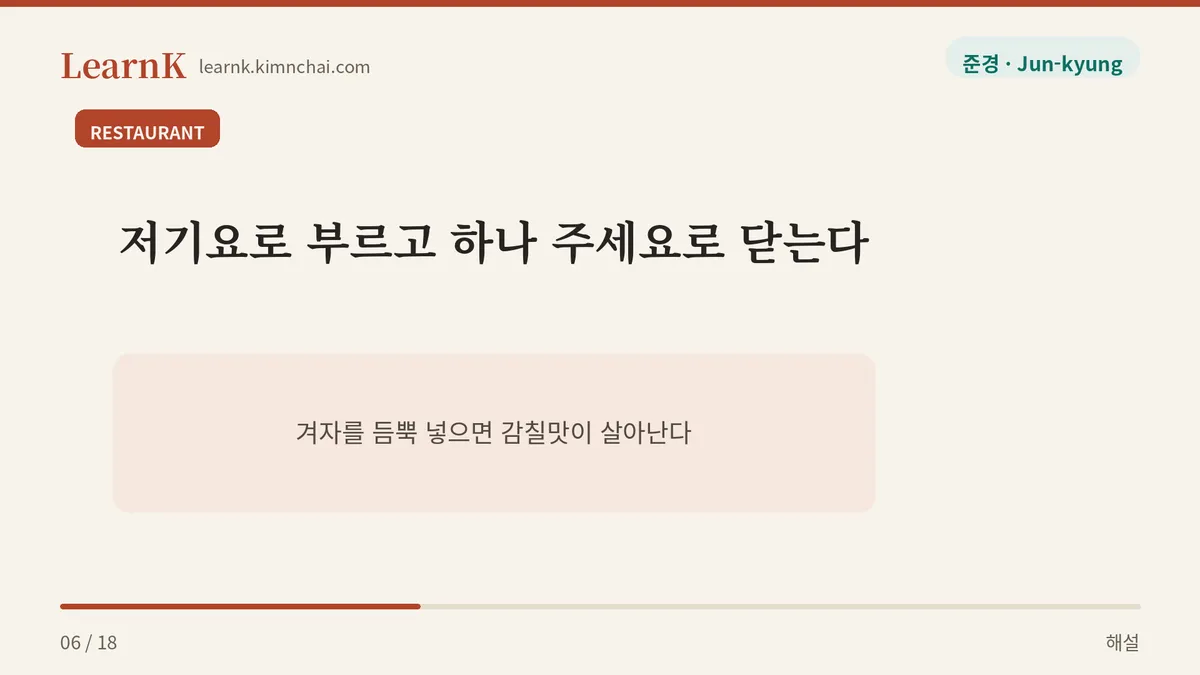
When ordering at a restaurant: 저기요, 물냉면 하나랑 비빔냉면 하나 주세요. (jeogiyo, mulnaengmyeon hanarang bibimnaengmyeon hana juseyo.) — “Excuse me, one mulnaengmyeon and one bibimnaengmyeon, please.” Used together with 저기요 (jeogiyo), which is how you call over a server, it makes for a perfect order.
-
When suggesting to a friend: 날도 더운데 냉면 어때? (naldo deounde naengmyeon eottae?) — “It’s so hot out—how about some naengmyeon?” This is an informal (반말) expression that uses the hot weather as a casual excuse to suggest it.
-
When talking about your preferences: 저는 겨자를 듬뿍 넣은 물냉면을 제일 좋아해요. (jeoneun gyeojareul deumppuk neoeun mulnaengmyeoneul jeil joahaeyo.) — “I like mulnaengmyeon with lots of mustard the best.” 겨자 (gyeoja) is a spicy seasoning that gives a sharp tingle to the tip of your nose, bringing out the savory depth of the naengmyeon.
Comparing Formal/Informal Speech and Similar Expressions
Since ‘냉면 (naengmyeon)’ is simply the name of a food, it doesn’t have separate honorific or humble forms, but the level of formality of your sentence changes when you order.
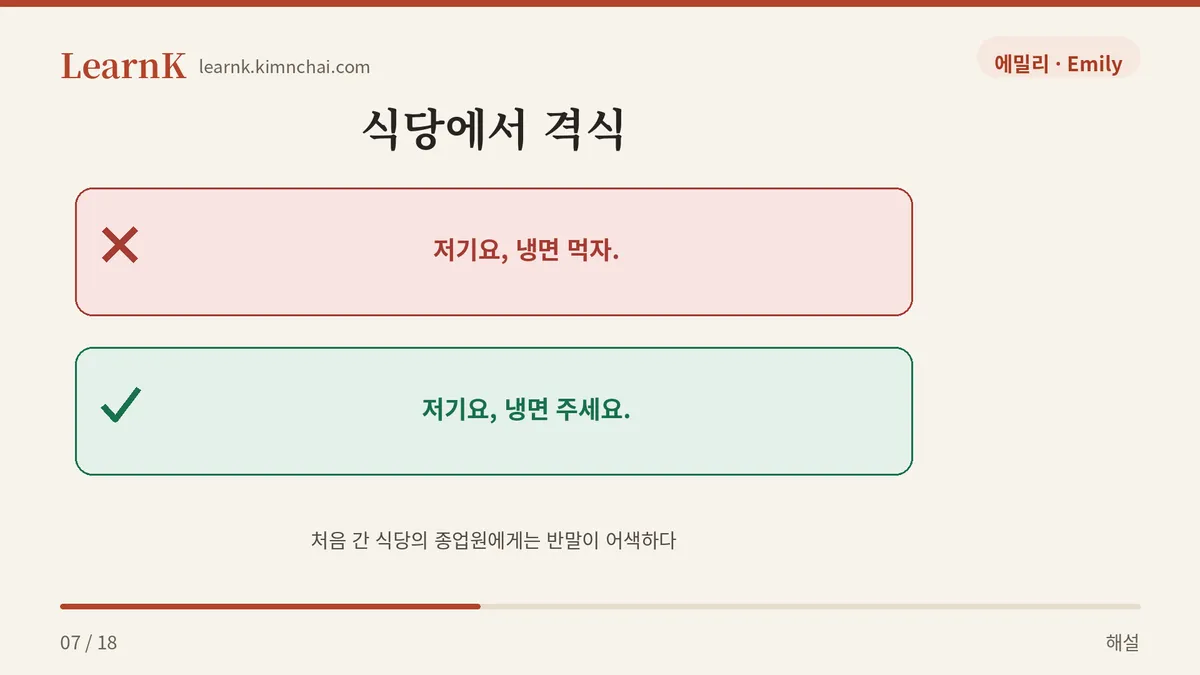
- Formal (존댓말): 냉면 주세요. (naengmyeon juseyo.) — For a restaurant you’re visiting for the first time, when you want to be polite.
- Informal (반말): 냉면 먹자. (naengmyeon meokja.) — Between close friends or family.
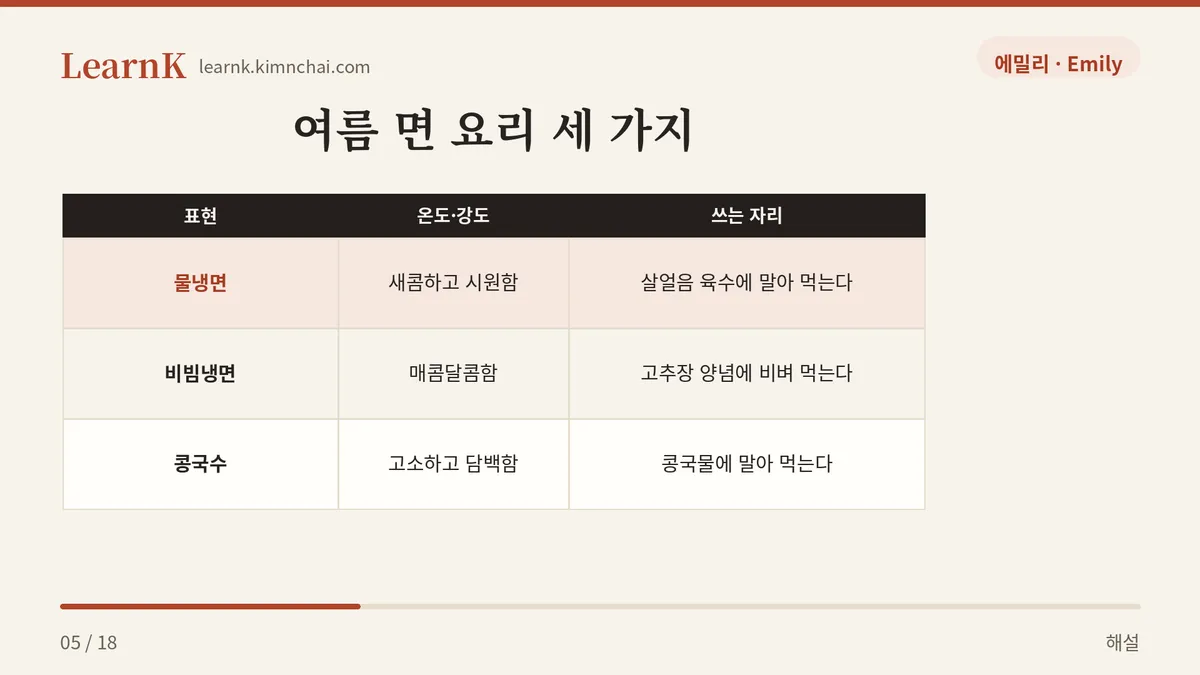
A similar summer noodle dish is 콩국수 (kongguksu), noodles served in a soybean broth. Both are refreshing, but the difference is that while naengmyeon is tangy and spicy, kongguksu is nutty and mild.
Cultural Background
Naengmyeon was originally a dish from the northern regions, eaten during the cold winter in a warm room with an icy broth. Among its varieties, 평양냉면 (Pyeongyang-naengmyeon) is famous for its plain, understated broth, and it has a large following of enthusiasts who say, “It’s bland at first, but you keep thinking about it.” In Korean dramas, too, there are frequent scenes where characters sit down face-to-face at a naengmyeon restaurant at the end of a hard day and pour out their true feelings. In a way, a single bowl of naengmyeon is used as a symbol of comfort and reconciliation.
Closing Quiz
Which of the following is the word for the naengmyeon that’s mixed with a sweet-and-spicy gochujang sauce?
- 물냉면 (mulnaengmyeon)
- 비빔냉면 (bibimnaengmyeon)
- 콩국수 (kongguksu)
(Answer: No. 2, 비빔냉면 (bibimnaengmyeon)! The name comes from ‘비비다 (bibida)’ (to mix).)
Definitions and example sentences are from the National Institute of Korean Language’s Basic Korean Dictionary (krdict.korean.go.kr); that portion of this post, including our translations, is licensed under CC BY-SA 2.0 KR.