Korean Word of the Day: '사이다 (saida)' — From Soda to Sweet Relief, an Essential K-Drama Expression
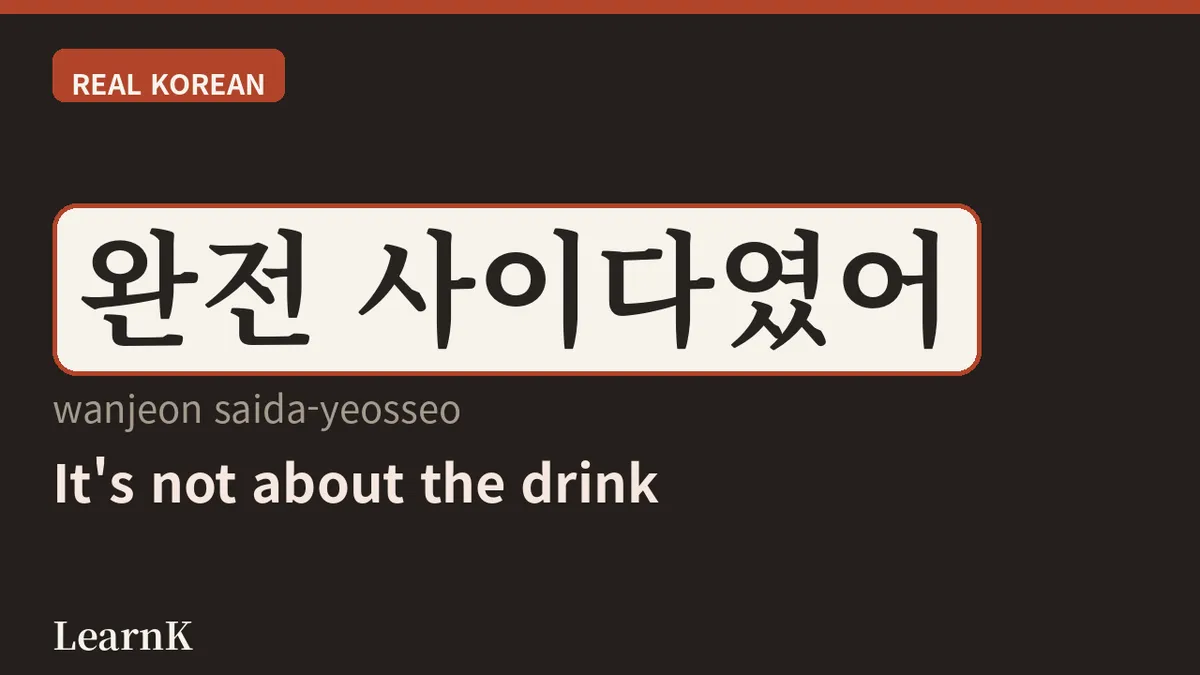
When you’re watching a Korean drama and a truly satisfying scene comes on, the live comment feed fills up with a single word. That word is 사이다 (saida). When a protagonist who’s been bottling everything up finally lets an antagonist have it, K-culture fans around the world cry out in unison, “완전 사이다! (wanjeon saida!)” — “Total saida!” But 사이다 (saida) is originally the name of a drink. So how did this fizzy soda become a way to express emotion? Today we’ll dig deep, from the word’s original dictionary meaning to how it’s really used in dramas.
사이다
사이다 (saida) is originally a noun for a clear, sharp, carbonated soft drink. But these days Koreans — drama fans especially — use the word in a completely different sense. That satisfying, refreshing, weight-off-your-chest feeling you get when a frustrating situation is suddenly, completely resolved? That’s what they call 사이다 (saida). It compares the crisp sensation of carbonation tingling down your throat to the feeling of a blockage inside you finally clearing.
To really understand the nuance of this expression, you need to know its opposite: 고구마 (goguma), meaning “sweet potato.” Ever eaten a sweet potato without water and felt it get stuck in your throat? That’s why a stifling, frustrating plot development is called 고구마 (goguma). Drama fans will grumble, “고구마 100개 먹은 것 같다 (goguma baek-gae meogeun geot gatda)” — “It’s like I ate 100 sweet potatoes” — and then cheer when a saida scene finally arrives: “이제야 사이다다! (ijeya saida-da!)” — “Finally, some saida!”
Checking the National Institute of Korean Language Dictionary
First, let’s look at the “original meaning” as defined by the national institution’s dictionary.
사이다 (noun): A clear carbonated drink made by mixing carbonation into sweetened water. [en] soda pop — A soft drink made by mixing soda with sweetened water. [es] bebida gaseosa azucarada — Bebida gaseosa transparente hecha de agua azucarada con gas carbónico. [zh] 汽水 — 在糖水中掺入碳酸制成的透明碳酸饮料。 — National Institute of Korean Language, Basic Korean Dictionary (krdict.korean.go.kr)
(There’s no Portuguese translation in the dictionary, so for reference, our own rendering would be refrigerante gaseoso transparente — this is our own translation.)
Let’s also look at the actual usage examples listed in the dictionary.
이 약수터의 물은 맛이 엄청 특이하네. 톡 쏘는 맛이 꼭 사이다 같아. 칠 곱하기 이는 십사이다. 어디서나 손쉽게 먹을 수 있는 샌드위치는 간편식의 대명사이다. 눈으로 직접 볼 수 있으면 구체 명사이다. — National Institute of Korean Language, Basic Korean Dictionary (krdict.korean.go.kr)
The first example is the classic usage of 사이다 (saida) the drink. It says the spring water’s sharp, tingly taste is “just like 사이다 (saida),” using the refreshing zing of carbonation as a comparison. The interesting ones are the other three. “십사이다 (sib-sa-ida)” (meaning “is fourteen”), “대명사이다 (daemyeongsa-ida)” (“is a pronoun”), “명사이다 (myeongsa-ida)” (“is a noun”) — here “사이다” isn’t the drink at all, but the predicate particle -이다 (-ida) attached after a number or word. Written in Hangul, the letters come out exactly the same, so it looks like “사이다” is hiding inside them. This clever overlap of letters can be seen as the very seed of the wordplay that turned a drink’s name into an emotion word.
Example Sentences by Situation
Let’s make our own sentences using the “satisfying relief” meaning that isn’t in the dictionary.
- Watching a new hire who’s always ignored fire back with pure logic in a meeting: 정말 사이다였어요. (jeongmal saida-yeosseoyo.) — This means “That was so satisfying, it was such a relief.”
- Talking to a friend about a drama’s ending: 마지막 화 완전 사이다더라. (majimak hwa wanjeon saida-deora.) — A casual (반말) way of saying the final episode was incredibly satisfying.
- Praising a coworker who said everything they needed to say to the boss: 와, 사이다 발언이네요! (wa, saida bareon-ineyo!) — Here “사이다 (saida)” is used like an adjective, meaning “a refreshingly satisfying remark.”
Polite vs. Casual Speech & Similar Expressions
사이다 (saida) isn’t a formal word — it’s internet-and-everyday slang. So in polite speech, you only raise the level of the predicate. Casual is 사이다야! (saida-ya!), and polite is 사이다예요! (saida-yeyo!).
For more dignified settings, it’s better to use an idiom with the same meaning. The classic ones are 속이 뻥 뚫리다 (sogi ppeong ttullida) — “to have your chest blown wide open” — or 속이 시원하다 (sogi siwonhada) — “to feel refreshed inside.” For example, “그 소식을 들으니 속이 다 시원하네요 (geu sosigeul deureuni sogi da siwonhaneyo)” — “Hearing that news is such a relief” — means the same thing as 사이다 (saida) but sounds natural in any setting. The opposite feeling is expressed with the earlier 고구마 (goguma) or 답답하다 (dapdaphada) (“to feel stifled/frustrated”).
Cultural Background
The stage on which the expression 사이다 (saida) exploded in popularity was, of course, the drama. Korean dramas lay down a long “고구마 (goguma) stretch” where the protagonist endures injustice for a long time, then deliver catharsis to viewers with a “사이다 (saida) scene” of satisfying payback in the later episodes. Classic examples are standing up head-on to an abusive conglomerate heir, or a belittled employee flipping the whole situation with sheer skill.
A protagonist who holds nothing back and says everything they need to say — The attitude shown by Park Sae-ro-yi in the drama Itaewon Class (JTBC, 2020) is talked about among fans as a symbol of the “사이다 (saida) character.” (We describe the situation rather than quoting the original lines.)
Nowadays 사이다 (saida) goes beyond dramas — it’s used for sports matches, the news, office life, and every moment where frustration finally clears. In this one word, the emotional temperature of Koreans is captured just as it is.
Closing Quiz
What’s the name of the food that means the opposite of 사이다 (saida) — a stifling, chest-tightening plot development? (Hint: it’s a root vegetable that gets stuck in your throat if you eat it without water.)
Definitions and example sentences are from the National Institute of Korean Language’s Basic Korean Dictionary (krdict.korean.go.kr); that portion of this post, including our translations, is licensed under CC BY-SA 2.0 KR.