Maeuntang — The Red Pot That Comes Out After the Sashimi Is Gone
매운탕
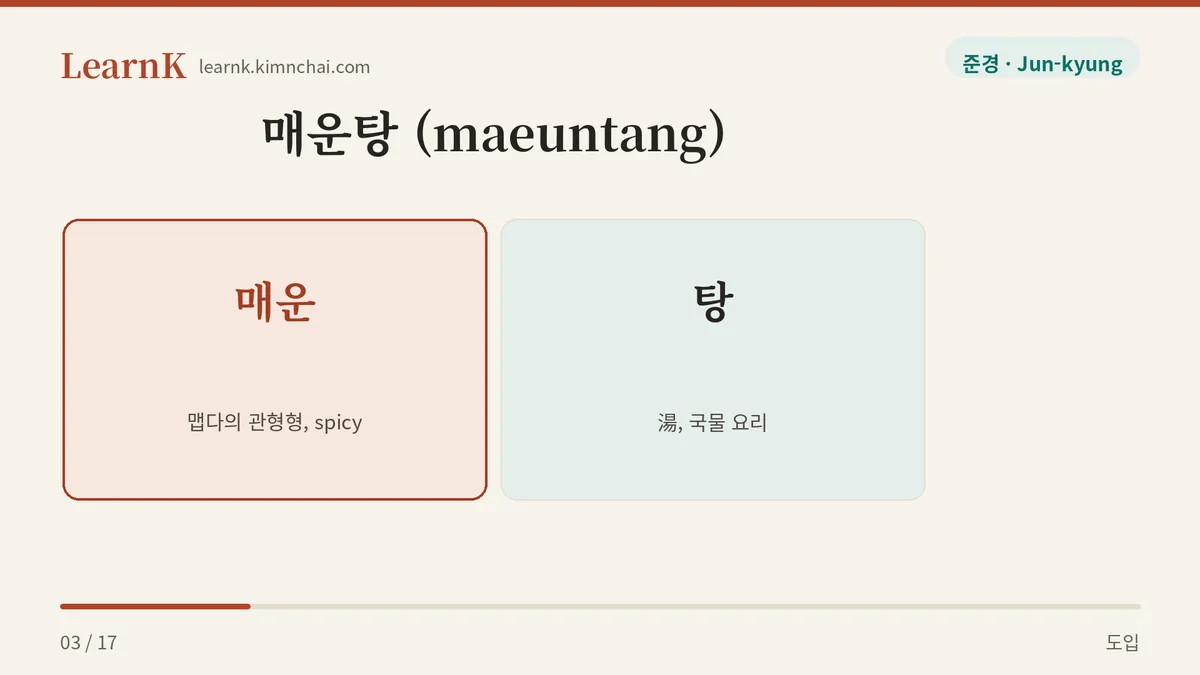
매운탕 (maeuntang) means a jjigae made by boiling fish and vegetables with gochujang stirred in, giving it a deep, spicy heat. It’s that red pot you’ll see in nearly every seaside scene in a Korean drama — and at a raw-fish restaurant, it’s the soup that finally arrives only after the sashimi plates have been cleared away. At a fishing spot, the first thing people say about a fish they’ve just pulled out of the water is 이걸로 매운탕 끓이자 (igeollo maeuntang kkeurija) — “Let’s make maeuntang with this.”
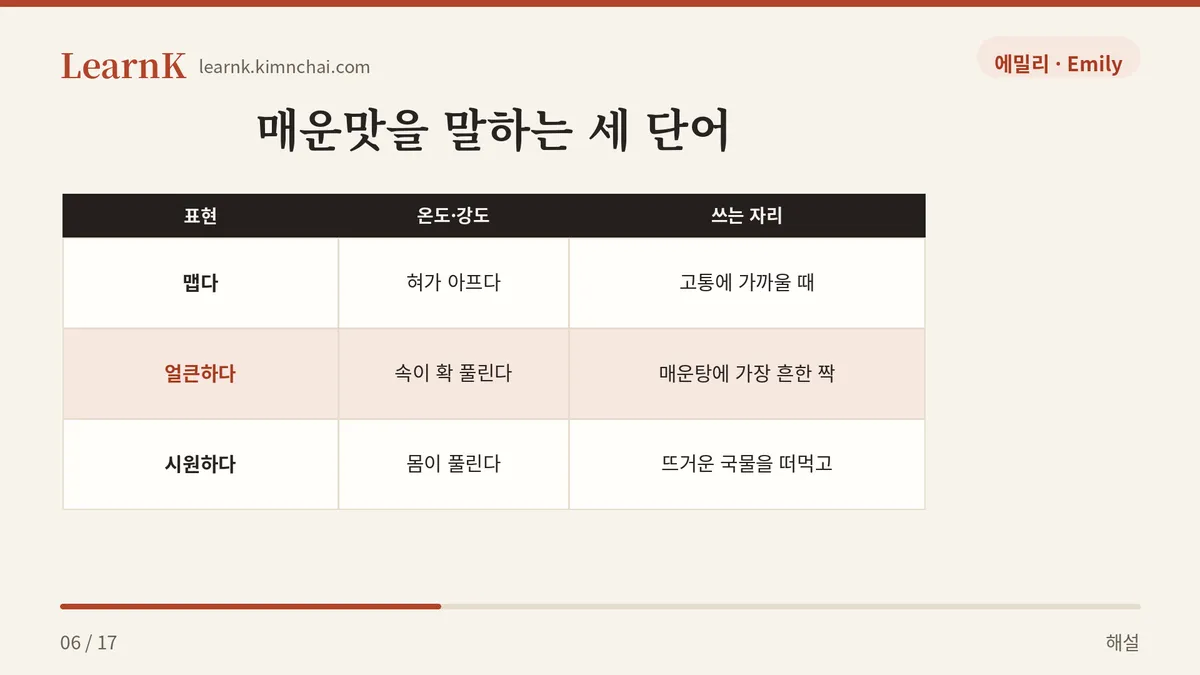
There are two things learners easily miss about this word. First, 매운탕 (maeuntang) does not refer to every spicy soup — only to a spicy soup that has fish in it. From the name alone — “매운 (maeun, spicy) + 탕 (tang, soup)” — you’d think it could attach to any spicy broth, but in a Korean speaker’s mind this word always arrives together with fish. Second, when Koreans describe the heat of 매운탕, they reach for 얼큰하다 (eolkeunhada) far more often than 맵다 (maepda). 얼큰하다 isn’t “my tongue is burning” — it’s closer to “it clears me right out from the inside.” Which is why you get the scene that looks completely backwards to a foreigner: someone takes a spoonful of scalding, bright-red broth and says 시원하다 (siwonhada), literally “it’s cool/refreshing.” Here 시원하다 has nothing to do with temperature — it points to the feeling of your body loosening up.
Checking the National Institute of Korean Language dictionary
매운탕 「명사」 (noun) 생선과 채소를 넣고 고추장을 풀어 얼큰하게 끓인 찌개. [en] maeuntang — Jjigae, stew, made by boiling fish and vegetables with gochujang, red chili paste. [ja] メウンタン。さかなのからみスープ【魚の辛味スープ】 — 魚や野菜を入れてコチュジャンで味付けをし、辛く煮込んだチゲ料理。 [es] maeuntang, sopa de pescado picante — Sopa picante de pescado y verduras, condimentada con gochuchang (salsa de chile). [zh] 鲜辣鱼汤 — 锅中放入鲜鱼和蔬菜,再放入辣椒酱等炖煮而成的辣乎乎的汤。 — National Institute of Korean Language, Basic Korean Dictionary (krdict.korean.go.kr)
It’s worth remembering that the dictionary definition explicitly names 고추장 (gochujang). The red color of 매운탕 comes not just from chili powder but from gochujang, which is why the broth isn’t clear but slightly thick.
(The Portuguese definition isn’t carried in the dictionary, so we translated it ourselves — maeuntang: ensopado picante de peixe e legumes, temperado com gochujang, a pasta de pimenta vermelha coreana. That one line is our own translation, not a dictionary quotation.)
Now let’s look at the actual usage examples the dictionary provides, exactly as they appear.
우리는 그물에 걸린 물고기로 매운탕을 끓였다. — National Institute of Korean Language, Basic Korean Dictionary (krdict.korean.go.kr)
urineun geumure gollin mulgogiro maeuntangeul kkeuryeotda. — “We made maeuntang with the fish caught in the net.” This is the single most typical setting for 매운탕. The flow of the sentence captures it perfectly: it isn’t made with ingredients bought in advance, but with fish caught right there on the spot. 매운탕 is a dish that begins in that order — you catch it, so you cook it.
어머니는 시장에서 사 온 동태를 넣고 얼큰한 매운탕을 끓이셨다. — National Institute of Korean Language, Basic Korean Dictionary (krdict.korean.go.kr)
eomeonineun sijangeseo sa on dongtaereul neoko eolkeunhan maeuntangeul kkeurisyeotda. — “Mother put in the frozen pollack she’d bought at the market and made a good spicy maeuntang.” If the previous sentence was outdoors, this one is indoors. 동태 (dongtae) means frozen pollack, and it’s the most common maeuntang ingredient in Korean homes in winter. Notice too how the modifier 얼큰한 (eolkeunhan) pairs up so naturally with 매운탕.
남편은 매운탕 국물 맛을 보고는 너무 싱겁다며 소금을 넣었다. — National Institute of Korean Language, Basic Korean Dictionary (krdict.korean.go.kr)
nampyeoneun maeuntang gungmul maseul bogoneun neomu singgeopdamyeo sogeumeul neoeotda. — “My husband tasted the maeuntang broth, said it was too bland, and added salt.” In any conversation about 매운탕, what gets talked about isn’t the solid ingredients but the 국물 (gungmul), the broth. This sentence shows how the verdict — too salty, too bland — is settled by a single spoonful of broth.
낚시터에서 막 잡아 올린 붕어로 만든 매운탕은 정말 일품이었다. — National Institute of Korean Language, Basic Korean Dictionary (krdict.korean.go.kr)
naksiteoeseo mak jaba ollin bungeoro mandeun maeuntangeun jeongmal ilpumieotda. — “The maeuntang made with crucian carp just pulled up at the fishing spot was truly outstanding.” This tells us 매운탕 isn’t only made with saltwater fish — freshwater fish like crucian carp work too. 일품이다 (ilpumida) is a somewhat formal expression used to praise food.
와, 오늘은 매운탕이네? — National Institute of Korean Language, Basic Korean Dictionary (krdict.korean.go.kr)
wa, oneureun maeuntangine? — “Whoa, maeuntang today?” A short, casual exclamation that pops out at the dinner table. Just tossing out the name of the dish like this is enough to complete the meaning: “So tonight’s dinner is maeuntang.”
Seeing it in a real conversation
Situation: A riverside fishing spot at dusk. Jun-kyung has carried the crucian carp he caught today over to the wooden platform in a bucket.
Jun-kyung: 야, 이거 봐. 붕어 다섯 마리. 오늘 제대로 물었어. Hey, look at this. Five crucian carp. They were really biting today.
Emily: 오, 대박. 그럼 이걸로 매운탕 끓이는 거지? Whoa, awesome. So we’re making maeuntang with these, right?
Jun-kyung: 당연하지. 고추장 풀고 미나리 넣으면 끝이야. 저기 버너 있어. Of course. Stir in some gochujang, throw in the water parsley, and that’s it. There’s a burner over there.
Emily: 나 간 좀 세게 해 줘. 지난번 매운탕은 솔직히 좀 싱거웠어. Season it strong for me. Honestly, last time’s maeuntang was a bit bland.
Jun-kyung: 알았어, 알았어. 너 진짜 한국 사람 다 됐다. 처음엔 맵다고 손도 못 댔잖아. All right, all right. You’ve totally become Korean. At first you wouldn’t even touch it because it was spicy.
Emily: 15년이면 혀도 바뀌지. 아, 라면 사리 챙겼어? 매운탕엔 그게 있어야 되는데. Fifteen years will change your tongue. Oh, did you bring instant noodles? Maeuntang needs those.
These usages sound off
매운탕 is the name of a thing, so it isn’t a word that can be rude depending on who you’re talking to. Instead, let’s look at two misunderstandings learners trip over again and again.
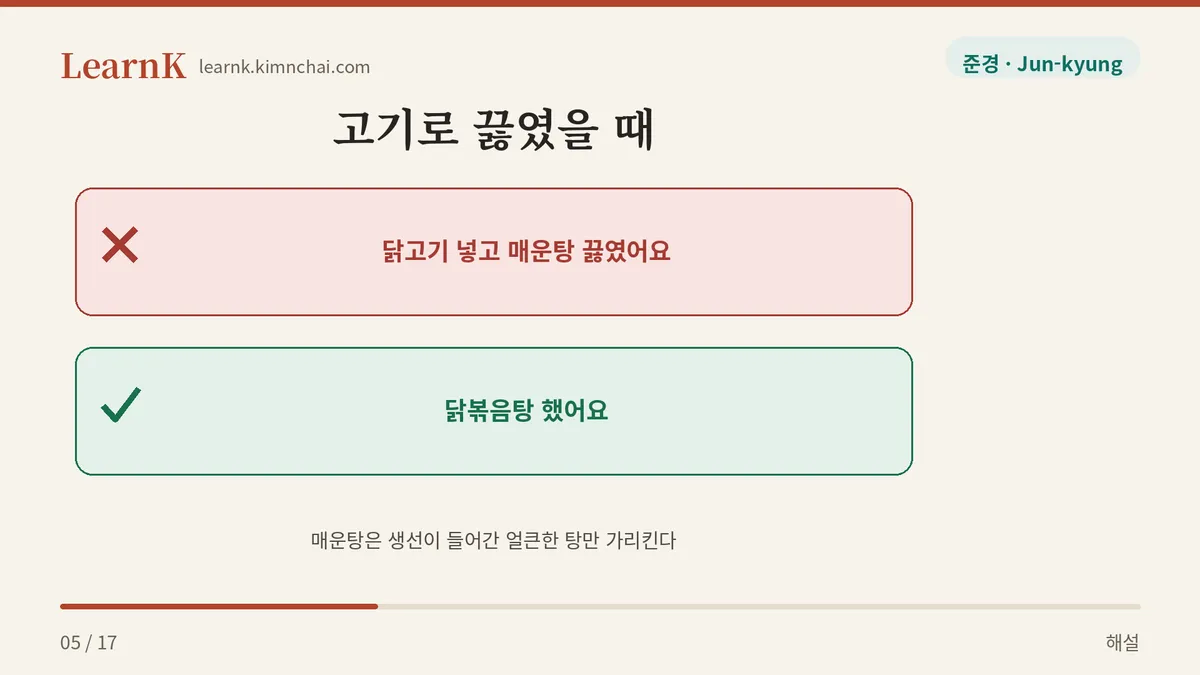
✗ 어제 저녁에 닭고기 넣고 매운탕 끓였어요. (eoje jeonyeoge dakgogi neoko maeuntang kkeuryeosseoyo.) — “Last night I made maeuntang with chicken.” ✓ 어제 저녁에 닭볶음탕 (dakbokkeumtang) 했어요. (eoje jeonyeoge dakbokkeumtang haesseoyo.) — “Last night I made dakbokkeumtang.” → 매운탕 doesn’t cover every “spicy soup” — it means specifically a spicy soup made with fish. Attach 매운탕 to a spicy broth made with meat and a Korean speaker will pause for a second.
✗ (횟집에서) 매운탕 주시는데 안 맵게 해 주세요. (maeuntang jusineunde an maepge hae juseyo.) — “(At a raw-fish restaurant) Give us the maeuntang, but please make it not spicy.” ✓ (횟집에서) 저희는 **맑은탕 (malgeuntang)**으로 주세요. (jeohuineun malgeuntangeuro juseyo.) — “(At a raw-fish restaurant) We’ll have the malgeuntang, please.” → The name itself points to a spicy broth, so “non-spicy maeuntang” sounds like a contradiction. Korean raw-fish restaurants normally offer 매운탕 and 맑은탕 (once also called 지리, jiri) side by side as options, so if you can’t handle spice, just choose 맑은탕 from the start.
Example sentences by situation
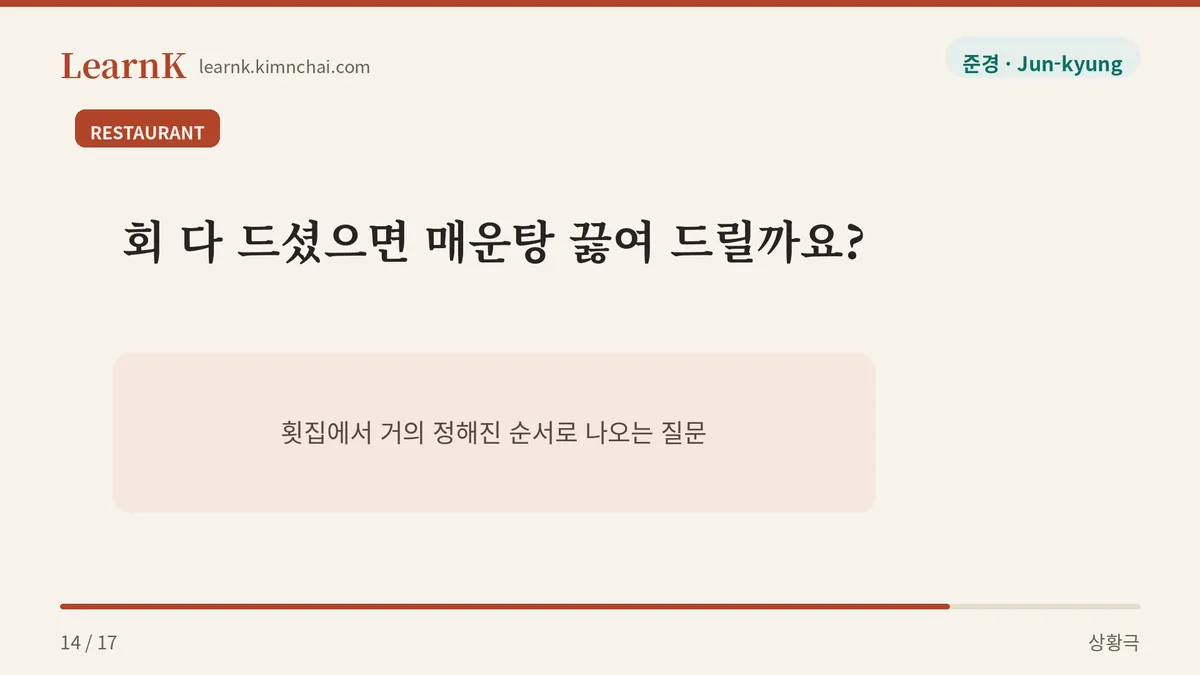
1) At a raw-fish restaurant, when you’ve nearly finished the sashimi — the server asks
회 다 드셨으면 매운탕 끓여 드릴까요? (hoe da deusyeosseumyeon maeuntang kkeuryeo deurilkkayo?) The reason the question is phrased “다 드셨으면” (“if you’ve finished”) rather than “회 다 드시고 나면” is that 매운탕 is the closing dish, boiled from the bones and head left over after the fish was filleted. In Korean raw-fish restaurants this question is practically a fixed part of the sequence. All you need in reply is “네, 부탁드려요 (ne, butakdeuryeoyo)” — “Yes, please.”
2) On a winter evening, walking into the house and asking Mom
엄마, 오늘 저녁 뭐야? — 동태 매운탕. (eomma, oneul jeonyeok mwoya? — dongtae maeuntang.) In a home-cooking context, people put the ingredient name in front: 동태 매운탕 (dongtae maeuntang), 우럭 매운탕 (ureok maeuntang, rockfish maeuntang), and so on. When that’s the answer that comes back on a cold evening, it’s generally good news.
3) To a friend at a campsite (casual speech)
오늘 잡은 거 이거밖에 없는데, 그냥 매운탕 끓이자. (oneul jabeun geo igebakke eomneunde, geunyang maeuntang kkeurija.) When you’ve only caught a little, sashimi is hard to pull off, but 매운탕 is still doable. You can stretch it out with radish, potato, and water parsley — which makes 매운탕 “the right answer when your ingredients are iffy.”
Polite vs. casual speech, and related expressions
매운탕 is a noun, so there’s no honorific level built into the word itself. The politeness is decided by the verb you use with it. To a friend: 매운탕 끓였어 (maeuntang kkeuryeosseo). To someone older or senior: 매운탕 끓였어요 / 끓였습니다 (maeuntang kkeuryeosseoyo / kkeuryeotseumnida). When offering it to an elder: 매운탕 좀 드세요 (maeuntang jom deuseyo). And when an elder is the one who made it, you add subject honorification, as in 끓이셨다 (kkeurisyeotda) — exactly the form in the dictionary example, “어머니는 … 끓이셨다.”
Here’s how it sits relative to similar soup dishes.
| Expression | Flavor / intensity | Where it’s used |
|---|---|---|
| 매운탕 (maeuntang) | Spicy-hot and red | Only when fish is involved. Raw-fish restaurants, fishing spots, home cooking |
| 맑은탕 (malgeuntang) | Clear and mild, not spicy | The non-spicy twin of the same fish soup. Ordered as the alternative to maeuntang at raw-fish restaurants |
| 생선찌개 (saengseon jjigae) | A neutral umbrella term | May or may not be spicy. Used when you’re explaining something |
| 동태찌개 (dongtae jjigae) | Spicy-hot, but the ingredient is fixed | Only when made with pollack (dongtae). Common in home cooking |
In one line: 매운탕 is named after its taste (that 얼큰한 heat), while 동태찌개 is named after its ingredient. That’s why you can stack the two together and say “동태 매운탕 (dongtae maeuntang).”
Cultural background — after the sashimi is gone
The structure of the name is simple and transparent. It’s the adjective 맵다 (maepda) in its modifying form 매운, plus the Sino-Korean word 탕 (湯, tang) meaning a soup dish. The flavor became the name — no explanation required.
The place 매운탕 occupies on the Korean table is a little unusual. This dish is usually not the star but the finale. At a raw-fish restaurant it’s boiled from the bones and head left over after filleting, and served last with rice. That’s why Koreans who go out for sashimi so often say “매운탕이 진짜다 (maeuntangi jinjjada)” — “the maeuntang is the real thing.” They judge the restaurant not by the expensive plate but by the pot that comes after it.
The other setting is outdoors. On a fishing or camping trip, 매운탕 is less a recipe than a ritual. You clean what you caught right there, stir in gochujang, add instant noodles, and talk while you wait for the broth to boil. The scene shows up constantly in Korean dramas — characters who’ve been awkward with each other sit down around a single pot by the sea or a river, and while the broth bubbles, the things they couldn’t say start coming out. (The actual lines differ from show to show, so we’re only describing the situation here.) 매운탕 gets used, in that way, as a dish that keeps people sitting in one place.
And finally, the seasons. Winter brings 동태 (dongtae, frozen pollack), spring brings 도다리 (dodari, flounder), summer riversides bring 붕어 (bungeo, crucian carp) and 메기 (megi, catfish), and autumn brings 대하 (daeha, prawns) or 꽃게 (kkotge, blue crab). Plenty of fish get cooked three ways — “매운탕, 찜, 회 등” (maeuntang, steamed, raw, and so on) — like the 농어 (nongeo, sea bass) that appears in the dictionary’s examples. The ingredients change, but the backbone stays the same: gochujang, garlic, radish, and water parsley.
Today’s quiz
You’ve finished the sashimi at a raw-fish restaurant, but one person in your group can’t eat spicy food at all. What’s the most natural thing to say to the server?
- 매운탕인데 안 맵게 해 주세요. (maeuntanginde an maepge hae juseyo.) — “Maeuntang, but please make it not spicy.”
- 저희는 맑은탕으로 주세요. (jeohuineun malgeuntangeuro juseyo.) — “We’ll have the malgeuntang, please.”
- 매운탕 말고 닭 매운탕으로 주세요. (maeuntang malgo dak maeuntangeuro juseyo.) — “Not maeuntang, we’ll have chicken maeuntang.”
Answer: 2. The word 매운탕 by definition points to a spicy broth, so “non-spicy maeuntang” sounds strange (option 1). Option 3 attaches 매운탕 to meat instead of fish, which simply doesn’t work. When you want a non-spicy fish soup, just ask for 맑은탕 (malgeuntang).
Definitions and example sentences are from the National Institute of Korean Language’s Basic Korean Dictionary (krdict.korean.go.kr); that portion of this post, including our translations, is licensed under CC BY-SA 2.0 KR.