밈 (mim) — The Word You Can't Follow Today If You Missed It Yesterday
밈 (mim)
밈 (mim) means a short piece of trending content that spreads online as people copy it and tweak it a little along the way — or the phrase, scene, or image that spreads that way. Even learners with fairly solid Korean tend to stall at this word. It isn’t that the meaning is hard. It’s that the situations where Koreans actually reach for it are narrower than you’d expect, and the attitude baked into it is pretty distinct.
The scene usually looks like this. Someone drops a 15-second video into the group chat. Everyone is typing “ㅋㅋㅋㅋㅋ” (kkkkk — the Korean equivalent of “lol”) and you’re the only one who can’t tell what’s funny. You ask carefully, and this is the answer that comes back: “아, 그거 요즘 밈이야. (a, geugeo yojeum mimiya.)” — “Oh, that’s a meme going around these days.” That one line carries a whole explanation inside it — where it originally came from doesn’t really matter, everyone is copying it right now, and in about two months nobody will be using it.
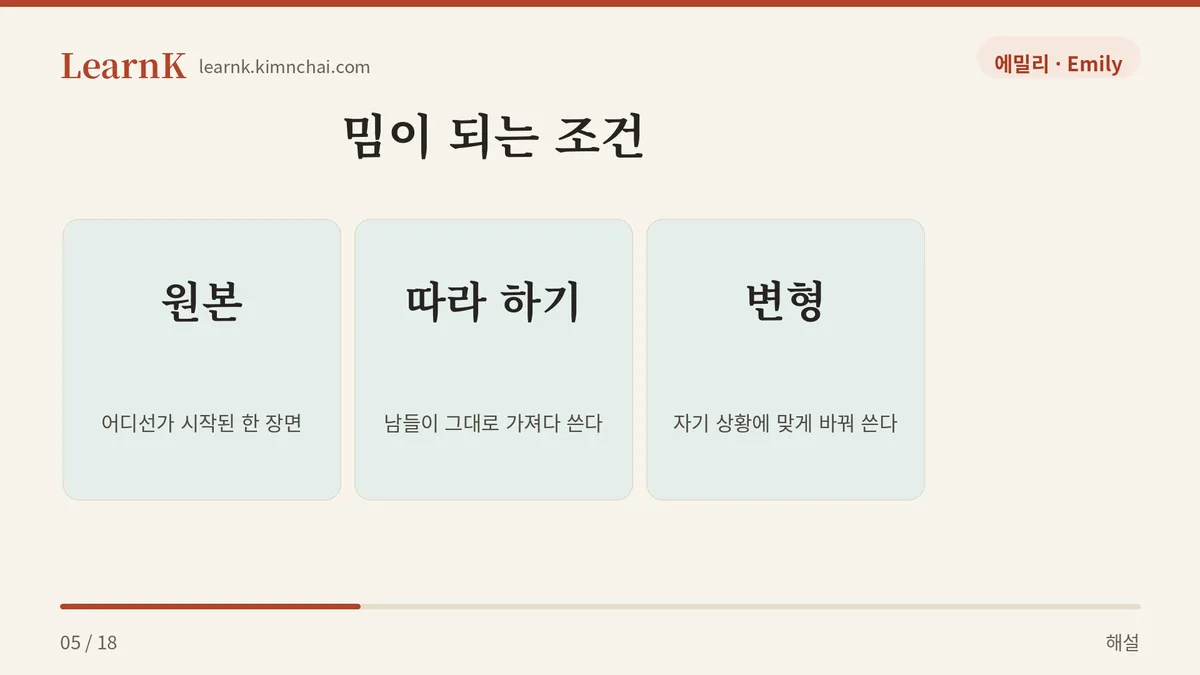
밈 (mim) covers more ground than 유행어 (yuhaengeo, “buzzword”). It can be a phrase, a single photo, or a particular facial expression, gesture, or editing style. They all share one thing: there’s an original, and people graft it onto their own situations and change it. If you watch the original, laugh once, and that’s the end of it, it’s just a funny video — but once people start making their own versions, that’s when it gets called a meme. So “이거 밈이야 (igeo mimiya)” also means “this is a format other people have already used hundreds of times.”
The tone is light. The word 밈 (mim) itself works almost as a signal that “this is not something to take seriously.” The moment you call something a meme, it stops being something to appreciate and becomes material to play with. Because of that, 밈 (mim) is picky about where it belongs. The dialogue and the misuse examples below should make that boundary visible.
Seeing it in real conversation
Scene: Chuseok evening. The table at the head of the family’s house has been cleared, and everyone is sitting out in the main room. A moment ago, a middle-school nephew said something nobody could make sense of and disappeared into his room.
준경: 야, 아까 지훈이가 한 말 무슨 뜻인지 알아들었어? Hey, did you catch what Jihoon said earlier?
에밀리: 아, 그거 요즘 애들 밈이야. 틱톡에서 한 달째 돌아. Oh, that’s a meme kids are using these days. It’s been going around on TikTok for a month.
준경: 아 진짜? 나 혼자 몰라서 아까 완전 진지하게 대답했잖아. Seriously? I was the only one who didn’t know, so I answered him completely seriously.
에밀리: 봤어. 그때 삼촌 표정 캡처했으면 그것도 밈 됐다. I saw. If I’d screenshotted your face right then, that would’ve become a meme too.
준경: 야! Hey!
에밀리: 농담이야, 농담. 나도 지훈이가 알려줘서 안 거야. Kidding, kidding. I only know because Jihoon told me.
These uses sound off
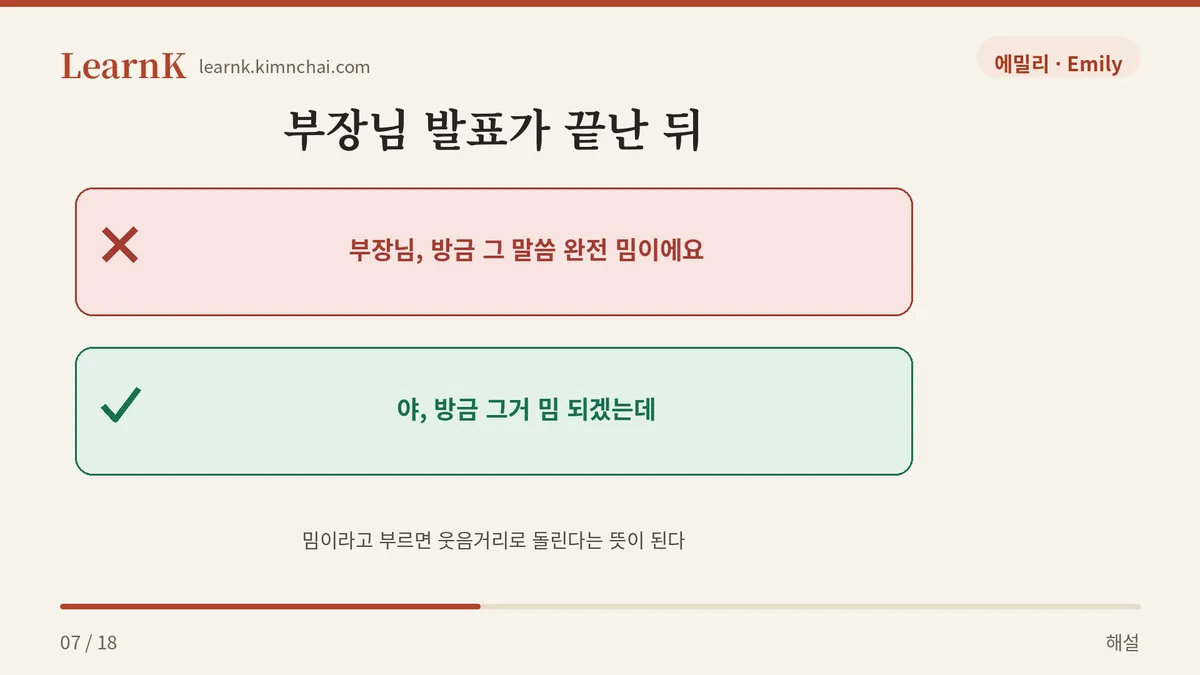
✗ (To your department head, right after his presentation) 부장님, 방금 그 말씀 완전 밈이에요. (bujangnim, banggeum geu malsseum wanjeon mimieyo.) ✓ (Quietly, to the coworker next to you) 야, 방금 그거 밈 되겠는데? (ya, banggeum geugeo mim doegenneunde?) → Calling something a meme is close to saying “this is fair game to be passed around for laughs.” Used in front of the person it’s about, it isn’t a compliment — it’s teasing. With someone senior to you, “인상적이었습니다 (insangjeogieotseumnida)” — “That was impressive” — is the safe choice.
✗ 어제 그 사고 영상 요즘 밈이더라. (eoje geu sago yeongsang yojeum mimideora.) ✓ 어제 그 사고 영상 요즘 여기저기 퍼지더라. (eoje geu sago yeongsang yojeum yeogijeogi peojideora.) → Attach 밈 (mim) to something where people were hurt or harmed, and you’re treating that event as a spectacle. The grammar is perfectly fine, but the listener’s face will go flat.
Example sentences by situation
1. Deciding on a promotional direction in a company marketing meeting
이거 밈으로 만들면 진짜 퍼질 것 같은데요? (igeo mimeuro mandeulmyeon jinjja peojil geot gateundeyo?)
This sentence is extremely common in Korean company meetings these days. It isn’t “let’s make an ad” — it’s “let’s make a format people will want to copy.” 밈 (mim) shows up often in exactly this shape: 밈으로 만들다 (mimeuro mandeulda), “to turn something into a meme.”
2. When a friend digs up an embarrassing old photo of you
야, 이 사진 우리끼리만 봐. 밈 되면 나 진짜 죽어. (ya, i sajin urikkiriman bwa. mim doemyeon na jinjja jugeo.)
Here 밈이 되다 (mimi doeda) means “people will spread this around and remix it whether I like it or not.” There’s a stronger version — 밈으로 박제되다 (mimeuro bakjedoeda) — where 박제 (bakje) originally means a taxidermied animal specimen. It carries the exaggeration of being preserved forever, impossible to erase.
3. When you want to learn current expressions in a Korean study group
요즘 한국 밈은 어디서 봐야 돼? (yojeum hanguk mimeun eodiseo bwaya dwae?)
A practical sentence for learners. By the time a meme makes it into a textbook, the trend is already over — so in the end, asking a person is the fastest route.
Politeness levels and similar expressions
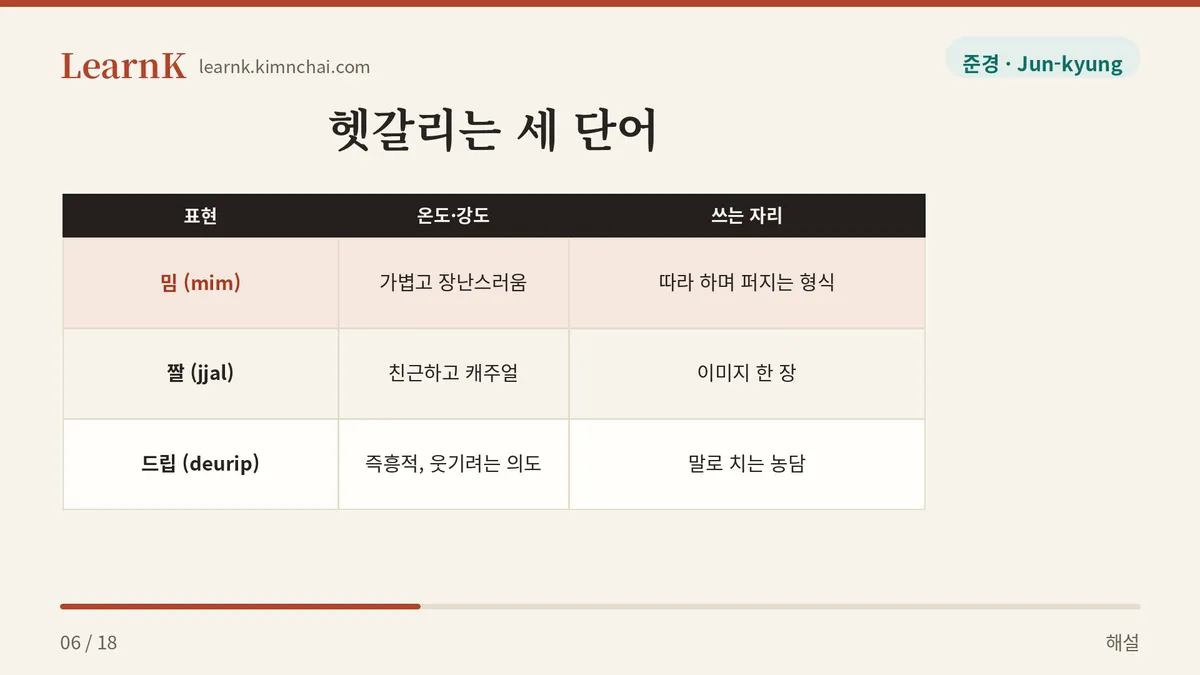
밈 (mim) is a noun, so it carries no built-in polite/casual distinction. Politeness is handled at the end of the sentence — with a friend, 밈이야 (mimiya); in a setting that calls for manners, 밈이에요 (mimieyo). What matters, though, is that no amount of “-이에요 (-ieyo)” washes off the word’s own light, internet-flavored smell.
| Expression | Tone & intensity | Where it’s used |
|---|---|---|
| 밈 (mim) | Light and playful. Strong internet flavor | Among peers, on social media, in online communities. Not used in reports or formal settings |
| 짤 (jjal) | Friendly and casual | For pointing at a single image. “짤 좀 보내줘 (jjal jom bonaejwo)” — “Send me that pic” |
| 유행어 (yuhaengeo) | Neutral, descriptive | Anywhere. Works in news, classrooms, even academic papers |
| 드립 (deurip) | Off-the-cuff, aiming for a laugh first | Among peers. Refers to a spoken joke you toss out |
To sum up: a format that gets copied and spreads is a 밈 (mim); when it’s a single image, it’s a 짤 (jjal); a spontaneous spoken joke is a 드립 (deurip); and when you want to name all of these politely, it’s a 유행어 (yuhaengeo).
Cultural background — a word modeled on the gene
밈 (mim) is a direct borrowing of English meme. The British biologist Richard Dawkins coined it in his 1976 book The Selfish Gene, shortening the Greek mimeme, meaning “that which is imitated,” into a single syllable to echo gene. It was a metaphor: culture replicates, mutates, and spreads the way genes do. That an academic term ended up, forty years later, as the everyday word for internet jokes is partly a testament to how accurate the original metaphor was.
In Korea, the word became everyday vocabulary in the late 2010s, arriving by way of YouTube and Twitter. Before that, the same territory had been split among 짤 (jjal), 유행어 (yuhaengeo), and 드립 (deurip). A distinctive feature of Korean memes is that the source is usually broadcast TV. A single cut from a variety show or one scene from a drama gets screenshotted and revived years — sometimes more than a decade — later. A classic case comes from the drama 《야인시대》 (Yain Sidae), which began airing in 2002, in the scene where the main character negotiates wages with a U.S. military officer and nails down the amount.
사 딸라. (sa ttalla.) — from the drama 《야인시대》 (Yain Sidae, SBS, 2002–2003)
This short line came back to life on the internet not when it aired, but about fifteen years afterward, eventually turning up in ads and on TV. It’s a neat illustration of how memes skip across time.
That’s also why 밈 (mim) marks a generational line in Korea. The moment you fail to understand the one thing your nephew says at the holiday dinner table, adults find out which stratum of the internet they’re standing on. Jun-kyung in the dialogue above was standing in exactly that spot. And it’s the same reason the word matters to learners. Knowing 밈 (mim) isn’t about knowing a word — it’s about knowing what the people currently speaking the language are looking at and laughing at.
Today’s quiz
Which of the following is the most awkward place to use 밈 (mim)?
- Posting a short video in a friends’ group chat — “이거 요즘 밈이잖아 ㅋㅋ”
- In a company marketing meeting — “이 장면 밈으로 밀어보면 어떨까요?”
- Watching dashcam footage of a traffic accident — “이 영상 요즘 밈이더라”
- To your nephew — “그 말 밈이야? 무슨 뜻인데?”
Answer: 3. The moment you call something a meme, it becomes material to play with. Attach the word to an event where someone may genuinely have been hurt, and the grammar can be flawless while the listener’s face goes flat. In a case like this, it’s better to stick to the facts — something like “요즘 많이 퍼지더라 (yojeum mani peojideora)” — “it’s been spreading a lot lately.”
Definitions and example sentences are from the National Institute of Korean Language’s Basic Korean Dictionary (krdict.korean.go.kr); that portion of this post, including our translations, is licensed under CC BY-SA 2.0 KR.