오마카세 (omakase) — The Meal Where You Close the Menu and Leave It to the Chef
오마카세 (omakase)
On a day when you’ve decided to have a slightly special dinner in Seoul, there’s one word that keeps catching your eye the moment you open a reservation app. That word is 오마카세 (omakase). 오마카세 (omakase) means a style of dining in which the customer doesn’t choose the menu at all — what gets served, and in what order, is left entirely up to the chef. Even after you sit down, no menu arrives. Instead, the chef looks at the ingredients that came in that day and serves what they’ve decided on, one plate at a time, in a set order. The customer has exactly one job — say up front what you can’t eat, and after that, just sit there.
When someone in a Korean variety show or drama says 오늘 오마카세 갈까? (oneul omakase galkka? — “Should we go for omakase today?”), it doesn’t simply mean “let’s eat sushi.” Someone got a promotion, it’s a birthday, or you’re meeting a person you haven’t seen in ages — it’s closer to a signal that today is going to be treated as a special day. That’s why this word carries a warmth beyond the name of a food.
The nuance comes in three layers. First, 맡긴다 (matginda) — “entrusting.” The customer sets down the right to choose, and in exchange the chef takes on the responsibility of putting out the best of what the day has. Second, 값이 나간다 (gapsi naganda) — “it costs.” In Korea, omakase generally runs around 100,000 won for a course, often more in the evening, so saying 오마카세 갔다 (omakase gatda — “I went for omakase”) by itself signals a splurge you had to work yourself up to. Third, 초밥집을 벗어났다 (chobapjibeul beoseonatda) — “it’s left the sushi restaurant.” It was originally a word used at the counter of a Japanese sushi bar, but in Korea it has spread so widely that there’s 한우 오마카세 (hanu omakase — Korean beef omakase), 커피 오마카세 (keopi omakase — coffee omakase), 디저트 오마카세 (dijeoteu omakase — dessert omakase), and people will even jokingly call a dinner thrown together from leftovers 냉장고 오마카세 (naengjanggo omakase — “refrigerator omakase”).
Grammatically it’s a noun. Here are the forms you’ll hear most often.
- 오마카세 먹으러 가다 (omakase meogeureo gada) — to go to a restaurant that does omakase
- 오마카세로 시키다 (omakase-ro sikida) — to order the entrusted course instead of à la carte
- 오마카세 하는 집 (omakase haneun jip) — a place that serves omakase
오마카세를 하다 (omakase-reul hada) sounds natural when the restaurant is the subject; from the customer’s side, 오마카세 먹었다 (omakase meogeotda) / 오마카세로 시켰다 (omakase-ro sikyeotda) is far more common.
Seeing It in Real Conversation
Scene: A neighborhood sushi place booked two months in advance. They’ve just sat down at a counter that seats only eight.
Jun-kyung: 여기 메뉴판 없어. 오마카세 한 가지만 해. There’s no menu here. They only do omakase.
Emily: 아, 그래서 예약이 그렇게 어려웠구나. 근데 나 못 먹는 거 있는데 어떡해? Ah, so that’s why it was so hard to book. But what do I do about something I can’t eat?
Jun-kyung: 지금 말씀드리면 돼. 그것만 빼고 알아서 내주셔. Just tell them now. They’ll leave it out and take care of the rest.
Emily: 셰프님, 저 고등어는 알레르기가 있어서요. 나머지는 다 잘 먹습니다. Chef, I’m allergic to mackerel. I eat everything else just fine.
Jun-kyung: 자, 이제 우린 아무것도 안 해도 돼. 이게 오마카세의 묘미지. There. Now we don’t have to do anything. That’s the whole charm of omakase.
Emily: 안 고르는 게 이렇게 편한 거였어? 나 회사 점심도 오마카세로 하고 싶다. Not having to choose is this comfortable? I want my work lunches omakase too.
Jun-kyung: 그럼 매일 김치찌개 나온다. 사장님 마음이니까. Then you’d get kimchi stew every day. It’d be up to the boss.
These Would Sound Off
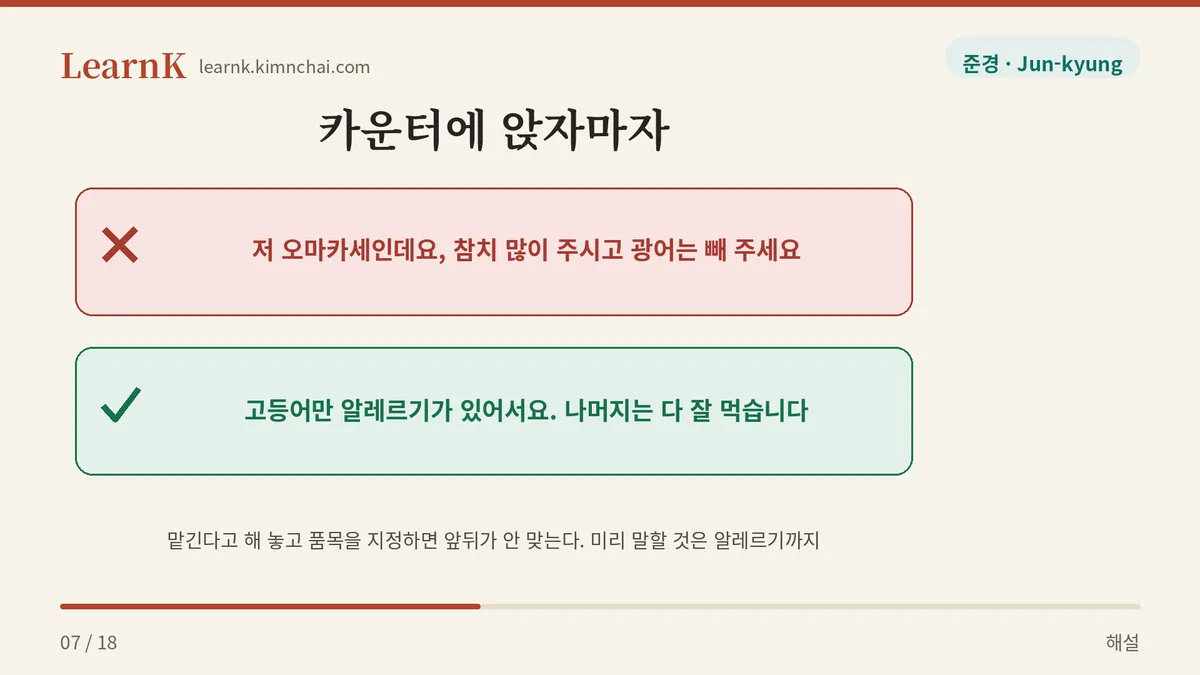
✗ (to the chef, the moment you sit down) 저 오마카세인데요, 참치 많이 주시고 광어는 빼 주세요. (jeo omakase-indeyo, chamchi mani jusigo gwangeoneun ppae juseyo. — “I’m having the omakase, so give me lots of tuna and leave out the flounder.”) ✓ (to the chef, the moment you sit down) 고등어만 알레르기가 있어서요. 나머지는 다 잘 먹습니다. (godeungeoman allereugiga isseoseoyo. nameojineun da jal meokseumnida. — “Mackerel is the only thing I’m allergic to. I eat everything else just fine.”) → 오마카세 (omakase) means “I leave it to you.” Saying you’re leaving it to the chef and then specifying item by item contradicts the word itself. What a customer speaks up about here goes only as far as allergies, religious restrictions, and things you genuinely cannot eat — placing preference orders isn’t considered polite.
✗ (at a snack shop, with a straight face) 이모, 저 오마카세로 주세요. (imo, jeo omakase-ro juseyo. — “Ma’am, I’ll have the omakase, please.”) ✓ (at a snack shop) 이모, 오늘 뭐가 제일 맛있어요? 그걸로 주세요. (imo, oneul mwoga jeil masisseoyo? geugeollo juseyo. — “Ma’am, what’s best today? I’ll have that.”) → Among friends it works as a joke, but said with a straight face to an owner you’re meeting for the first time, it’ll leave them flustered. The word carries the weight of “an expensive seat where a course is laid out for you,” so using it at a casual eatery makes it unclear whether you’re joking or serious.
Example Sentences by Situation
1) Booking an anniversary dinner (to a friend, casual speech)
우리 결혼기념일인데 이번엔 오마카세 가려고. 두 달 전에 예약했어. (uri gyeolhon-ginyeomirinde ibeoneun omakase garyeogo. du dal jeone yeyakaesseo.) “It’s our wedding anniversary, so this time we’re going for omakase. I booked it two months ago.”
Most omakase places run on reservations only, and popular ones mean waiting anywhere from a few weeks to a few months. That’s why 예약했어 (yeyakaesseo — “I booked it”) follows along almost as a set phrase.
2) Deciding on lunch at work (to a colleague, polite speech)
점심에 오마카세요? 그건 좀 부담스러운데요. 그냥 국밥 먹죠. (jeomsime omakase-yo? geugeon jom budamseureounde-yo. geunyang gukbap meokjyo.) “Omakase for lunch? That’s a bit much for me. Let’s just get gukbap.”
부담스럽다 (budamseureopda) is often used to mean that something is expensive enough to weigh on you. It’s also the phrase Koreans reach for most when turning down omakase.
3) Joking with the extended meaning (to family, casual speech)
오늘 저녁은 오마카세야. 냉장고에 있는 걸로 내가 알아서 차릴게. (oneul jeonyeogeun omakase-ya. naengjanggoe inneun geollo naega arraseo charilge.) “Tonight’s dinner is omakase. I’ll put something together from whatever’s in the fridge.”
This kind of twisted wordplay is common in Korea these days. Only the meaning “don’t choose, I’ll handle it” is kept, while the fancy shell of the word is used as the joke.
Formal vs. Casual Speech, and Similar Expressions
오마카세 (omakase) is a noun, so it carries no honorific level on its own. The politeness is decided by the verb that follows. To a friend you’d say 오마카세 갔다 왔어 (omakase gatda wasseo), and to someone senior 오마카세 다녀왔습니다 (omakase danyeowasseumnida). That said, suggesting it to someone older or higher-ranking calls for care, because of the price. 부장님, 오마카세 가시죠 (bujangnim, omakase gasijyo — “Sir, let’s go for omakase”) can sound like you’re telling them to open their wallet, so people usually reroute it into something like 제가 좋은 데 예약해 뒀습니다 (jega joeun de yeyakae dwosseumnida — “I’ve booked us somewhere nice”).
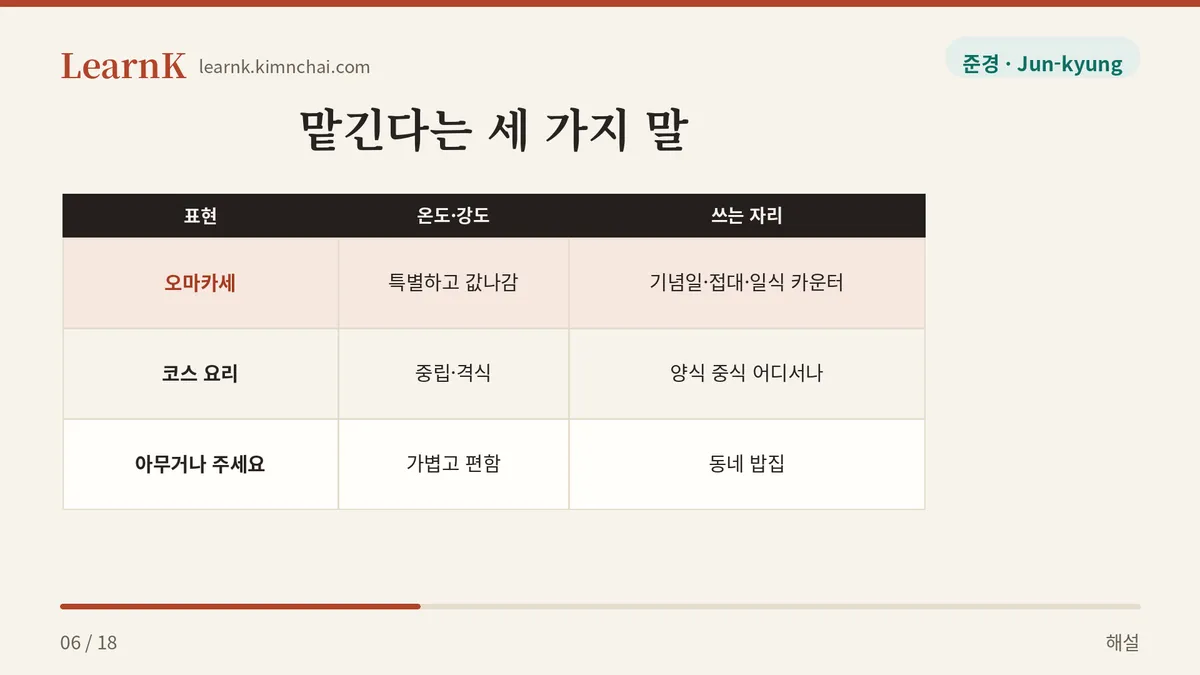
| Expression | Temperature / Intensity | Where it’s used |
|---|---|---|
| 오마카세 (omakase) | Special and pricey | Anniversaries, entertaining clients, Japanese counters. Rarely for an everyday lunch |
| 맡김 차림 (matgim charim) | Plain, purified Korean coinage | Public notices, broadcast subtitles. Almost never in conversation |
| 코스 요리 (koseu yori) | Neutral, formal | Anywhere, including Western and Chinese food. No nuance of price |
| 아무거나 주세요 (amugeona juseyo) | Light and easy | Neighborhood diners. Same idea of entrusting, but zero formality |
Even though both mean “leave it to you,” 아무거나 주세요 (amugeona juseyo) is closer to “I can’t be bothered to choose, so whatever,” while 오마카세 (omakase) is closer to “I trust your judgment.” The direction is the same, but the weight of respect is different.
Cultural Background — How the Word for “Leaving It to You” Made the Crossing
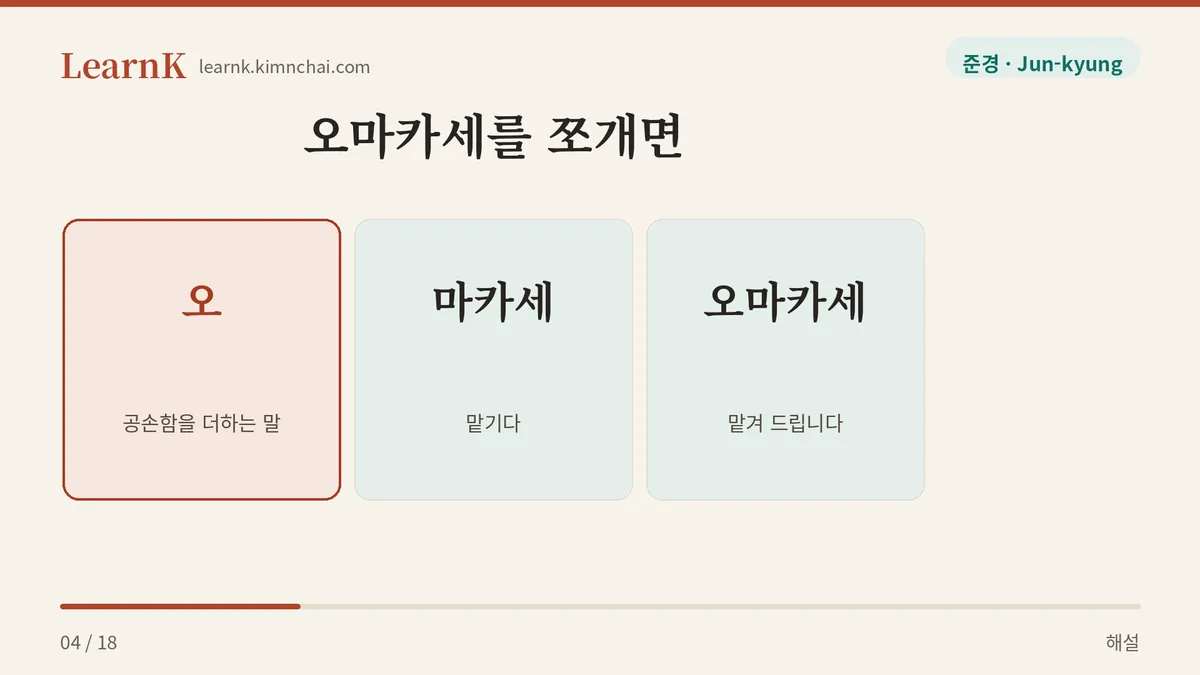
오마카세 (omakase) is a loanword that transcribes the Japanese お任せ(おまかせ) straight into sound. Its root is the Japanese verb 任せる(まかせる), meaning “to entrust,” and the お in front is a prefix that adds politeness. So on paper it’s a perfectly ordinary phrase, something like “I leave it to you” — but the custom of a customer at a Japanese sushi counter telling the chef “I’ll leave it to you today” turned into a menu name, and it crossed all the way to Korea in that form.
The word became widespread in Korea from the late 2010s. The National Institute of Korean Language proposed 맡김 차림 (matgim charim) as a refined native-Korean replacement for the loanword, and you can spot that expression in broadcast subtitles and public notices. In actual shop signs and everyday conversation, though, 오마카세 (omakase) still dominates overwhelmingly. For learners, it’s enough to remember it this way: 오마카세 (omakase) on signs and in conversation, 맡김 차림 (matgim charim) in official documents.
There’s a reason this word spread through Korea so unusually fast. Korean dining culture has traditionally meant laying out lots of side dishes and everyone helping themselves — omakase is the exact opposite: one plate at a time, in front of one person, in the order the chef decides. That unfamiliar format lined up perfectly with the feeling of “a special day,” which is why omakase scenes in dramas usually show up right before a confession or right before someone brings up an important favor. Dim lighting, a narrow counter, and no menu standing as a shield between the two of you — there are few better backdrops for finally saying the thing.
Today’s Quiz
You’ve made a reservation at an omakase place and just sat down at the counter. When the chef asks 드시기 전에 알려 주실 것 있으신가요? (deusigi jeone allyeo jusil geot isseusingayo? — “Is there anything I should know before you start eating?”), what’s the most natural answer?
- 참치 세 점이랑 연어 두 점 주세요. (chamchi se jeomirang yeoneo du jeom juseyo. — “Three pieces of tuna and two pieces of salmon, please.”)
- 저 새우 알레르기가 있어서요. 나머지는 다 괜찮습니다. (jeo saeu allereugiga isseoseoyo. nameojineun da gwaenchanseumnida. — “I’m allergic to shrimp. Everything else is fine.”)
- 혹시 메뉴판 좀 주시겠어요? (hoksi menyupan jom jusigesseoyo? — “Could I get a menu, by any chance?”)
Answer: 2. Omakase is a seat where you’ve handed the right to choose over to the chef, so what the customer mentions in advance goes only as far as must-know information like allergies. Number 1 amounts to placing an order after saying you’d leave it up to them, which contradicts itself, and number 3 doesn’t work in the first place, since this is a restaurant with no menu at all.