편찮으시다 (pyeonchaneusida) — How Korean Talks Around an Elder's Illness
편찮으시다
편찮으시다 (pyeonchaneusida) is the honorific form of ‘아프다 (apeuda)’ — to be sick. It means that someone older than you is not comfortable in their body; that is, that an elder has fallen ill and is unwell. Even learners with fairly solid Korean tend to hesitate in front of this word. ‘아프다 (apeuda)’ shows up in your very first week of study, and yet you can’t use it as-is with the very people you most often need it for — your parents, your grandmother, your boss.
The places this expression appears are more or less fixed. Calling the office to say you won’t be in. Asking after someone’s parents when you meet them again after a long time. Explaining to each other why you’re there in a hospital waiting room. In other words, the moments when you have to speak out loud about the physical condition of someone else’s elder. And it is exactly at those moments that Korean avoids being blunt.
The nuance sorts into three points. First, the subject must be someone else — and someone above you at that. Use it about yourself when you’re sick and it turns into honoring yourself. Second, it refers to the condition of the body as a whole. It doesn’t suit a single throbbing spot, like a finger or a throat. Third, it carries a certain weight. Rather than a mild headache or a cold you sleep off in a night, it fits a state serious enough to keep someone in bed for days or send them to the hospital. That’s why the person on the receiving end of ‘편찮으시다 (pyeonchaneusida)’ naturally puts on a worried face.
The form is worth knowing too. This word is ‘편찮다 (pyeonchanta)’ with the honorific ending ‘-으시- (-eusi-)’ attached, and in modern spoken Korean ‘편찮다 (pyeonchanta)’ almost never appears on its own. In practice it always comes with ‘-으시- (-eusi-)’. So learners are better off not splitting it into two pieces and instead memorizing 편찮으시다 (pyeonchaneusida) as a single chunk. The forms you’ll actually run into most often are these — 편찮으세요 (pyeonchaneuseyo), 편찮으셔서 (pyeonchaneusyeoseo), 편찮으신 (pyeonchaneusin), 편찮으셨어요 (pyeonchaneusyeosseoyo), 편찮으시대 (pyeonchaneusidae).
Seeing It in Real Conversation
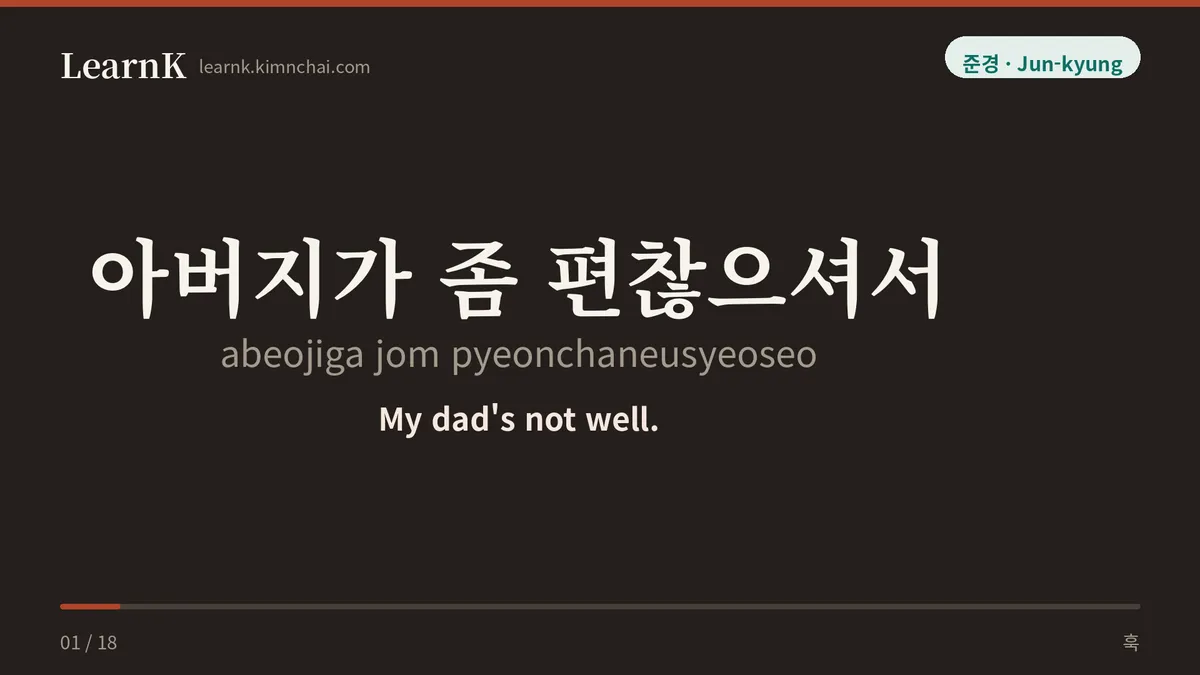
Scene: the first-floor lobby of a university hospital. Jun-kyung, on his way out after checking his father in for an appointment, runs into Emily.
Jun-kyung: 어, 에밀리? 너 여기 웬일이야. Oh, Emily? What are you doing here?
Emily: 나 독감 주사 맞으러 왔지. 근데 너야말로 무슨 일이야? I came for a flu shot. But what about you?
Jun-kyung: 아버지가 좀 편찮으셔서. 지난주부터 계속 기침하시는데 병원을 안 가시더라고. My dad’s not well. He’s been coughing since last week but wouldn’t go to the doctor.
Emily: 아이고… 많이 편찮으신 거야? Oh no… Is he badly ill?
Jun-kyung: 아니야, 검사만 해 보는 거야. 별거 아닐 거야. No, they’re just running some tests. It’s probably nothing.
Emily: 그래도 얼른 나으셔야 할 텐데. 아버님께 안부 전해 줘. Still, I hope he gets better soon. Give my regards to your father.
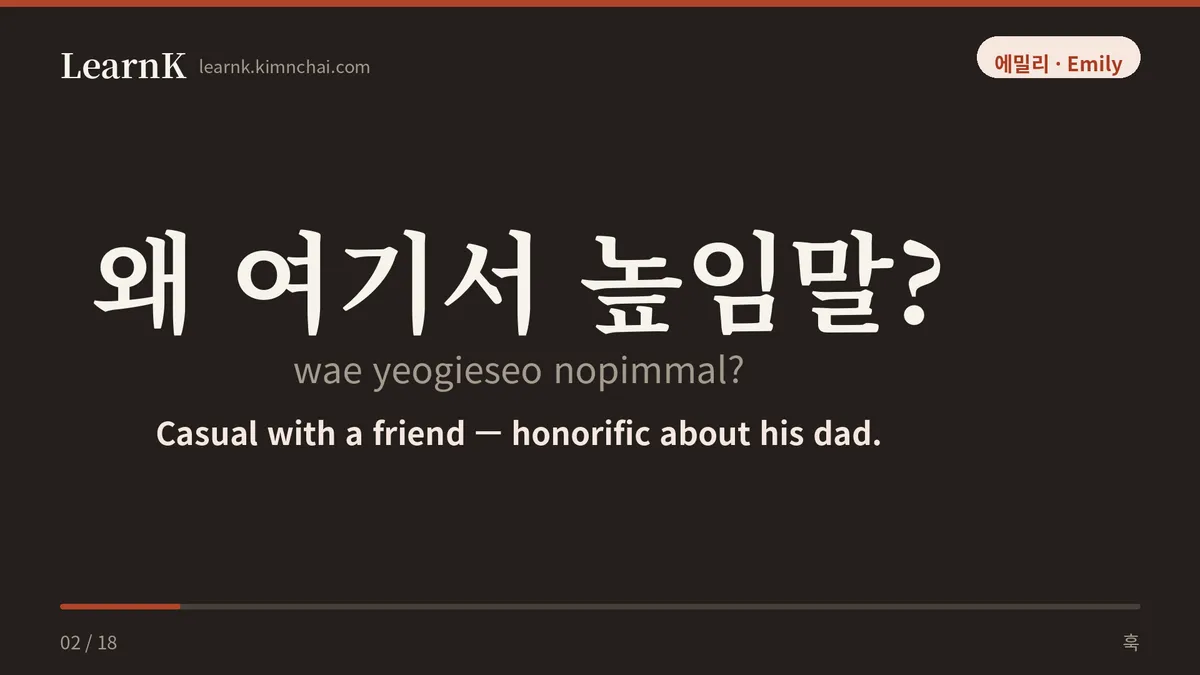
The thing to notice here is that ‘편찮으시다 (pyeonchaneusida)’ comes out even though the two of them are talking in casual speech (반말, banmal). That’s because the target of the honorific isn’t the listener (Emily) but the subject inside the sentence (Jun-kyung’s father). You speak comfortably with your friend while still elevating their parent — this is the heart of the Korean honorific system.
These Uses Sound Off
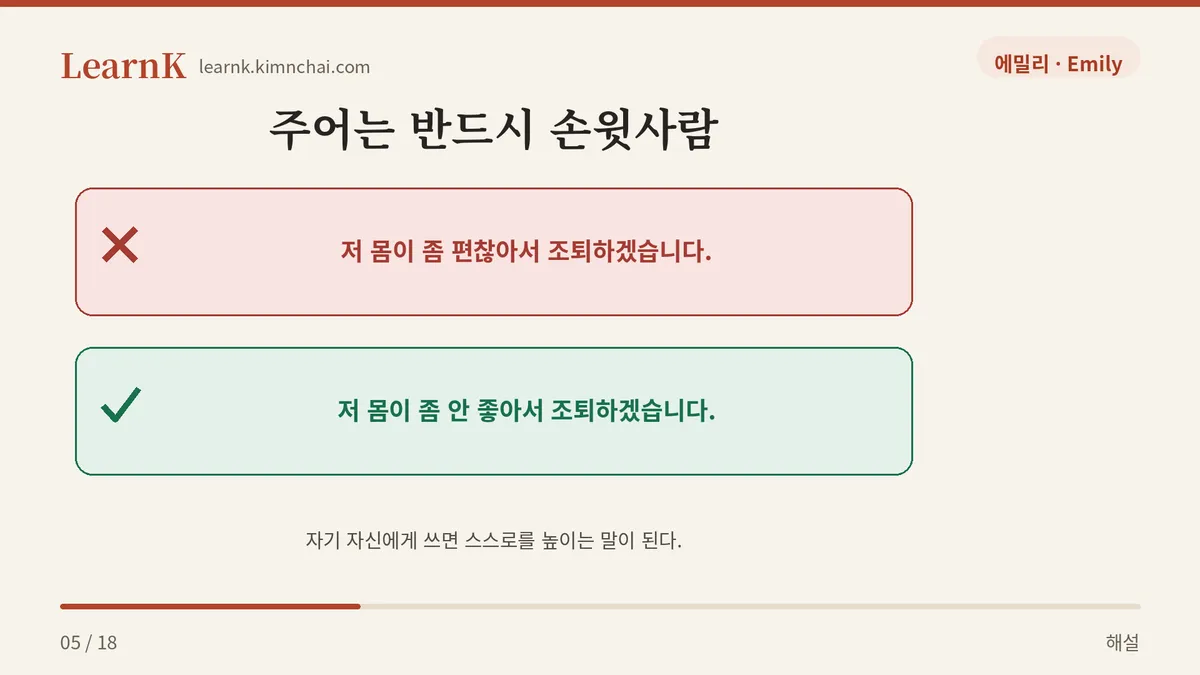
✗ 저 어제부터 몸이 좀 편찮아서 조퇴하겠습니다. ✓ 저 어제부터 몸이 좀 안 좋아서 조퇴하겠습니다. → Using it about yourself turns it into honoring yourself. No matter how polite the setting, for your own body you use ‘아프다 (apeuda)’ or ‘몸이 안 좋다 (momi an jota)’.
✗ 할머니, 어제부터 무릎이 편찮으세요? ✓ 할머니, 어제부터 무릎이 아프세요? → The person is the right choice, but the setting is off. ‘편찮으시다 (pyeonchaneusida)’ points to the whole body being unwell, so for pain in one spot — a knee, a shoulder, a throat — you use ‘아프시다 (apeusida)’.
Example Sentences by Situation
1. Telling work you’ll be absent or leaving early — this is the most common setting for it in a Korean workplace. You don’t need a long explanation; this one line is usually enough that nobody asks further.
죄송합니다, 어머니가 갑자기 편찮으셔서 오늘 연차를 써야 할 것 같습니다. (joesonghamnida, eomeoniga gapjagi pyeonchaneusyeoseo oneul yeonchareul sseoya hal geot gatseumnida.) 죄송합니다, 어머니가 갑자기 편찮으셔서 오늘 연차를 써야 할 것 같습니다. — Sorry, my mother suddenly fell ill, so I think I need to take a day off today.
2. Your opening greeting on a hospital visit — the line you say the moment you step into the room. It flows naturally straight into ‘어떠세요 (eotteoseyo)’.
할머니, 많이 편찮으시다고 들었어요. 좀 어떠세요? (halmeoni, mani pyeonchaneusidago deureosseoyo. jom eotteoseyo?) 할머니, 많이 편찮으시다고 들었어요. 좀 어떠세요? — Grandma, I heard you’ve been quite ill. How are you feeling?
3. Asking after someone you haven’t seen in a while — a set greeting used between adults at holidays or weddings, or when asking about a friend’s parents.
부모님은 건강하시죠? 어디 편찮으신 데는 없으시고요? (bumonimeun geonganghasijyo? eodi pyeonchaneusin deneun eopseusigoyo?) 부모님은 건강하시죠? 어디 편찮으신 데는 없으시고요? — Are your parents well? Nothing ailing them, I hope?
Related Expressions, Polite and Casual
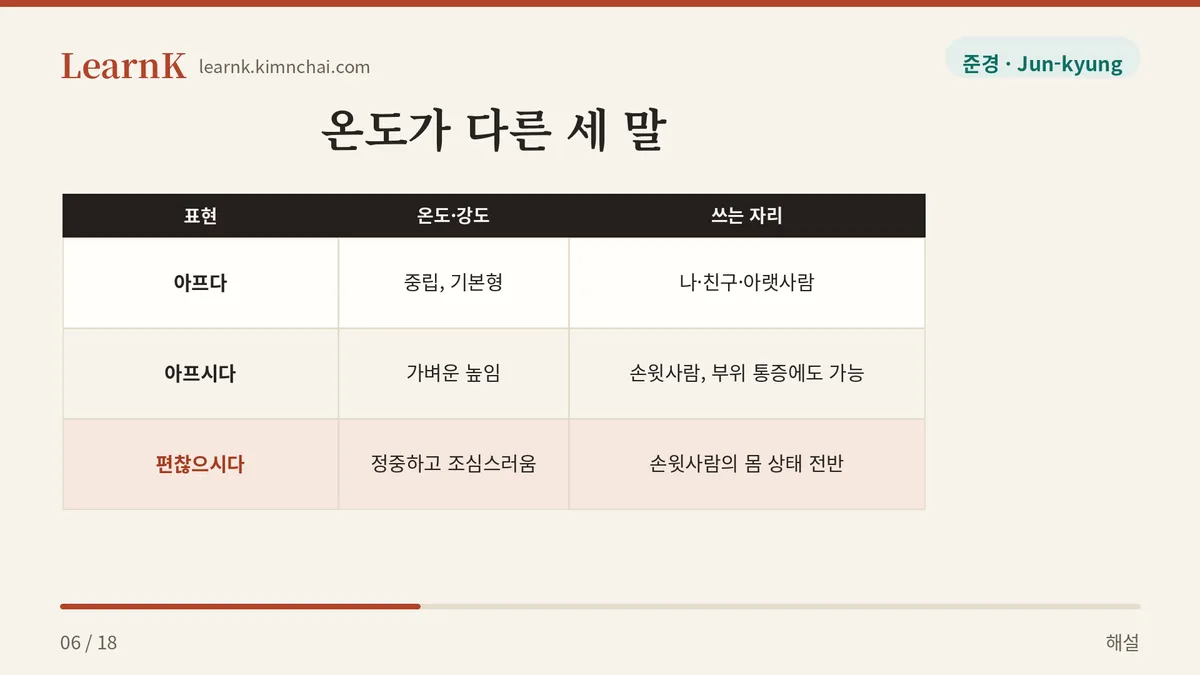
| Expression | Tone & weight | Where it’s used |
|---|---|---|
| 아프다 (apeuda) | Neutral, the base form | Yourself, friends, people younger than you. Works for localized pain too |
| 아프시다 (apeusida) | Light honorific | Someone above you. Can be used for pain in one spot, like a knee or a throat |
| 편찮으시다 (pyeonchaneusida) | Polite and careful | An elder’s overall physical condition. Not used for localized pain |
| 몸져눕다 (momjyeonupda) | Heavy | When someone is ill enough to be laid up in bed. Not an honorific in itself |
| 병환 (byeonghwan) | The most formal and weighty | Written language, formal greetings. Used as in ‘병환이 깊으시다 (byeonghwani gipeusida)’ |
The pair that’s easiest to confuse is ‘아프시다 (apeusida)’ and ‘편찮으시다 (pyeonchaneusida)’. Both can be used about someone above you, but ‘아프시다 (apeusida)’ focuses on the pain itself, while ‘편찮으시다 (pyeonchaneusida)’ focuses on the overall state of being unwell. So ‘어제 넘어지셔서 발목이 아프시대 (eoje neomeojisyeoseo balmogi apeusidae)’ sounds natural, but drop ‘편찮으시대 (pyeonchaneusidae)’ into the same slot and it sounds as though not just one ankle but their whole body is ailing.
Cultural Background — Traces of Speaking Around It
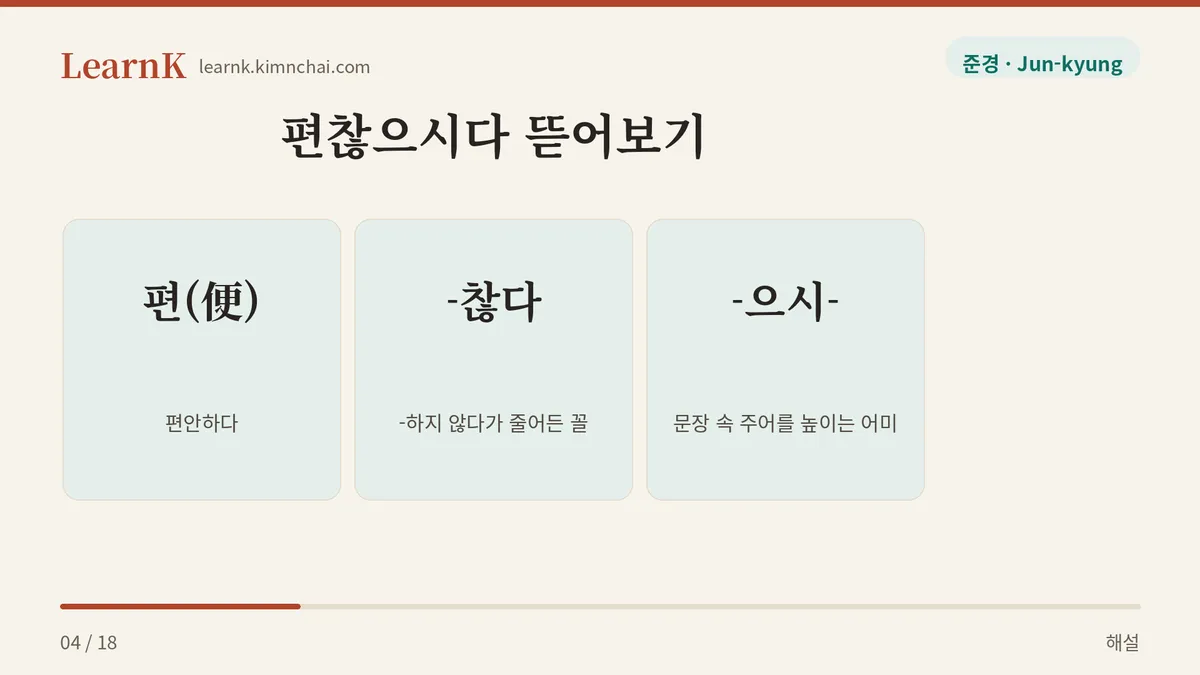
Take this word apart and you can see exactly how Korean handles an elder’s body. ‘편찮다 (pyeonchanta)’ is the Sino-Korean 편 (便, meaning ‘at ease’) plus ‘-하지 않다 (-haji anta)’, contracted: 편하지 않다 (pyeonhaji anta) → 편치 않다 (pyeonchi anta) → 편찮다 (pyeonchanta). In other words, the original meaning of this word isn’t ‘to be sick’ but ‘to be not at ease’. Instead of flatly declaring that an elder is sick, the language takes a step back and says, roundabout, that they are ‘in a state of discomfort’. It has hardened into a plain honorific by now, but the trace of that euphemism is still there in the feel of the word.
Which is why this word is often spoken more lightly than the reality. Even with a family member hospitalized with something serious, outside the family you’ll only hear ‘아버지가 좀 편찮으셔서요 (abeojiga jom pyeonchaneusyeoseoyo)’ — ‘my father’s a bit unwell.’ And the listener knows that the ‘좀 (jom)’, ‘a bit,’ may not be a bit at all. That’s also why the same scene keeps coming back in Korean dramas, where this one sentence turns the whole story around — the hero is doing fine in Seoul until a single phone call from back home has them packing a bag, and the content of that call is always the news that their mother is unwell. The line is short and understated, but the audience reads the weight behind it.
Turn it the other way and use the word about someone below you, and that weight becomes comic. If your friend catches a cold and you say ‘너 어디 편찮으시냐 (neo eodi pyeonchaneusinya)’, it isn’t sincere concern — it’s teasing. Koreans do in fact make that kind of joke all the time. Once a learner picks up on this layer of nuance, they stop being someone who has memorized honorifics and become someone who can actually use them.
Today’s Quiz
Which of the following sentences uses 편찮으시다 (pyeonchaneusida) naturally?
- 저 어제부터 목이 편찮아서 병원에 다녀왔어요.
- 팀장님, 어머님이 편찮으시다면서요. 좀 어떠세요?
- 우리 집 강아지가 며칠째 편찮으세요.
Show the answer
Answer: 2
In 1, the speaker applies an honorific to themselves, and on top of that attaches the word to pain in a single spot — the throat. ‘목이 아파서 (mogi apaseo)’ is correct. In 3, ‘-으시- (-eusi-)’ is attached to a pet, which can’t be the target of an honorific. People do it on purpose for cuteness sometimes, but the standard form is ‘아파요 (apayo)’. In 2, the target of the honorific (the team leader’s mother) is clear, the word points to her overall condition, and it fits perfectly in a setting where you’re asking after someone.
Definitions and example sentences are from the National Institute of Korean Language’s Basic Korean Dictionary (krdict.korean.go.kr); that portion of this post, including our translations, is licensed under CC BY-SA 2.0 KR.