Heart Going Pit-a-pat — '설렘 (seolleom),' the Language of Fluttering in K-Dramas
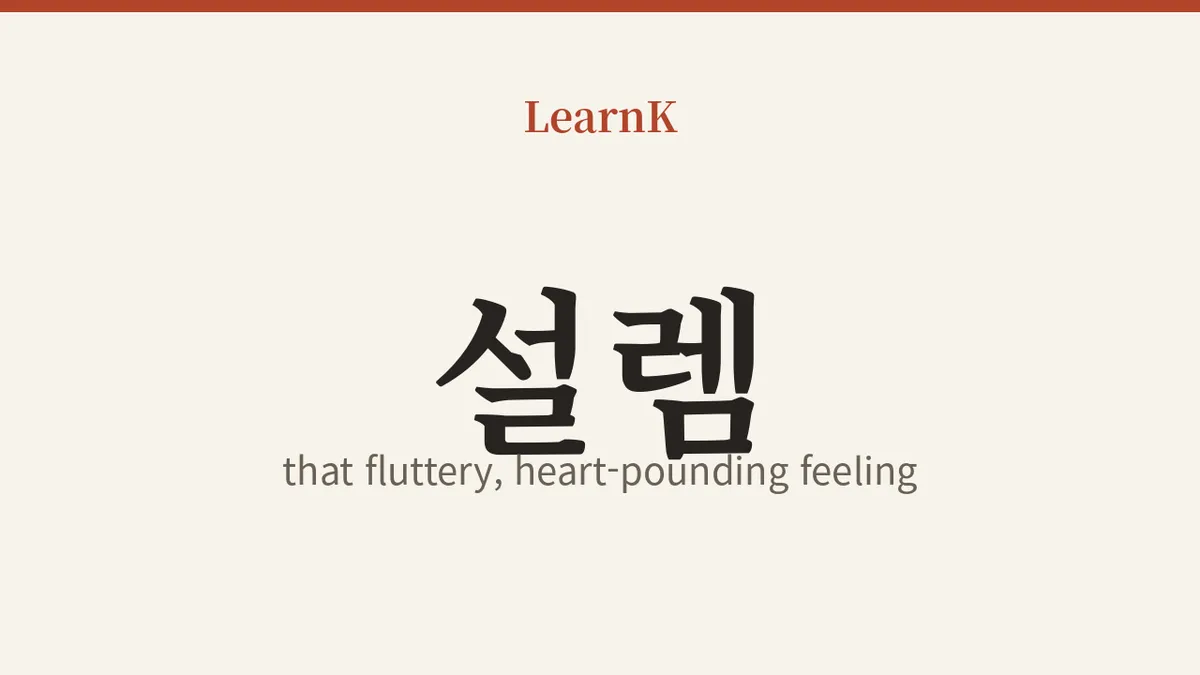
설렘
That moment when your eyes meet someone you like, when you pace back and forth in front of your closet before a first date, when you finally hold tomorrow’s concert ticket in your hand — that feeling of your chest tingling for no reason and your heart beating faster than usual. Koreans have one word for this emotion: 설렘 (seolleom). If you watch K-dramas, it’s a word you’ll run into again and again in subtitles and reviews. Today, let’s dig deep into this lovely little word.
Meaning and Nuance
설렘 (seolleom) is a noun that comes from the verb 설레다 (seolleda). It refers to a state in which your heart won’t settle down but instead flutters and races with anticipation. There are two key points.
First, it’s a positive emotion. You’re not fluttering out of anxiety — you’re fluttering as you look forward to something good. Second, the object of that feeling is not necessarily romantic. Of course, the 설렘 you feel because of someone you like is the most famous kind, but you can use it anywhere there’s a “pleasant sense of anticipation”: the 설렘 of the night before a trip, the 설렘 of a new semester, the 설렘 of your first day at work.
In English, flutter, excitement, or butterflies in the stomach come close, but there’s no perfect translation for that uniquely Korean “fresh and tingly” feeling of 설렘 (seolleom) — so these days overseas fans sometimes just write seolleom.
Example Sentences by Situation
Let’s get a feel for it with some original example sentences.
Situation 1 — Before a first date (texting a friend)
내일 첫 데이트라 벌써 설레서 잠이 안 와. naeil cheot deiteura beolsseo seolleseo jami an wa. (I have my first date tomorrow, and I’m already so fluttery I can’t sleep.)
Here the verb form 설레서 (seolleseo, 설레어서) is used to express the reason — “because I’m fluttering.” It’s a cute exaggeration: your heart is pounding so much you can’t fall asleep.
Situation 2 — Packing a suitcase (talking to oneself)
3년 만의 해외여행이라니, 이 설렘을 어떻게 참지? samnyeon manui haeoeyeohaengirani, i seollemeul eotteoke chamji? (My first trip abroad in three years — how am I supposed to hold in all this excitement?)
With nothing to do with romance at all, the noun 설렘 (seolleom) expresses the giddy feeling about a long-awaited trip.
Situation 3 — Right before entering the concert venue (fans chatting)
최애를 직접 본다고 생각하니까 심장이 터질 것 같아. 완전 설렌다! choeaereul jikjeop bondago saenggakhanikka simjangi teojil geot gata. wanjeon seollenda! (Just thinking about seeing my bias in person, I feel like my heart’s going to burst. I’m totally fluttering!)
설렌다 (seollenda) is the casual (반말) present-tense form, and it vividly conveys a real-time emotion — “my heart is pounding right now” — on social media or between friends.
Comparing Polite vs. Casual Speech and Similar Expressions
The same emotion is spoken differently depending on who you’re talking to.
- Casual (반말): 설레 / 설렌다 (seolle / seollenda) — friends, a partner, social media
- Polite (존댓말): 설레요 / 설렙니다 (seolleyo / seolleimnida) — elders, formal settings
For example, when an idol greets fans on a broadcast, they’ll say politely, “여러분을 만나서 정말 설레요 (seolleyo)” (“Meeting all of you, my heart is really fluttering”).
Let’s also learn some expressions that are similar but carry a different shade. 두근거리다 (dugeungeorida) focuses on the physical symptom of a racing heart, so it can be used for nervousness or fear too. In contrast, 설레다 (seolleda) is almost always about “pleasant anticipation” — that’s the difference. Also, 떨리다 (tteollida) is the feeling of your body trembling with nerves, so it works before an exam or a presentation, but 설레다 (seolleda) doesn’t carry that kind of edgy anxiety.
Cultural Background — K-Dramas and ‘설렘’
The moments that fans of Korean romance dramas most eagerly wait for are often called 설렘 포인트 (seollem pointeu) — “flutter points.” The lead couple’s hands accidentally brushing, sharing one umbrella on a rainy day, or the so-called ‘벽치기 (byeokchigi)’ scene where one leans the other against a wall — these are exactly the moments that make viewers’ hearts race.
In fact, drama reviews and comment sections overflow with expressions like “이 장면 설렘 폭발” (“this scene is a flutter explosion”) and “설렘 주의” (“flutter warning”). For instance, in a popular romance drama, the moment a gruff male lead quietly looks after the female lead, viewers all cry out together, “심장 아파” (“my heart hurts”), savoring the 설렘 to the fullest. In this way, 설렘 (seolleom) has become more than a simple word — it’s a whole “appreciation code” for enjoying Korean romance content.
Closing Quiz
What’s the most natural word for the blank below?
“내일 좋아하는 가수 콘서트에 가! 생각만 해도 (______).” (“I’m going to my favorite singer’s concert tomorrow! Just thinking about it, I ______.”)
① 무서워 (museowo) ② 설레 (seolle) ③ 슬퍼 (seulpeo)
The answer is ② 설레 (seolle). It’s a situation where your heart flutters with anticipation of seeing a singer you love. Be sure to try out the 설렘 (seolleom) you learned today the next time you watch a K-drama!