성수동 (Seongsu-dong) — How an Alley of Shoe Factories Became Seoul's Hippest Neighborhood
성수동 (Seongsu-dong) is the name of a neighborhood in Seongdong-gu, Seoul: an old industrial district once packed wall-to-wall with shoe factories and print shops, now a stretch of streets full of cafés and pop-up stores. You’ve probably already seen these three characters a few times — in a Korean idol’s vlog, in the subtitles of a variety show, or in a Korean friend’s Instagram story. It’s also the answer that comes back two or three times out of ten when you ask a Korean friend 우리 어디 갈까? (uri eodi galkka?), ‘Where should we go?’, on a weekend.
There’s a specific reason this word is tricky for foreign learners. Look it up in a dictionary and you won’t find it — and if you do, it stops at something like ‘an administrative subdistrict of Seongdong-gu, Seoul.’ But what a Korean pictures when they say 성수동 (Seongsu-dong) is not an administrative district. It’s a high-ceilinged café built inside a converted red-brick warehouse, a brand pop-up store that opens for one month and vanishes, the two-hour line out front — and, tucked in between all of that, the old shoe workshops that are still there.
성수동
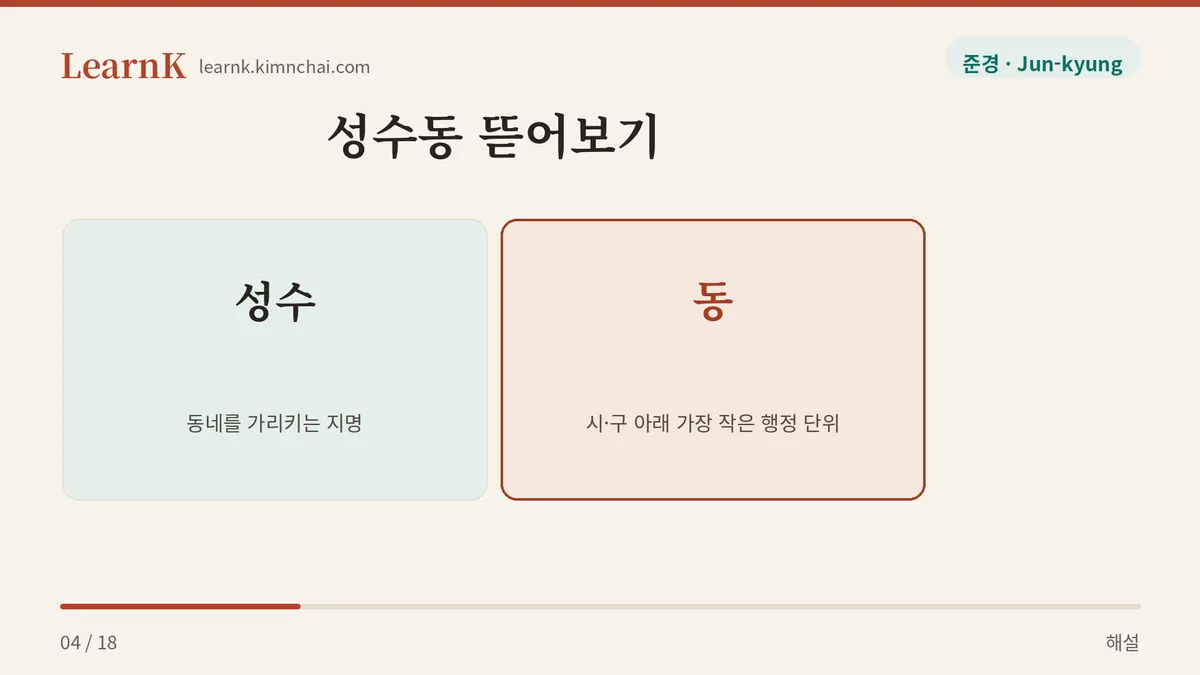
성수동 (Seongsu-dong) is the place name 성수 (Seongsu) with the administrative unit 동 (dong) attached. In Korea, 동 is the smallest administrative unit below a city (시, si) and a district (구, gu), and it maps most closely onto the English word ‘neighborhood.’ That’s why most Korean neighborhood names end in this syllable — 연남동 (Yeonnam-dong), 익선동 (Ikseon-dong), 삼청동 (Samcheong-dong), and 성수동 (Seongsu-dong).
In real conversation, though, people drop the 동 far more often than they keep it: 성수 가자 (Seongsu gaja), 연남에서 만나 (Yeonnam-eseo manna). It’s the same instinct that makes a New Yorker call Williamsburg just ‘Billyburg.’ Shortening a name means you go there often enough to shorten it — and that it’s shorthand shared among the people who go.
The nuance matters. The sentence 성수동 갔다 왔어 (Seongsu-dong gatda wasseo) isn’t simply passing along the information ‘I went to that area.’ It comes with a temperature: ‘I went to the place that’s hot right now,’ ‘I saw what’s trending.’ Which is why the line often mixes a quiet brag with a little exhaustion. Because it really is that crowded.
In Real Conversation
Situation: Saturday, two in the afternoon, in front of Exit 3 of Seongsu Station. The line for a brand pop-up store stretches all the way to the end of the alley.
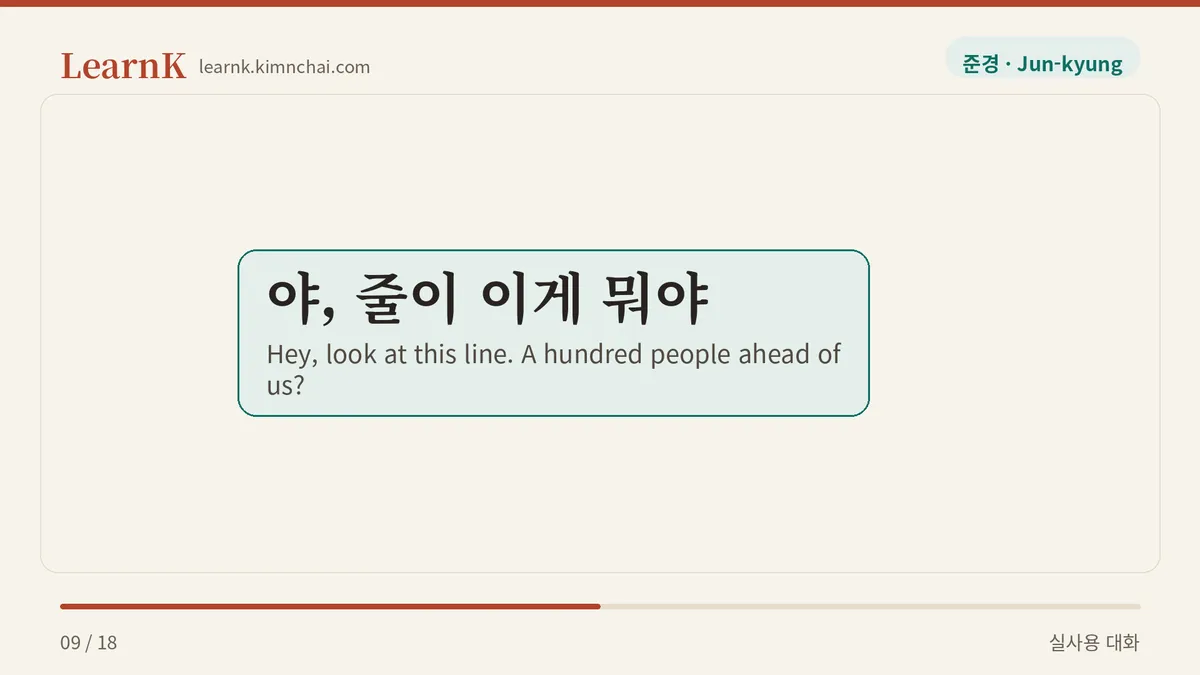
Jun-kyung: 야, 줄이 이게 뭐야. 우리 앞에 백 명은 되겠는데? Hey, look at this line. There must be a hundred people ahead of us.
Emily: 성수동이 다 그렇지 뭐. 나 이거 보려고 2주 기다렸어. That’s just how Seongsu-dong is. I waited two weeks for this.
Jun-kyung: 나 여기 이십 년 전에 와 봤거든? 그땐 죄다 구두 공장이었어. You know I came here twenty years ago? Back then it was all shoe factories.
Emily: 진짜? 상상이 안 가는데. Seriously? I can’t picture that at all.
Jun-kyung: 아저씨들이 리어카에 가죽 싣고 다니고… 여기가 성수동 맞나 싶다니까. Guys hauling leather on handcarts… I keep wondering if this is even the same Seongsu-dong.
Emily: 어, 줄 움직인다! 옛날 얘기는 안에 들어가서 해. Oh, the line’s moving! Save the old stories for inside.
This Sounds Off
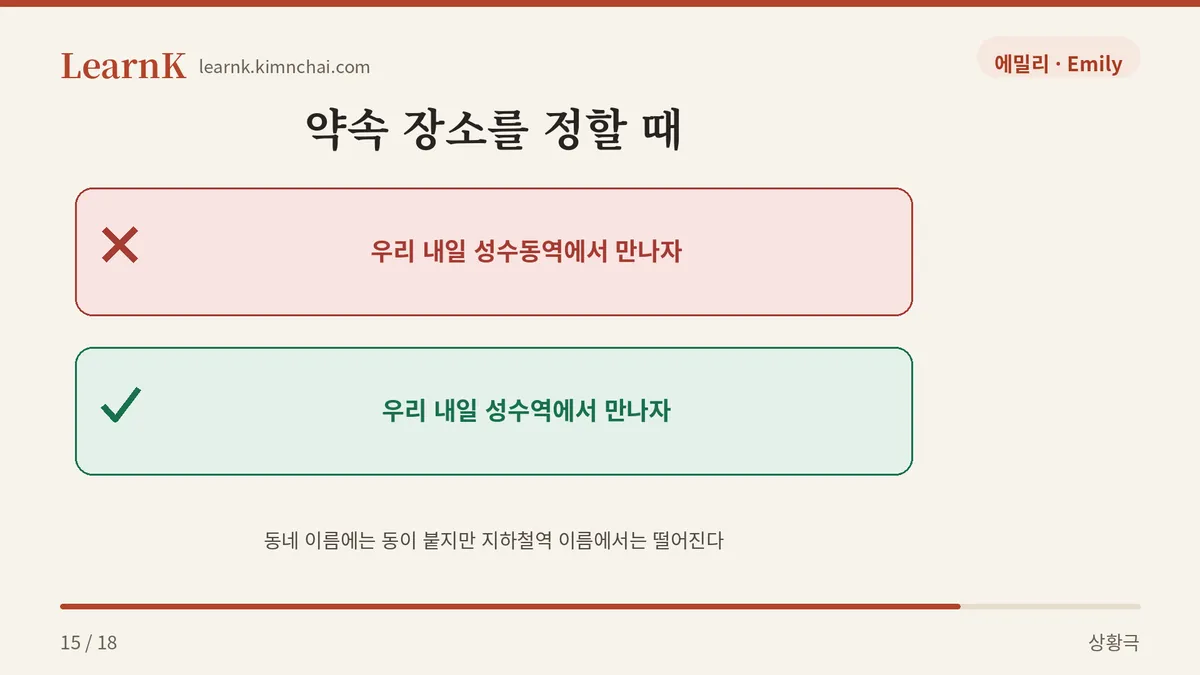
✗ 우리 내일 성수동역에서 만나자. (Uri naeil Seongsu-dong-yeogeseo mannaja.) ✓ 우리 내일 성수역에서 만나자. (Uri naeil Seongsu-yeogeseo mannaja.) → The neighborhood is 성수동, but subway station names drop the 동. It works the same way for 역삼동 (Yeoksam-dong) → 역삼역 (Yeoksam Station) and 합정동 (Hapjeong-dong) → 합정역 (Hapjeong Station). Build a station name with the 동 still attached and a Korean will hear something off immediately.
✗ (to an elderly craftsman who has been making shoes in Seongsu-dong for forty years) 사장님, 성수동 요즘 완전 힙하죠? (Sajangnim, Seongsu-dong yojeum wanjeon hip-hajyo?) ✓ (to an elderly craftsman who has been making shoes in Seongsu-dong for forty years) 사장님, 성수동 많이 변했죠? (Sajangnim, Seongsu-dong mani byeonhaetjyo?) → Even for the same neighborhood, the memories differ by generation. To someone in their twenties, Seongsu-dong is a street of pop-up stores; to someone who has worked here their whole life, it’s the place where the factories disappeared one by one. Use the word 힙하다 (hip-hada) in front of that person and instead of sounding enthusiastic, you sound clueless.
Example Sentences by Situation
1. Suggesting weekend plans to a friend
이번 주말에 성수동 갈래? (Ibeon jumare Seongsu-dong gallae?) — Want to go to Seongsu-dong this weekend?
This is casual speech, used between peers. The ending ‘-ㄹ래? (-llae?)’ asks lightly about the other person’s willingness, so it puts no pressure on them. Here 성수동 is both the name of a destination and shorthand for an entire plan — ‘a day of café-hopping, browsing, and taking photos.’ You don’t have to spell out what you’ll do; it’s understood.
2. Talking with a Korean you’ve just met
저는 성수동 쪽에 살아요. (Jeoneun Seongsu-dong jjoge sarayo.) — I live over around Seongsu-dong.
쪽 (jjok) means ‘in the direction of’ or ‘near,’ and it lets you give a rough location without revealing a precise address. It’s a cushion Koreans reach for often when saying the bare neighborhood name to someone they’ve just met feels like too much.
3. When the crowds have worn you out
주말 성수동은 사람이 너무 많아서 못 가겠어요. (Jumal Seongsu-dongeun sarami neomu manaseo mot gagesseoyo.) — Seongsu-dong on the weekend is so crowded I don’t think I can go.
Adding ‘-겠- (-get-)’ loads the sentence with resignation: ‘as far as I can judge right now, there’s just no way.’ It’s one of the most common things Koreans say about Seongsu-dong, and it usually carries the unspoken second half, ‘it’s still nice on a weekday.‘
Polite and Casual Speech, and Related Expressions
A place name itself has no polite or humble form. What changes is the sentence wrapped around it.
- Casual: 성수동 가 봤어? (Seongsu-dong ga bwasseo?)
- Polite: 성수동 가 보셨어요? (Seongsu-dong ga bosyeosseoyo?)
Here’s how the words for the same neighborhood differ in temperature.
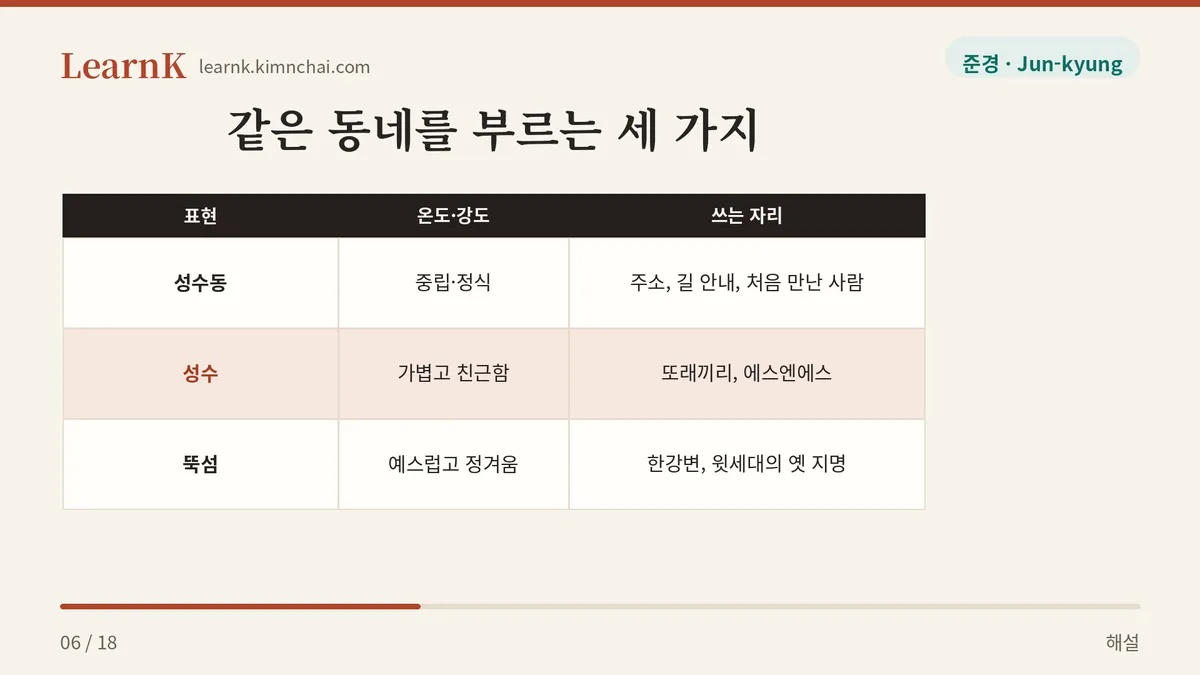
| Expression | Temperature / intensity | Where it’s used |
|---|---|---|
| 성수동 (Seongsu-dong) | Neutral. The neighborhood’s official name | Anywhere — addresses, directions, someone you’ve just met |
| 성수 (Seongsu) | Light and friendly | Among peers and on social media: 성수 가자 (Seongsu gaja), 성수 갔다 왔어 (Seongsu gatda wasseo) |
| 연무장길 (Yeonmujang-gil) | Specific and practical | When pinning down an exact meeting spot. Seongsu-dong’s main street |
| 서울숲 (Seoulsup) | Easygoing, unhurried | In the context of a walk or a day out. The big park on the west side of Seongsu-dong |
| 뚝섬 (Ttukseom) | Old-fashioned and fond | Along the Han River, and as a station name. What older generations called this area |
On a map the five almost entirely overlap, but the people who say them are different. Someone in their twenties will most likely say 성수, a family with young kids 서울숲, and someone past sixty 뚝섬. For a Korean learner, which word you pick becomes a signal of what kind of person you are in relation to this neighborhood — how you know it.
Cultural Background — From Shoe Factories to Pop-Up Holy Ground
Read the Chinese characters in 성수 (聖水) literally and you get ‘holy water.’ The widely repeated explanation for the name is that it borrows one syllable each from 성덕정 (聖德亭), a pavilion that once stood in the area, and 뚝도수원지 (纛島水源池), the Ttukdo Waterworks. 뚝도수원지 opened in 1908 as Korea’s first modern water purification plant, and the site survives today as the Waterworks Museum. This was the neighborhood that first supplied Seoul with running water — so a name that came from water suits it rather well.
It’s also fun that Koreans these days call Seongsu-dong 팝업의 성지 (paepeobui seongji), ‘the holy land of pop-ups.’ 성지 (聖地) originally referred to a religious holy site, but now it’s used broadly to mean ‘the place any fan of a given thing simply has to visit.’ Thanks to the coincidence that 성수 (聖水) and 성지 (聖地) share a Chinese character, the phrase also lands a bit like a pun.
The neighborhood’s history is easy to trace. In the 1960s and ’70s, handmade-shoe factories clustered here, and a large share of the shoes sold in Seoul were made in these alleys. In the 1990s, print shops and auto repair garages filled the gaps. In the mid-2000s Seoul Forest opened, and through the 2010s cafés that kept the old warehouse and factory buildings intact began appearing one by one — and the current turned. People had discovered that old factory buildings, with their high ceilings and rough walls, actually photograph beautifully.
So when you walk through Seongsu-dong today, you can see time stacked in layers. Next to an old 다방 (dabang), an old-style tearoom selling three-thousand-won coffee, sits a dessert shop selling twenty-thousand-won plates, and in the alley behind them you can still hear sewing machines. That’s also why Seongsu-dong turns up so often in Korean variety shows and vlogs. Point the camera anywhere and the old and the new land in the same frame.
There’s one reason I recommend learners know this background. When a Korean friend asks 성수동 어때? (Seongsu-dong eottae?), ‘What’s Seongsu-dong like?’, answering only 사람 많아요 (saram manayo), ‘It’s crowded,’ versus asking back 옛날엔 구두 공장이었다면서요? (Yennallen gudu gongjang-ieotdamyeonseoyo?), ‘I hear it used to be all shoe factories?’, gives you a completely different depth of conversation.
Today’s Quiz
You’re making weekend plans with a Korean friend. Your friend asks:
내일 성수 갈래? (Naeil Seongsu gallae?)
Which of these is closest to what your friend means?
- Want to commute together tomorrow to the office in Seongsu-dong?
- Want to go hang out in Seongsu-dong tomorrow and check out the cafés and pop-up stores?
- Want to go to Seongsu-dong tomorrow and get a pair of shoes made to order?
The answer is 2. 성수 (Seongsu), with the 동 dropped, is the short form friends use, and the moment it comes out, what’s being proposed is less a destination than a whole way of spending the day in that neighborhood. Option 3 is genuinely possible in Seongsu-dong, but someone going to have shoes made usually states the purpose outright, as in 성수동 수제화 거리 갈래? (Seongsu-dong sujehwa geori gallae?), ‘Want to go to the handmade-shoe street in Seongsu-dong?’
When it’s your turn to answer, here’s how. To a friend: 콜! 몇 시? (Kol! Myeot si?) To someone you need to be a bit more polite with: 네, 좋아요. 몇 시에 만날까요? (Ne, joayo. Myeot sie mannalkkayo?)
Definitions and example sentences are from the National Institute of Korean Language’s Basic Korean Dictionary (krdict.korean.go.kr); that portion of this post, including our translations, is licensed under CC BY-SA 2.0 KR.