시한부 (sihanbu) — K-Drama's Favorite Word, But It Also Lives Outside the Hospital
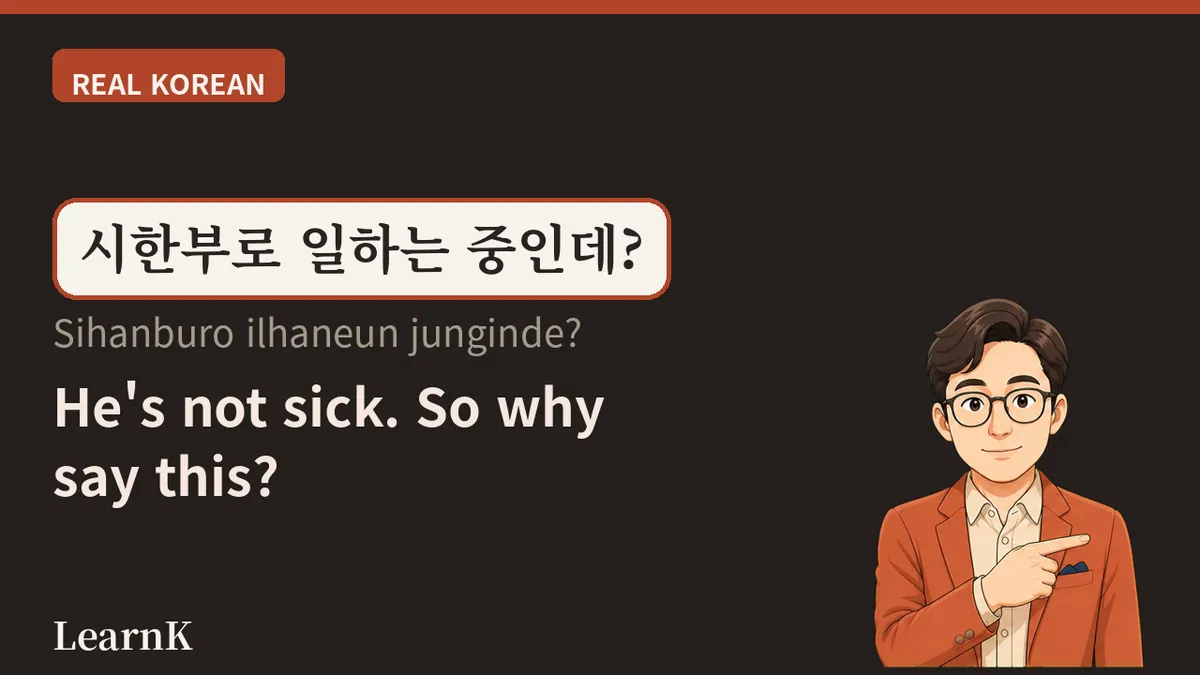
시한부
시한부 (sihanbu) means putting a fixed time limit on something. Put plainly: “the day it ends has already been decided.”
If you’ve watched even a little Korean drama, you almost certainly met this word for the first time in an exam-room scene. The doctor closes the chart, the lead stares out the window, the music thins out, and the subtitle reads 시한부 선고 (sihanbu seongo). So a lot of learners memorize the word as a synonym for “incurable illness” or “about to die.”
That’s only half right. The backbone of 시한부 (sihanbu) is not illness — it’s time. That’s why the word turns up perfectly comfortably in part-time job listings, in labor-negotiation news, and in company contracts. Today we’ll follow it out of the hospital and see how it lives out there.
The emphasis in 시한부 (sihanbu) isn’t on “short” but on “the end is nailed down.” Whether the remaining time is long or short, the simple fact that it has been fixed is what gives the word its weight. Not fixed → 무기한 (mugihan, indefinite). Fixed → 시한부 (sihanbu).
It’s a noun. It can’t serve as a predicate by itself, and it usually travels in one of three shapes.
- 시한부 + noun: 시한부 환자 (sihanbu hwanja, a terminally ill patient), 시한부 계약 (sihanbu gyeyak, a fixed-term contract), 시한부 파업 (sihanbu paeop, a time-limited strike), 시한부 인생 (sihanbu insaeng, a life with a set ending)
- 시한부로 + verb: 시한부로 일하다 (sihanburo ilhada, to work on a time-limited basis), 시한부로 사용하다 (sihanburo sayonghada, to use for a limited period), 시한부로 맡다 (sihanburo matda, to take charge of something temporarily)
- 시한부 선고를 받다 (sihanbu seongoreul batda): to be told by a doctor how much time is left — an almost fully frozen expression
The temperature of the word swings hard depending on context. Attached to a person, it becomes something you can’t toss around lightly; attached to a contract or a strike, it’s as dry as a newspaper headline. That one word can read at such different temperatures — that’s exactly what makes 시한부 (sihanbu) tricky.
Checking it in the National Institute of Korean Language dictionary
시한부 (sihanbu) 「noun」 Setting a certain time limit on something. [en] being time-limited — Having a certain time limit in something. [ja] じげんつき【時限付き】 — ある事に一定の期限を設けること。 [es] límite de tiempo, tiempo definido — Acción de dejar fijado un determinado período del tiempo para algo. [zh] 有期限,规定期限,限期 — 限定一定的时间去完成某事。 — National Institute of Korean Language, Basic Korean Dictionary (krdict.korean.go.kr)
Notice that nowhere in the definition do the words “illness” or “death” appear. The only thing the dictionary holds onto is “a certain time limit.”
※ The Portuguese gloss isn’t listed in the dictionary, so we translated it ourselves: prazo determinado, por tempo limitado — ato de fixar um período de tempo determinado para algo.
Now let’s look at the real usage examples from that same dictionary, exactly as they appear.
지수의 남편은 암세포가 늑막까지 빠르게 전이되어 일 년의 시한부 선고를 받았다. (Jisu-ui nampyeoneun amsepoga neungmak-kkaji ppareuge jeonidoeeo illyeon-ui sihanbu seongoreul badatda.) Jisu’s husband’s cancer spread rapidly to the pleura, and he was given one year to live. — National Institute of Korean Language, Basic Korean Dictionary (krdict.korean.go.kr)
This is the most typical use of all. The illness (cancer), the progression (metastasis), and the time remaining (one year) are all packed into a single sentence. Here 시한부 (sihanbu) points to the fact that the remaining time has been fixed as a number, and the act of telling you that number is 선고 (seongo, a pronouncement).
너에게 갑자기 시한부 인생이 선고된다면 어떻게 할 거야? (Neoege gapjagi sihanbu insaengi seongodoendamyeon eotteoke hal geoya?) If you were suddenly told you had only so long to live, what would you do? — National Institute of Korean Language, Basic Korean Dictionary (krdict.korean.go.kr)
The kind of hypothetical friends ask each other late at night. 시한부 인생 (sihanbu insaeng) is a set pairing meaning “a life whose remaining days are fixed,” and it’s also the form you’ll see most often in drama plot summaries.
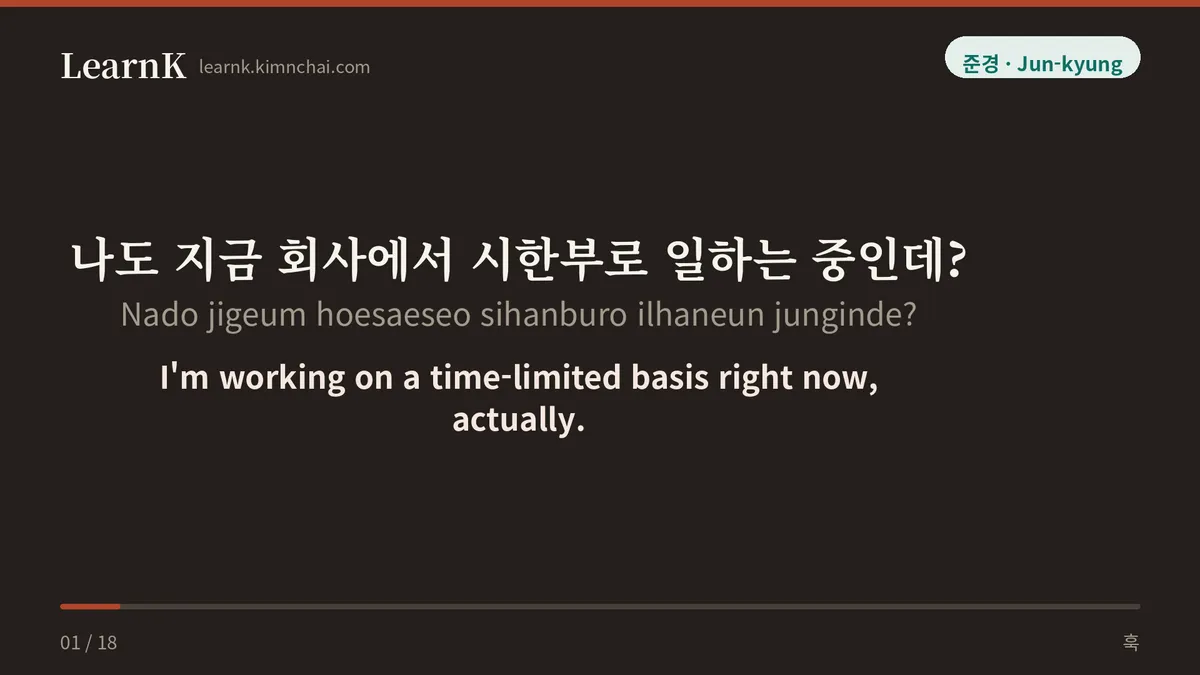
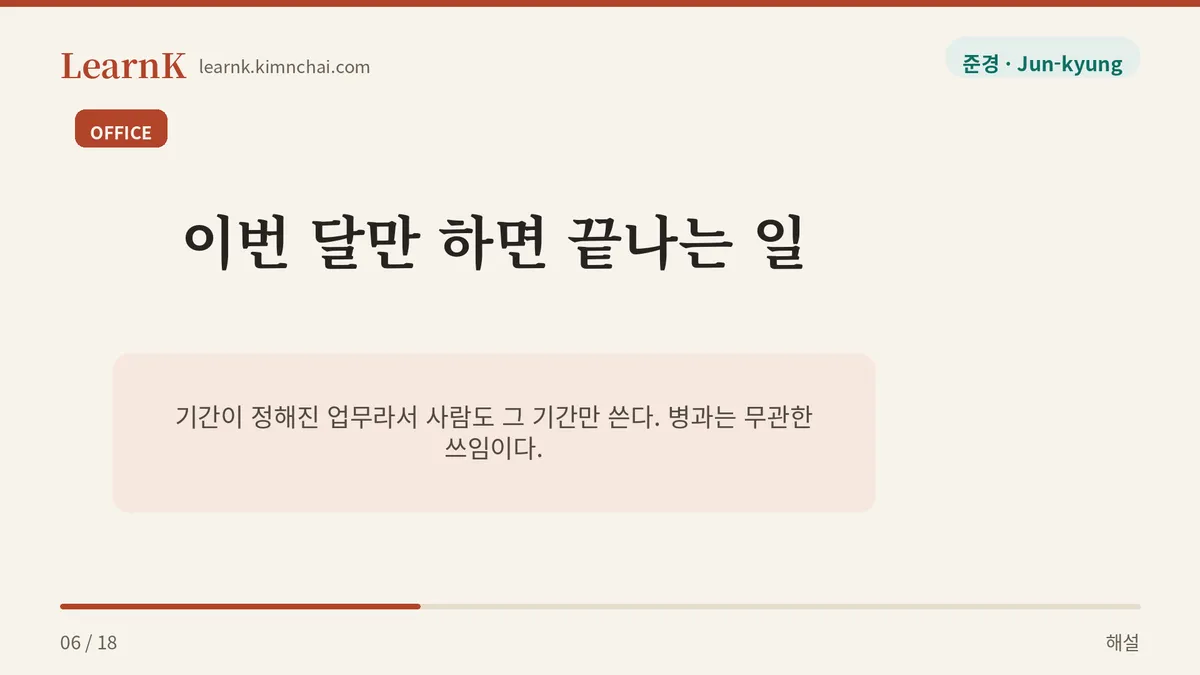
우리 회사에서는 이번 달만 하면 끝나는 일이 있어서 사람을 시한부로 쓰게 되었다. (Uri hoesaeseoneun ibeon dalman hamyeon kkeunnaneun iri isseoseo sarameul sihanburo sseuge doeeotda.) At our company there’s a job that wraps up at the end of this month, so we ended up hiring someone on a time-limited basis. — National Institute of Korean Language, Basic Korean Dictionary (krdict.korean.go.kr)
Here the mood flips completely. Illness has nothing to do with it. Because the work itself has a fixed span — “a job that’s done after this month” — the person is hired only for that span. It’s a purely businesslike sentence, and it’s the example that most shocks learners who learned 시한부 (sihanbu) from dramas alone.
김 대리가 병원에 입원하는 바람에 내가 잠깐 시한부로 그 일을 대신했다. (Gim daeriga byeongwone ibwonhaneun barame naega jamkkan sihanburo geu ireul daesinhaetda.) Assistant Manager Kim was hospitalized, so I covered that job on a temporary, time-limited basis for a while. — National Institute of Korean Language, Basic Korean Dictionary (krdict.korean.go.kr)
A hospital appears in this sentence, but the sick person is Assistant Manager Kim, and what is 시한부 (sihanbu) is the speaker’s stint filling in. It’s great practice for seeing exactly what the word attaches to.
시한부 환자. / 시한부로 일하다. / 시한부로 사용하다. (Sihanbu hwanja. / Sihanburo ilhada. / Sihanburo sayonghada.) A terminally ill patient. / To work on a time-limited basis. / To use for a limited time. — National Institute of Korean Language, Basic Korean Dictionary (krdict.korean.go.kr)
Three short usages the dictionary lists side by side. The first attaches to a person, the other two to work and to objects. That single line shows the full range of 시한부 (sihanbu) all by itself.
Seeing it in a real conversation
Setting: the living room at Emily’s place. The final episode of the drama they were watching together just ended, and tissues are scattered across the couch.
Jun-kyung: 야, 너 진짜 우는 거야? 3화에서 병원 가는 장면 나올 때 다들 눈치챘잖아. Hey, are you actually crying? Everyone figured it out back in episode 3 at the hospital scene.
Emily: 알아도 슬픈 건 슬픈 거야. 근데 한국 드라마는 왜 맨날 시한부야? Even if you know, sad is still sad. But why is it always a terminal diagnosis in Korean dramas?
Jun-kyung: 시간이 딱 정해져야 사람들이 급해지니까. 밥 한 끼도 마지막처럼 보이잖아. Because once the time is fixed, everyone gets urgent. Even a single meal starts to look like the last one.
Emily: 하긴… 근데 그 단어 좀 무섭다. 나 그거 병 얘기할 때만 쓰는 줄 알았어. True… But that word is kind of scary. I thought you only used it about illness.
Jun-kyung: 아니야. 나도 지금 회사에서 시한부로 일하는 중인데? Nope. I’m working on a time-limited basis at my company right now, actually.
Emily: 뭐어?! …아, 계약직. 놀랐잖아 진짜. Whaaat?! …Oh, a fixed-term contract. You seriously scared me.
These uses sound off
✗ (directly to a senior colleague who is battling illness) 선배님, 시한부시라면서요? 얼마나 남으셨어요? (Seonbaenim, sihanbusiramyeonseoyo? Eolmana nameusyeosseoyo?) ✓ (directly to a senior colleague who is battling illness) 선배님, 소식 들었어요. 제가 도울 일 있으면 꼭 말씀해 주세요. (Seonbaenim, sosik deureosseoyo. Jega doul il isseumyeon kkok malsseumhae juseyo.) → 시한부 (sihanbu) is a word that pins the remaining time down to a number, so bringing it up in front of the person concerned turns your sentence into a blunt “how many days do you have left?” The word is normally used in the third person, to pass along someone’s situation — not as a greeting to their face.
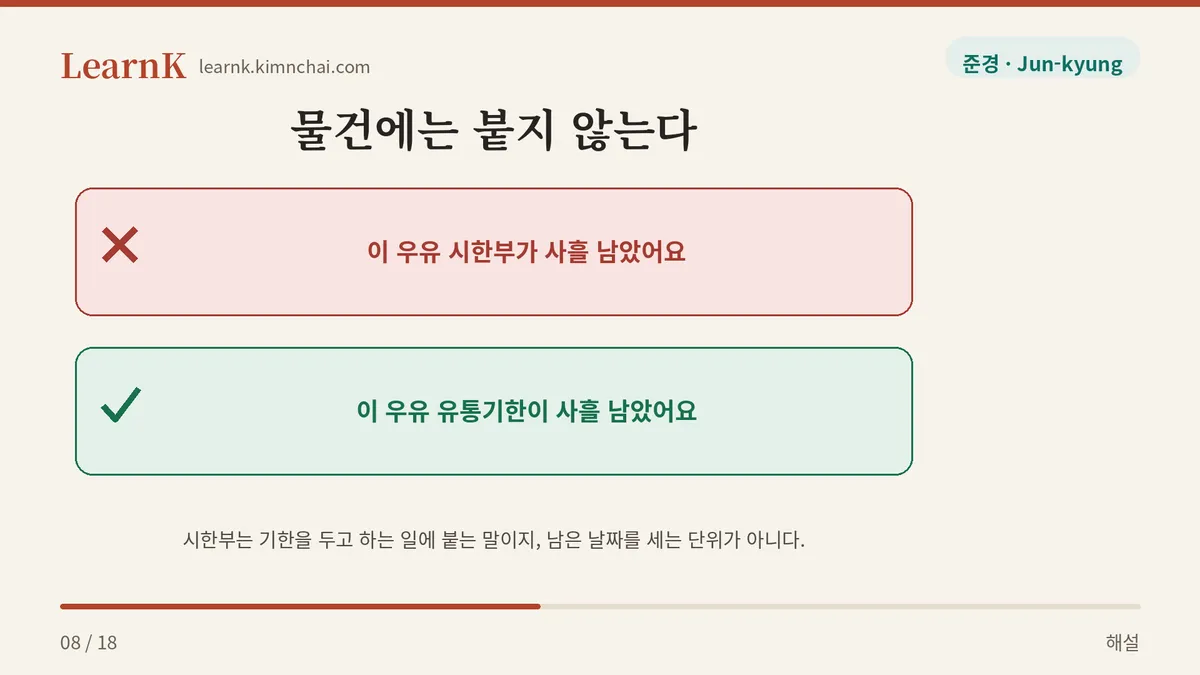
✗ 이 우유 시한부가 사흘 남았어요. (I uyu sihanbuga saheul namasseoyo.) ✓ 이 우유 유통기한이 사흘 남았어요. (I uyu yutonggihani saheul namasseoyo.) — This milk has three days left before its expiration date. → The date stamped on a product is 유통기한 (yutonggihan, sell-by date) or 소비기한 (sobigihan, use-by date). 시한부 (sihanbu) attaches to “something done within a set period”; it is not a unit for counting down remaining days. Because the Chinese character 기한 (gihan, time limit) seems to overlap, this is the pair learners mix up most often.
Example sentences by situation
1. In a part-time job interview — gently signaling that the position isn’t permanent
이 자리는 시한부예요. 축제 기간 2주만 운영하는 부스라, 끝나면 자리 자체가 없어집니다. (I jarineun sihanbuyeyo. Chukje gigan i-ju-man unyeonghaneun buseura, kkeunnamyeon jari jachega eopseojimnida.) This position is time-limited. It’s a booth that only runs for the two weeks of the festival, so once it’s over, the job itself disappears.
Use it in job postings or interviews to state that a position has a fixed term. The tone is neither heavy nor light — just factual.
2. In a news caption — a strike with a fixed end time
노조는 오늘 오전 9시부터 네 시간 동안 시한부 파업에 들어갔다. (Nojoneun oneul ojeon ahop-si-buteo ne sigan dongan sihanbu paeobe deureogatda.) The union began a four-hour time-limited strike today starting at 9 a.m.
시한부 파업 (sihanbu paeop) is a pairing you’ll see constantly in the media. Set against 무기한 파업 (mugihan paeop, an indefinite strike), it means “we’re doing this for a few hours today and then stopping.” In this slot, 시한부 (sihanbu) carries no emotion at all.
3. As a metaphor for a relationship — one that started knowing the end date
우리, 처음부터 시한부였잖아. 네가 반년 뒤에 돌아가는 거 알고 시작했어. (Uri, cheoeumbuteo sihanbuyeotjana. Nega bannyeon dwie doraganeun geo algo sijakaesseo.) We were on a clock from the start, weren’t we. I began this knowing you’d be going back in six months.
It also applies to relationships whose parting date is already set — study abroad, an overseas posting, a temporary assignment. The reason it sounds like a line from a drama is that dramas have, in fact, worked this usage hard.
Formal and casual speech, plus similar expressions
시한부 (sihanbu) is a noun, so it carries no honorific level of its own. Politeness is decided by the predicate at the end of the sentence.
- Polite: 아버지가 시한부 선고를 받으셨어요. (Abeojiga sihanbu seongoreul badeusyeosseoyo.) — My father was given a terminal diagnosis. (the subject honorific ‘-시- (-si-)’ is added)
- Casual: 걔네 아버지 시한부래. (Gyaene abeoji sihanburae.) — I heard his dad is terminally ill. (‘-래/-대 (-rae/-dae)’ marks it as something you heard secondhand)
When talking about someone else’s illness, Korean tends to take a step back using reportive endings like ‘-대/-래 (-dae/-rae)’. Stating it flatly can come across as passing judgment on another person’s private situation.
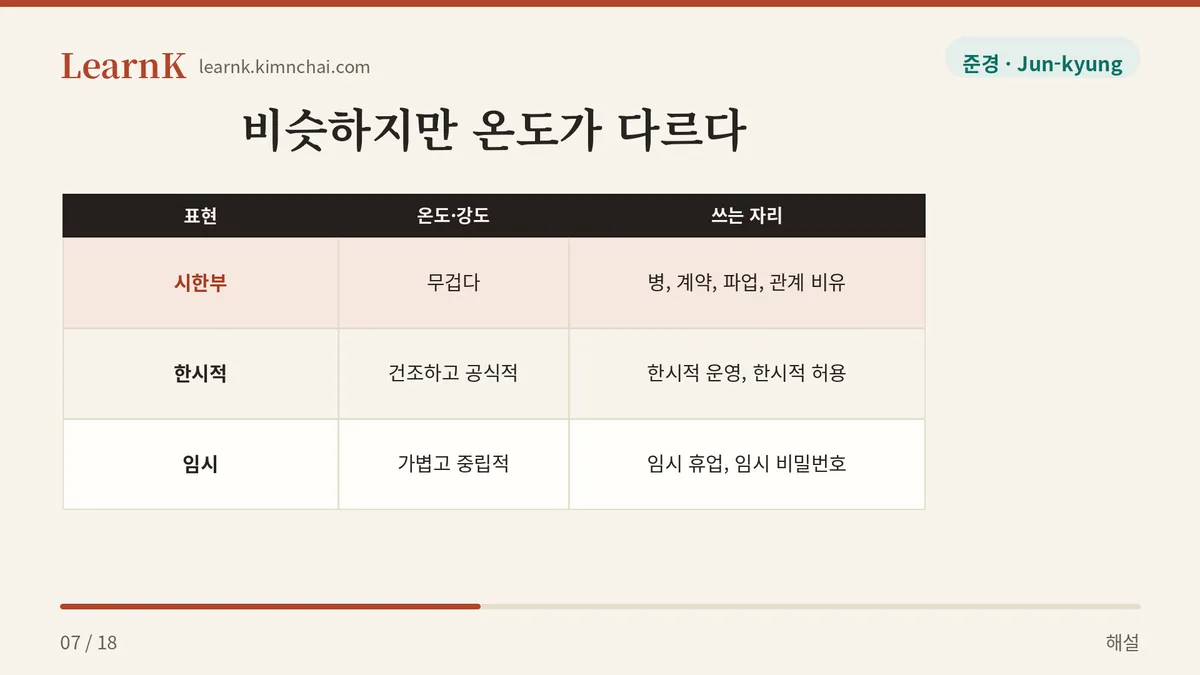
| Expression | Tone & weight | Where it’s used |
|---|---|---|
| 시한부 (sihanbu) | Heavy. The sense that the end date is nailed down | Illness, contracts, strikes, relationship metaphors. A drama regular |
| 한시적 (hansijeok) | Dry and official | News, official notices. 한시적 운영 (hansijeok unyeong, limited-time operation), 한시적 허용 (hansijeok heoyong, temporary permission) |
| 임시 (imsi) | Light and neutral | Everyday use across the board. 임시 휴업 (imsi hyueop, temporary closure), 임시 비밀번호 (imsi bimilbeonho, temporary password) |
| 조건부 (jogeonbu) | Neutral. Attaches a ‘condition’ rather than time | Contracts, agreements. 조건부 승인 (jogeonbu seungin, conditional approval) |
For the very same situation, 한시적으로 운영합니다 (hansijeogeuro unyeonghamnida) reads like a public notice, while 시한부로 운영합니다 (sihanburo unyeonghamnida) sounds oddly grave. Remember it this way and you’ll be right nearly every time: 한시적 (hansijeok) for official announcements, 시한부 (sihanbu) where people and their stories are at stake.
Cultural background — stories with a fixed ending
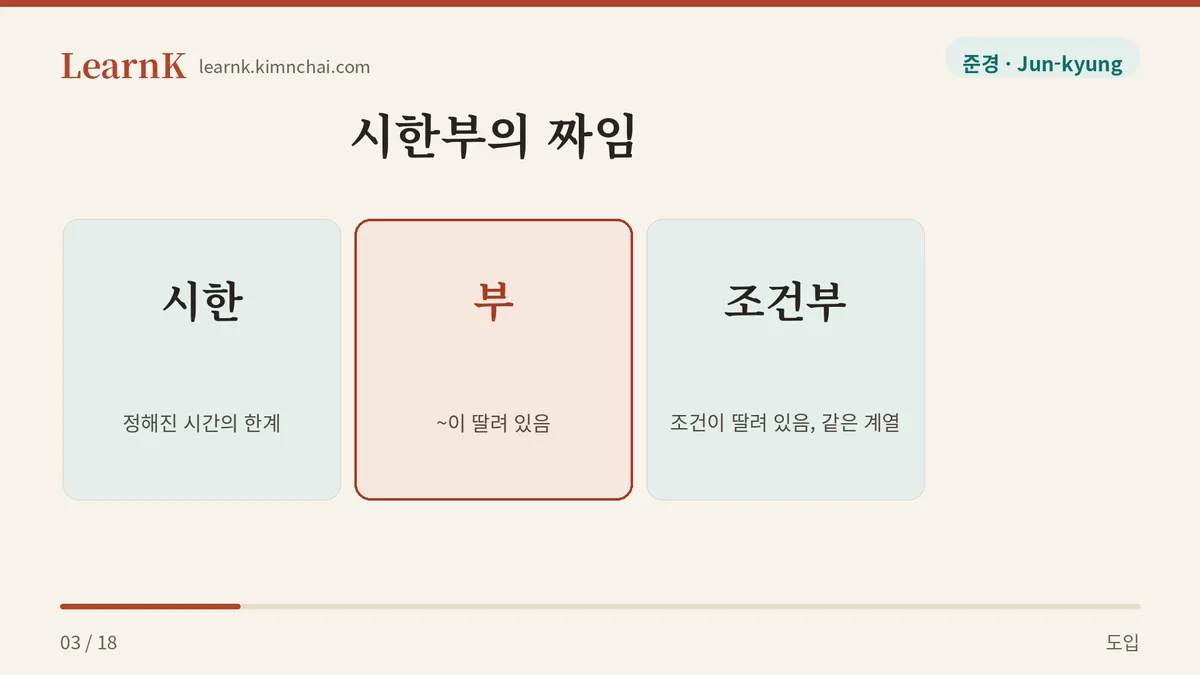
시한부 (sihanbu) combines the Sino-Korean word 시한 (時限, sihan) with the character 부 (附), “attached.” 시한 (sihan) is a set limit of time, and 부 (bu) means “comes attached with.” So literally it’s a businesslike “with a time limit attached.” Several words share this build — attach a condition and you get 조건부 (條件附, jogeonbu); attach a deadline and you get 기한부 (期限附, gihanbu). Learn this family and you can roughly decode any ‘-부 (-bu)’ word you meet for the first time.
The reason this dry little word sounds so heavy in Korea comes down to dramas. The melodramas of the 1990s and 2000s built their stories on the 시한부 (sihanbu) premise. As widely beloved works like 《가을동화》 (Gaeul Donghwa, Autumn in My Heart, KBS2, 2000) repeated the device, 시한부 (sihanbu) stopped being merely a word and became something like a genre marker.
Why writers can’t let the device go is obvious. The moment the remaining time is fixed, every ordinary scene becomes a final scene. A meal shared together, a goodbye at the bus stop, a night walk with nothing said — once 시한부 (sihanbu) is hanging over them, all of it takes on meaning.
That said, Korean viewers today regard the setup as a cliché. So recent productions openly subvert it or bring it up as a joke, and viewers respond with “또 시한부야? (Tto sihanbuya? — Another terminal illness plot?)” As a learner, it’s worth knowing this difference in temperature too: the word gets used both in earnest and as self-deprecating humor. Just remember that the latter is only permitted when no one who is actually ill is nearby.
Today’s quiz
Jun-kyung said this:
나 이번 달까지만 시한부로 일해. (Na ibeon dalkkajiman sihanburo ilhae.)
Which is the correct meaning?
- Jun-kyung has a serious illness and doesn’t have much time left
- Jun-kyung’s work period is set to end this month
- Jun-kyung has been working a lot of overtime lately
Answer: 2. 시한부로 일하다 (sihanburo ilhada) is a usage listed in the dictionary itself, and it means working for a set period. For the illness meaning, the word has to attach directly to a person, as in 시한부 선고를 받다 (sihanbu seongoreul batda) or 시한부 인생 (sihanbu insaeng). Get in the habit of looking at what comes after 시한부 (sihanbu) — that one habit alone will keep this word from confusing you.
Definitions and example sentences are from the National Institute of Korean Language’s Basic Korean Dictionary (krdict.korean.go.kr); that portion of this post, including our translations, is licensed under CC BY-SA 2.0 KR.