속상하다 (soksanghada) — Not Anger, but the Word for When Your Heart Stings
속상하다 (soksanghada) means that something hasn’t gone the way you hoped, leaving you unsettled and aching inside. When the hair you spent two months growing out gets ruined at the salon, when the file you stayed up all night making fails to save, when the plant you tended so carefully has dried up and died while you were away on a trip — this is a word Koreans reach for several times a day.
The point where Korean learners most often stop is the question, “So does that mean you’re angry?” No, it doesn’t. 속상하다 has no outward push to it. Anger is a feeling that travels toward someone else, while 속상하다 is a feeling that settles inward. That’s why a person who is 속상해 doesn’t raise their voice. Instead they sigh, they go quiet, and in the evening they call a friend and say 나 오늘 좀 속상한 일 있었어 (na oneul jom soksanghan il isseosseo) — “Something upsetting happened to me today.”
For this word to fit, three things usually have to be in place. First, there was an expectation. Second, that expectation was missed. Third, the miss left a mark on your heart. If even one of the three is missing, a different word takes its seat. If there was no expectation to begin with, it’s just 별로다 (byeollo-da) — “not great.” If the miss leaves no mark behind, 아쉽다 (aswipda) is enough.
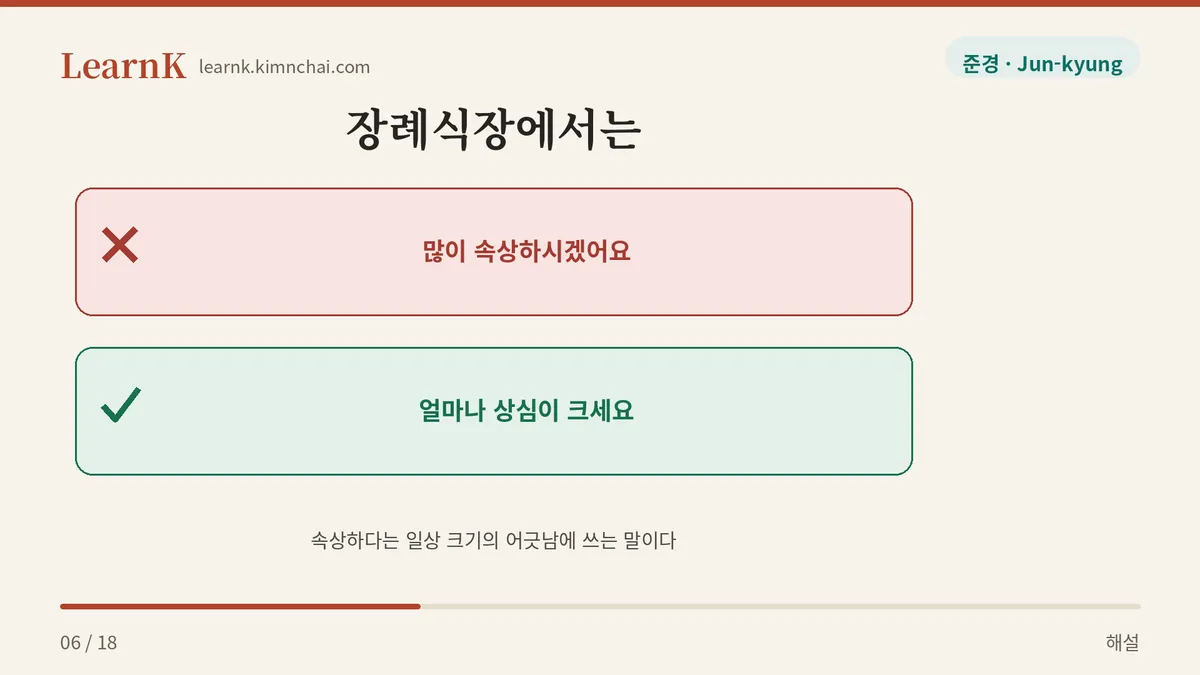
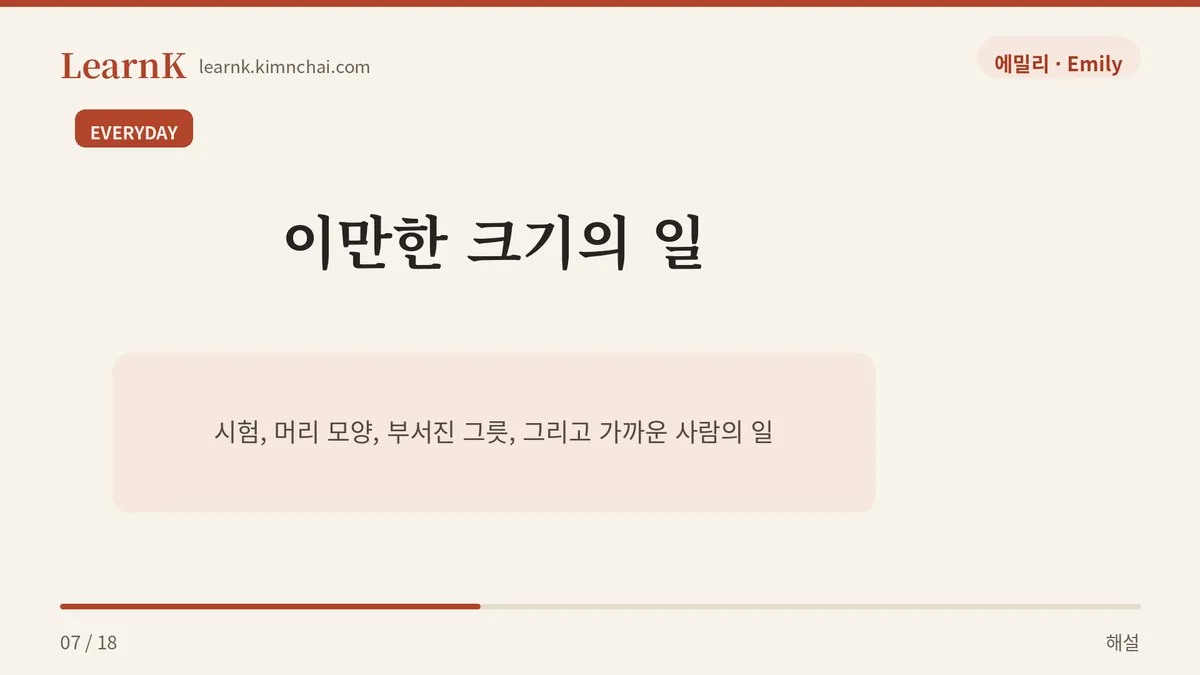
Size matters too. What 속상하다 carries is everyday-sized disappointment. An exam, a haircut, a job interview, a broken dish, your child’s grades, a thoughtless remark from a friend. In the face of something enormous like death or disaster, on the other hand, this word actually sounds too light. That seat belongs to 상심이 크시겠어요 (sangsimi keusigesseoyo) or 마음이 많이 아프시겠어요 (maeumi mani apeusigesseoyo).
Finally, 속상하다 isn’t a word reserved for your own affairs. When things don’t work out for someone close to you, you become 속상해 on their behalf. That’s exactly why you hear this word so often in Korean — other people’s troubles turn your own insides sore.
Checking It in the National Institute of Korean Language Dictionary
The National Institute of Korean Language’s Basic Korean Dictionary lists this word as an adjective and defines it as follows.
속상하다 [adjective] 일이 뜻대로 되지 않아 마음이 편하지 않고 괴롭다. Feeling uneasy and distressed because things do not go the way one wants. — National Institute of Korean Language, Basic Korean Dictionary (krdict.korean.go.kr)
The multilingual equivalents given in the same dictionary are below.
[en] upset — Feeling discomfort and anguish because things do not go one’s way. [ja] くやしい【悔しい】。つらい【辛い】 — 物事が思い通りにいかなくて、もどかしくて苦しい。 [es] molesto, descontento, angustiado — Que causa molestia y angustia por no salir las cosas como lo esperado. [zh] 伤心,难过 — 因为事与愿违,心里不舒服、很痛苦。 — National Institute of Korean Language, Basic Korean Dictionary (krdict.korean.go.kr)
(No Portuguese equivalent is listed in that dictionary. For reference, chateado, magoado come close — but we should note that this is our own rendering, not a dictionary headword.)
The English gloss because things do not go one’s way and the Japanese 思い通りにいかなくて both point to the same thing: the root of this word is not sadness but things going astray. Below are actual usage examples from the same dictionary.
친구가 남편과 말다툼해 속상하다며 나에게 전화해 하소연을 했다. My friend called me to pour her heart out, saying she’d quarreled with her husband and was upset. — National Institute of Korean Language, Basic Korean Dictionary (krdict.korean.go.kr)
→ This example shows where an upset heart goes. If she had been angry, she would have aimed it at her husband — but because she was 속상해, she calls a friend. This word tends to travel alongside moments of confiding in a third person.
선배가 내 인사를 본체만체해서 속상하다. My senior ignored my greeting, and it left me upset. — National Institute of Korean Language, Basic Korean Dictionary (krdict.korean.go.kr)
→ The event itself is tiny. Someone simply didn’t return a greeting. And yet it lingers. It’s a good illustration of just how big — or rather, how small — the disappointments are that 속상하다 handles.
아아, 뜻대로 되는 일도 없고 정말 속상하다. Ugh, nothing is going my way and I’m really upset. — National Institute of Korean Language, Basic Korean Dictionary (krdict.korean.go.kr)
→ Here the cause can’t be pinned to any one thing. You say it like this when it isn’t a single event but several days’ worth of things going astray piling up. The interjection 아아 (aa) at the front feels perfectly natural too.
휴. 정말 속상하다. 어제 회사 면접을 보고 왔는데 면접관들의 반응이 너무 안 좋았어. Sigh. I’m really upset. I went to a job interview yesterday and the interviewers’ reactions were so bad. — National Institute of Korean Language, Basic Korean Dictionary (krdict.korean.go.kr)
→ First comes the sigh (휴 (hyu)), then the feeling, and only then the story. This is the classic order in which an upsetting story gets told in real Korean conversation.
Seeing It in a Real Conversation
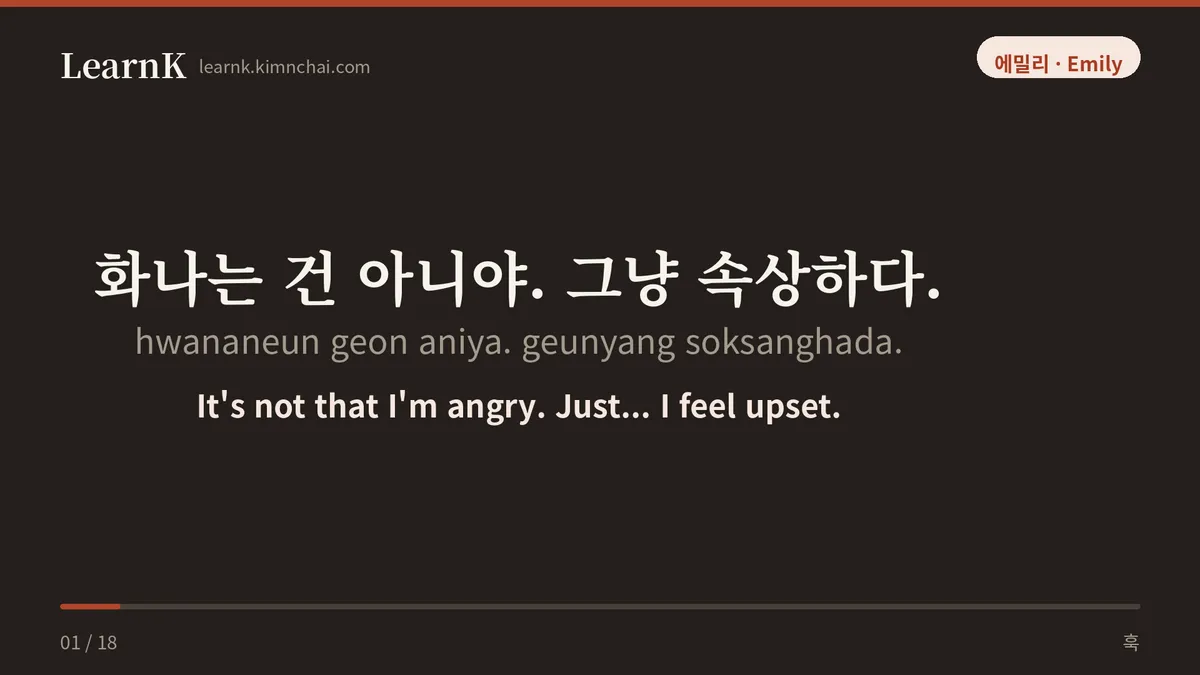
Setting: Saturday afternoon, the alley in front of a hair salon. Emily has just come out from getting her hair done, and Jun-kyung was waiting outside.
Jun-kyung: 어? 너 머리… 생각보다 훨씬 짧다? Huh? Your hair… it’s way shorter than I expected?
Emily: 사진까지 보여 드렸는데 이렇게 나왔어. 나 지금 진짜 속상해. I even showed them a photo and this is how it came out. I’m really upset right now.
Jun-kyung: 아, 그럴 만하지. 두 달을 기른 건데. Ah, no wonder. You’d been growing it out for two months.
Emily: 화나는 건 아니야. 그냥… 속상하다. 거울 볼 때마다 한숨 나와. It’s not that I’m angry. Just… I feel upset. I sigh every time I look in the mirror.
Jun-kyung: 야, 그래도 잘 어울려. 진짜로. Hey, it suits you though. Seriously.
Emily: 됐어, 위로 안 통해. 떡볶이 사 줘. Forget it, that’s not working. Buy me tteokbokki.
Take a close look at Emily’s second line: “화나는 건 아니야. 그냥 속상하다.” Koreans really do set these two side by side like this to tell them apart. Anger goes outward; 속상함 goes inward.
This Is Where It Sounds Off
✗ (At the funeral of a friend’s father) 많이 속상하시겠어요 (soksanghasigesseoyo). ✓ (At the funeral of a friend’s father) 얼마나 상심이 크세요 (sangsimi keuseyo). → 속상하다 is a vessel for everyday-sized disappointment. Used in the face of death, it sounds like you’re treating someone’s grief as something small. For a great loss, use 상심이 크시겠어요 (sangsimi keusigesseoyo) or 마음이 많이 아프시겠어요 (maeumi mani apeusigesseoyo).
✗ (To your boss in a meeting) 부장님, 그렇게 말씀하시니까 저 속상해요 (soksanghaeyo). ✓ (To your boss in a meeting) 제가 미처 챙기지 못했습니다. 다시 확인해 보겠습니다. → The grammar is perfectly fine. What’s off is the setting. 속상하다 is a word for showing your heart plainly among private, close relationships, so using it with a superior in a public setting suddenly turns a work conversation into an emotional appeal. This feeling is safer shared with a colleague after the meeting ends.
Example Sentences by Situation
1. The day you get back from a trip, out on the balcony You’ve just discovered that the plant you’d been watering for over a month has dried out.
일주일 다녀왔더니 화분이 다 말라 있어서 너무 속상했어요. (irjuil danyeowatdeoni hwabuni da malla isseoseo neomu soksanghaesseoyo.) I was away for a week, and the plant had completely dried out — I was so upset. → What matters here is that there’s no one to blame. The feeling left over when there’s no target for your anger is precisely 속상함.
2. The evening report cards come home, parent and child The child studied all night, but the score didn’t budge.
밤새 공부했는데 점수가 똑같아서 속상해. (bamsae gongbuhaenneunde jeomsuga ttokgataseo soksanghae.) I studied all night and my score was exactly the same, so I’m upset. → There was an expectation attached to the effort, and the result missed it. This is a textbook case where all three conditions we saw earlier are in place.
3. After hearing out a friend’s story, offering comfort This is how you receive someone else’s 속상함.
얘기 들어 보니까 많이 속상하셨겠어요. (yaegi deureo bonikka mani soksanghasyeotgesseoyo.) Hearing you tell it, you must have been really upset. → Attaching -시겠어요 (-sigesseoyo) turns it into a phrase that guesses at the other person’s feelings. It’s an extremely common shape in Korean comfort, so it’s worth memorizing whole.
Polite and Casual Forms, and Similar Expressions
Let’s start with the forms. Casual speech is 속상해 (soksanghae), general polite speech is 속상해요 (soksanghaeyo), and the formal style is 속상합니다 (soksanghamnida). That said, the formal style is rarely used in practice — it’s a word that holds private feeling, so dressing it in formal clothes just doesn’t suit it. When you’re reading someone else’s heart, use 속상하시겠어요 (soksanghasigesseoyo), and if it’s already in the past, 속상하셨겠어요 (soksanghasyeotgesseoyo).
Comparing it with words that look similar brings its territory into focus.
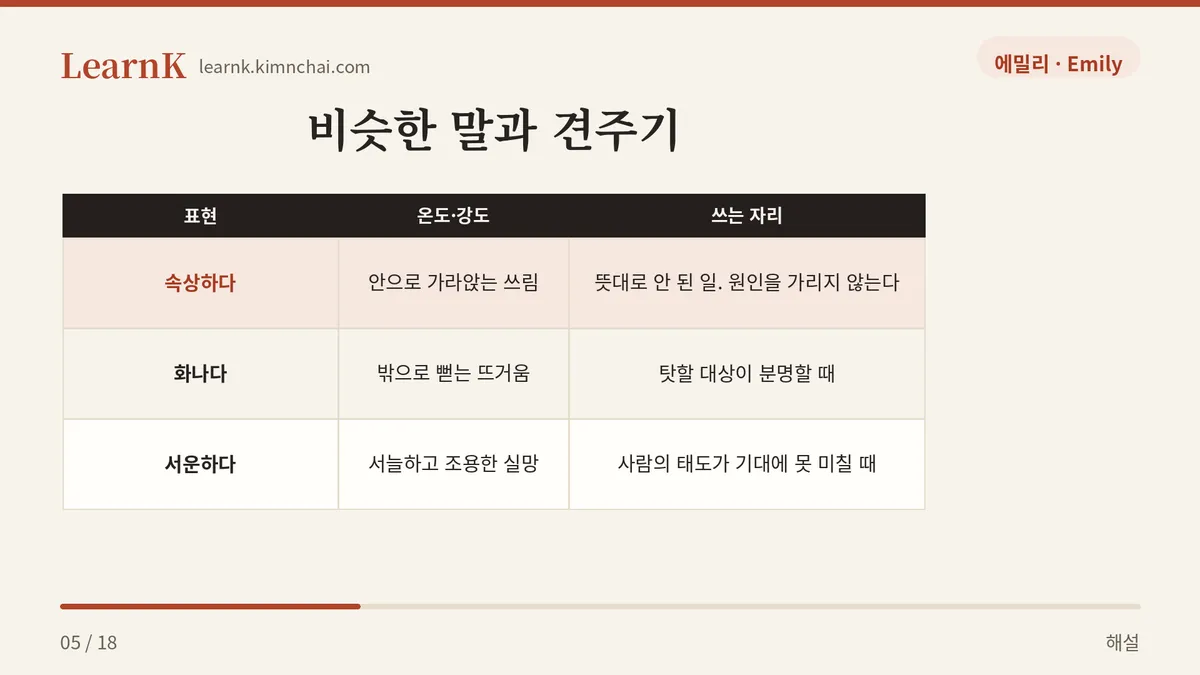
| Expression | Temperature / intensity | Where it’s used |
|---|---|---|
| 속상하다 (soksanghada) | A sting that settles inward, mixed with frustration | When things didn’t go as hoped — yours or a close person’s |
| 화나다 (hwanada) | Heat that pushes outward | When there’s a clear target to blame |
| 서운하다 (seounhada) | Cool, quiet disappointment | When someone’s attitude fell short of your expectations |
| 아쉽다 (aswipda) | Light and plain; leaves no mark on the heart | When a result falls a little short — usable in public settings too |
| 슬프다 (seulpeuda) | Deep and heavy | Loss, parting, tragedy |
The one that trips people up most is the difference from 서운하다. 서운하다 always has a person as its cause; you use it when someone didn’t do as much as you’d hoped. 속상하다, by contrast, doesn’t care whether the cause is a person, the weather, or a test score. In the dictionary example we saw earlier — 선배가 내 인사를 본체만체해서 속상하다 — you could swap in 서운하다 and it would still work. But standing in front of a dried-up plant, 서운하다 is simply not an option.
Cultural Background — A Country Where the Insides Go Bad
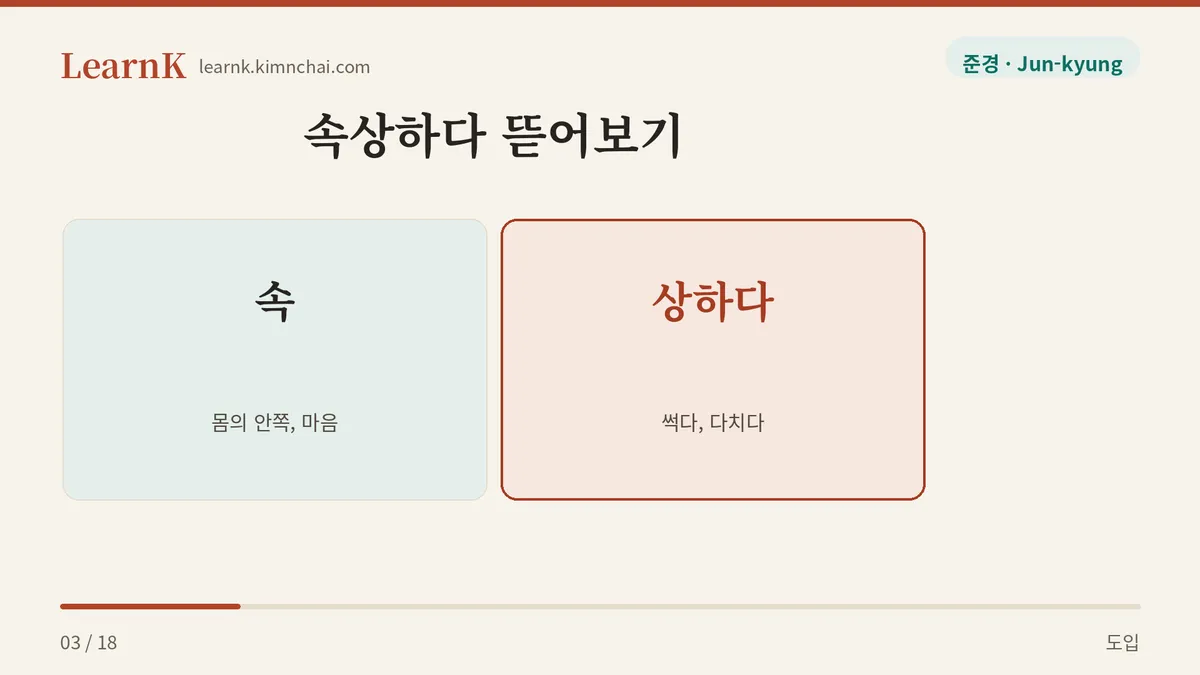
The way this word is built is transparent. 속 (sok) refers to the inside of the body, and by extension the heart; 상하다 (sanghada) describes food spoiling or a body getting injured. So 속상하다 literally says “the inside has gone bad.” It pictures emotion not in the heart but in the belly.
And this picture doesn’t stop with a single word. Korean has a whole run of expressions that use the 속 as their stage. When a frustrating situation drags on, 속이 타고 (sogi tago) — your insides burn. When you endure and endure until you reach your limit, 속이 터진다 (sogi teojinda) — your insides burst. Swallowing something you can’t say out loud and digesting it alone is called 속앓이 (sogari). Even the concept of 화병 (hwabyeong) — the idea that long-swallowed emotion eventually shows up as physical illness — grows from the same root. It’s a sense that emotion isn’t an abstract notion in the mind but an event taking place inside the body.
If you watch enough Korean dramas, you start to notice the particular seat this word occupies. A parent has been raising their voice at their child for a while; then, as the child turns to shut the door and leave, the parent catches them, drops their tone, and adds, “속상해서 그러는 거야” — “I’m only acting this way because I’m upset.” It means the shouting before was anger, and what remained afterward was 속상함. In Korean, this word is often placed where the far side of anger is revealed — which is to say, where reconciliation begins.
So if a Korean friend says “나 좀 속상해,” that’s less a complaint than an invitation. Rather than offering solutions, it’s better to receive it with “그랬겠다 (geuraetgetda)” — “that must have been rough” — or “많이 속상했겠다 (mani soksanghaetgetda)” — “you must have been so upset.” Just as Emily brushed off Jun-kyung’s compliment and demanded tteokbokki in the conversation above, 속상함 isn’t something to argue with — it’s something to sit through together.
Today’s Quiz
Which of the following is the most natural situation for using 속상하다?
① Your friend’s grandmother passed away and you went to the funeral. ② Lettuce you’d grown for a month was eaten up by bugs overnight. ③ A stranger on the street bumped hard into your shoulder and walked off without apologizing.
See the answer
Answer: ②
① The scale of grief overflows this word’s vessel. 상심이 크시겠어요 (sangsimi keusigesseoyo) is the right fit there. In ③, the person to blame is right in front of you and the feeling travels outward, so 기분 나쁘다 (gibun nappeuda) or 짜증 나다 (jjajeung nada) is closer. In ②, there was an expectation, things didn’t go as hoped, and there’s no one to be angry at — exactly the seat that 속상하다 fills.
Definitions and example sentences are from the National Institute of Korean Language’s Basic Korean Dictionary (krdict.korean.go.kr); that portion of this post, including our translations, is licensed under CC BY-SA 2.0 KR.