연락드리겠습니다 (yeollak-deurigetseumnida) — The One Line You Say When You're Holding the Answer
연락드리겠습니다
연락드리겠습니다 (yeollak-deurigetseumnida) is a promise — “I’ll be the one to reach out to you” — delivered in a register that lowers the speaker and raises the listener. In English it collapses into a single line, “I’ll be in touch,” but in Korean this sentence does two jobs at once: it closes the conversation and nails down whose turn comes next.
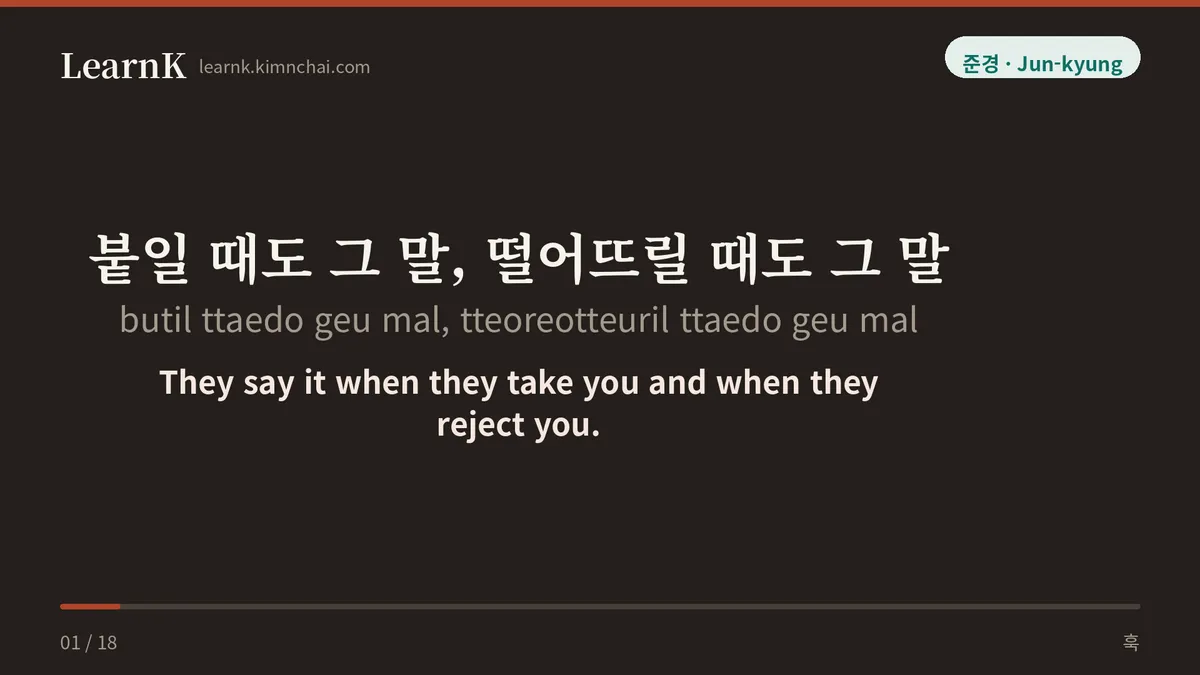
Think about where you actually hear it. Walking out the door of an interview room. At a bank counter. In a real estate office. At a hospital reception desk. The moment right after you’ve exchanged business cards for the first time. They all have something in common: there’s no answer yet, you are the one holding the answer, and the other person has to wait. Korean doesn’t paper over that awkward silence with a quick “later.” Instead you say 제가 연락드리겠습니다 (jega yeollak-deurigetseumnida), and the speech level itself carries an apology for making them wait. Which is why you should learn this expression by its temperature before you learn it by its meaning.
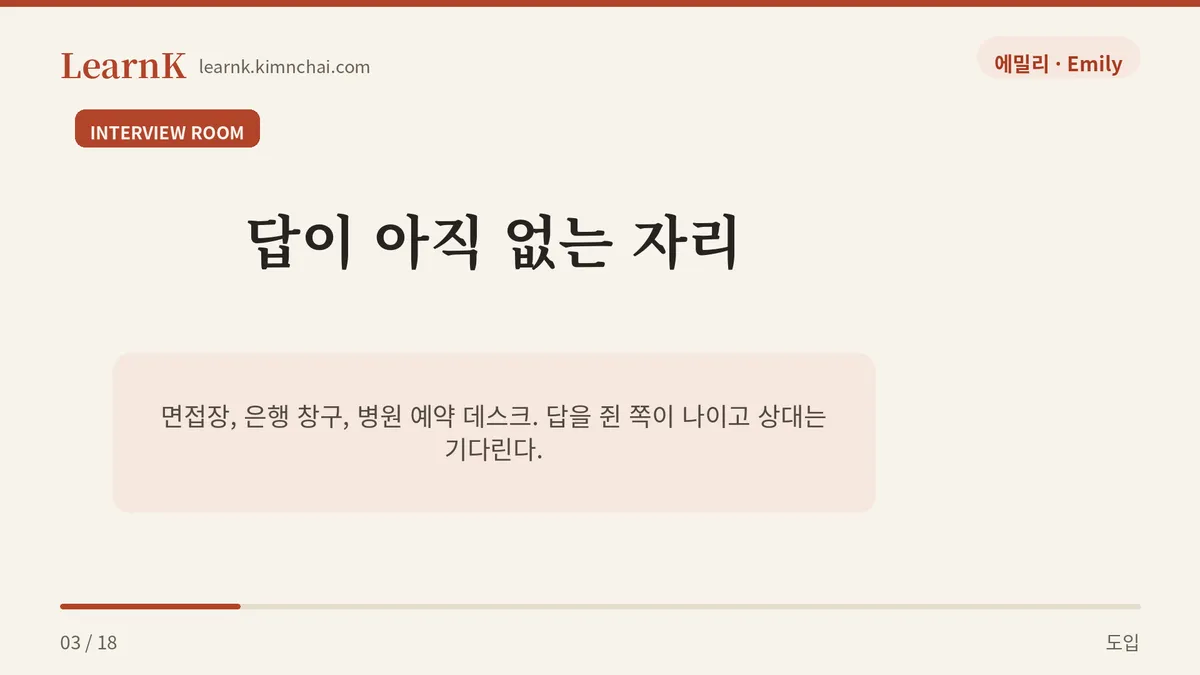
The sentence comes in four pieces. 연락 (yeollak) is the act of getting in touch; -드리다 (-deurida) marks that act as something done for someone you’re honoring; -겠- (-get-) is the speaker’s intention, “I will do this”; and -습니다 (-seumnida) is the most formal sentence ending Korean has. So in pure information content it’s identical to 연락하겠습니다 (yeollak-hagetseumnida). Both mean “I will contact you.” But they land on the ear quite differently. 연락하겠습니다 is closer to a notification; 연락드리겠습니다 is closer to a request wrapped in courtesy.
Here’s the part you absolutely must hold on to: direction. The person -드리다 elevates is not me, the speaker — it’s the person who will receive the contact. Lose track of that direction and you get exactly the mistakes in the next section.
A Real Conversation
Scene: Emily has just finished an interview and stepped outside the building. Jun-kyung is waiting at the bottom of the stairs.
준경: 어떻게 됐어? 표정이 왜 그래. How’d it go? Why the face?
에밀리: 몰라. 마지막에 “결과는 다음 주에 연락드리겠습니다” 이러고 끝났어. I don’t know. At the end they just said “we’ll be in touch with the result next week.”
준경: 야, 그거 원래 다 그렇게 말해. 붙일 때도 그 말, 떨어뜨릴 때도 그 말. Hey, everyone says that. They say it when they take you and when they reject you.
에밀리: 그러니까 무섭지. 나도 나오면서 “그럼 서류 정리해서 연락드리겠습니다” 했는데 목소리가 떨렸어. That’s exactly why it’s scary. On my way out I said “then I’ll get my documents together and be in touch,” and my voice shook.
준경: 잘했네. 그 한마디가 “저 아직 안 끝났습니다” 하는 거거든. Nice move. That one line is basically saying “I’m not done here yet.”
에밀리: 오, 그런 거였어? 난 그냥 인사인 줄 알았지. Oh, that’s what it does? I thought it was just a goodbye.
This Is Where It Sounds Off
✗ (to a friend) 나 지금 출발해. 도착하면 연락드리겠습니다 (yeollak-deurigetseumnida). ✓ (to a friend) 나 지금 출발해. 도착하면 연락할게 (yeollak-halge). → -드리다 is a word that raises the listener, so using it seriously with someone your own age suddenly feels like putting up a wall. Between friends it works only as a joking imitation of formality; say it sincerely and you’ll get a “why are you being weird with me?” in response.
✗ (handing over your own business card) 궁금한 점 있으시면 저에게 연락드리세요 (yeollak-deuriseyo). ✓ (handing over your own business card) 궁금한 점 있으시면 저에게 연락 주세요 (yeollak juseyo). → The direction of the honorific has flipped. -드리다 elevates whoever receives the contact — and in this sentence, that’s me. So you’ve ended up honoring yourself. That said, when the recipient is a third party who is your senior, it’s perfectly normal: 부장님께 연락드리세요 (bujangnimkke yeollak-deuriseyo) is not the least bit odd.
Example Sentences by Situation
Situation 1 — When you can’t answer on the spot at a service counter. A bank employee needs to verify one more document. Saying “I’m not really sure” right there would chip away at trust, so instead you pin down both who will check and when.
확인해 보고 오늘 오후 안에 다시 연락드리겠습니다. (hwaginhae bogo oneul ohu ane dasi yeollak-deurigetseumnida.)
The moment 다시 (dasi, “again”) and a time frame get attached, a vague pleasantry turns into a commitment. In a Korean workplace, the weight of this expression is mostly decided by the time frame tacked onto the end of it.
Situation 2 — The last line of an email to your professor. The meeting date hasn’t been set yet, and setting it is on you.
일정이 조율되는 대로 바로 연락드리겠습니다. (iljeongi joyuldoeneun daero baro yeollak-deurigetseumnida.)
Korean emails love to close on exactly this note: “the next move is mine.” Making it so the other person doesn’t have to do anything more is considered good manners.
Situation 3 — A repair technician scheduled to visit. A one-line text the AC technician sends before heading out.
출발 10분 전에 미리 연락드리겠습니다. (chulbal sip-bun jeone miri yeollak-deurigetseumnida.)
In the service industry this sentence reads as a signal: “I respect your time.” Which is why this single text message sometimes matters more to the rating than the visit itself.
Related Expressions, Formal and Casual
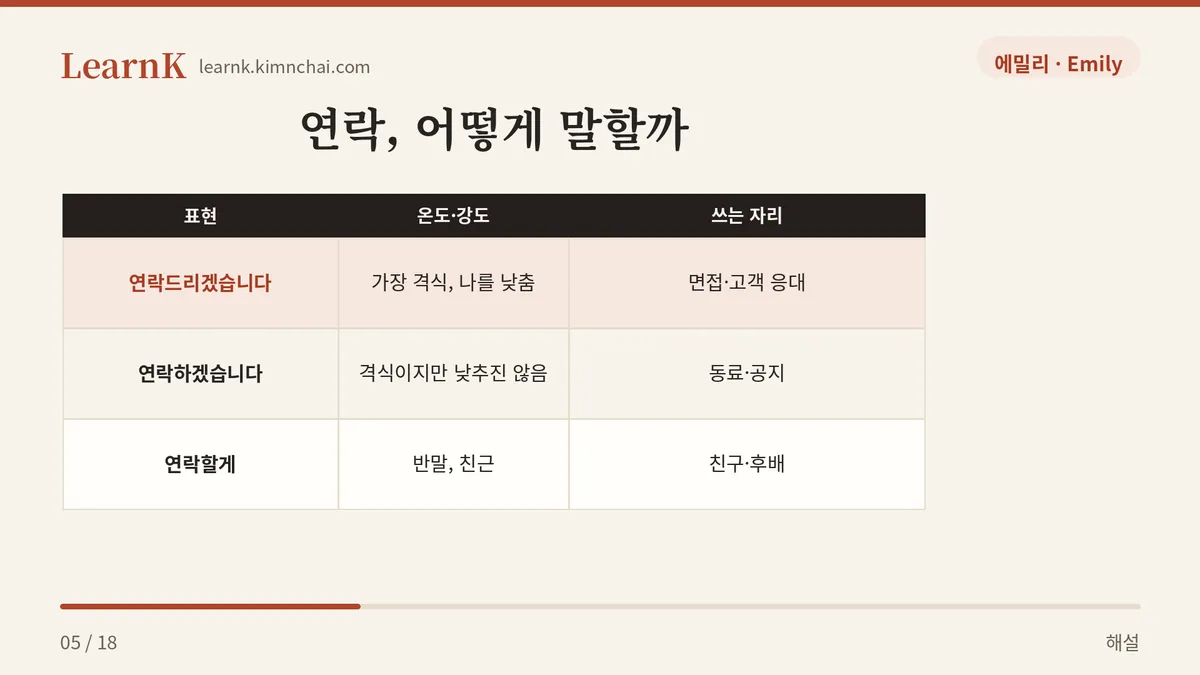
| Expression | Temperature & intensity | Where you use it |
|---|---|---|
| 연락드리겠습니다 (yeollak-deurigetseumnida) | Most formal; lowers the speaker | Interviews, customer service, meeting a senior for the first time |
| 연락드릴게요 (yeollak-deurilgeyo) | Same humility, far softer | A senior you know, a regular customer, a client you’ve grown comfortable with |
| 연락하겠습니다 (yeollak-hagetseumnida) | Formal, but doesn’t lower the speaker | Colleagues, announcements, situations where you’re informing |
| 연락할게 (yeollak-halge) | Casual speech, friendly | Friends, people younger than you |
| 연락 주세요 (yeollak juseyo) | Direction reversed — asking them | When you’re the one doing the waiting |
Formality steps down one notch at a time from top to bottom — and then, on the last row, the arrow flips entirely. The first four all mean “I’ll do it”; only the last one means “please, you do it.” Memorize this table as a block and you’ll never hesitate over which sentence to pick as you’re hanging up the phone.
Cultural Background — Who’s Holding the Ball
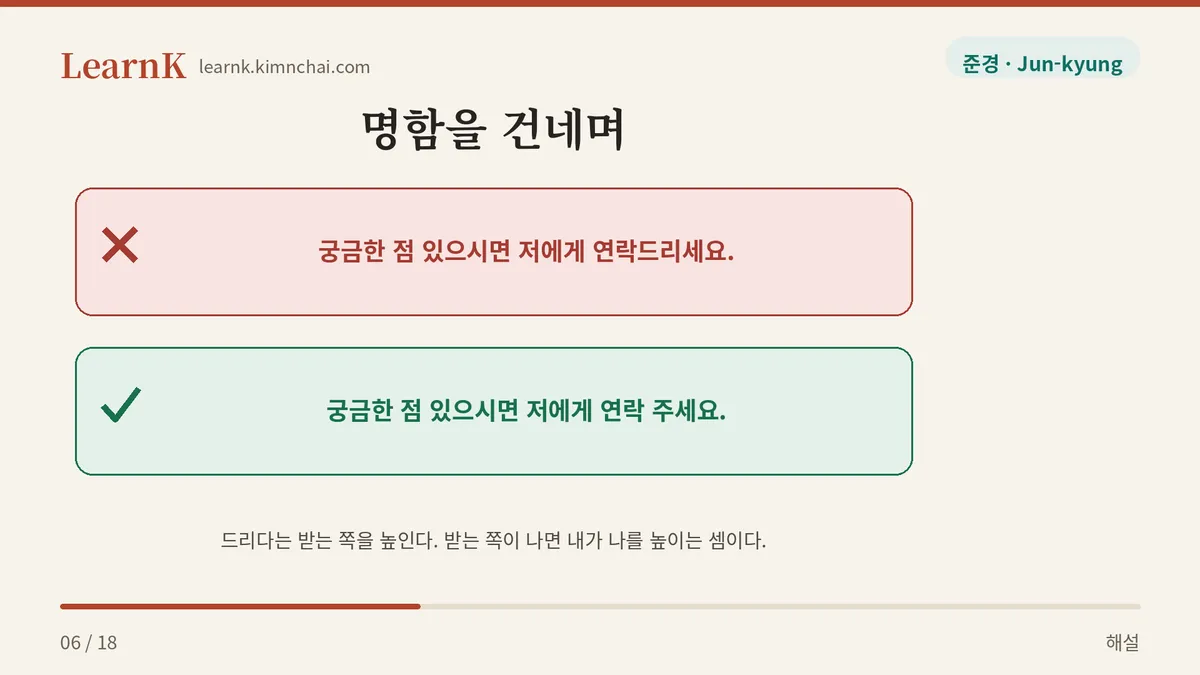
드리다 (deurida) is the humble form of 주다 (juda, “to give”). Korean’s way is to swap out the verb entirely when the recipient of an action is your senior, even if the action is the same: 말하다 becomes 말씀드리다 (malsseum-deurida), 돕다 becomes 도와드리다 (dowa-deurida), 알리다 becomes 알려드리다 (allyeo-deurida). 연락드리다 belongs to the same family. It’s obvious why this rule gives learners trouble — but on the flip side, master this one piece and an entire sentence turns polite in a single stroke.
The place where this expression rings heaviest in Korea is, unsurprisingly, the interview room. 결과는 추후 연락드리겠습니다 (gyeolgwaneun chuhu yeollak-deurigetseumnida) is effectively a set phrase, and both an offer and a rejection get announced with the very same sentence. So the moment you hear it, a wait of several days begins. That’s exactly why interview scenes in Korean dramas about job seekers always end on the same expression.
One more thing worth knowing: this expression is also a courtesy for parting. Korean conversations prefer to close by previewing the next contact rather than cutting off with a blunt “well, I’ll be going.” 연락드리겠습니다 isn’t a sentence that ends a relationship — it’s one that folds it up for a while. Which is why, in many cases, no one considers it rude if the contact never actually comes. This is the point that confuses learners most, but the test is surprisingly simple. If a time frame is attached, it’s a promise; if not, it’s closer to a farewell. With 내일 오전에 연락드리겠습니다 (naeil ojeone yeollak-deurigetseumnida) you can go ahead and wait. With a bare 연락드리겠습니다, wait — but go do something else in the meantime.
Today’s Quiz
Which of the following four sentences sounds off?
- (to an interviewer) 서류 준비되면 바로 연락드리겠습니다.
- (to a friend) 나 도착하면 연락드리겠습니다.
- (to a customer) 확인 후 30분 안에 연락드리겠습니다.
- (to your professor) 초안 정리해서 내일 연락드리겠습니다.
Answer: number 2. -드리다 elevates the person who will receive the contact, and a friend isn’t someone you elevate. Here, 도착하면 연락할게 (dochakhamyeon yeollak-halge) is the natural choice. In the other three, the listener is either your senior or a customer, so they’re fine exactly as written.
The definitions, example sentences, and dialogue in this post are original work written without quoting any dictionary (the featured expression is not listed as a headword in the National Institute of Korean Language’s Basic Korean Dictionary).