복날 (boknal) — Three Days a Year, When Koreans Eat the Hottest Thing on the Hottest Day
When mid-July comes around, a line forms outside Korea’s 삼계탕 (samgyetang) restaurants every lunch hour — long enough to curl around the corner of the alley. People walk right past the air-conditioned cafés and stand for a solid thirty minutes just to sit down in front of a stone pot with steam pouring off the broth. The reason for that line is today’s expression. 복날 (boknal) means the days that fall on 초복 (chobok), 중복 (jungbok), and 말복 (malbok) — the hottest stretch of summer.
It’s written 복날, but it’s pronounced [봉날] (bongnal). The final ㄱ meets the ㄴ that follows it and turns into ㅇ — that’s 비음화 (bieumhwa), nasalization. The National Institute of Korean Language’s dictionary lists the English headword as bongnal for exactly this reason, so don’t panic if a search for boknal comes up empty.
The important thing is that 복날 is not a general word for “a hot day.” It’s three specific days a year, marked on the calendar in advance. The first is 초복 (chobok), about ten days later comes 중복 (jungbok), and another ten or twenty days after that is 말복 (malbok) — and the three together are called 삼복 (sambok). So when you tell a Korean 오늘 복날이야 (It’s boknal today), you’re not talking about the weather. You’re talking about the calendar, and at the same time about dinner.
It helps to know the temperature of the word, too. 복날 is not a holiday. Nobody gets the day off, nobody exchanges gifts, and there’s nothing to congratulate anyone for. What it carries instead is a sense of looking after people. The word 몸보신 (momboshin) — restoring a body worn down by the heat with something hot — follows it everywhere, which is why the greetings that go around on 복날 lean toward checking in rather than celebrating. It also attaches straight onto the front of a noun, like a modifier: 복날 음식 (boknal eumsik, boknal food), 복날 더위 (boknal deowi, boknal heat), 복날 특수 (boknal teuksu, the boknal sales boom).
Checking the Basic Korean Dictionary
First, here is how the national institute’s dictionary defines the word, exactly as written.
복날 「명사」 (noun) 여름 중 가장 더운 때인 초복, 중복, 말복이 되는 날. The days that fall on chobok, jungbok, and malbok — the hottest time of summer. [en] bongnal — The three hottest days of summer, which are called chobok, jungbok, and malbok, respectively. [ja] ふくじつ【伏日】 — 夏の最も暑いときの初伏、中伏、末伏の三伏の日。 [es] bongnal, canícula — Periodo estival en el que el calor es más intenso. Hay el chobok (primer día de canícula), el jungbok (día intermedio de canícula) y malbok (ultimo día de canícula). [zh] 伏天 — 指一年中最炎热的初伏、中伏、末伏时节。 — National Institute of Korean Language, Basic Korean Dictionary (krdict.korean.go.kr)
The Spanish definition is interesting for rendering 복날 as canícula. It shares a root with the English “dog days of summer,” both coming from Sirius, the Dog Star, which rises in the predawn sky at the height of summer. The etymology has nothing at all to do with the Korean 복 (伏), and yet the season the two words point to overlaps exactly.
The Portuguese definition isn’t carried in this dictionary, so the following is our own translation (not a dictionary quote): boknal — os três dias mais quentes do verão, chamados chobok, jungbok e malbok.
Here are four of the real usage examples the dictionary provides, quoted exactly as they appear.
오늘은 복날이라 개장국을 파는 식당이 손님들로 붐볐다. (oneureun boknarira gaejanggugeul paneun sikdangi sonnimdeullo bumbyeotda) — Since it was boknal today, the restaurants selling gaejangguk were packed with customers. 우리는 복날을 맞아 국물이 걸쭉한 삼계탕을 먹었다. (urineun boknareul maja gungmuri geoljjukan samgyetangeul meogeotda) — For boknal, we ate samgyetang with a thick, rich broth. 복날을 맞아 몸보신도 할 겸 동료들과 삼계탕을 먹으러 갔다. (boknareul maja momboshindo hal gyeom dongnyodeulgwa samgyetangeul meogeureo gatda) — For boknal, partly to build my strength back up, I went out for samgyetang with my coworkers. 할아버지는 옛날에 복날이면 몸보신을 하기 위해 보신탕을 한 사발 드셨다고 한다. (harabeojineun yennare boknarimyeon momboshineul hagi wihae boshintangeul han sabal deusyeotdago handa) — They say that back in the day, every boknal, my grandfather would have a bowl of boshintang to build up his strength. — National Institute of Korean Language, Basic Korean Dictionary (krdict.korean.go.kr)
In the first sentence, 복날이라 (boknarira) is a shortened form of 복날이라서 (boknariraseo), and it supplies the reason the restaurant was crowded. That one sentence contains the whole picture: the most typical scene of 복날 is a crowd outside a restaurant. Note, though, that the 개장국 (gaejangguk) in the sentence is an old 복날 dish that is almost never eaten today — more on that in the cultural background below.
The second and third sentences share the phrase 복날을 맞아 (boknareul maja), a set chunk that shows up often on exams. It means “to mark a particular day,” and you’ll see it especially in news articles and official notices. The 도 할 겸 in the third sentence means doing several things at once, so the sentence packs in three purposes at the same time: eating lunch, building up your strength, and spending time with coworkers. Piling into a samgyetang place with your colleagues is the most common face of 복날 today.
In the fourth sentence, 복날이면 (boknarimyeon) is the same as 복날마다 (boknalmada, every boknal), so it describes a habit repeated year after year, not a one-time event. It’s no accident that the subject is a grandfather and that 옛날에 (yennare, back in the day) is attached. This example shows the 복날 of a generation ago, not the 복날 of today.
The dictionary also lists the words this one commonly pairs with.
복날이 오다. / 복날이 되다. / 복날 음식. / 복날 더위. (boknari oda / boknari doeda / boknal eumsik / boknal deowi) — Boknal comes. / It’s boknal. / boknal food. / boknal heat. — National Institute of Korean Language, Basic Korean Dictionary (krdict.korean.go.kr)
The first two put 복날 in the subject position and mean that the day is approaching. The last two attach it directly in front of a noun with no particle at all. Memorize just these four and you can build most of the sentences 복날 appears in.
Seeing it in a real conversation
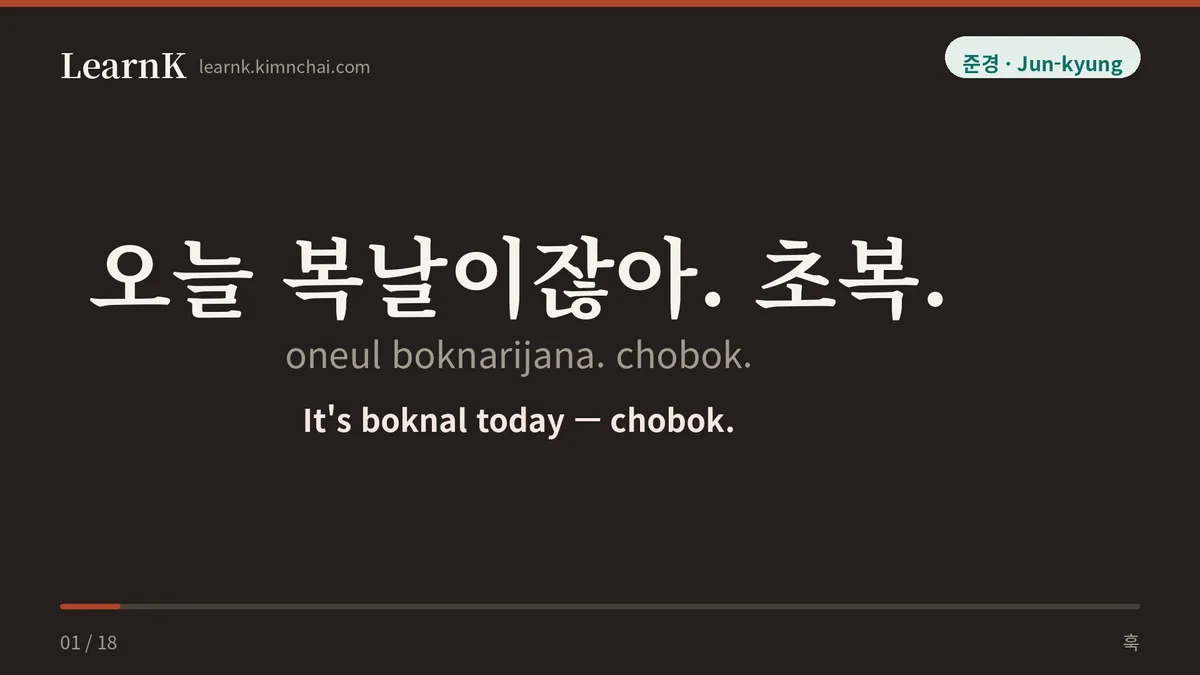
Scene: lunch hour on chobok. Outside the samgyetang place near the office, the line stretches all the way to the end of the alley.
Emily: 헐, 무슨 줄이 이렇게 길어? 여기 원래 이 정도는 아니잖아. Whoa, why is the line this long? It’s not usually like this.
Jun-kyung: 오늘 복날이잖아. 초복. 이 동네 사람들 다 나온 것 같은데. It’s boknal today — chobok. Looks like the whole neighborhood came out.
Emily: 아, 맞다. 근데 일 년 중 제일 더운 날에 굳이 뜨거운 걸 먹는 거, 난 아직도 적응이 안 돼. Oh right. But eating something piping hot on the hottest day of the year — I still can’t get used to it.
Jun-kyung: 이열치열이지. 땀 쫙 빼고 나면 오히려 개운해. 속을 데워야 여름을 난다니까. Fight heat with heat. Once you sweat it all out you actually feel refreshed. You warm up your insides to get through the summer.
Emily: 그래서 다들 복날마다 이러고 서 있는 거구나. 그럼 나도 오늘은 삼계탕. So that’s why everyone stands in line like this every boknal. Fine, samgyetang for me too today.
Jun-kyung: 잘 생각했어. 오늘은 내가 살게. 딱 30분만 버티자. Good call. I’ll buy today. Let’s just hold out 30 minutes.
This is where it sounds off
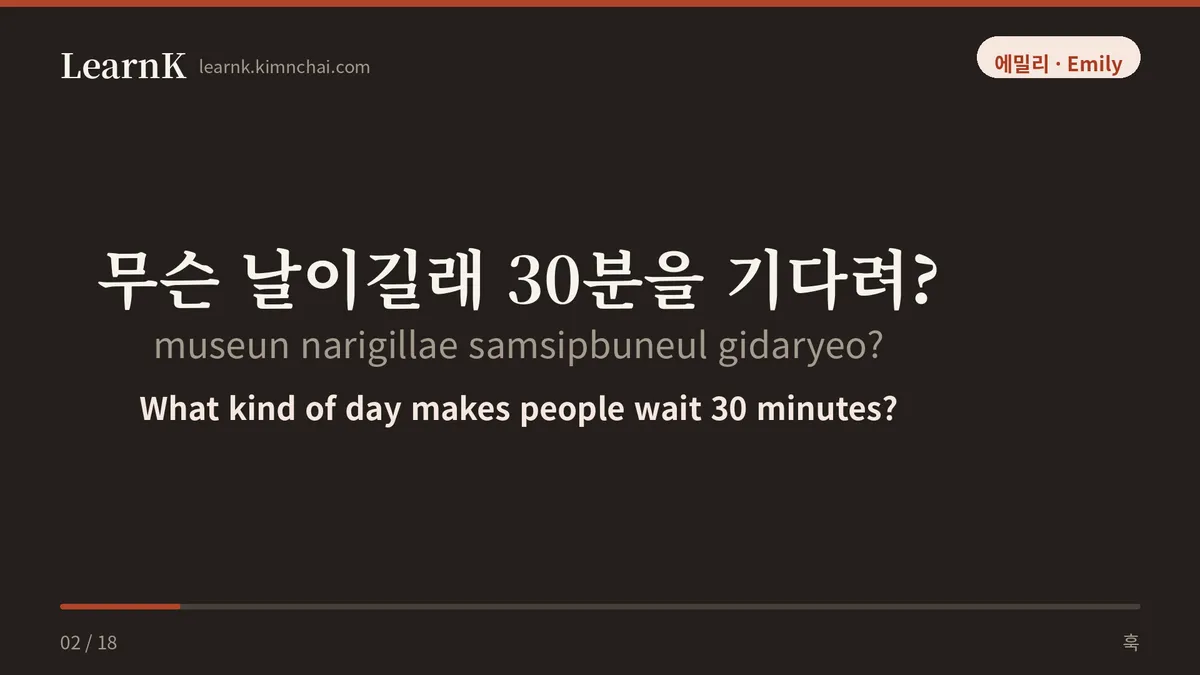
✗ (to your manager) 부장님, 복날 축하드립니다! — Congratulations on boknal, sir! ✓ (to your manager) 부장님, 오늘 복날인데 점심 뭐 드세요? — It’s boknal today — what are you having for lunch? → 복날 is neither a national holiday nor a commemorative day, so it isn’t something to congratulate anyone for. Attach a greeting to it the way you would to Christmas or Lunar New Year, and a Korean will laugh and ask, “그걸 왜 축하해?” (Why would you congratulate me for that?). Greetings on 복날 take the form of checking in and inviting, not celebrating.
✗ 오늘 진짜 덥다. 완전 복날이네. — It’s so hot today. Total boknal. ✓ 오늘 진짜 덥다. 복날도 아닌데 왜 이래. — It’s so hot today. It isn’t even boknal — what’s going on? → 복날 refers to three specific dates fixed on the calendar. Use it for any old hot day and the other person will say, “오늘이 초복이었어?” (Wait, was today chobok?) and go check the calendar. If you want to talk about the heat itself, 삼복더위 (sambokdeowi) is the right word.
Example sentences by situation
![복날은 [봉날]로 읽는다](/img/boknal-korean-dog-days-of-summer/s04.webp)
1. A notice the team lead posts in the company group chat
오늘 복날이라 점심은 팀 회식입니다. 12시에 로비에서 만나요. (oneul boknarira jeomsimeun tim hoesigimnida. yeoldu sie robieseo mannayo.) It’s boknal today, so lunch is a team outing. Let’s meet in the lobby at noon.
복날 is the day that gives a company the excuse for a department lunch. It’s not a day off, but it does tend to be a day when the company picks up the tab. The key to this sentence is that the two words 복날이라 make any further explanation unnecessary.
2. In front of a chicken stall at the market — a regular customer and the owner
복날 앞두고 닭값이 또 올랐네요. (boknal apdugo dakgapsi tto ollanneyo.) Chicken prices went up again with boknal coming.
복날 is a day that shows up in news stories about prices, too. Chickens for samgyetang, watermelons, and abalone all get more expensive around this time. 앞두고 (apdugo) means having something right around the corner, and it pairs especially well with words like 복날 that name a fixed date.
3. A mother calling her child who lives alone
복날인데 밥은 챙겨 먹었니? 혼자 있어도 삼계탕이라도 사 먹어. (boknarinde bapeun chaenggyeo meogeonni? honja isseodo samgyetangirado sa meogeo.) It’s boknal — did you eat properly? Even if you’re alone, at least buy yourself some samgyetang.
This is the kind of sentence that gets said most on 복날. In the end 복날 is a day for looking after other people, so the check-in calls that come on this day almost always contain some version of 먹었니? (Did you eat?).
Formal vs. casual, and the words next door
복날 is a noun, so the word itself has no formal-versus-casual split. What changes is how you end the sentence. With a friend, 오늘 복날이야; with someone older or senior, 오늘 복날이에요 or 오늘이 초복이라고 하더라고요. What actually trips learners up isn’t the politeness level — it’s the distance between the words that look like neighbors.
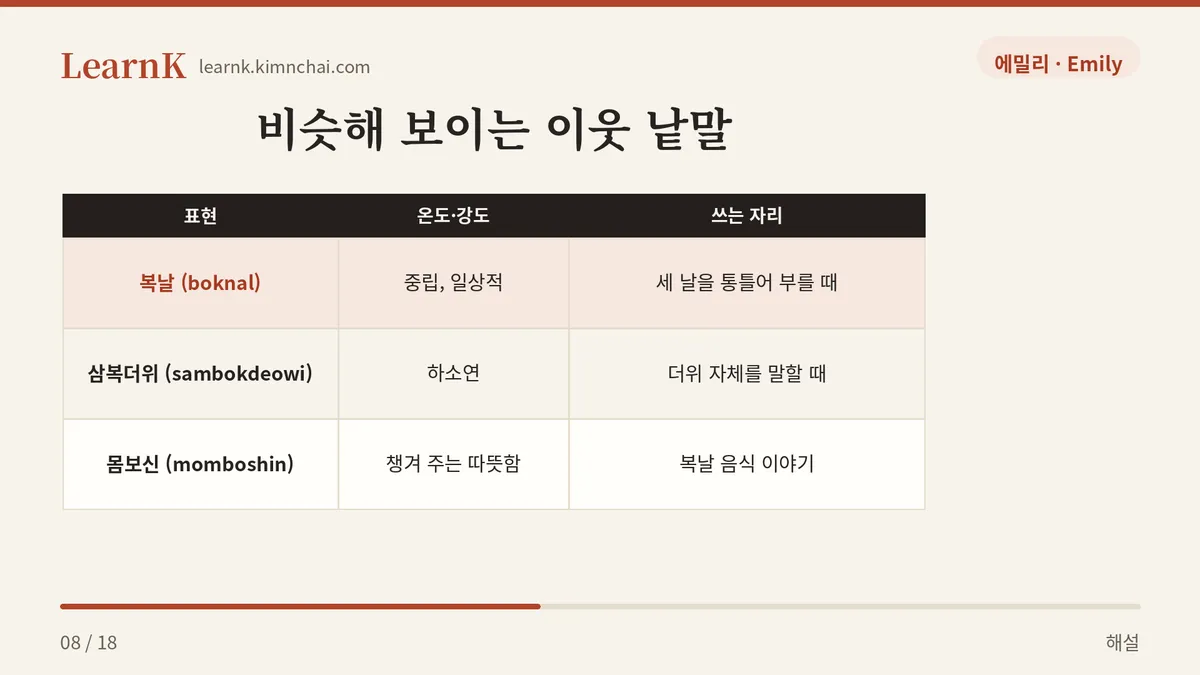
| Expression | Tone / intensity | Where it’s used |
|---|---|---|
| 복날 (boknal) | Neutral, everyday | Referring to the three days as a group. When you don’t need to pin down which one |
| 초복·중복·말복 (chobok, jungbok, malbok) | Specific, matter-of-fact | When you’re naming which boknal. Calendars, news, notices |
| 삼복더위 (sambokdeowi) | Emphasizes the heat itself; complaining | Weather talk. 삼복더위에 고생이 많으십니다 (You’re really toughing it out in this midsummer heat) |
| 몸보신 (momboshin) | The warmth of eating to take care of yourself | Talk about boknal food. Older people especially love this word |
| 보양식 (boyangsik) | Slightly formal | Menu names, restaurant signs, article headlines |
Put them all naturally into one sentence and you get this: 삼복더위에 지쳐서, 복날을 맞아 보양식으로 몸보신을 했다 (Worn out by the midsummer heat, I built my strength back up with a restorative dish for boknal).
Cultural background — the hanja 伏 “to lie low,” and fighting heat with heat
The 복 in 복날 is the hanja 伏, meaning “to lie prostrate.” The widely known explanation is that it marks the time when autumn’s cool energy is pressed flat beneath summer’s still-powerful heat. The dates are set by the old almanac rather than the solar calendar: 초복 is the third 경일 (庚日, gyeongil — a “geng day” in the sexagenary cycle) after the summer solstice, 중복 is the fourth, and 말복 is the first 경일 after 입추 (ipchu, the start of autumn). That’s why 복날 falls on slightly different dates each year, and why in some years the gap between 중복 and 말복 stretches to twenty days. Such a year is called 월복 (越伏, wolbok), and people say of it, “올해는 여름이 길겠다” (Summer’s going to be a long one this year).
As for why people eat the hottest thing on the hottest day, the answer that always comes attached is 이열치열 (iyeolchiyeol) — controlling heat with heat. The idea is that in summer your energy drains away with your sweat and your insides go cold, so you have to warm them back up with hot food. In practice, samgyetang dominates the 복날 table, with 육개장 (yukgaejang), 추어탕 (chueotang), 장어구이 (jangeogui), and 전복죽 (jeonbokjuk) also common. It’s a custom that’s still very much alive — convenience stores and delivery apps tally and publish their samgyetang sales for this day separately.
The 개장국 (gaejangguk) and 보신탕 (boshintang) in the dictionary examples above belong to the 복날 of a generation ago. They have all but vanished among younger Koreans, and in 2024 a law banning the practice was passed. The dictionary is a record of sentences as they were actually used, which is why the older usage survives there — and for a learner that’s actually useful. When an older character in a Korean drama says these words, it’s a device that tells you which generation the character belongs to, not a picture of what’s on the table today.
In dramas and variety shows, 복날 is usually used as a device for getting people into one room. A boss takes the staff out for samgyetang, a daughter-in-law boils a chicken in the courtyard of her in-laws’ house, family members who haven’t been in touch for ages sit down at one table for the day. A day that isn’t as heavy as a real holiday but still gives you a reason to call people together — that’s exactly where 복날 sits.
Today’s quiz
Which of the following uses 복날 most naturally?
① 오늘 진짜 덥다. 완전 복날이네. — It’s so hot today. Total boknal. ② 부장님, 복날 축하드립니다! — Congratulations on boknal, sir! ③ 복날이라고 회사 앞 삼계탕집에 줄이 어마어마해요. — Because it’s boknal, the line at the samgyetang place in front of the office is enormous. ④ 어제 비가 많이 와서 복날이 취소됐대. — I heard boknal got canceled because it rained a lot yesterday.
Answer: ③
① misuses 복날 to mean “a really hot day.” 복날 refers only to the three days fixed on the calendar, so 삼복더위 is the word here. ② mistakes 복날 for a holiday. It’s not a day for congratulations but a day for looking after each other, so you greet people by checking in or inviting them out. ④ mistakes 복날 for an event. It’s a date set by the traditional seasonal calendar, so it can’t be canceled or postponed because of the weather. ③ combines 이라고, which gives a reason, with the classic scene of 복날 — a line outside a samgyetang restaurant — making it a sentence you could hear word for word in a real conversation.
Definitions and example sentences are from the National Institute of Korean Language’s Basic Korean Dictionary (krdict.korean.go.kr); that portion of this post, including our translations, is licensed under CC BY-SA 2.0 KR.