본가 (bonga) — The Home That Only Exists Once You've Left It
본가 (bonga)
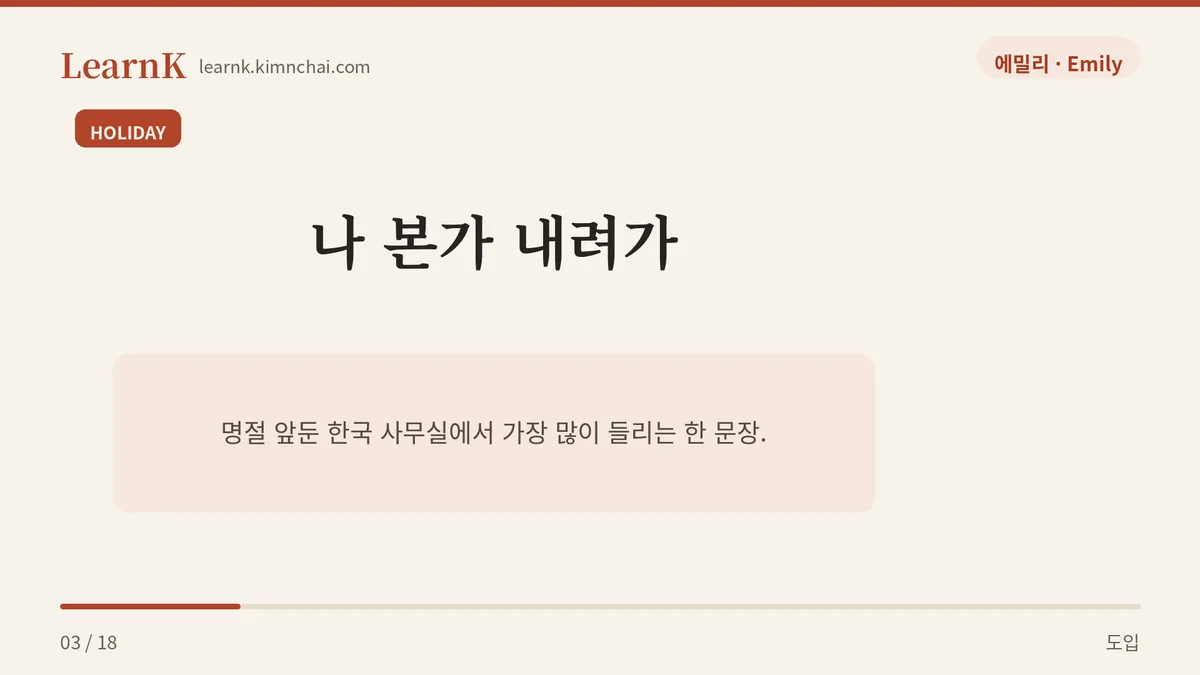
Ask a Korean friend what they’re doing for the holidays and nine times out of ten you’ll get the same answer: “나 본가 (bonga) 내려가.” (na bonga naeryeoga — “I’m heading down to my 본가.”) 본가 (bonga) means “the home you originally lived in before moving out on your own” — that is, the house where you lived with your parents before becoming independent. Not the one-room studio where you currently sleep and eat, but the house where your room is still sitting there exactly as you left it. Here’s the interesting part: this word only comes into existence for people who have left home. A place that was simply 집 (jip), “home,” while you lived with your parents finally earns a name of its own the moment you pack your bags and walk out.
So the instant 본가 (bonga) comes out of someone’s mouth, the listener picks up one extra piece of unspoken information: “Ah, this person lives apart from their parents.” That’s exactly why the word gets tossed around so often in Korea. Huge numbers of people move up from the provinces to Seoul for university or work, and for them there are always two homes — the one they live in and the one they go back to.
The temperature of the word is plain. It carries no emotional charge. It doesn’t come steeped in nostalgia the way 고향 (gohyang) does, and it isn’t deferential the way 부모님 댁 (bumonim daek) is. It just points at a fact. That’s why you can use it in light small talk with someone you’ve only just met, and also in a conversation about the address field on a company form. There is exactly one subtlety, and it lives in the verb that follows. When someone based in Seoul goes to a 본가 out in the provinces, they say “본가에 내려간다 (bongae naeryeoganda)” — go down to my 본가 — and in the reverse direction, “본가에 올라간다 (bongae ollaganda)” — go up to my 본가. This has nothing to do with actual directions on a map; it’s an old speech habit that treats Seoul as the reference point.
Checking the National Institute of Korean Language dictionary
The National Institute of Korean Language’s Basic Korean Dictionary lists two senses for this word.
본가 (bonga) 「명사 (myeongsa) — noun」
- 따로 나와 살기 이전에 원래 살던 집. — The home one originally lived in before moving out to live separately.
- [EN] original home — A family house in which a member used to live before moving out to live independently.
- [JA] ほんけ【本家】 — 分家する前に暮らしていた元の家。
- [ES] casa de los padres, casa principal — Casa donde alguien vivía originalmente antes de emanciparse.
- [ZH] 老家 — 独自生活前生活过的原来的家。 — National Institute of Korean Language, Basic Korean Dictionary (krdict.korean.go.kr)
본가 (bonga) 「명사 (myeongsa) — noun」 2. 여자가 결혼하기 전에 부모와 살던 집. — The home a woman lived in with her parents before getting married.
- [EN] parents’ home — A family house in which a woman used to live together with her parents before getting married.
- [JA] じっか【実家】 — 女性が結婚する前に、親と暮らした家。
- [ES] casa de los padres — Casa donde vivía con sus padres una mujer antes de casarse.
- [ZH] 娘家 — 女性结婚前与父母生活的家。 — National Institute of Korean Language, Basic Korean Dictionary (krdict.korean.go.kr)
The dictionary does not carry a Portuguese translation. For reference only, it would come out to something like casa dos pais — but we should be clear that this is our own rendering, not the dictionary’s.
Put the two senses side by side and the difference is sharp. Sense 1 is keyed to “before independence,” regardless of gender; sense 2 is keyed to “before marriage.” In everyday Korean conversation today, sense 1 is overwhelmingly the dominant one. Sense 2 is used of married women, and in modern daily speech the word 친정 (chinjeong) has largely taken over that space.
Here are five real usage examples from the same dictionary, reproduced as they appear.
- 갓 결혼한 아들 내외가 본가 근처에 살림을 내었다. (gat gyeolhonhan adeul naeoega bonga geuncheoe sallimeul naeeotda.)
- 본가에 눌러 있다. (bongae nulleo itda.)
- 지수는 대학을 졸업한 후 대전에 있는 본가로 돌아갔다. (Jisuneun daehageul joreophan hu Daejeone inneun bongaro doragatda.)
- 본가가 어디인데요? (bongaga eodiindeyo?)
- 승규는 서울에 직장을 구하게 되면서 본가를 떠나게 되었다. (Seunggyuneun Seoure jikjangeul guhage doemyeonseo bongareul tteonage doeeotda.) — National Institute of Korean Language, Basic Korean Dictionary (krdict.korean.go.kr)
Let’s walk through the situation behind each one.
- “갓 결혼한 아들 내외가 본가 근처에 살림을 내었다.” — A newly married son and his wife have moved out of his parents’ house, but not far — they’ve set up a new household within walking distance. 살림을 내다 (sallimeul naeda) is an idiom meaning to start a separate household of one’s own. Here 본가 is the home the son originally lived in.
- “본가에 눌러 있다.” — Someone well past the age of moving out still hasn’t gone, and is staying on at their parents’ house. 눌러 있다 (nulleo itda) carries the nuance of “staying put rather than leaving,” so depending on the situation it can land as light teasing.
- “지수는 대학을 졸업한 후 대전에 있는 본가로 돌아갔다.” — Jisu had been living alone while attending university in Seoul or another city, and upon graduating packed everything up and went back to the family home in Daejeon. This is an extremely typical migration path for young Koreans.
- “본가가 어디인데요?” — One of the most natural ways to ask where someone is from mid-conversation. Baked into this single sentence is the premise that “you currently live apart from your parents.”
- “승규는 서울에 직장을 구하게 되면서 본가를 떠나게 되었다.” — A case where landing a job becomes the trigger for moving out. It’s the exact reverse of the movement in example 3.
Seeing it in a real conversation
Situation: Moving day — Jun-kyung is moving out of the studio apartment he’s lived in for five years. Emily has come over to help carry boxes.
Emily: 이 박스는 어디로 보내? 새 집? Where does this box go? The new place?
Jun-kyung: 아, 그건 본가로. 겨울 옷이라 새 집엔 둘 데가 없어. Ah, that one goes to my parents’ place. It’s winter clothes—there’s no room at the new apartment.
Emily: 야, 너 지금 짐 절반을 본가에 떠넘기는 거 아니야? Hey, aren’t you dumping half your stuff at your parents’ place right now?
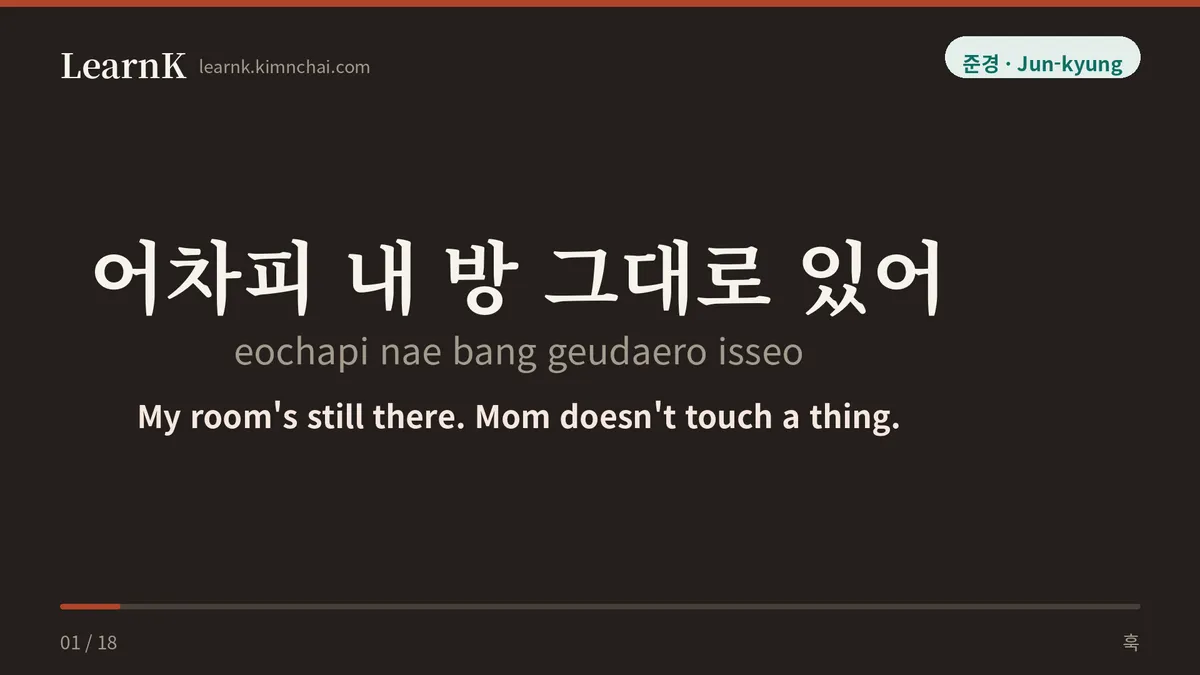
Jun-kyung: 어차피 내 방 그대로 있어. 엄마가 손도 안 대셔. My room’s still there anyway. Mom doesn’t touch a thing.
Emily: 부럽다. 나는 본가가 비행기로 열두 시간인데. Lucky you. Mine’s a twelve-hour flight away.
Jun-kyung: 그래서 네가 이사할 때마다 그렇게 다 갖다 버리는구나. So that’s why you throw everything out every time you move.
This is where it sounds off
✗ (A high schooler still living with their parents) 저 학원 끝나고 바로 본가에 갈게요. (jeo hagwon kkeunnago baro bongae galgeyo.) ✓ (A high schooler still living with their parents) 저 학원 끝나고 바로 집에 갈게요. (jeo hagwon kkeunnago baro jipe galgeyo.) — I’ll head straight home after cram school. → 본가 is a word you use on the premise that you have already left that house. Use it while you’re still living with your parents and you end up referring to your own home like it belongs to someone else, which makes the listener pause for a beat.
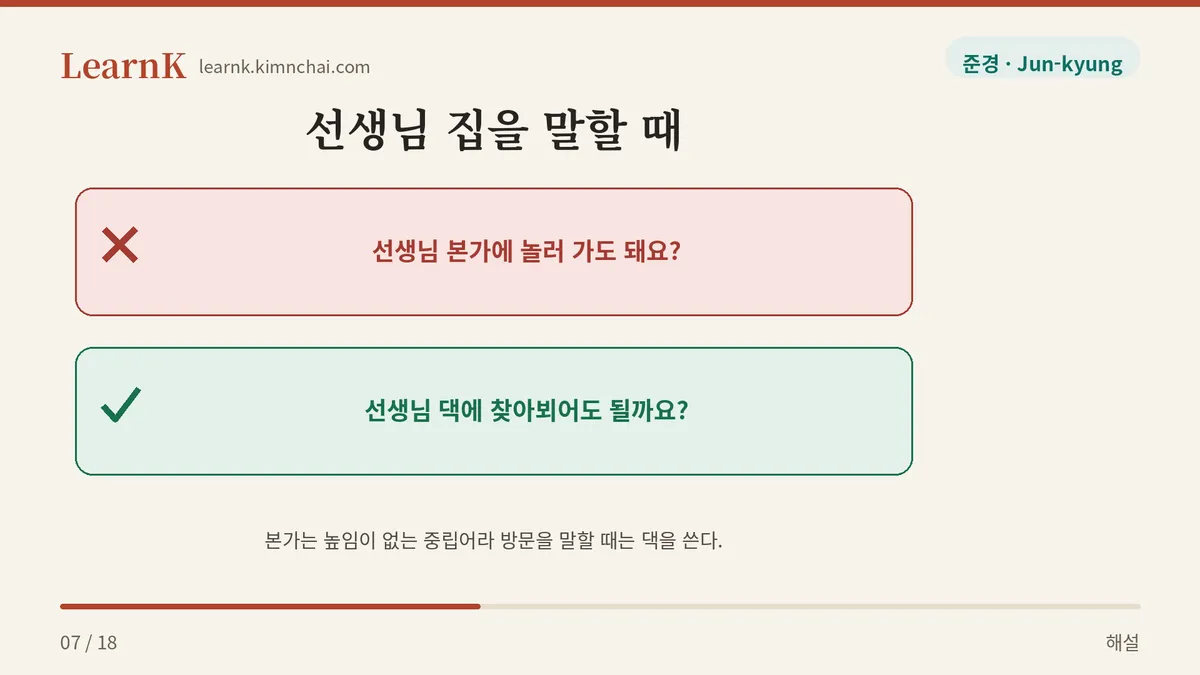
✗ (To a teacher) 선생님, 다음 주에 선생님 본가에 놀러 가도 돼요? (seonsaengnim, daeum jue seonsaengnim bongae nolleo gado dwaeyo?) ✓ (To a teacher) 선생님, 다음 주에 선생님 댁에 찾아뵈어도 될까요? (seonsaengnim, daeum jue seonsaengnim daeke chajaboeeodo doelkkayo?) — Teacher, would it be all right if I came to visit your home next week? → 본가 is a neutral term that points at a factual relationship, so it carries no weight of honorification. When you’re telling someone senior to you that you’d like to visit the home they currently live in, you need 댁 (daek) for the sentence to be properly polite. That said, if you’re asking about origins — “선생님은 본가가 어디세요?” (seonsaengnimeun bongaga eodiseyo? — “Teacher, where’s your 본가?”) — then 본가 is perfectly natural.
Example sentences by situation
Situation 1 — Friday before a holiday weekend, between coworkers
A: 이번 추석에 본가 내려가? (ibeon Chuseoge bonga naeryeoga?) Are you heading down to your 본가 for Chuseok? B: 응, 표는 겨우 구했는데 다섯 시간 걸린대. (eung, pyoneun gyeou guhaenneunde daseot sigan geollindae.) Yeah, I barely managed to get a ticket — apparently it’s a five-hour trip.
This is the single most-heard exchange in a Korean office right before a holiday. 내려가다 (naeryeogada) here means going from Seoul out to the provinces. If the other person is from Seoul, the same question gets you: “난 본가가 여기라 그냥 있어.” (nan bongaga yeogira geunyang isseo. — “My 본가 is right here, so I’m just staying put.”)
Situation 2 — Dinner with a junior colleague, three months into living alone
A: 요즘 밥은 잘 챙겨 먹어? (yojeum babeun jal chaenggyeo meogeo?) Have you been eating properly lately? B: 본가에서 반찬을 택배로 보내 주셔서요. 냉장고 반이 엄마 김치예요. (bongaeseo banchaneul taekbaero bonae jusyeoseoyo. naengjanggo bani eomma gimchiyeyo.) My 본가 keeps sending side dishes by courier. Half my fridge is my mom’s kimchi.
A sentence that captures the state of having moved out while your parents’ hands still reach you. In Korea a 본가 is a physical address, but it’s also a channel that stays open through side-dish containers and delivery boxes.
Situation 3 — A blind date, opening conversation
A: 본가가 어디세요? (bongaga eodiseyo?) Where’s your 본가? B: 부산이요. 대학 때 올라와서 이제 십 년 됐네요. (Busaniyo. daehak ttae ollawaseo ije sip nyeon dwaenneyo.) Busan. I came up for university, so it’s been ten years now.
“어디 사세요?” (eodi saseyo? — “Where do you live?”) is a somewhat loaded question about a current address, but “본가가 어디세요?” is received as a light question about where you’re from. It’s a very Korean detour: opening a conversation without directly prying into where the other person’s apartment is.
Formality levels and neighboring expressions
본가 is a noun, so it has no built-in polite/casual distinction of its own. The level of formality is decided by the verb that follows. To a friend: “본가 가?” (bonga ga?). To a boss: “본가에 다녀오겠습니다” (bongae danyeoogetseumnida). And at the most formal: “본가에 다녀오려고 합니다” (bongae danyeooryeogo hamnida). What matters far more, though, is knowing the distance between this word and its lookalike neighbors.
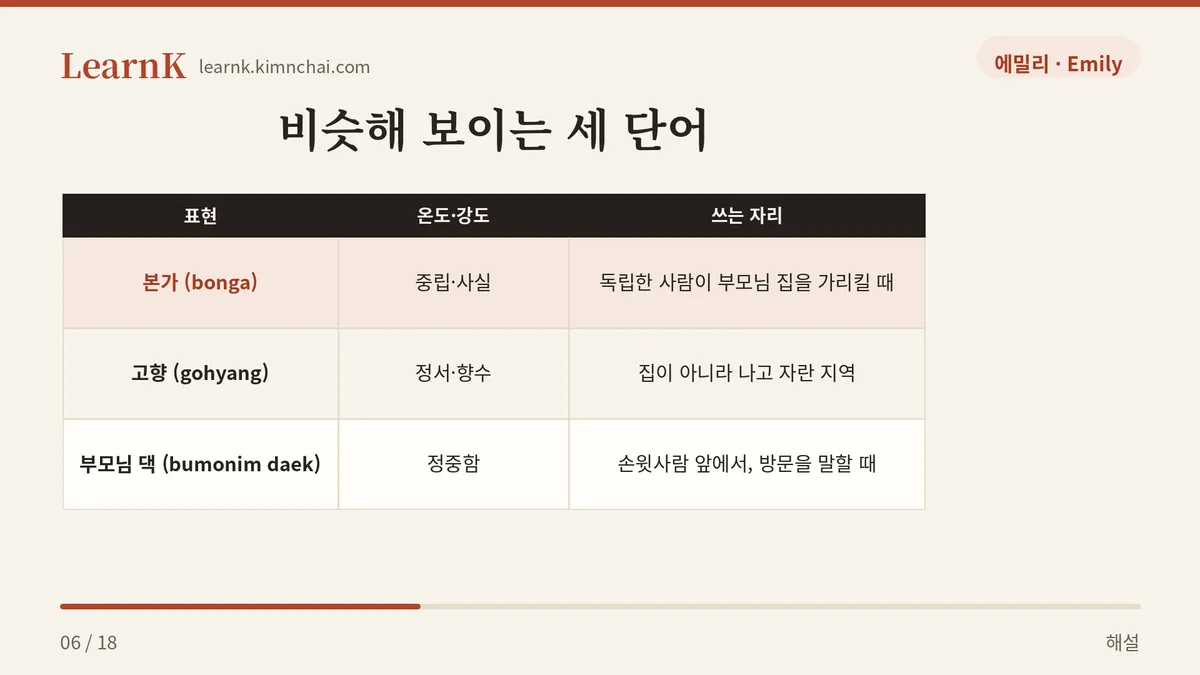
| Expression | Tone & intensity | Where it belongs |
|---|---|---|
| 본가 (bonga) | Neutral, factual | When someone living independently refers to their parents’ house. Works in both formal and casual speech |
| 부모님 댁 (bumonim daek) | Polite and soft | In front of someone senior, especially when saying you’ll visit that home |
| 고향 (gohyang) | Emotional, thick with nostalgia | Not a house but the region where you were born and raised. Even if your parents move away, your 고향 stays where it is |
| 친정 (chinjeong) | Warm and personal | When a married woman refers to her own parents’ home |
| 자취방 (jachwibang) | Humble, everyday | The opposite pole from 본가. The room you’re living in alone right now |
고향 (gohyang) is especially easy to mix up. 본가 is a building; 고향 is a piece of ground. If your parents move to Seoul, your 본가 becomes Seoul — but the 고향 where you were born and raised is still that original city.
Cultural background — the fact that your room is still there
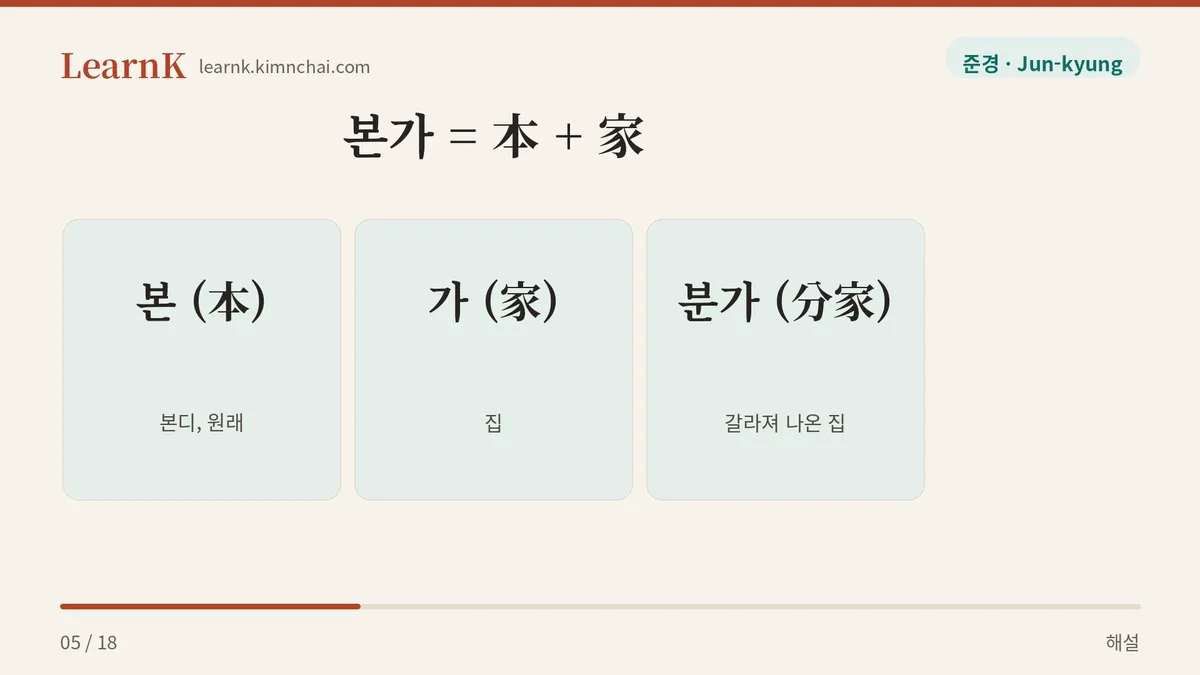
In Chinese characters it’s 本家: 본(本) meaning “original” and 가(家) meaning “house.” Literally “the house that was originally there,” and it pairs with 분가 (bunga, 分家), the word for branching off into a household of your own. What’s intriguing is the Japanese translation the dictionary offers. Sense 1 gets ほんけ【本家】, the identical set of characters, while sense 2 gets じっか【実家】. Which is to say: even using the same characters, the two languages have placed this word in slightly different spots.
There’s a reason 본가 lands with such weight in Korea specifically. Universities and jobs are concentrated in the capital region, so packing up and heading to Seoul in your early twenties has hardened into something like a rite of passage. From that moment on, a young person’s life has two addresses: the rented room where the mail arrives, and one other room where the bed, the school uniform, and the high school study guides are all still sitting exactly where they were.
When a 본가 shows up in a Korean drama, the scene usually wears a familiar expression. The protagonist, worn down by life in Seoul, boards a night train with no warning. The door opens and the first thing their mother asks is “밥은 먹었냐” (babeun meogeonnya? — “Have you eaten?”). They open their old room for the first time in years and find it untouched since the day they left, and go quiet for a moment. The reason the emotion carries without a single line of dialogue is that the fact itself — that the room waited for them with time stopped inside it — is already the whole story.
So for Koreans, a 본가 is not just an address. It’s the thing that jams the highways for hours every holiday, that keeps refilling the kimchi container in the fridge, and that becomes the last-resort option during a stretch of unemployment: “일단 본가로 들어갈까” (ildan bongaro deureogalkka — “Should I just move back to my 본가 for now?”). Once a Korean learner starts using this word accurately, they’ll feel their conversations with Korean friends suddenly gain a layer of depth.
Today’s quiz
Which of the following is the most unnatural situation in which to use 본가 (bonga)?
- Someone from Daejeon who took a job in Seoul and lives alone — “이번 주말에 본가 내려가려고.” (ibeon jumare bonga naeryeogaryeogo. — “I’m planning to head down to my 본가 this weekend.”)
- A high schooler living with their parents — “학원 끝나면 바로 본가에 가야 해.” (hagwon kkeunnamyeon baro bongae gaya hae. — “I have to go straight to my 본가 after cram school.”)
- A married daughter who has moved out — “어제 본가에 김치 가지러 다녀왔어.” (eoje bongae gimchi gajireo danyeowasseo. — “I went over to my 본가 yesterday to pick up kimchi.”)
- To someone you’ve just met — “본가가 어디세요?” (bongaga eodiseyo? — “Where’s your 본가?”)
Show the answer
Answer: 2
본가 is a word used by someone who has already left that house. If you’re currently living with your parents, that place is simply 집 (jip), home. This student would sound natural saying “학원 끝나면 바로 집에 가야 해” (hagwon kkeunnamyeon baro jipe gaya hae). Options 1 and 3 line up exactly with senses 1 and 2 of the dictionary entry, and option 4 matches the dictionary’s own example, “본가가 어디인데요?”
Definitions and example sentences are from the National Institute of Korean Language’s Basic Korean Dictionary (krdict.korean.go.kr); that portion of this post, including our translations, is licensed under CC BY-SA 2.0 KR.