보쌈 (bossam) — A Word That Calls for a Whole Table, Not Just a Plate of Meat
보쌈
보쌈 (bossam) means thinly sliced boiled pork eaten wrapped in napa cabbage leaves or kimchi. The name already has the eating method built into it, so when a Korean says 보쌈 시킬까? (bossam sikilkka?), it’s less about picking one item off a menu than about proposing, “let’s lay out the table and sit around it tonight.” The evening of a moving day, a housewarming, the afternoon after 김장 (gimjang) — the annual kimchi-making — a night when overtime has dragged on: wherever bossam appears, there are almost always at least two people.
To get the nuance, it’s quickest to picture the table. When you order bossam, boiled meat doesn’t arrive alone. Salted cabbage leaves or the tender inner leaves, 새우젓 (saeujeot) — salted shrimp — garlic, 쌈장 (ssamjang), and, depending on the season, fresh oysters or shredded radish come with it. The very motion of laying the meat on a leaf, adding a little salted shrimp, and wrapping it up in your hand is part of the dish. That’s why the most common misunderstanding among Korean learners is “bossam = the name of boiled pork” — because there’s a separate word for the meat itself. That word is 수육 (suyuk).
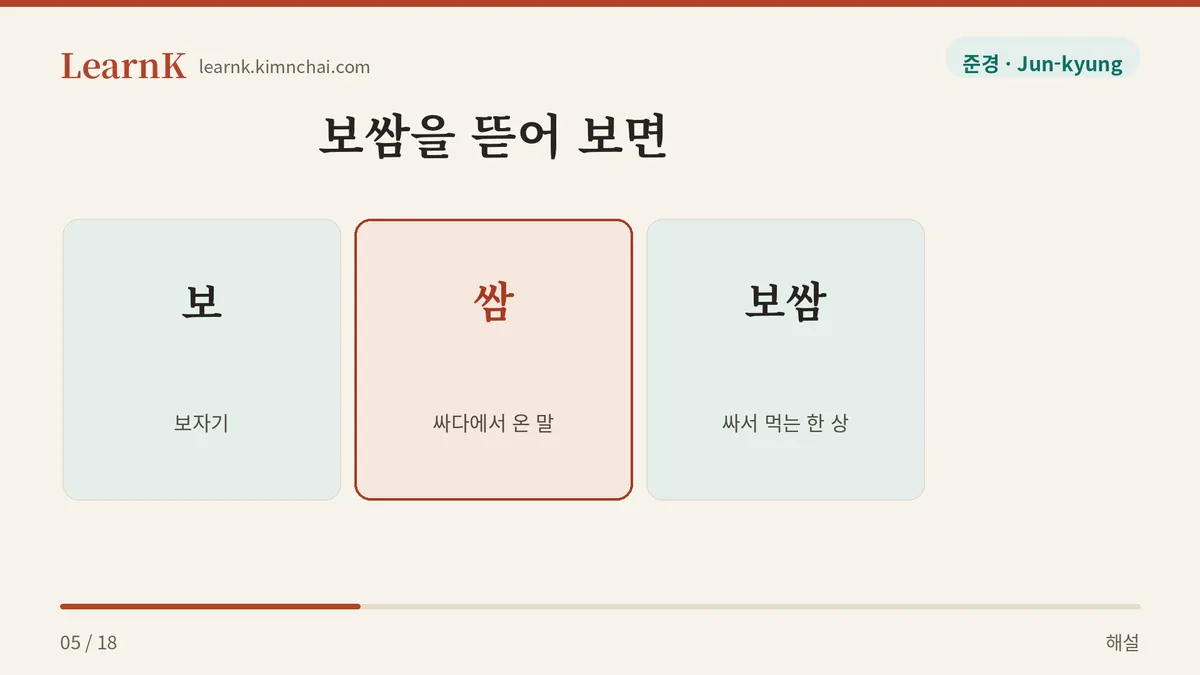
The dictionary lists two senses. One is an old-style dish in which head meat was wrapped in a cloth, pressed under something heavy until it set firm, then sliced and eaten. The other is exactly the bossam you meet on a delivery app today. In present-day conversation, “보쌈” almost without exception means the second one. But the root of the name still sits, untouched, in the first definition — 보에 싸서 (bo-e ssaseo), “wrapped in a cloth.” The 보 (bo) of 보자기 (bojagi), a wrapping cloth, and the 쌈 (ssam) of 싸다 (ssada), to wrap. This word took its name not from an ingredient but from a method.
Checking the National Institute of Korean Language dictionary
보쌈 「명사」 「1」 삶아서 뼈를 골라낸 소나 돼지 등의 머리 고기를 보에 싸서 무거운 것으로 눌러 단단하게 만든 뒤 썰어서 먹는 음식. [en] bossam; napa wraps with pork — A dish made by boiling the head of a cow, pig, etc., of which the bones have been picked out, and then wrapping the boiled beef or pork in thin cloth, hardening the wrapped meat by pressing it under a heavy object, and then slicing the hardened meat. [ja] ポサム — 茹でて骨を抜き取った牛や豚などの頭肉を風呂敷につつんで重いもので押して、かたくしてから切って食べる料理。 [es] bossam — Plato que consiste en carne de res o cerdo cocida en agua, deshuesada, prensada con algo pesado tras ser envuelta en un paño, y cortada en rodajas. [zh] 肉冻 — 将牛头肉或猪头肉等煮熟并去骨后,用布包起来,再用重物将其压实之后切成薄片食用的食物。 — National Institute of Korean Language, Basic Korean Dictionary (krdict.korean.go.kr)
보쌈 「명사」 「2」 삶은 돼지고기를 얇게 썰어서 배춧속이나 보쌈김치 등과 함께 먹는 음식. [en] bossam — A dish of thin-sliced boiled pork eaten with the tender inner leaves of kimchi cabbages, bossamkimchi, wrapped kimchi, etc. [ja] ポサム — 薄切りにした茹でた豚肉を白菜の葉やポッサムキムチなどと一緒に食べる料理。 [es] bossam — Plato que consiste en carne de cerdo cocida y cortada en rodajas finas, que se sirve acompañado de condimento para kimchi o bossamkimchi (kimchi enrollado). [zh] 菜包肉 — 将煮熟的猪肉切成薄片,和白菜心或包卷辛奇等一同食用的食物。 — National Institute of Korean Language, Basic Korean Dictionary (krdict.korean.go.kr)
The dictionary carries no Portuguese translation. For reference, here is our own rendering — bossam: prato de carne de porco cozida e cortada em fatias finas, comida enrolada em folhas tenras de acelga-chinesa ou com kimchi. (This is our own translation, not the dictionary’s text.)
Put the two senses side by side and the difference is sharp. Sense 「1」 is a food that is pressed until it sets; sense 「2」 is a food you wrap and eat while it’s warm. That’s also why the Chinese translations split — one becomes 肉冻 (meat jelly), the other 菜包肉 (meat wrapped in vegetables).
Now let’s look at the actual example sentences the dictionary lists.
보쌈 배달원. A bossam delivery driver. — National Institute of Korean Language, Basic Korean Dictionary (krdict.korean.go.kr)
(bossam baedarwon) This short phrase shows exactly what this dish is today. Bossam is something people make at home, but in the city it shows up far more often as something you order in.
싱싱한 배추 잎사귀에 보쌈 고기를 싸서 먹으면 맛이 그만이다. Wrapping bossam meat in a fresh cabbage leaf and eating it — nothing beats that taste. — National Institute of Korean Language, Basic Korean Dictionary (krdict.korean.go.kr)
(ssingssinghan baechu ipsagwie bossam gogireul ssaseo meogeumyeon masi geumanida) Note the phrase 보쌈 고기 (bossam gogi). That’s how you refer to the meat inside the bossam when you need to name it separately. And 싸서 먹으면 (ssaseo meogeumyeon), “if you wrap it and eat it” — the act of wrapping is written right into the condition for the taste.
따끈한 보쌈에 시원한 막국수는 어때? How about warm bossam with cold makguksu? — National Institute of Korean Language, Basic Korean Dictionary (krdict.korean.go.kr)
(ttakkeunhan bossame siwonhan makguksuneun eottae) This is a casual sentence suggesting a menu. Pairing something warm with something cool as a recommendation is very common in Korean, and plenty of real restaurants sell these two together.
그가 안주로 보쌈 한 접시를 시켰다. He ordered a plate of bossam as anju. — National Institute of Korean Language, Basic Korean Dictionary (krdict.korean.go.kr)
(geuga anjuro bossam han jeopsireul sikyeotda) Here it’s used as 안주 (anju) — food eaten alongside drinks. Bossam often arrives at the table with soju. The counting unit is 한 접시 (han jeopsi), one plate.
승규는 보쌈을 꼭 생굴 김치와 함께 먹었다. Seung-gyu always ate his bossam with fresh oyster kimchi. — National Institute of Korean Language, Basic Korean Dictionary (krdict.korean.go.kr)
(Seungguneun bossameul kkok saenggul gimchiwa hamkke meogeotda) This is classic winter bossam. When oysters are in season, a lot of people add them, and the phrase 꼭 ~와 함께 (kkok ~wa hamkke), “always together with,” captures that stubborn personal preference nicely.
A real conversation
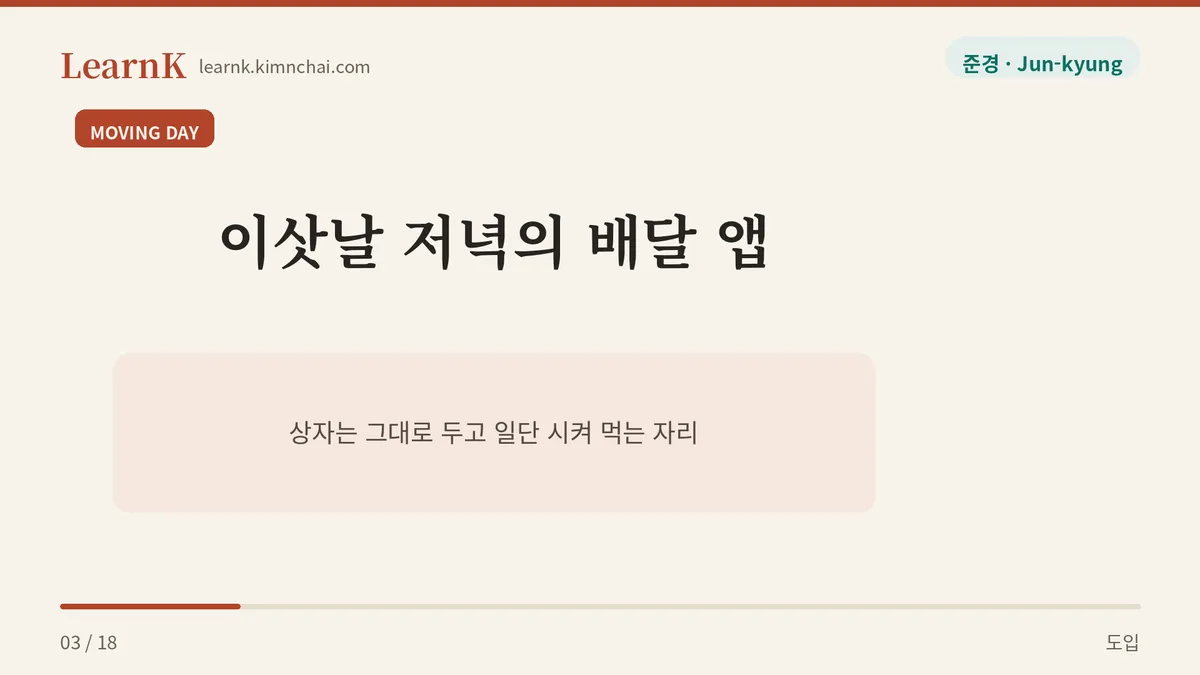
Scene: the evening of moving day. Boxes are still stacked in the living room, and the two of them sit on the floor and open a delivery app.
Jun-kyung: 상자는 내일 풀자. 일단 뭐라도 시키자, 뭐 먹을래? Let’s unpack the boxes tomorrow. Let’s order something first — what do you want?
Emily: 이삿날 저녁은 보쌈 아니야? 나 여기 산 지 15년인데 그렇게 배웠어. Isn’t bossam the thing on moving day? I’ve lived here 15 years and that’s what I learned.
Jun-kyung: 오, 제법인데. 근데 이 동네 보쌈 잘하는 집을 아직 모르겠다. Oh, not bad. But I don’t know a good bossam place in this neighborhood yet.
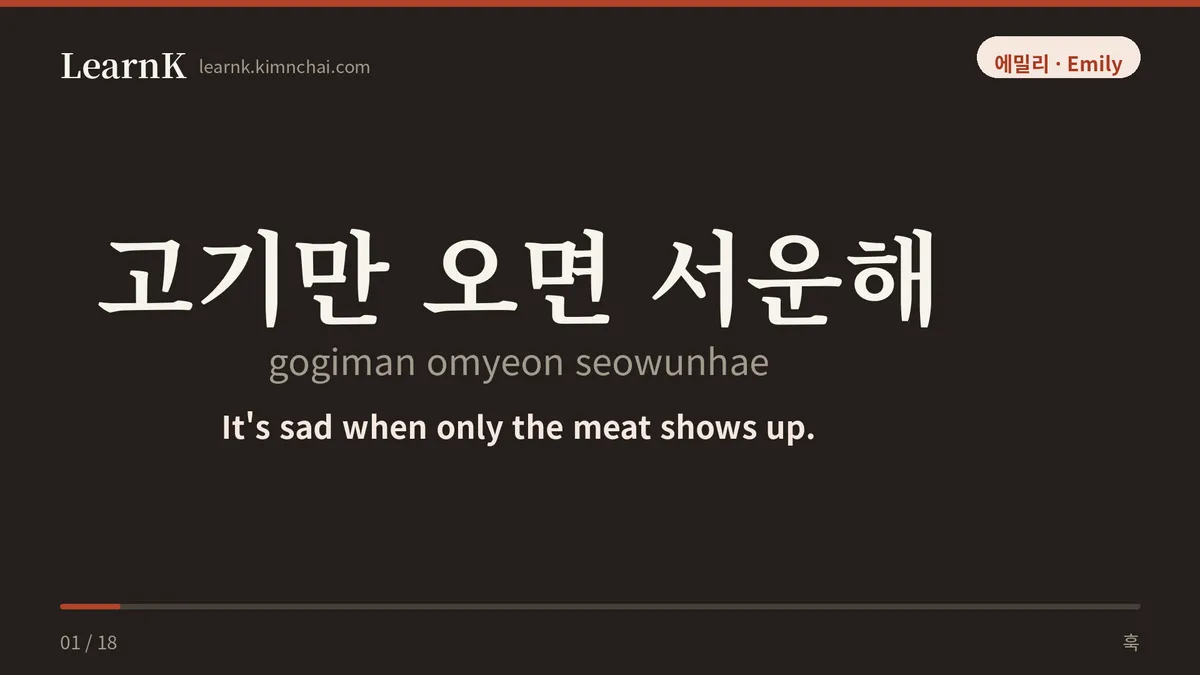
Emily: 리뷰에 김치 많이 준다는 데로 골라. 고기만 오면 서운해. Pick one the reviews say gives lots of kimchi. It’s sad when only the meat shows up.
Jun-kyung: 알겠어. 큰 걸로 시키고 막국수도 하나 추가할게. Got it. I’ll order the large and add a makguksu too.
Emily: 좋아. 그럼 나는 접시가 어느 상자에 있는지부터 찾아볼게. Great. Then I’ll start looking for which box the plates are in.
This sounds off
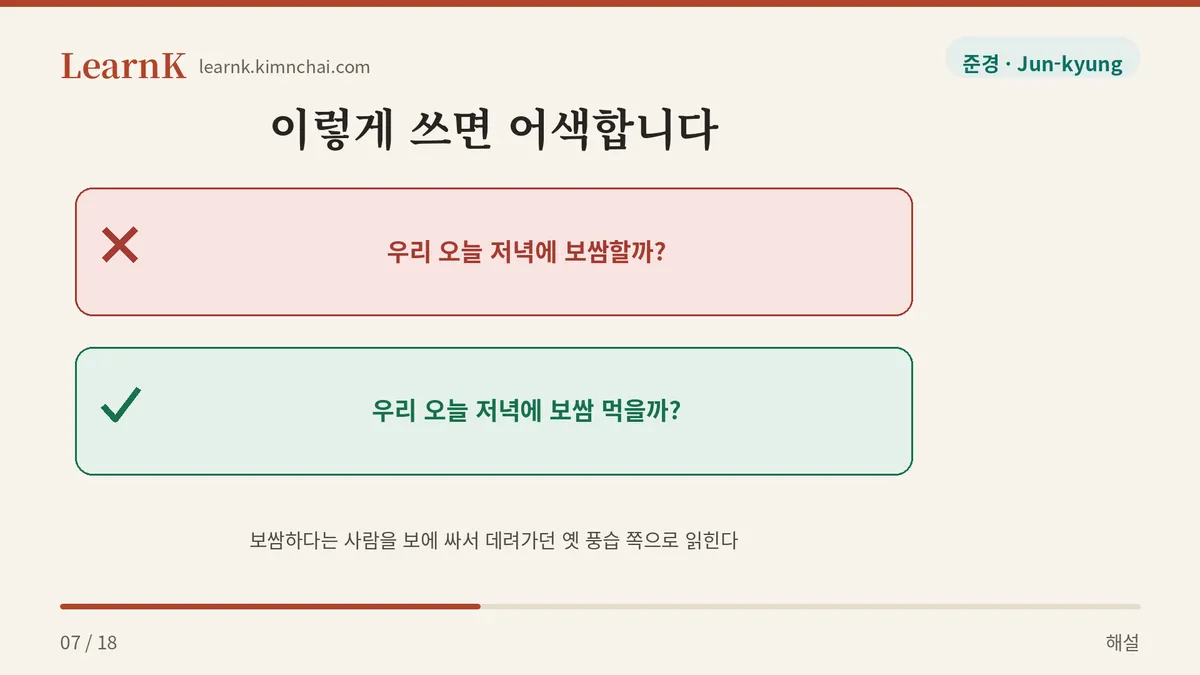
✗ 우리 오늘 저녁에 보쌈할까? (uri oneul jeonyeoge bossamhalkka?) ✓ 우리 오늘 저녁에 보쌈 먹을까? (uri oneul jeonyeoge bossam meogeulkka?) → Some food names take 하다 (hada) naturally, but the list is fixed and arbitrary — you can’t say 치킨하다 (chikinhada), yet 한잔하다 (hanjanhada), “to have a drink,” is fine. Bossam isn’t on that list. On top of that, the dictionary carries a separate homonym 보쌈 (bossam) referring to an old custom of wrapping a person in a cloth and carrying them off, so 보쌈하다 (bossamhada) reads as something completely unrelated to food. To suggest eating it, it’s always 보쌈 먹자 (bossam meokja) or 보쌈 시키자 (bossam sikija).
✗ (with only a plate of 수육 ordered) 나 오늘 보쌈 시켰어. (na oneul bossam sikyeosseo) ✓ (looking at meat, cabbage, and kimchi that arrived as a full spread) 나 오늘 보쌈 시켰어. → The grammar is fine, but the picture doesn’t match. If it’s just boiled meat, that’s 수육 (suyuk); it becomes bossam once the things you wrap it with are set down alongside it. When Koreans hear this word, they automatically picture a table with cabbage leaves and salted shrimp on it.
Example sentences by situation
Situation 1 — inviting a friend over to your new place. This is how you ask someone to a housewarming while taking the pressure off them. You head off the “what should I bring?” question before it’s asked.
보쌈 시켜 놓을 테니까 몸만 와. (bossam sikyeo noeul tenikka mom-man wa) I’ll have bossam ordered, so just bring yourself.
Situation 2 — deciding on the menu for a work dinner, speaking to a superior. Adding a reason makes the suggestion much softer.
부장님, 오늘은 보쌈 어떠세요? 다 같이 싸 먹기 좋아서요. (bujangnim, oneureun bossam eotteoseyo? da gachi ssa meokgi joaseoyo) Sir, how about bossam today? It’s good for everyone to wrap and share.
Situation 3 — a late-autumn afternoon, just after gimjang is finished. This is a very familiar sentence in Korea, pointing to that one meal eaten with freshly made kimchi.
김장 끝나고 먹는 보쌈이 진짜지. (gimjang kkeutnago meokneun bossami jinjjaji) Bossam eaten right after making kimchi — that’s the real thing.
Polite and casual forms, and neighboring words
Bossam itself is the name of a thing, so it has no separate honorific or plain form. The level of politeness is decided by the verb you use with it. To a friend it’s 보쌈 시킬까? (bossam sikilkka?); to a superior or a guest it becomes 보쌈 시킬까요? (bossam sikilkkayo?) or 보쌈으로 하시겠어요? (bossameuro hasigesseoyo?). When ordering at a restaurant, 보쌈 하나 주세요 (bossam hana juseyo) is the safest choice.
Here’s how it compares with the neighboring words that are easy to confuse.
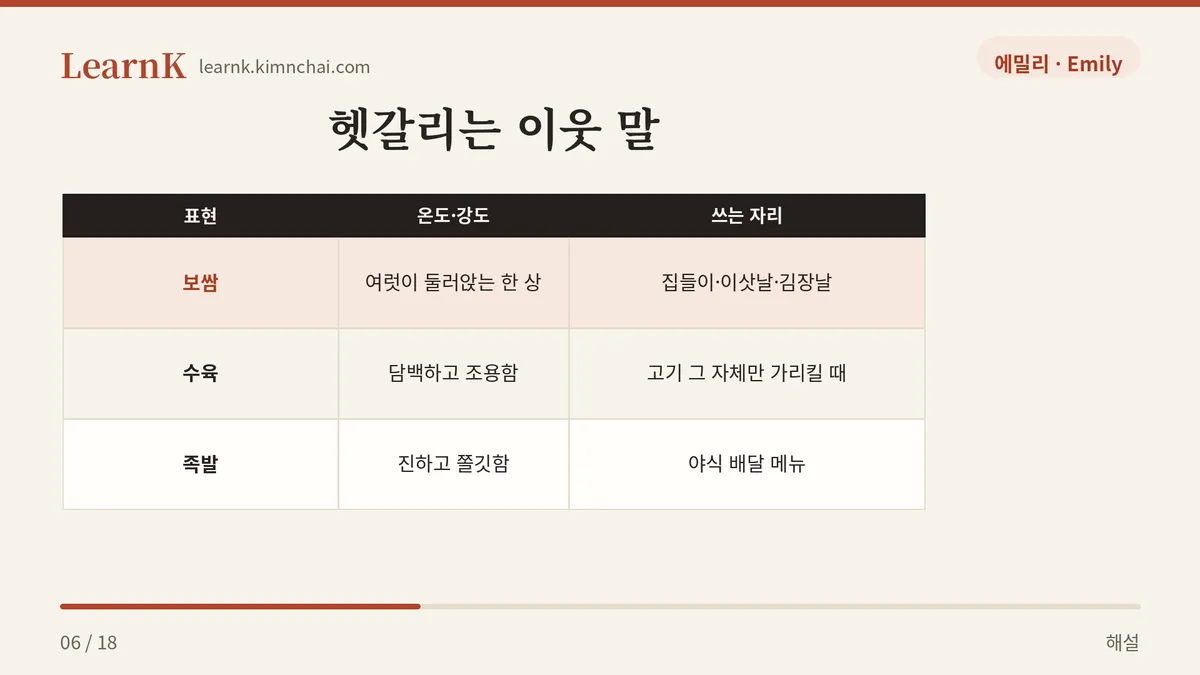
| Expression | Temperature / intensity | Where it’s used |
|---|---|---|
| 보쌈 (bossam) | A loud, lively spread with several people around it | Housewarmings, moving days, gimjang days, late-night food, company dinners |
| 수육 (suyuk) | Plain and quiet. The meat itself | Gukbap shops, home cooking. When you mean the meat alone, with nothing served alongside |
| 족발 (jokbal) | Rich and chewy. The classic late-night food | Always listed right next to bossam on delivery menus |
| 쌈 (ssam) | Not a dish but a way of eating | Sangchu-ssam, ssamjang — anything to do with “wrapping and eating” |
The relationship between suyuk and bossam matters most. The cooked meat may be identical, but once the makings for wrapping it are set down together, the name changes to bossam. Jokbal uses a different cut entirely (pig’s trotters), but because delivery apps file them in the same category, the question 보쌈이랑 족발 중에 뭐? (bossamirang jokbal junge mwo?) — “bossam or jokbal?” — comes up often in Korean nights.
Cultural background — the wrapping hand
Let’s start with the name. The answer sits right there in the dictionary’s first definition — 보에 싸서 (bo-e ssaseo), “wrapped in a cloth.” 보(褓) is a wrapping cloth, and 쌈 comes from 싸다 (ssada), to wrap. In the old method, meat was wrapped in a cloth and pressed until it set; in today’s bossam, a person wraps meat in a cabbage leaf. All that has changed is who does the wrapping — from the cloth to a human hand — while the picture the name points to stays the same. This word was born from an action, not an ingredient.
That’s why bossam has remained an awkward dish to eat alone. Wrapping takes two hands, and the cabbage leaves, salted shrimp, and garlic have to sit in the middle, so the whole table faces inward. The scene on gimjang day of laying freshly boiled meat on freshly salted cabbage and putting it into each other’s mouths; the scene of spreading newspaper among the moving boxes and sitting in a circle — when a Korean drama shows a gathering like this, there’s a good chance bossam is on the table. It works as a prop that says “these people got closer today” without a line of dialogue.
The seasons are attached to it too. In winter, when oysters are in, people serve bossam with fresh oysters; during gimjang season it comes with freshly made 겉절이 (geotjeori), unfermented kimchi. It’s no coincidence that one of the dictionary’s example sentences mentions eating it “with fresh oyster kimchi.” When a Korean learner memorizes this word, remembering this background is far more useful in practice than remembering the definition. Bossam is the name of a dish and, at the same time, a signal about what kind of gathering you’re at.
Today’s quiz
A friend tells you, “나 어제 혼자 편의점에서 삶은 돼지고기만 사서 먹었어.” (“Yesterday I bought just some boiled pork at the convenience store and ate it by myself.”) What’s the most natural Korean word for what they ate?
- 보쌈 (bossam)
- 수육 (suyuk)
- 쌈장 (ssamjang)
Answer: 2, 수육 (suyuk). If there was nothing to wrap it in — cabbage leaves, kimchi — you don’t call it bossam. Option 3, 쌈장 (ssamjang), is the name of the doenjang-based sauce you add when wrapping, so it can’t refer to the dish as a whole.
Definitions and example sentences are from the National Institute of Korean Language’s Basic Korean Dictionary (krdict.korean.go.kr); that portion of this post, including our translations, is licensed under CC BY-SA 2.0 KR.