부대찌개 (budaejjigae) — A Pot Born Outside the Army Base: What It Means and How to Really Use It
부대찌개
부대찌개 (budaejjigae) means a jjigae — a Korean stew — made by putting ham, sausage, and all sorts of vegetables into a pot and boiling them. One wide, shallow pot goes down in the middle of the table, and the moment the red broth starts bubbling, everyone sitting around it picks up a ladle and spoons some into their own small dish. The restaurant by the office on a rainy Friday evening, an alley in a college neighborhood after finals, the local diner on payday — in Korea, the situations where this word comes up almost always involve at least two people, with a green bottle of soju standing somewhere nearby.
The name itself makes you look twice. The 부대 here is the 부대 of 군부대(軍部隊), “military unit, army base.” So there is an army sitting inside the name of a dish — I’ll untangle that story later, in the culture section. What’s worth knowing first is that this word pays a learner back with more than a single vocabulary item. Knowing 부대찌개 is close to knowing how Koreans think about “eating together.”
Korean soupy dishes split roughly three ways. 국 (guk) has generous broth and is served in individual bowls — you eat your own portion. 탕 (tang) is simmered a long time until the broth turns deep and concentrated. 찌개 (jjigae) has less broth, is seasoned more strongly, and above all sits in its pot in the center of the table so several people can spoon from it together. Among all the jjigae, 부대찌개 has the biggest pot and the most miscellaneous cast of ingredients.
Look at what goes in and you see the character of the dish immediately. Ham and sausage, ground meat, and canned baked beans come from the Western side; kimchi, tofu, green onion, onion, and red-pepper-powder seasoning come from the Korean side. On top of that come the add-ons the customer picks personally — ramyeon noodles, rice cakes, cheese, dumplings. In particular, 사리 (sari) — an extra portion of noodles or the like added to the pot — is a word that never sits out a 부대찌개 conversation, so it’s worth memorizing alongside. One line, “사리 추가요 (sari chuga-yo)” (“Extra noodles, please”), and any restaurant will understand you instantly.
The verbs that go with it are all but fixed, too. The most natural one is 끓이다 (kkeurida), “to boil.” 부대찌개를 끓이다 (budaejjigae-reul kkeurida) — 만들다 (“to make”) isn’t wrong, but a broth dish feels less like something you make than something you boil, so Koreans reach for 끓이다 almost every time. On the eating side it’s 부대찌개를 먹다 (budaejjigae-reul meokda), and when you order, you count it not in 개 (the general counter for items) but in 인분 (inbun), “servings.”
Learn its temperature as well. 부대찌개 is not fine dining. It rarely shows up at a formal meeting of two families or a quiet first date. It shows up instead at loud, generous, abundant gatherings, among people already comfortable with each other. When a Korean says “우리 부대찌개 먹으러 갈까? (uri budaejjigae meogeureo galkka?)” — “Shall we go get budaejjigae?” — it’s a menu suggestion and, at the same time, a way of saying “let’s take it easy and sit for a good long while today.”
Checking It in the National Institute of Korean Language Dictionary
How does a dictionary built by a national institution write this word down? Here is the definition and the multilingual translations from the National Institute of Korean Language’s Basic Korean Dictionary.
부대찌개 「명사」 (noun) 냄비에 햄, 소시지, 각종 야채 등을 넣고 끓인 찌개. (A jjigae made by putting ham, sausage, various vegetables and so on into a pot and boiling them.) [en] budaejjigae; sausage jjigae — Jjigae, stew, made with ingredients like ham, sausage, a variety of vegetables, etc., boiled in a pot. [ja] プデチゲ — 鍋にハムやソーセージ、各種の野菜などを入れて煮込んだチゲ料理。 [es] budaejjigae, estofado hecho con jamón, salchichas y verduras — Estofado preparado con jamón, salchichas y verduras variadas. [zh] 部队锅 — 在汤锅内放入火腿、香肠、各种蔬菜等炖煮而成的汤。 — National Institute of Korean Language, Basic Korean Dictionary (krdict.korean.go.kr)
A Portuguese translation isn’t included in this dictionary, so the following is our own: budaejjigae — ensopado coreano feito com presunto, salsichas e legumes variados, cozidos numa panela.
The definition is short, and that’s exactly what makes it accurate. Pinning the ingredients down to just “ham, sausage, various vegetables” is also a way of saying that everything else varies from household to household and shop to shop. Now let’s look at the real usage examples listed in the same dictionary.
어머니는 소시지와 김치를 넣고 부대찌개를 끓이셨다. — National Institute of Korean Language, Basic Korean Dictionary (krdict.korean.go.kr)
eomeoni-neun sosiji-wa kimchi-reul neoko budaejjigae-reul kkeurisyeotda. — “Mother put in sausage and kimchi and made budaejjigae.” This is a home-cooking scene. Only two things appear, sausage and kimchi, and that is the skeleton of 부대찌개. The -시- (-si-) in 끓이셨다 is the honorific pre-final ending that elevates the mother.
아버지는 뜨끈한 국물의 부대찌개를 안주 삼아 소주를 드시곤 하셨다. — National Institute of Korean Language, Basic Korean Dictionary (krdict.korean.go.kr)
abeoji-neun tteukkeunhan gungmurui budaejjigae-reul anju sama soju-reul deusigon hasyeotda. — “Father used to drink soju with piping-hot budaejjigae as his anju.” 안주 (anju) refers to food eaten alongside alcohol. This one sentence shows 부대찌개’s dual identity: a side dish for rice and a drinking companion at the same time.
나는 부대찌개만 있으면 밥 한 그릇은 뚝딱 먹어 치운다. — National Institute of Korean Language, Basic Korean Dictionary (krdict.korean.go.kr)
na-neun budaejjigae-man isseumyeon bap han geureus-eun ttukttak meogeo chiunda. — “As long as there’s budaejjigae, I polish off a whole bowl of rice in no time.” 뚝딱 (ttukttak) is an adverb for the way you finish something off in an instant. That salty broth that makes you empty your rice bowl without leaving a grain — this sentence captures the sensation in a very Korean way.
너 부대찌개도 끓일 줄 알고 대단하다. — National Institute of Korean Language, Basic Korean Dictionary (krdict.korean.go.kr)
neo budaejjigae-do kkeuril jul algo daedanhada. — “You even know how to make budaejjigae — impressive.” This is admiration expressed in casual speech. -(으)ㄹ 줄 알다 ((eu)l jul alda) means “to know how to / be able to do something,” and it comes up constantly in cooking talk.
부대찌개를 끓이다. — National Institute of Korean Language, Basic Korean Dictionary (krdict.korean.go.kr)
budaejjigae-reul kkeurida. — “to make budaejjigae.” This is the base-form pairing the dictionary lists. When you memorize the word, don’t memorize the noun alone — memorize the whole collocation, and sentences will come out far faster.
See It in a Real Conversation
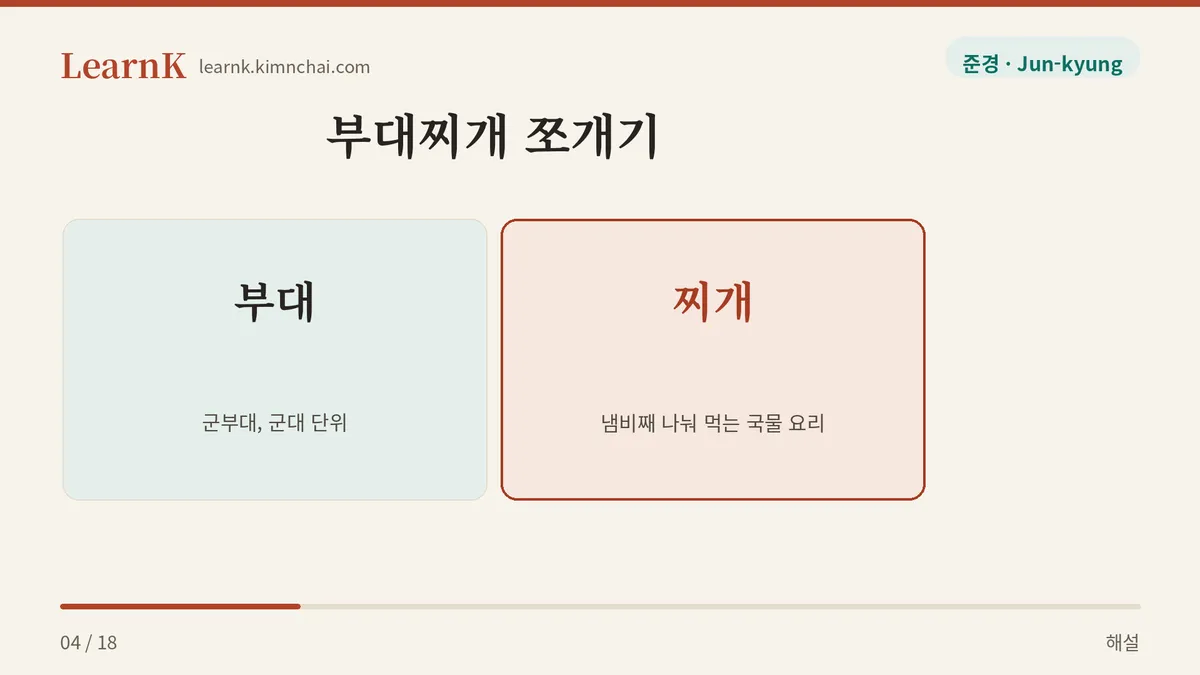
Setting: a rainy Friday evening, the processed-foods aisle of a neighborhood supermarket. Jun-kyung is pushing the cart while Emily looks over the shelves beside him.
Jun-kyung: 에밀리야, 비도 오는데 오늘 부대찌개 어때? 재료 여기 다 있는데. Emily, it’s raining — how about budaejjigae today? All the ingredients are right here.
Emily: 좋지. 근데 햄 한 캔으로 되겠어? 우리 둘이 먹을 건데. Sounds good. But is one can of ham enough? It’s for the two of us.
Jun-kyung: 아 그러네, 두 개 담자. 사리는 라면으로 할까 당면으로 할까? Ah, you’re right, let’s grab two. Ramyeon noodles or glass noodles?
Emily: 무조건 라면. 나 부대찌개 끓일 때 라면 사리 없으면 안 먹어. Ramyeon, no question. When I make budaejjigae, I won’t touch it without ramyeon noodles.
Jun-kyung: 우리 엄마랑 똑같은 소리 하네. 김치는 집에 익은 거 있지? You sound exactly like my mom. We’ve got well-fermented kimchi at home, right?
Emily: 있어, 딱 시어졌어. 오늘 국물 제대로 나오겠는데? Yeah, it just got nice and sour. The broth’s gonna come out great today.
These Uses Sound Off
부대찌개 is the name of a food, so it isn’t really a place where honorific mistakes happen. Instead, here are two misunderstandings learners actually run into.
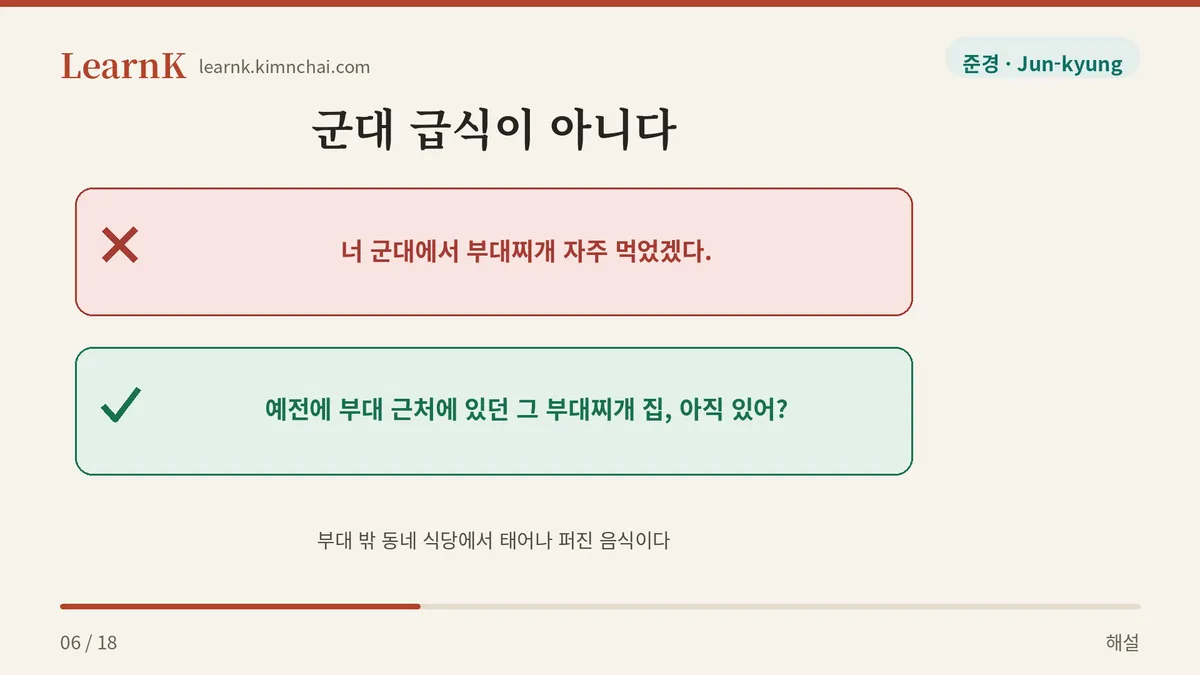
✗ (to a friend who has finished military service) 너 군대에서 부대찌개 자주 먹었겠다. “You must have eaten budaejjigae a lot in the army.” ✓ (to a friend) 예전에 부대 근처에 있던 그 부대찌개 집, 아직 있어? “That budaejjigae place that used to be near the base — is it still there?” → Because 부대 sits in the name, it’s easy to assume this was army mess-hall food, but 부대찌개 was made and sold — and spread — not inside the bases but in the neighborhood restaurants outside them. It wasn’t the soldiers’ food; it was the food of the people living next door to the base.
✗ (at a restaurant) 사장님, 부대찌개 한 개 주세요. “Excuse me, one budaejjigae, please.” ✓ (at a restaurant) 사장님, 부대찌개 2인분이요. “Excuse me, two servings of budaejjigae.” → 부대찌개 is boiled in one big pot and shared, so you count it in 인분 (inbun), “servings,” not in 개, the general counter for individual items. On top of that, most shops take orders starting at two servings. If you’ve come alone, it’s better to check first whether they sell a single-person portion (1인 부대찌개).
Example Sentences by Situation
1. Suggesting lunch to a coworker on a rainy day
비도 오는데 점심에 부대찌개 어때요? 사리도 넣고요. bi-do o-neunde jeomsime budaejjigae eottaeyo? sari-do neokoyo. → It’s raining — how about budaejjigae for lunch? With extra noodles, too.
부대찌개 is a word that comes out bundled with the weather. It attaches very naturally to the end of a remark about rain, snow, or the first cold snap. With a coworker you’re not yet on casual terms with, you float it gently like this, with -어때요? (-eottaeyo?).
2. Ordering at a restaurant
사장님, 부대찌개 2인분 주시고요, 라면 사리 하나 추가할게요. sajangnim, budaejjigae i-inbun jusigoyo, ramyeon sari hana chugahalgeyo. → Excuse me, two servings of budaejjigae, and I’ll add one portion of ramyeon noodles.
사장님 (sajangnim) is the safest, most all-purpose way to address a restaurant owner or staff member. Linking your sentences with -고요 gives you the tone of ordering several things in one breath.
3. Passing a cooking tip to a friend
김치가 좀 시어야 부대찌개 국물이 제대로 나와. kimchi-ga jom sieoya budaejjigae gungmuri jedaero nawa. → The kimchi has to be a bit sour for the budaejjigae broth to come out right.
This is tip-swapping in casual speech. -아/어야 (-a/eoya) marks a condition — “only if / it has to be that way.” Well-fermented sour kimchi is always a topic when 부대찌개 comes up.
Formal vs. Casual, and Similar Expressions
부대찌개 is a noun, so the word itself doesn’t change between formal and casual speech. What changes is the end of the sentence. To a friend: 부대찌개 끓였어 (budaejjigae kkeuryeosseo). To someone senior: 부대찌개 끓였습니다 (budaejjigae kkeuryeotseumnida). When an elder is the one who made it, you elevate them with 끓이셨다 (kkeurisyeotda), just like the dictionary example.
The neighboring words that are easy to mix up divide like this.
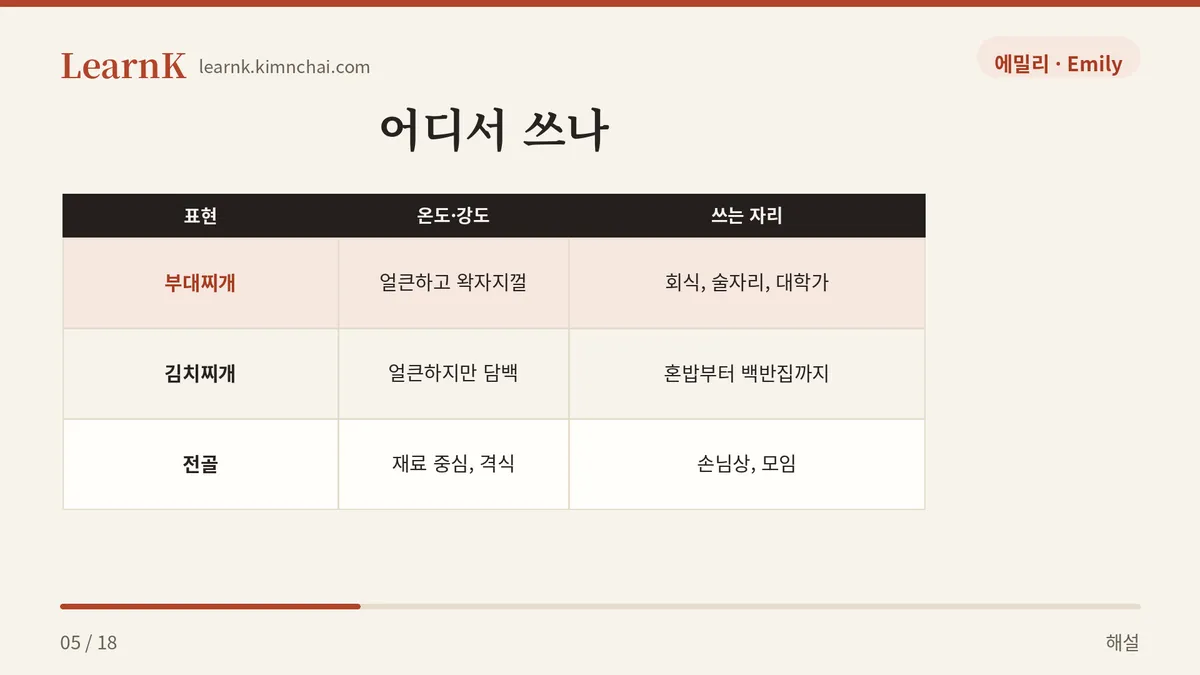
| Expression | Temperature / intensity | Where it’s used |
|---|---|---|
| 부대찌개 (budaejjigae) | Spicy-hot and salty, boisterous | Group gatherings. Work dinners, drinking food, college districts |
| 김치찌개 (kimchijjigae) | Spicy but clean-tasting | Anywhere, from eating alone to a home-style set-meal shop |
| 전골 (jeongol) | Ingredient-focused, more formal | Meals for guests, gatherings. Boiled on a burner at the table |
| 찌개 (jjigae) | Neutral. The umbrella term | When you haven’t decided which kind yet |
If you haven’t picked the menu yet, say “찌개 먹을까? (jjigae meogeulkka?)”; once you have, say “부대찌개 먹을까? (budaejjigae meogeulkka?)”
Cultural Background — A Pot Born Outside the Army Base
The word formation is simple: 부대(部隊) + 찌개. That first 부대 is the Sino-Korean word for a military unit. The widely known origin story goes back to the neighborhoods where U.S. military bases were stationed after the Korean War. Canned processed meats like ham and sausage flowed out of the bases, and the people living in those neighborhoods began putting them into kimchi and red-pepper seasoning and boiling it all up — that, the story goes, is where it started. Which means this dish has had the shape of two countries’ ingredients mixed in a single pot from the very beginning.
The texture differs by region. The Uijeongbu style has a relatively clear broth built around red-pepper-powder seasoning; the Songtan style adds cheese and ground meat, making it far richer and thicker. Even today there is an alley in Uijeongbu packed with 부대찌개 shops, so the place name works almost as the name of a recipe. Some shops sell it under a different name, 존슨탕 (jonseuntang); accounts of where that name came from differ, so here I’ll simply note that a second name exists.
It was born in poor times, but its place today is anything but shabby. An evening after overtime ends, an afternoon after exams finish, drinks with a friend you haven’t seen in ages — if a Korean drama shows several people dipping their spoons into one pot and talking over each other, there’s a good chance that pot is 부대찌개. That’s also why the camera goes out of its way to close in on the bubbling pot. This dish is a device for showing who you’re eating with rather than what you’re eating.
Even the order of eating has a rhythm. At first the broth is clear and mild; the longer it boils, the more the saltiness of the ham and the sourness of the kimchi come out, and it deepens steadily. That’s why the 사리 doesn’t go in at the start but partway through. At the end, you fry rice in whatever broth is left, and the meal is finished. The pace of sitting two hours in front of a single pot — that pace is the pace of a Korean dinner.
Today’s Quiz
Two of you walk into a restaurant to eat 부대찌개. Which order sounds most natural?
- 사장님, 부대찌개 두 개 주세요.
- 사장님, 부대찌개 2인분 주세요.
- 사장님, 부대찌개 두 그릇 주세요.
Answer: 2. 부대찌개 isn’t a dish that comes out one per person; it’s one big pot that everyone spoons from together, so you count it in 인분 (inbun) rather than in 개 (“items”) or 그릇 (“bowls”). Tack on “라면 사리 하나 추가할게요 (ramyeon sari hana chugahalgeyo)” — “and I’ll add one portion of ramyeon noodles” — and it’s perfect.
Definitions and example sentences are from the National Institute of Korean Language’s Basic Korean Dictionary (krdict.korean.go.kr); that portion of this post, including our translations, is licensed under CC BY-SA 2.0 KR.