병아리 (byeongari) — How a Little Yellow Chick Became the Nickname for "the New Kid"
병아리
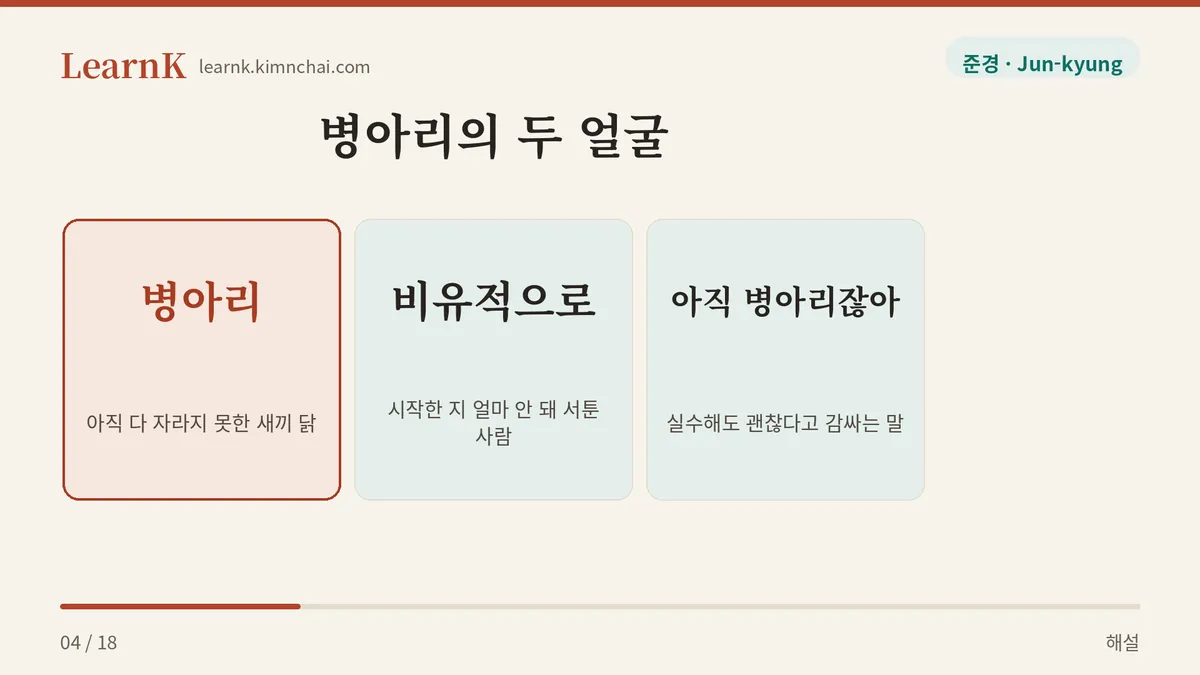
병아리 (byeongari) means a chick — a baby chicken that hasn’t finished growing — and, figuratively, a person who started something so recently that they’re still clumsy at it. In Korea, the place you hear this word most often isn’t a henhouse; it’s among people. The new hire fumbling with the copier during their first week, the club member who has to be taught how to hold a racket on day one, the driver who got their license a month ago — to people like these, Koreans say 아직 병아리잖아 (ajik byeongarijanha), “come on, they’re still a chick.” It isn’t a scolding. If anything, it’s much closer to a shield: it’s okay to mess up, this is exactly the stage for it.
To feel the warmth of this word, just picture the image behind it. A freshly hatched chick is yellow, tiny, unable to do anything on its own, and it toddles along behind the mother hen. Korean took that whole picture and moved it onto people. So when someone calls you a 병아리, the message isn’t “that person has no skills” but “that person still needs looking after.” It’s immaturity, not incompetence — and built into the word is the assumption that immaturity is a problem time solves on its own.
That’s why the word is especially comfortable to use about yourself. Saying 저 아직 병아리예요 (jeo ajik byeongariyeyo) sounds humble, and at the same time it naturally carries the request “so please go easy on me.” Using it about someone else, though, depends on the relationship. From a close senior colleague with a smile, it’s affection; from someone you just met, or in the middle of an argument, it flips straight into looking down on the person. Same word, opposite temperature depending on the setting — that’s the heart of this expression.
Checking with the National Institute of Korean Language
Let’s start with the definition an official body has laid out. The National Institute of Korean Language’s Basic Korean Dictionary lists 병아리 as a noun and splits the meaning in two.
병아리 (byeongari) 「noun」
- 아직 다 자라지 못한 새끼 닭. — A baby chicken that has not yet fully grown. [en] chick — A young bird that has yet to grow fully. [ja] ひよこ・ひな【雛】 — まだ卵からかえって間のない鶏のひな。 [es] pollito — Cría de gallina que todavía no ha crecido del todo. [zh] 雏鸡,小鸡 — 还没长大的小鸡。 — National Institute of Korean Language, Basic Korean Dictionary (krdict.korean.go.kr)
병아리 (byeongari) 「noun」 2. (비유적으로) 어떤 일을 시작한 지 얼마 되지 않아 일 처리가 미숙한 사람. — (figuratively) A person who began some work only recently and is unskilled at handling it. [en] novice — (figurative) A person who has little experience and is not good at handling his/her tasks. [ja] ひよっこ。しんまい【新米】 — (比喩的に)まだ始めたばかりで、仕事が未熟な人。 [es] (no headword listed) — (FIGURADO) Persona inexperta en la realización de su tarea por haber comenzado hace poco el trabajo. [zh] 雏鸡,新人 — (喻义)开始做某事没多久、处理事务不够熟练的人。 — National Institute of Korean Language, Basic Korean Dictionary (krdict.korean.go.kr)
The dictionary carries no Portuguese translation, so we’ve supplied one for reference (it is not from the dictionary itself): sense 1 would be pintinho (the young of a chicken that hasn’t fully grown), and sense 2 novato (figuratively, a person who started recently and is still clumsy at the work).
What’s worth noticing is that sense 2 comes with the tag (비유적으로), “figuratively.” In other words, in a Korean native speaker’s mind the word is still baby chicken first, with the human meaning layered on top of that picture. That’s why a person called a 병아리 tends to feel they’ve been treated as cute rather than mocked.
Here are the actual usage examples the same dictionary provides.
새로 태어난 병아리들은 성 감별 과정을 거쳐 암컷과 수컷으로 분리되었다. (saero taeeonan byeongarideureun seong gambyeol gwajeongeul geochyeo amkeotgwa sukeoseuro bullidoeeotda.) — The newly hatched chicks went through a sexing process and were separated into females and males. 닭장 속의 암탉이 여러 병아리들을 보살피고 거느린다. (dakjang sogui amtalgi yeoreo byeongarideureul bosalpigo geoneurinda.) — The hen in the coop cares for and leads a number of chicks. 병아리들은 구구 소리를 내는 엄마 닭의 뒤를 쫓아다녔다. (byeongarideureun gugu sorireul naeneun eomma dalgui dwireul jjochadanyeotda.) — The chicks followed along behind the clucking mother hen. 알에서 막 깬 병아리는 정말 귀여웠다. (al-eseo mak kkaen byeongarineun jeongmal gwiyeowotda.) — The chick that had just hatched from the egg was really cute. 와, 꼬꼬랑 병아리다! (wa, kkokkorang byeongarida!) — Wow, a chicken and a chick! — National Institute of Korean Language, Basic Korean Dictionary (krdict.korean.go.kr)
- The 성 감별 (seong gambyeol), “sexing,” sentence has the explanatory tone of an industrial setting like a poultry farm. It’s the kind of line you’d meet in news copy or a documentary subtitle, and here 병아리 is not a metaphor at all — it’s a literal baby chicken.
- The 암탉이 보살피고 거느린다 (amtalgi bosalpigo geoneurinda) sentence shows exactly why this word picked up the feeling of “a being under protection.” A chick is always in the position of having someone look after it.
- The 엄마 닭의 뒤를 쫓아다녔다 (eomma dalgui dwireul jjochadanyeotda) sentence is the root of the figurative usage. Everything about why Koreans call a new hire trailing their mentor around the office a 병아리 is contained in that single image.
- The 알에서 막 깬 병아리는 정말 귀여웠다 (al-eseo mak kkaen byeongarineun jeongmal gwiyeowotda) sentence pairs the word with an emotion word (귀엽다, “cute”). That’s evidence the word isn’t neutral — it leans toward affection.
- 와, 꼬꼬랑 병아리다! (wa, kkokkorang byeongarida!) is a child’s way of talking. 꼬꼬 (kkokko) is baby talk for a chicken, so the sentence reads like a kid’s delighted shout on a trip to the zoo or the countryside.
The dictionary also lists collocations such as 병아리를 까다 (byeongarireul kkada) and 병아리가 깨다 (byeongariga kkaeda). From the chick’s side, breaking out of the egg, it’s 깨다; from the side of the mother hen — or the person — doing the hatching, it’s 까다. Learners mix this pair up constantly, so it’s worth memorizing them together.
See it in a real conversation
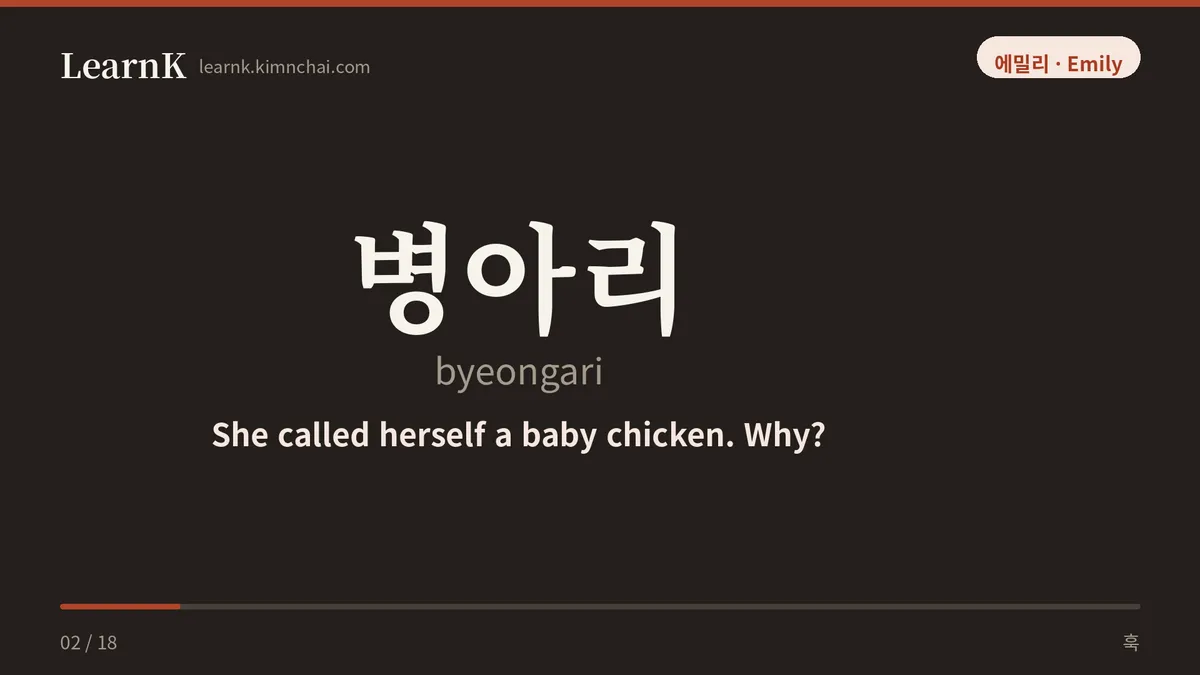
Setting: a neighborhood gym on a Saturday morning. It’s Emily’s first day at the badminton club.
Jun-kyung: 저기 라켓 놓인 데 가서 이름만 적으면 돼. 긴장할 거 하나도 없어. Just go over to where the rackets are and write your name down. There’s nothing to be nervous about.
Emily: 나 완전 병아리인데 껴 줄까? 라켓도 오늘 처음 잡아 봤어. I’m a total newbie — will they even let me join? Today’s the first time I’ve held a racket.
Jun-kyung: 야, 여기 다 그렇게 시작했어. 나도 삼 년 전엔 병아리였고. Hey, everybody here started like that. I was a newbie three years ago too.
Emily: 진짜? 너 지금 완전 고수처럼 치잖아. Seriously? You play like a total pro now.
Jun-kyung: 반년만 나와 봐. 그때쯤엔 네가 새로 온 병아리들 챙기고 있을걸. Just come for six months. By then you’ll be the one looking after the new chicks.
Emily: 어우, 상상만 했는데 벌써 어깨에 힘 들어가는데? Ugh, I only imagined it and my shoulders are already puffing up.
This sounds off
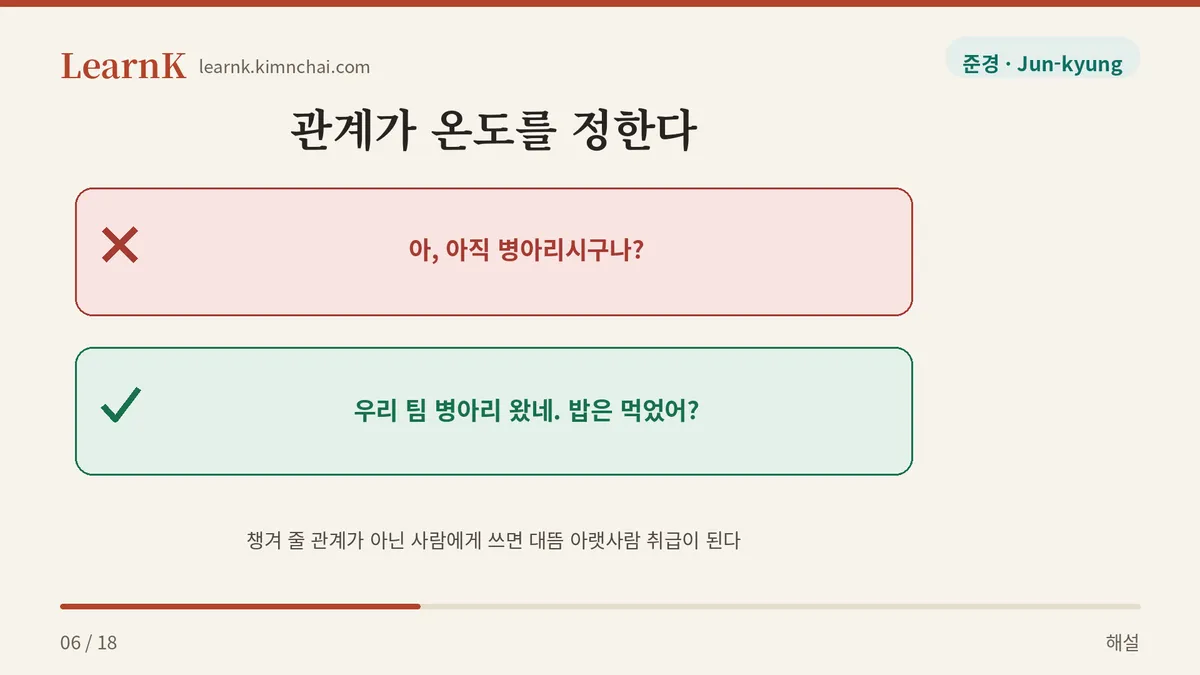
✗ (to an employee of a client company you’re meeting for the first time) 아, 아직 병아리시구나? (a, ajik byeongarisigguna?) — “Ah, so you’re still a chick?” ✓ (to a junior on your own team, with a smile) 우리 팀 병아리 왔네. 밥은 먹었어? (uri tim byeongari wanne. babeun meogeosseo?) — “Our team’s chick has arrived. Have you eaten?” → 병아리 is a word for “someone I’m going to take care of,” so using it with a person you have no such relationship with instantly reads as treating them as your inferior. With someone from outside your circle, 신입이시군요 (sinibisigunyo), “ah, you’re new here,” is the safe choice.
✗ (to a junior who made a mistake, stone-faced) 그러니까 아직 병아리 소리를 듣지. (geureonikka ajik byeongari sorireul deutji.) — “That’s exactly why people still call you a chick.” ✓ (to a junior who made a mistake) 괜찮아, 나도 처음엔 다 그랬어. (gwaenchana, nado cheoeumen da geuraesseo.) — “It’s fine, I was the same at the start.” → It’s a word that originally means “I’m cutting you some slack,” so laying it on top of anger flips it into ridicule. This word only arrives with its intended meaning when it comes with a smiling face.
Example sentences by situation
1) A three-month employee playing themselves down at a company dinner
저는 아직 병아리라서 배울 게 산더미예요. (jeoneun ajik byeongariraseo baeul ge sandeomiyeyo.) “I’m still a chick, so I have a mountain of things to learn.”
Stuck at the front of a self-introduction or an apology, it works as a shield. It sounds less heavy and less self-abasing than 「제가 부족해서 (jega bujokhaeseo)」, “because I fall short,” which makes it one of the expressions new employees use most often in a Korean workplace.
2) A senior colleague covering for a junior in front of someone from another department
얘 이번 주에 들어온 병아리예요. 좀 잘 봐주세요. (yae ibeon jue deureoon byeongariyeyo. jom jal bwajuseyo.) “This one’s a chick who just joined this week. Please go easy on them.”
This is the line you throw out after a mistake has already happened. That single phrase, “still a chick,” functions to bring the other person’s anger down a notch.
3) Posting in a hobby community for the first time
등산 병아리인데 초보 코스 좀 추천해 주세요. (deungsan byeongariinde chobo koseu jom chucheonhae juseyo.) “I’m a hiking chick — could you recommend some beginner trails?”
Attaching a field in front, as in 「등산 병아리 (deungsan byeongari)」, “hiking chick,” or 「주식 병아리 (jusik byeongari)」, “stock-market chick,” is extremely common online. It has a softer tone than 초보 (chobo), “beginner,” which makes it good for asking for help.
Politeness levels and similar expressions
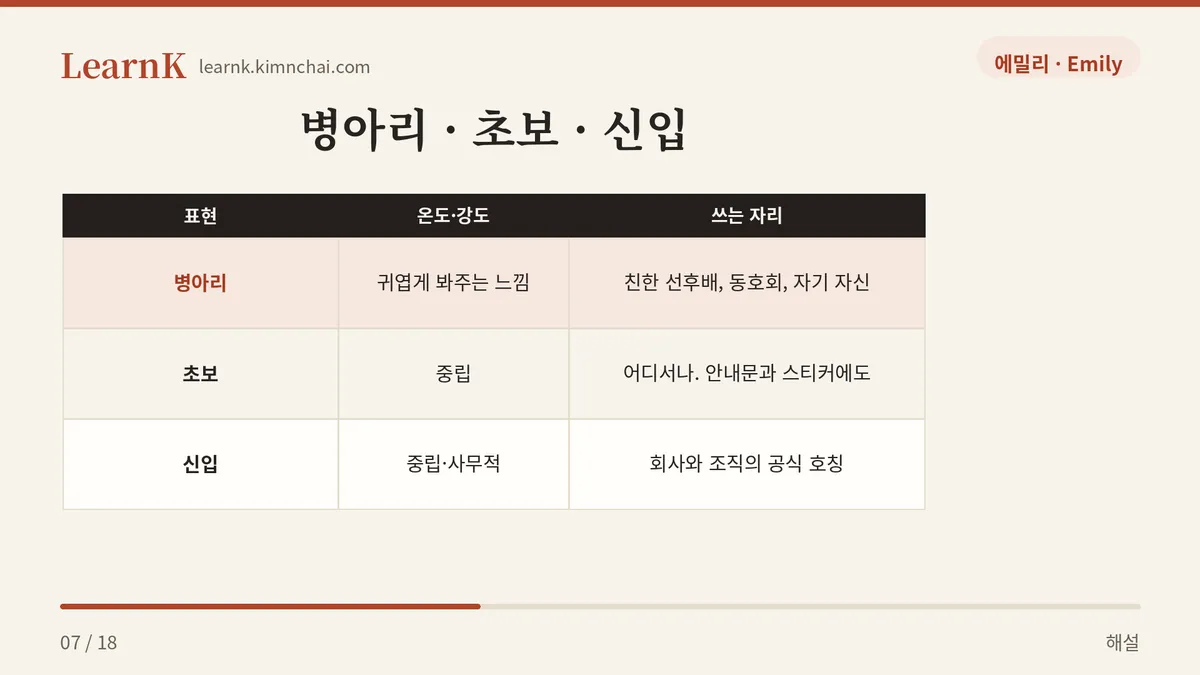
병아리 is a noun, so it carries no honorific level in itself. Politeness is decided only by the predicate that follows: 병아리예요 (byeongariyeyo) versus 병아리야 (byeongariya). Do remember, though, that adding polite endings does not erase the faint condescension the word carries when it points at someone else.
| Expression | Tone & strength | Where it’s used |
|---|---|---|
| 병아리 (byeongari) | Indulgent, affectionate, soft | Close seniors and juniors, hobby clubs. Especially comfortable about yourself |
| 햇병아리 (haetbyeongari) | An intensified 병아리; the weight falls on inexperience | Among peers. Be careful in front of the person themselves |
| 초보 (chobo) | Neutral | Anywhere. Even on signs and car stickers |
| 신입 (sinip) | Neutral, businesslike | The official term in companies and organizations |
| 쌩초보 (ssaengchobo) | Strong and self-deprecating | Mostly about yourself. Rude if aimed at someone else |
To sum up: when you’re stating a fact, use 초보 and 신입; when you’re putting feeling into it, use 병아리. That’s exactly why an official notice says 「신입 회원 모집 (sinip hoewon mojip)」, “recruiting new members,” and never 「병아리 모집 (byeongari mojip)」.
Cultural background — yellow backpacks and the chicks outside the school gate
In Korea, 병아리 is a word glued to childhood. Vendors used to sell boxed chicks outside elementary schools, and the memory of kids buying one for a few hundred won and then fretting over it for a few days is shared across several generations. That’s also where yellow got locked in as the color of “young and under protection.” Kindergarten buses are yellow, so are the backpacks of kids in the lower elementary grades, so are the child-safety signs. So the moment you call a new hire a 병아리, the listener’s mind automatically lights up with yellow and with the leniency of “well, they’re still young, what can you do.”
The chick sexing that showed up in the example sentences isn’t an unfamiliar topic in Korea either. Chick sexers were once a specialized profession that many Koreans took overseas, so they appeared often in news reports and documentaries. In other words, 병아리 is a fairy-tale word and an industrial-workplace word at the same time.
In TV dramas, this word turns up in an almost fixed spot. In stories starring a rookie detective, a rookie nurse, or a rookie reporter, it’s the line a gruff senior drops while covering for a mistake. Without quoting any actual dialogue, just describing the situation: the senior stands in front of the rookie who has caused trouble and takes the responsibility onto themselves, along the lines of “that one’s still a chick, so I’m taking them with me” — a scene Korean workplace dramas paint over and over. The cut that follows, of the rookie holding back tears after hearing that line, is practically part of the formula. So this word is both a name for immaturity and a signal that someone is taking responsibility for you.
Today’s quiz
Which of the following is the most natural situation for using 병아리?
- On the opening day of a new restaurant, a customer says it to a chef with thirty years of experience.
- Someone who has come to a hiking club for the very first time says it while introducing themselves to the members.
- Right after the department head finishes a presentation in a meeting, a subordinate says it to the department head.
The answer is 2. 병아리 fuses the fact of “I started not long ago” with the request “so please go easy on me” into a single lump, which makes it safest and most natural when you use it about yourself in a self-introduction. Option 1 doesn’t fit the meaning at all, since the career is long, and option 3 aims the word at someone senior to you, so it comes out rude.
Definitions and example sentences are from the National Institute of Korean Language’s Basic Korean Dictionary (krdict.korean.go.kr); that portion of this post, including our translations, is licensed under CC BY-SA 2.0 KR.