급식체 (geupsikche) — The Teen Slang Your Textbook Never Taught You
급식체
급식체 (geupsikche) is the umbrella term for the exaggerated, playful way of talking used by kids who are still eating school lunches — in other words, teenagers. It never shows up in a Korean textbook and no news anchor would ever say it, but scroll down the comments under a YouTube video or follow the subtitles on a variety show and it pops out every few seconds. This is usually the exact spot where a learner who has studied Korean for years suddenly crumbles and thinks, “I can’t speak any Korean at all.” It isn’t that they don’t know the grammar. It’s that these words run outside the grammar to begin with.
One thing to pin down first. 급식체 (geupsikche) is not words like 오지고 지리고 (ojigo jirigo) themselves — it’s the label you put on that whole family of words. Just as Korean has 구어체 (gueoche, spoken style) and 문어체 (muneoche, written style), it has 급식체 (geupsikche). Which is why the word gets used far more often by adults shaking their heads at speech they can’t follow than by the teenagers actually doing the talking.
The shapes 급식체 (geupsikche) takes fall into roughly four groups.
- Keeping only the initial consonants: 인정 (injeong, “agreed”) → ㅇㅈ, 리얼 (rieol, “for real”) → ㄹㅇ. You toss out bare consonants and the meaning still lands.
- Adding an intensifying prefix: 핵- (haek-), 개- (gae-). 핵꿀잼 (haekkkuljaem) means “seriously fun.”
- Rhyming chains: 오지고 지리고 (ojigo jirigo). Rhythm comes before meaning — existing words strung together by sound.
- Attaching -각 (-gak): 치킨각 (chikin-gak) means “now is the moment for fried chicken.” Stuck onto a noun, it creates the sense of “the setup for that / the signs point that way.”
Nuance matters too. The word grew out of an internet habit of calling teenagers 급식 (geupsik, “school-lunch kids”) as a put-down. So when someone says “그건 급식체야 (geugeon geupsikche-ya),” a judgment quietly tags along: childish, not much thought behind it. The word looks neutral on the surface, but its temperature is not lukewarm. Slap this label on someone’s way of speaking without knowing that, and you haven’t paid a compliment — you’ve picked a fight.
A Real Conversation
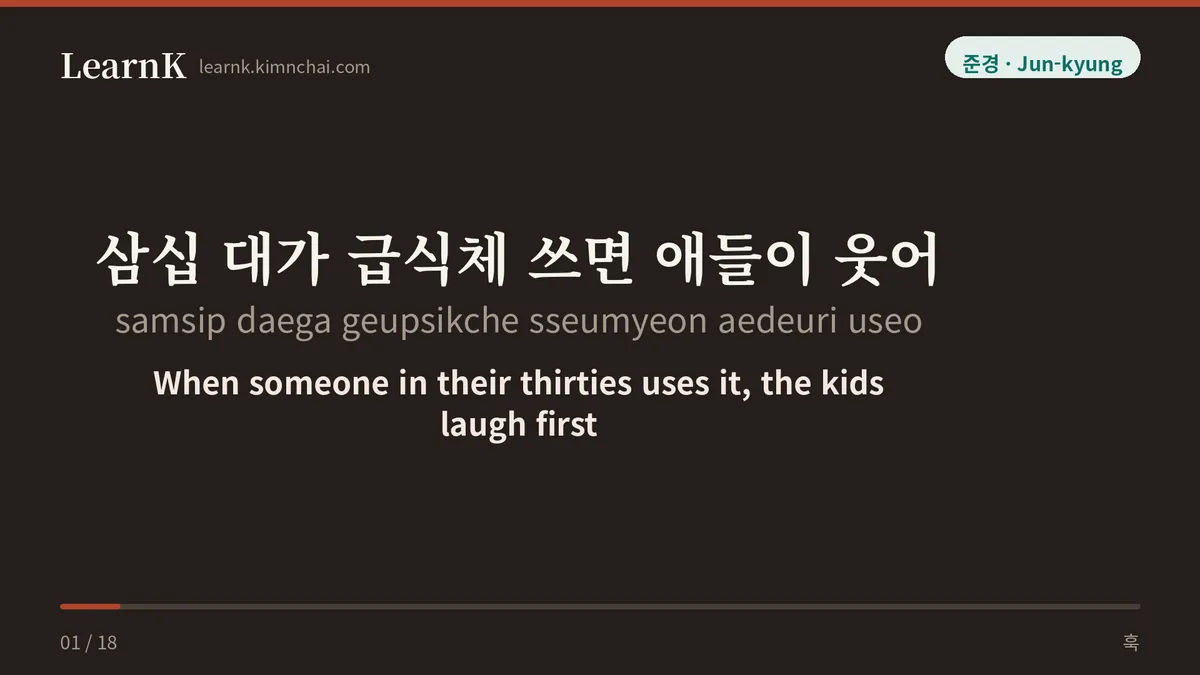
The scene: nine at night, an English academy class for middle schoolers has just let out. Emily, the instructor, and Jun-kyung, who has come to pick someone up, are standing at the foot of the academy building’s stairs.
Emily: 준경아, 아까 애들이 ‘이거 완전 레전드각이잖아’ 이러던데 그게 무슨 뜻이야? Jun-kyung, the kids were saying something like “this is totally legend-worthy” — what does that mean?
Jun-kyung: 아, 그거 급식체. 중고등학생들 쓰는 말투 있잖아. Ah, that’s geupsikche — you know, the way middle and high schoolers talk.
Emily: 급식? 밥이랑 무슨 상관이야? Geupsik? What does that have to do with school lunch?
Jun-kyung: 아직 학교 급식 먹는 나이라고 그렇게 불러. 걔네 특유의 말투가 급식체야. They call them that because they’re still eating school lunches. That age group’s own way of talking is geupsikche.
Emily: 나도 배워서 써 볼까? 애들이랑 좀 친해지게. Should I learn some and use it? To get closer to the kids.
Jun-kyung: 야, 하지 마. 삼십 대가 급식체 쓰면 애들이 제일 먼저 웃어. Hey, don’t. When someone in their thirties uses geupsikche, the kids are the first ones to laugh.
These Uses Sound Off
✗ (looking over a report a junior colleague wrote) 이거 말투가 좀 급식체 같은데? (igeo maltuga jom geupsikche gateunde?) — “The tone of this is kind of geupsikche, isn’t it?” ✓ (looking over a report a junior colleague wrote) 말투가 조금 구어체 같은데, 문어체로 다듬어 볼까요? (maltuga jogeum gueoche gateunde, muneoche-ro dadeumeo bolkkayo?) — “The tone reads a little conversational — shall we polish it into written style?” → 급식체 (geupsikche) carries an undertow of “young and thoughtless.” Used while evaluating someone’s writing, it doesn’t land as a note on style — it lands as an insult to the person.
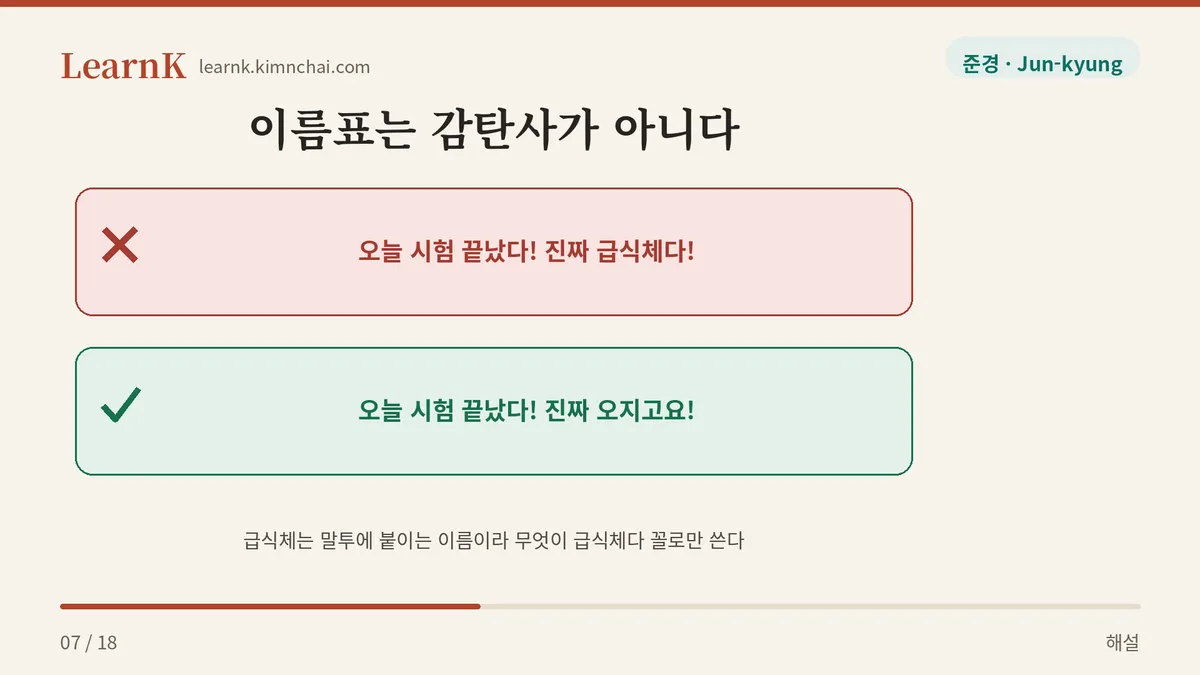
✗ 오늘 시험 끝났다! 진짜 급식체다! (oneul siheom kkeutnatda! jinjja geupsikche-da!) ✓ 오늘 시험 끝났다! 진짜 오지고요! (oneul siheom kkeutnatda! jinjja ojigoyo!) — “Exams are done today! This is so awesome!” Talking like this is 급식체 (geupsikche). → 급식체 (geupsikche) is neither an interjection nor an adjective. It’s a label you attach to a way of speaking, so it only works in the frame “X is 급식체.” To express delight, you use a word that belongs to 급식체 — not the name of the category itself.
Example Sentences by Situation
1. In a social media content meeting at work The team splits over an ad line aimed at teenagers. The marketer in charge puts the brakes on the side that wants to throw in buzzwords to look young.
“어설프게 급식체 흉내 내면 애들이 제일 먼저 알아채요.” (eoseolpeuge geupsikche hyungnae naemyeon aedeuri jeil meonjeo aracheyo) If we do a half-baked imitation of teen slang, the kids will be the first to notice.
2. Over dinner among parents of middle schoolers One of them sighs that their kid uses the same words at home as with friends. The tone is half exasperation, half affection.
“우리 애는 집에서도 급식체로 말해서 통역이 필요할 지경이야.” (uri aeneun jibeseodo geupsikche-ro malhaeseo tongyeogi piryohal jigyeongiya) My kid talks in teen slang even at home — I practically need an interpreter.
3. Among learners at a Korean study group Someone brings up that even after finishing every textbook, they still can’t keep up with their Korean friends’ group chats.
“교재는 다 뗐는데 급식체 앞에선 아직도 초보예요.” (gyojaeneun da ttaenneunde geupsikche apeseoneun ajikdo choboyeyo) I’ve finished all the textbooks, but I’m still a beginner when it comes to teen slang.
Polite and Casual Forms, and Related Words
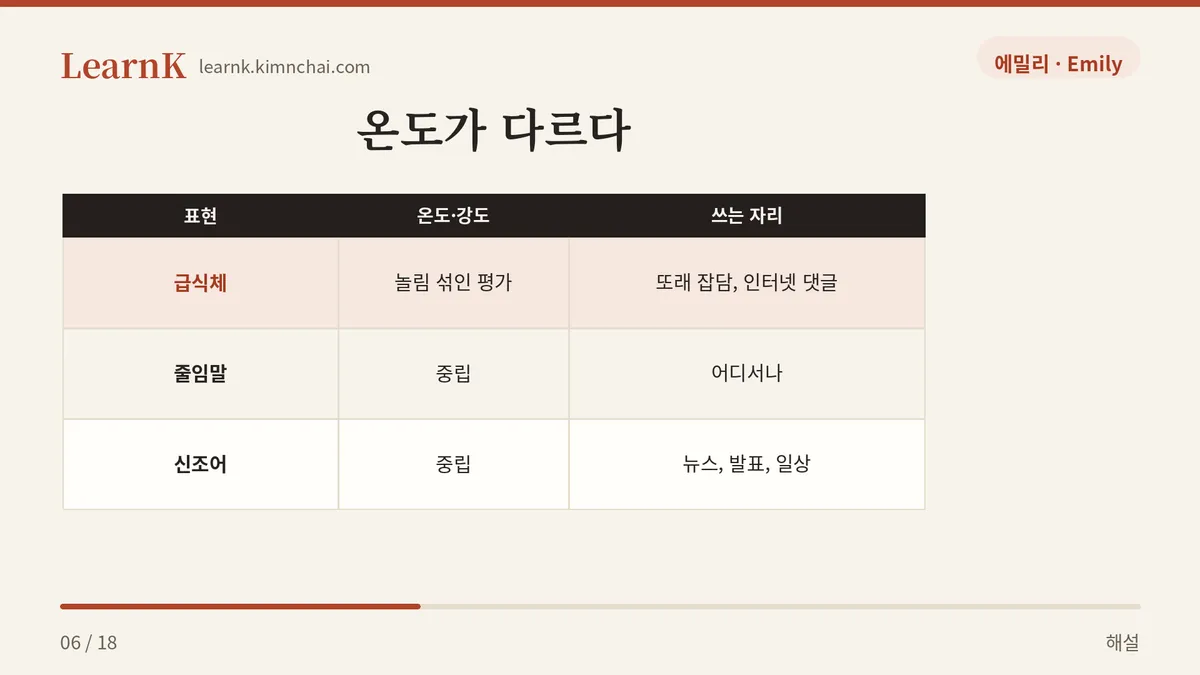
급식체 (geupsikche) is a noun, so shifting its level of formality is easy enough on its own. In 반말 (banmal, casual speech) it becomes 급식체야 (geupsikche-ya); in 존댓말 (jondaenmal, polite speech), 급식체예요 (geupsikche-yeyo) or 급식체입니다 (geupsikche-imnida). But remember that dressing the word in polite clothes doesn’t strip out the mockery baked into it. “팀장님 말투가 급식체이십니다 (timjangnim maltuga geupsikche-isimnida)” is not a polite sentence — it’s a fight pretending to be one. Formality and courtesy are two different things.
Here’s how the words that occupy similar ground compare.
| Expression | Temperature / Strength | Where it’s used |
|---|---|---|
| 급식체 (geupsikche) | An evaluation with mockery mixed in | Chatting among peers, internet comments. Careful in front of the person |
| 줄임말 (jurimmal) | Neutral. Unrelated to age | Anywhere |
| 신조어 (sinjoeo) | Neutral. Newly coined words in general | News, presentations, everyday conversation |
| 은어 (euneo) | Stiff and academic | Papers, articles, classrooms |
Even when the subject is identical, the word you choose reveals your attitude. In a presentation or a report, 십 대 신조어 (sip dae sinjoeo, “teen coinages”) is the safer pick; laughing about it with a friend, 급식체 (geupsikche) is far more vivid.
Cultural Background — The School Lunch Years
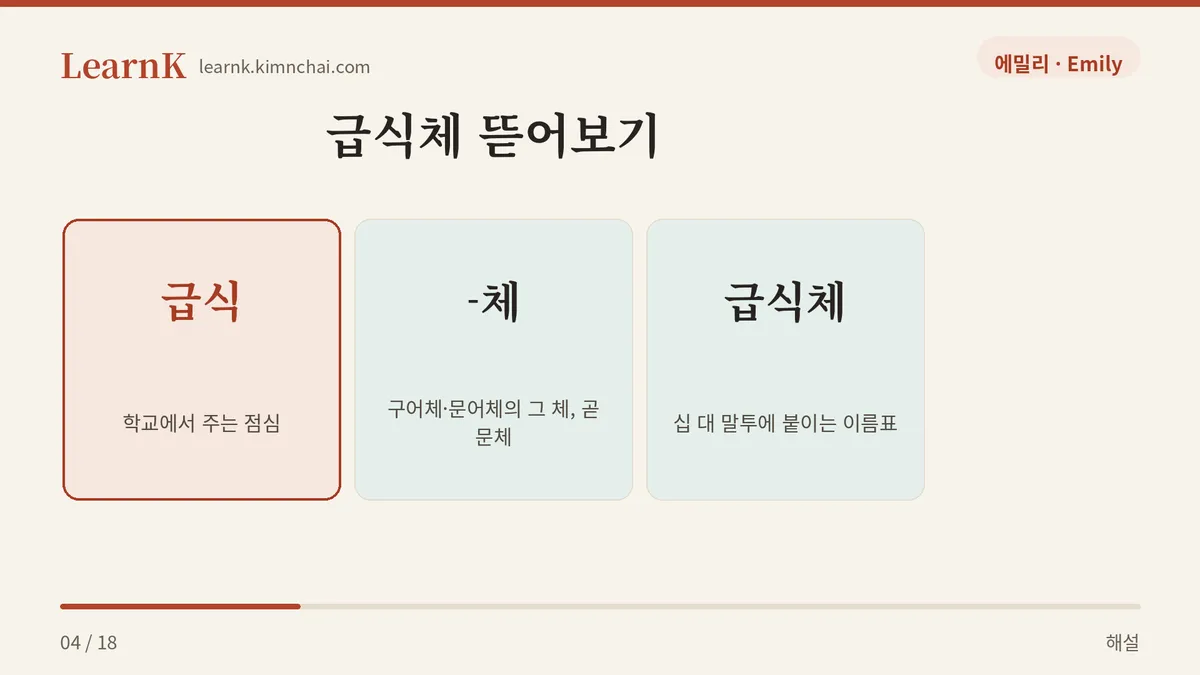
급식 (geupsik) is the lunch served at school, and -체 (-che) is the same -체 as in 구어체 (gueoche) and 문어체 (muneoche) — the one that means “style of speech or writing.” The internet-community habit of calling teenagers “kids who still eat school lunch” picked up that -체, and 급식체 (geupsikche) was born. It’s worth remembering that the beginning wasn’t kind. The edge has dulled a lot and it’s often a joke now, but there’s a put-down at the root.
In the late 2010s, variety show subtitles and YouTube carried this way of talking everywhere. Once broadcast subtitles started transcribing teenagers’ speech word for word and putting it on screen, language that had circulated only among peers was suddenly laid out in front of the whole country. In youth dramas and school-set shows, how well the teen speech is captured often becomes the line between “realistic” and “not.” Teen dialogue imagined by adults gives itself away in a single line.
Layered on top of that is the famously short lifespan of Korean buzzwords. The teenagers who made 급식체 (geupsikche) popular are now in their late twenties, and today’s teenagers use something else entirely. So the people working hardest at 급식체 (geupsikche) these days aren’t teenagers at all — they’re the people who were teenagers back then. That’s exactly why “an adult using 급식체” is a punchline. Not because they’re behind the times, but because they’ve set aside the language of their own age to borrow someone else’s.
The practical conclusion for learners is clear. 급식체 (geupsikche) is best kept as vocabulary you understand but don’t produce. Once you know what it means, your Korean friends’ group chats suddenly become readable and variety show subtitles come into focus. But the moment you use it yourself, you take on the risk of misjudging your age and the setting. That’s why Jun-kyung talked even Emily out of it — and she’s fifteen years into her Korean.
Today’s Quiz
Which of the following uses 급식체 (geupsikche) most naturally?
- 오늘 소풍 진짜 급식체였어! (oneul sopung jinjja geupsikche-yeosseo!)
- 조카 카톡이 전부 급식체라 한 줄도 못 알아듣겠어. (joka katogi jeonbu geupsikche-ra han juldo mot aradeutgesseo.)
- 부장님, 요청하신 회의 자료를 급식체로 정리했습니다. (bujangnim, yocheonghasin hoeui jaryoreul geupsikche-ro jeongnihaetseumnida.)
Answer: 2. 급식체 (geupsikche) is a label you attach to a way of speaking, so it’s used in the frame “X is 급식체.” Number 1 drops it into an interjection or adjective slot, which sounds off, and number 3 amounts to running down your own document — enough to freeze the air in the meeting room.
Definitions and example sentences are from the National Institute of Korean Language’s Basic Korean Dictionary (krdict.korean.go.kr); that portion of this post, including our translations, is licensed under CC BY-SA 2.0 KR.