한복 (hanbok) — Not Just the Outfit You Pull Out on Seollal Morning
On the first morning of the Seollal holiday, the apartment elevator doors open and someone is standing there dressed nothing like usual. Roomy sleeves, a skirt hem falling all the way to the tops of the feet — and beside her, a child in a 저고리 (jeogori) banded with stripes of color. 한복 (hanbok) means ‘traditional Korean clothing.’ It’s a word for holiday mornings, for the 폐백 (pyebaek) bowing ceremony at weddings, for a baby’s first-birthday party — and these days, a word that goes back and forth several times an hour along the stone walls of Gyeongbokgung Palace.
For someone learning Korean, the hard part of this word isn’t its meaning — it’s knowing where it belongs. 한복 (hanbok) is not everyday clothing. But it isn’t something that lives only behind museum glass either. It’s a garment pulled from the back of the closet on two or three special mornings a year, and at the same time a garment you can now wear to a café on a weekday afternoon without a single person turning to look. You need both of these faces to use the word 한복 (hanbok) without sounding off.
The grammar isn’t demanding. It’s a noun, and the verb that attaches to it most often is 입다 (ipda), ‘to wear.’ From there it branches out. 한복을 차려입다 (hanbogeul charyeoipda) means to put it on properly and formally, so the phrase carries a whiff of compliment. 한복을 맞추다 (hanbogeul matchuda) means not buying off the rack but ordering one made to fit your body, and 한복을 대여하다/빌리다 (hanbogeul daeyeohada / billida) is the modern way — renting one for two hours from a shop near a tourist site. On holiday mornings you’ll especially hear 한복으로 갈아입다 (hanbogeuro garaipda): taking off your pajamas or ordinary clothes and changing into that other outfit — a phrase that holds the moment the character of the whole day shifts.
Checking it in the National Institute of Korean Language dictionary
한복 [명사] 한국의 전통 의복. [en] hanbok — Traditional Korean clothes. [ja] ハンボク【韓服】 — 韓国の伝統衣装。 [es] hanbok, traje coreano — Traje tradicional de Corea. [zh] 韩服 — 韩国的传统服装。 — National Institute of Korean Language, Basic Korean Dictionary (krdict.korean.go.kr)
The dictionary carries no Portuguese definition. For reference, it would come out roughly as hanbok — traje tradicional coreano, and that single line is our own translation, not a quotation from the dictionary.
Let’s read the dictionary’s actual usage examples in the original. You can see at a glance which scenes this word gets placed in.
설날 아침에 우리 가족은 한복으로 옷을 갈아입고 할아버지 댁에 갔다. — National Institute of Korean Language, Basic Korean Dictionary (krdict.korean.go.kr)
→ The most typical setting of all. (Seollal achime uri gajogeun hanbogeuro oseul garaipgo harabeoji daege gatda. ‘On Seollal morning our family changed into hanbok and went to Grandfather’s house.’) The key is that 갈아입고 (garaipgo) and 할아버지 댁 (harabeoji daek) sit in the same sentence. Changing clothes is the preparation for going to bow.
할머니는 각색의 옷감으로 색동 한복을 지어 주셨다. — National Institute of Korean Language, Basic Korean Dictionary (krdict.korean.go.kr)
→ (Halmeonineun gaksaegui otgameuro saekdong hanbogeul jieo jusyeotda. ‘Grandmother made me a saekdong hanbok out of cloth of many colors.’) 색동 (saekdong) is a pattern of differently colored fabrics joined in horizontal bands, used mostly for children’s clothes. The phrase 지어 주셨다 (jieo jusyeotda) reveals that this garment wasn’t bought for the child — it was made by hand for her.
한복을 곱게 차려 입은 예쁜 각시가 마당 한가운데 수줍게 서 있었다. — National Institute of Korean Language, Basic Korean Dictionary (krdict.korean.go.kr)
→ (Hanbogeul gopge charyeo ibeun yeppeun gaksiga madang hangaunde sujupge seo isseotda. ‘A pretty young bride, beautifully dressed in hanbok, stood shyly in the middle of the yard.’) This sentence shows just how often 곱게 차려 입다 (gopge charyeo ipda) travels together with 한복. 각시 (gaksi) is an old-fashioned word for a newly married woman, so you can tell this is a wedding scene.
어머니는 일상생활에 편리하도록 한복을 간결하게 개량해서 입으셨다. — National Institute of Korean Language, Basic Korean Dictionary (krdict.korean.go.kr)
→ (Eomeonineun ilsangsaenghware pyeollihadorok hanbogeul gangyeolhage gaeryanghaeseo ibeusyeotda. ‘Mother wore hanbok that she had simplified and adapted to be convenient for daily life.’) Here the word 개량 (gaeryang, ‘adaptation, improvement’) appears. The roots of 개량한복 and 생활한복, which come up later, are right here in this sentence.
유명 디자이너가 한복을 현대적인 감각으로 표현한 새로운 디자인을 소개하였다. — National Institute of Korean Language, Basic Korean Dictionary (krdict.korean.go.kr)
→ (Yumyeong dijaineoga hanbogeul hyeondaejeogin gamgageuro pyohyeonhan saeroun dijaineul sogaehayeotda. ‘A famous designer introduced new designs expressing hanbok with a modern sensibility.’) The sense here is that hanbok is not merely an object of preservation but a garment still being newly made today. It’s a sentence pattern you’ll often see in news and fashion articles.
Seeing it in a real conversation
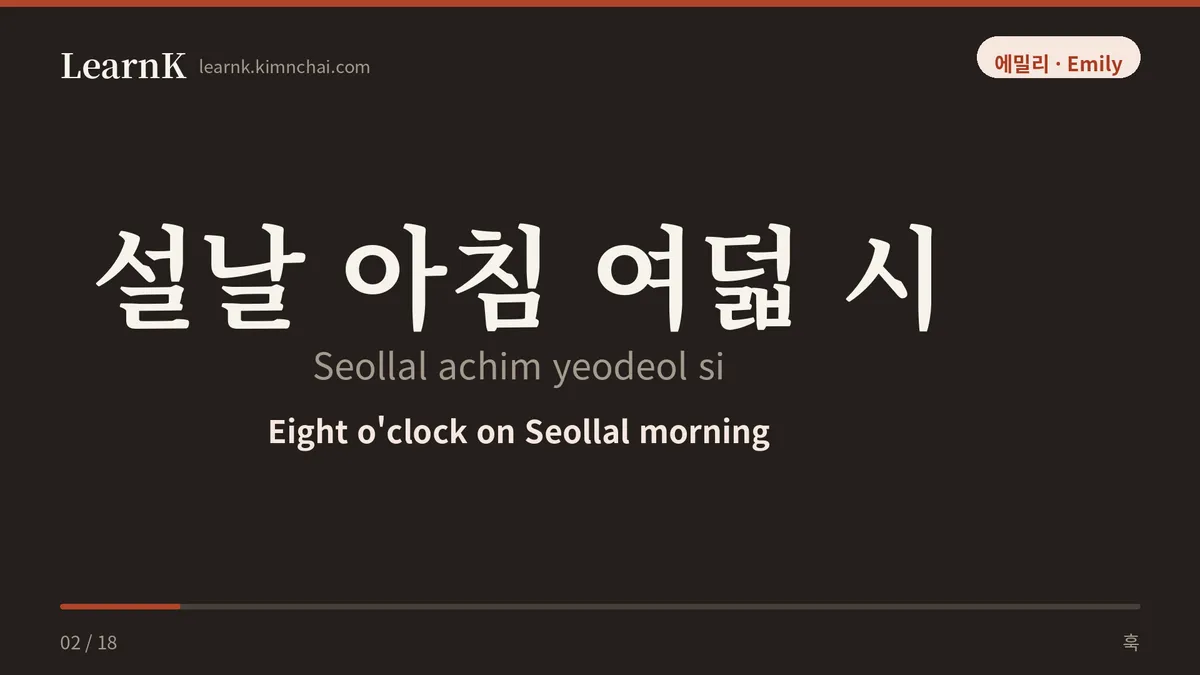
Situation: Eight o’clock on Seollal morning. The living room of Jun-kyung’s family home. Emily, who has been invited over, has just arrived carrying a big garment bag.
Jun-kyung: 어, 왔어? 근데 그 가방은 뭐야. 설마 갈아입을 옷 가져온 거야? Oh, you’re here. What’s with the bag? Don’t tell me you brought a change of clothes.
Emily: 응. 작년에 광장시장에서 한복 맞췄거든. 오늘 아니면 언제 입어. Yeah. I had a hanbok made at Gwangjang Market last year. If not today, then when?
Jun-kyung: 야, 진짜 잘 가져왔다. 우리 할머니 보시면 엄청 좋아하시겠는데. Wow, good call. My grandma’s going to be thrilled.
Emily: 근데 나 아직도 고름 매는 게 안 돼. 이것 좀 봐 줘. But I still can’t tie the goreum. Give me a hand with this.
Jun-kyung: 어… 사실 나도 잘 몰라. 엄마! 여기 한복 고름 좀 매 주세요! Uh… honestly, I don’t really know either. Mom! Can you come tie this hanbok ribbon?
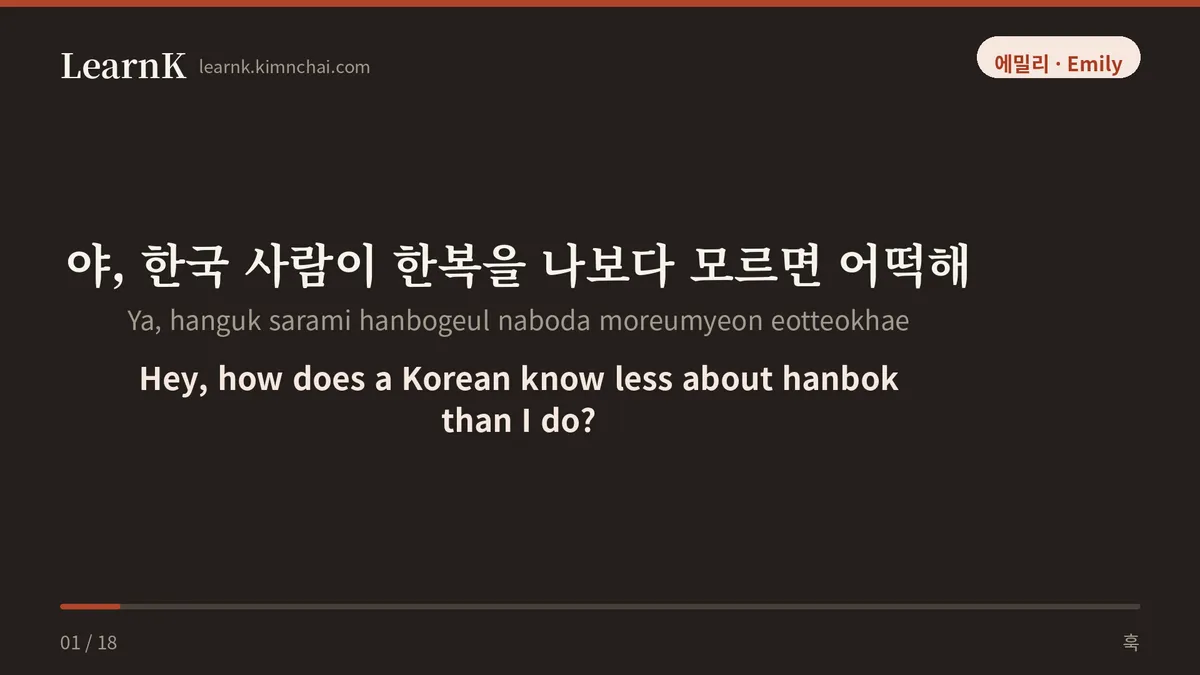
Emily: 야, 한국 사람이 한복을 나보다 모르면 어떡해. Hey, how does a Korean know less about hanbok than I do?
These usages sound off
한복 (hanbok) is the name of an object, so it looks like there’s no wrong place to put it — but there are two spots where learners genuinely trip.
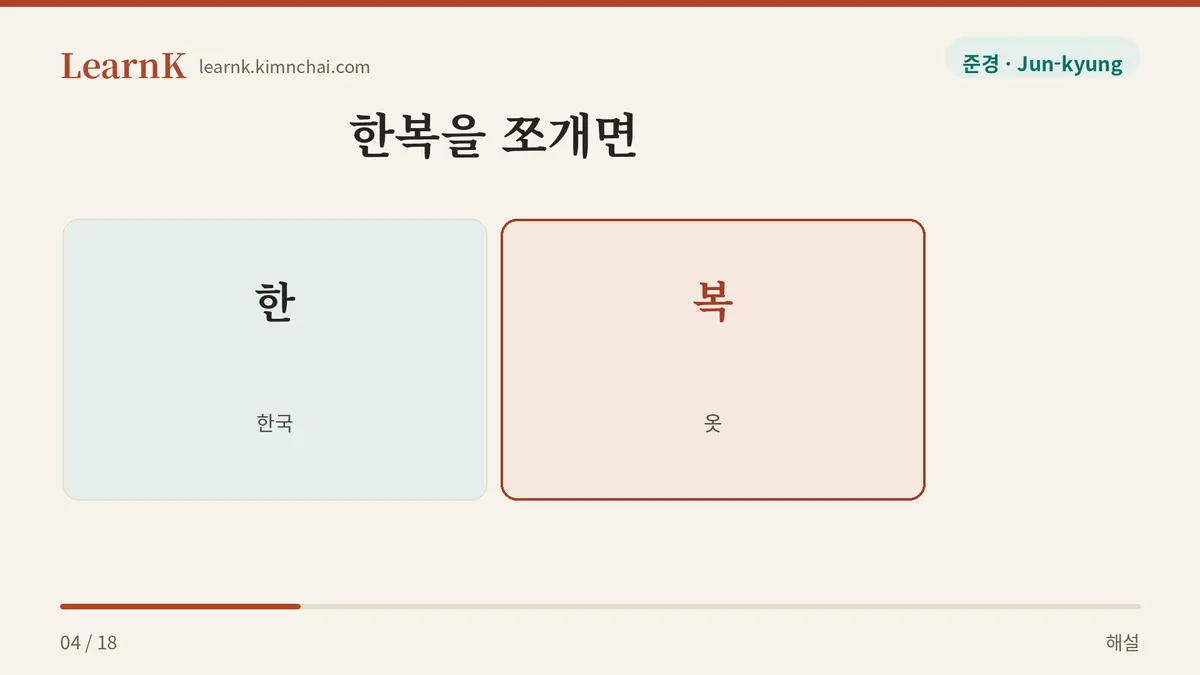
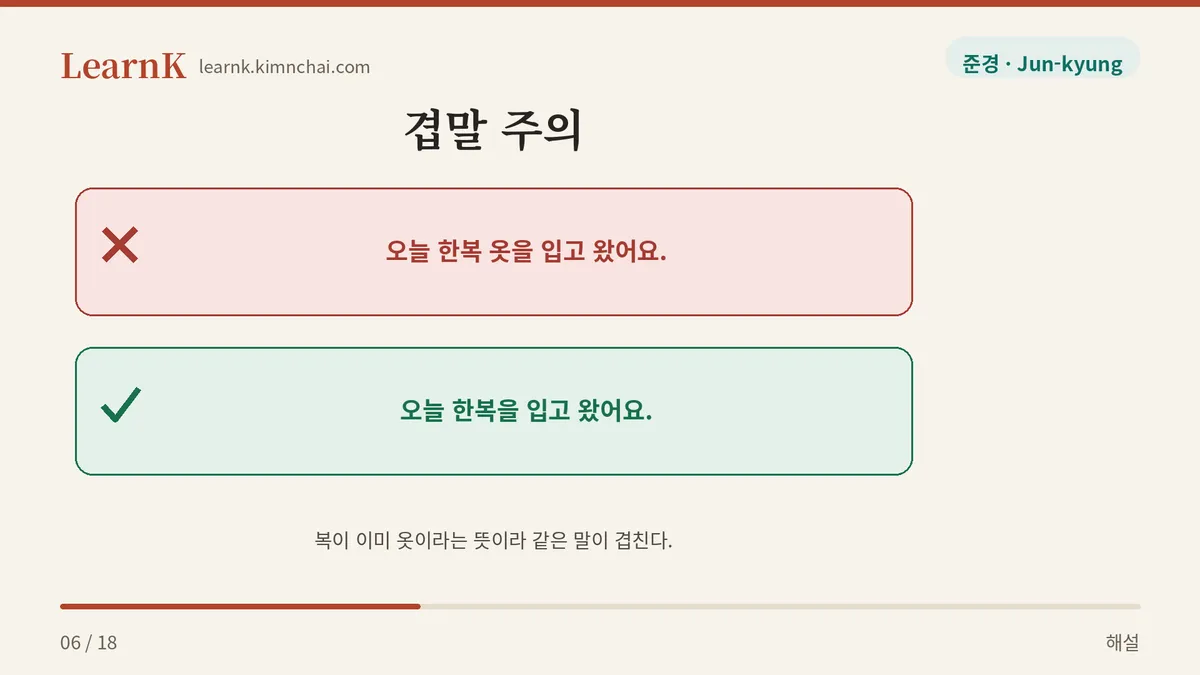
✗ 오늘 한복 옷을 입고 왔어요. ✓ 오늘 한복을 입고 왔어요. → The 복 (服) in 한복 (韓服) already means ‘clothing.’ 한복 옷 stacks the same word twice, and it snags the ear. Native speakers almost never use this combination.
✗ (to an elder who has arrived dressed in hanbok) 할머니, 오늘 한복 코스프레 하셨네요! ✓ (to an elder who has arrived dressed in hanbok) 할머니, 오늘 한복 곱게 차려입으셨네요. → The grammar is fine, but the temperature is off. 코스프레 (koseupeure, ‘cosplay’) frames clothing as a costume thrown on for fun, so saying it to an elder who dressed with care makes light of both the garment and the occasion. When you want to pay a compliment, 곱다 (gopda), 차려입다 (charyeoipda), and 잘 어울리다 (jal eoullida) are the safe choices.
Example sentences by situation
1. Talking about a friend’s wedding
The part after the ceremony where the bride and groom bow to the elders of both families is called 폐백 (pyebaek). The outfit worn for it is often prepared separately.
어머님이 폐백 한복을 직접 맞추셨대요. (Eomeonimi pyebaek hanbogeul jikjeop matchusyeottaeyo.) — I hear his mother had the pyebaek hanbok custom-made herself.
2. Making weekend plans
Seoul’s old palaces don’t charge admission to visitors wearing hanbok, so rental shops are lined up right outside the gates.
한복 빌려 입고 가면 입장료 안 내도 돼. (Hanbok billyeo ipgo gamyeon ipjangnyo an naedo dwae.) — If you rent a hanbok and wear it there, you don’t have to pay admission.
3. At the office on a weekday morning
Seeing a coworker who has come in wearing something hanbok-ish on a completely ordinary day.
어? 그거 생활한복이에요? 되게 편해 보이네요. (Eo? Geugeo saenghwal-hanbogieyo? Doege pyeonhae boineyo.) — Oh? Is that a saenghwal-hanbok? It looks really comfortable.
Politeness levels and similar expressions
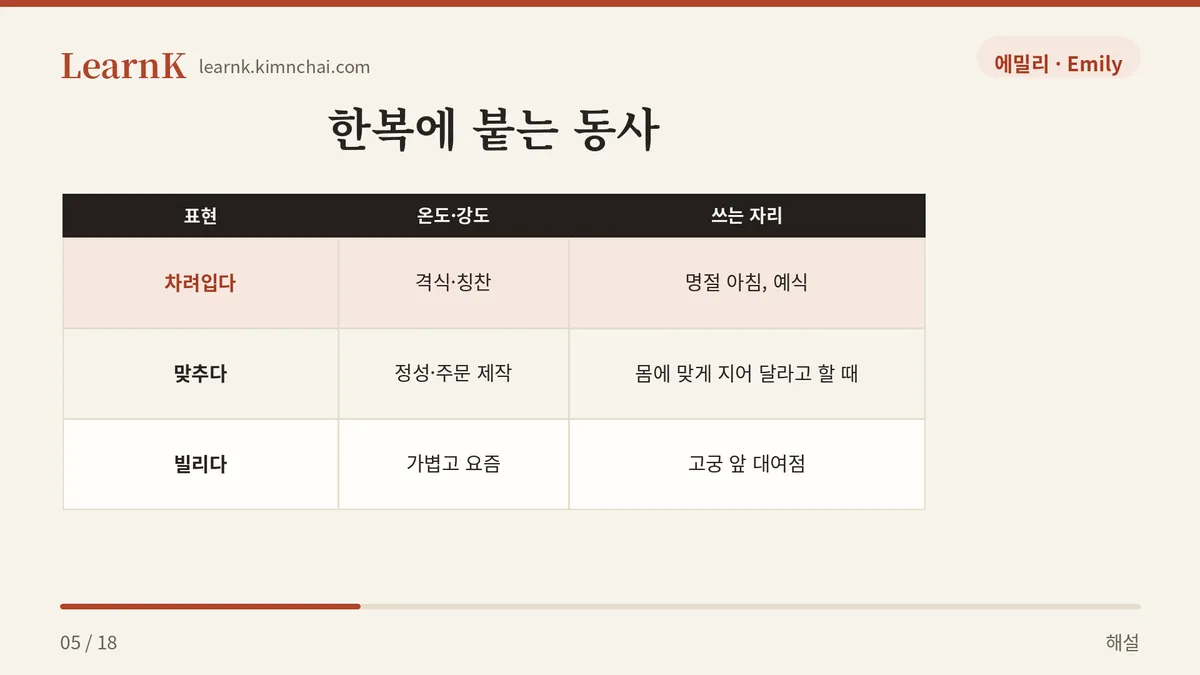
한복 (hanbok) is a noun, so the word itself doesn’t change between polite and casual speech. The honorifics are all carried by the verb. To an elder, it isn’t 한복을 입었네요 but 한복을 입으셨네요 (hanbogeul ibeusyeonneyo), and more politely still, 한복을 차려입으셨네요 (hanbogeul charyeoibeusyeonneyo). There’s no need to swap the garment itself for a stiffer word like 의복 (uibok, ‘apparel’).
The words around it have different textures, so let’s line them up in a table.
| Expression | Tone / intensity | Where it’s used |
|---|---|---|
| 한복 (hanbok) | Neutral, the default | Anywhere — holidays, ceremonies, introductions, the news |
| 생활한복 (saenghwal-hanbok) | Comfortable, contemporary | Hanbok worn as everyday clothes; common in shop and online-store names |
| 개량한복 (gaeryang-hanbok) | Explanatory, slightly dated | For clothing whose traditional form has been reworked for practicality |
| 색동옷 (saekdongot) | Affectionate, childlike | First-birthday parties, Seollal. Never used for adult clothing |
| 전통 의상 (jeontong uisang) | Stiff and objective | Comparisons between countries, informational signage, presentations |
Foreign learners sometimes take a liking to 전통 의상 (jeontong uisang), but it’s barely used in everyday conversation. With a friend, plain 한복 (hanbok) is plenty; 전통 의상 only really fits when you’re lining up the clothing of several countries side by side.
Cultural background — a name that only appeared after Western suits arrived
한복 (hanbok) is a Sino-Korean word: 韓 (Korea) + 服 (clothing). What’s interesting is that the name isn’t nearly as old as you’d expect. Back when Koreans wore nothing else, there was no reason to give it a name — it was just ‘clothes.’ Only when Western-style clothing, 양복 (yangbok, 洋服), arrived and two kinds of garment came to hang side by side in the closet did anyone need a word to tell them apart. The appearance of a name means the appearance of something to compare it against. Even today, 양복 (yangbok) and 한복 (hanbok) are used together as a matched pair.
The construction is simple. Women wear a 저고리 (jeogori, a short jacket) and a 치마 (chima, skirt); men wear a 저고리 (jeogori) and 바지 (baji, trousers), with a 두루마기 (durumagi, overcoat) thrown on top. There’s one hurdle that trips up learners and young Koreans in equal measure, and it showed up in the dialogue above: 고름 (goreum). It’s the long ribbon that fastens the front of the jeogori — no buttons, no zipper — so when you only tie it once a year, your hands go stiff every time as if it were the first. ‘How does this go again?’ drifting around the living room on a holiday morning is a very familiar scene.
The occasions where hanbok appears are fairly fixed: 세배 (sebae, the New Year bow) on the mornings of Seollal and Chuseok, 돌잔치 (doljanchi) for a baby’s first birthday, 폐백 (pyebaek) at a wedding, and celebrations like an elder’s sixtieth birthday, 회갑 (hoegap). What they all share is that people gather and bows are made. In dramas, of course, the place you’ll see hanbok for the longest stretch is a historical drama. Put the palace costumes of Dae Jang Geum (MBC, 2003) next to the turn-of-the-century dress of Mr. Sunshine (tvN, 2018), and you can see with your own eyes how much sleeve width, skirt length, and color shift from era to era, even within the single word 한복.
The changes happening now are no small thing either. As the dictionary examples show, designers are putting out new designs with a modern sensibility, and saenghwal-hanbok — with zippers added or lengths shortened — sells as ordinary clothing. Thanks to free palace admission, the area in front of Gyeongbokgung on a weekend is crowded with people fresh out of the rental shops. So today, 한복을 입었다 (hanbogeul ibeotda), ‘I wore hanbok,’ points to one of two scenes: an early morning when it came out of the closet on the way to bow to the elders, or an afternoon of taking photos with friends in front of a palace. Which one it is, the surrounding context will tell you.
Today’s quiz
On Seollal morning, a grandmother sees her granddaughter beautifully dressed in a 색동저고리 (saekdong-jeogori). Which would be the most natural thing for her to say?
① 우리 손녀, 한복 코스프레 잘 어울리네. ② 우리 손녀, 한복 옷 예쁘게 입었네. ③ 우리 손녀, 한복 곱게 차려입었네.
Show the answer
The answer is ③. The 코스프레 in ① treats the outfit as a play costume, which doesn’t match the temperature of a holiday morning. The 한복 옷 in ② doubles up, since 복 (服) already means ‘clothing.’ And the 곱게 차려입다 (gopge charyeoipda) in ③ is the phrase that pairs most naturally with hanbok — it appears in the dictionary examples word for word.
Definitions and example sentences are from the National Institute of Korean Language’s Basic Korean Dictionary (krdict.korean.go.kr); that portion of this post, including our translations, is licensed under CC BY-SA 2.0 KR.