저희 (jeohui) — The Word That Bows From the Very First Word
저희
저희 (jeohui) is 우리 (uri), “we / our,” taken down one notch. It is a humble form: a speaker uses it in front of someone of higher standing to refer to a group of people that includes themselves, or to something attached to their own side. If you have ever watched a Korean drama where a new hire faces an executive and says “저희 팀이 준비했습니다 (jeohui timi junbihaetseumnida — our team put this together),” or a shop owner greets a customer with “저희 매장은요 (jeohui maejangeunyo — well, our store…),” you have already heard this word dozens of times. The meaning is exactly the same as 우리 (uri). What changes is not the meaning — it’s the height.
Learners are usually taught that Korean politeness is decided at the end of the sentence: add -요 (-yo) and it’s polite, leave it off and it’s casual. But 저희 (jeohui) bows before the sentence ever gets there — right at the subject slot. From the very first word out of your mouth, it announces, “I am speaking from the lower position here.” That’s why a learner who reaches for 저희 (jeohui) at the right moment gives the impression of “this person knows Korean manners,” even when their grammar wobbles a little. Conversely, opening a job interview with “우리 학교에서는… (uri hakgyoeseoneun… — at our school…)” isn’t a wrong sentence, but something about it lands stiff.
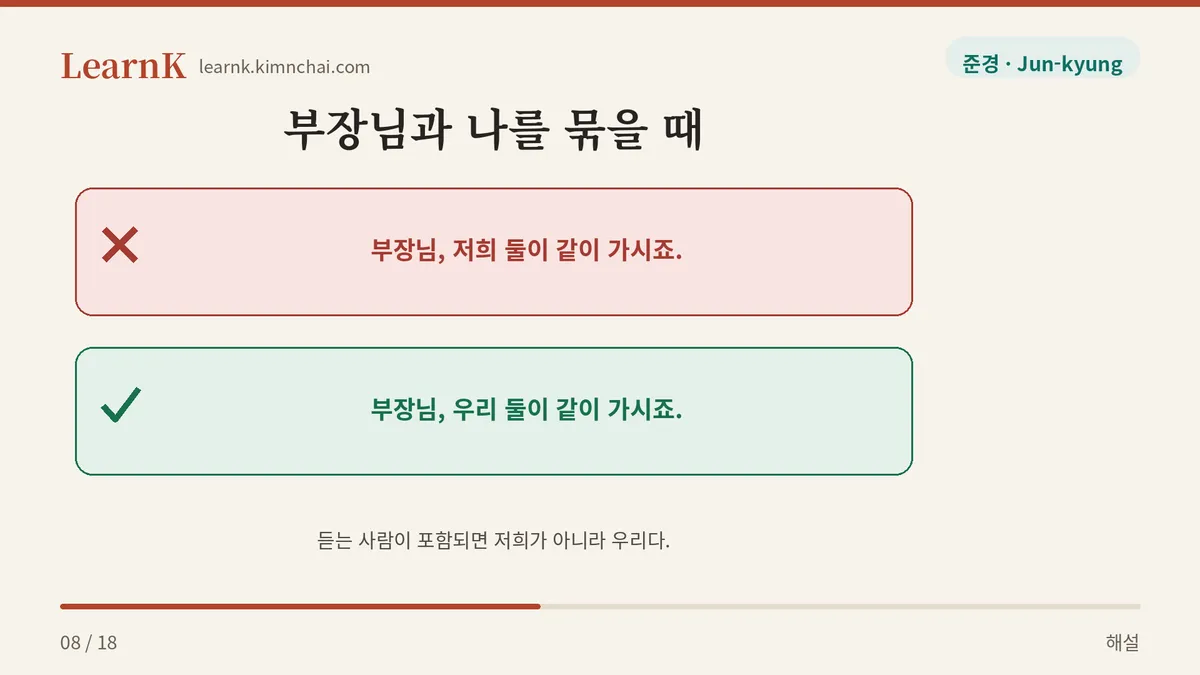
The most important rule is this. What 저희 (jeohui) lowers is me and the people on my side. The listener is not inside it. If you bundle your department head together with yourself and say “저희 둘이 갈까요? (jeohui duri galkkayo? — shall the two of us go?),” you’ve just lowered your boss too. A “we” that includes the person you’re talking to is plain 우리 (uri), no matter how senior they are. 저희 (jeohui) is a word that always begins by drawing a line: our side versus you.
Checking It in the National Institute of Korean Language Dictionary
저희 (jeohui) (pronoun)
A word the speaker uses toward someone of higher standing to refer to a group of people that includes themselves. [en] our — A word used by the speaker to refer to a group of people including himself/herself when speaking to another person who is superior to him/her. [ja] わたくしたち【私達】。じぶんたち【自分達】 — 話し手が目上の人に自分を含めた複数の人を指していう語。 [es] nosotros — Palabra que usa el hablante para señalar a varias personas incluyendo a sí mismo a un persona superior que él. [zh] 我们 — 说话人指代自己在内的一些人。
A word the speaker uses toward someone of higher standing to refer, with a touch of affection, to something related to themselves. [en] our — A word used by the speaker to endearingly refer to something related to himself/herself when speaking to another person who is superior to him/her. [ja] わたくし【私】。じぶん【自分】 — 話し手が目上の人に自分に関することを親しんでいう語。 [es] nuestro, nuestra — Palabra que usa el hablante para señalar íntimamente lo relacionado consigo mismo delante de un persona superior a él. [zh] 我们 — 说话人亲切地指代与自己有关的一些对象。一般对比自己身份地位高的人使用。
A word that points back at people already mentioned or already introduced. [en] they — A word that refers to people that were already mentioned or appeared. [ja] かれら【彼等】。あれら【彼等】 — 前に言及した人たちを再び指す語。 [es] nosotros — Palabra que se usa para señalar de nuevo a la persona que ya se ha mencionado o que ha aparecido anteriormente. [zh] 那些人 — 重指前面已说过或出现过的人群。
— National Institute of Korean Language, Basic Korean Dictionary (krdict.korean.go.kr)
The Portuguese gloss is not carried in this dictionary, so the following is our own translation (not the dictionary’s original text). [pt] nosso, nossa — palavra que o falante usa diante de alguém superior para se referir humildemente a um grupo que o inclui, ou a algo relacionado a si.
Set definitions 1 and 2 side by side and you can see the two faces of 저희 (jeohui). The first is a bundle of people — 저희 부서 (jeohui buseo, our department), 저희 가족 (jeohui gajok, our family). The second is something belonging to my side — 저희 집 (jeohui jip, our house), 저희 회사 (jeohui hoesa, our company), 저희 미술관 (jeohui misulgwan, our art museum). The one learners actually end up using more often is the second. In Korea, this lowering comes out almost automatically whenever you mention your own home, your own company, or your own shop to someone else. Definition 3 — pointing back at people already mentioned — is closer to an older, bookish usage, and you’ll rarely run into it in everyday conversation.
Here are real example sentences from the dictionary.
- 어머니, 아버지, 저희들 가르치시느라고 고생 많으셨죠? (eomeoni, abeoji, jeohuideul gareuchisineurago gosaeng maneusyeotjyo?) — Mom, Dad, it must have been so hard putting us through school.
- 그럼 저희 부서부터 발표하겠습니다. (geureom jeohui buseobuteo balpyohagetseumnida.) — Then our department will present first.
- 선생님, 이게 저희 집안에서 소장하고 있던 도자기인데 감정가가 얼마나 될까요? (seonsaengnim, ige jeohui jibaneseo sojanghago itdeon dojagiinde gamjeonggaga eolmana doelkkayo?) — Sir, this is a piece of pottery our family has kept for generations — what would you appraise it at?
- 네, 저희 미술관은 전문가가 진품이라고 감정한 작품들만 전시하고 있어요. (ne, jeohui misulganeun jeonmungaga jinpumirago gamjeonghan jakpumdeulman jeonsihago isseoyo.) — Yes, our museum only exhibits works that experts have authenticated as genuine.
— National Institute of Korean Language, Basic Korean Dictionary (krdict.korean.go.kr)
- 어머니, 아버지, 저희들…: This is a child speaking to their parents, bundling the siblings together. The plural suffix -들 (-deul) is tacked on after 저희 (jeohui) to make 저희들 (jeohuideul) — doubling up like this is common when referring to people. Even inside the family, the sense that parents are unmistakably the seniors comes through intact.
- 그럼 저희 부서부터…: A meeting room with several departments gathered. When you put your own department forward in front of others, you lower it. This is a sentence pattern worth memorizing whole as an opening line for presentations.
- 선생님, 이게 저희 집안에서…: The words of someone who has come to ask for an appraisal. The expert is raised with 선생님 (seonsaengnim) while the speaker’s own family is lowered with 저희 (jeohui) — two directions of politeness working at once inside a single sentence.
- 네, 저희 미술관은…: The words of the side serving a customer. This is the 저희 (jeohui) you’ll hear most often in Korean shops, clinics, and hotels. The customer is always placed in the higher seat.
See It in a Real Conversation
Situation: the evening before Chuseok, in the kitchen of Jun-kyung’s family home. They’re frying jeon, and his uncle and aunt arrive in ten minutes.
Jun-kyung: 큰아버지 곧 오신대. 기름 냄새 빼게 창문 좀 열어 줘. My uncle’s arriving soon. Open the window to air out the oil smell.
Emily: 어, 근데 나 아까 통화할 때 “우리 집에서 뵈어요” 했는데 그거 이상했나? Oh — but on the phone earlier I said “see you at our place.” Was that weird?
Jun-kyung: 어른한테는 “저희 집에서 뵈어요”가 자연스럽지. 뜻은 똑같은데 한 칸 낮춰 드리는 거야. To an elder, “jeohui house” sounds better. Same meaning, you just lower yourself a notch.
Emily: 아 맞다. 근데 너한테는 그냥 우리 집이지? Right. But with you it’s just “uri jip,” yeah?
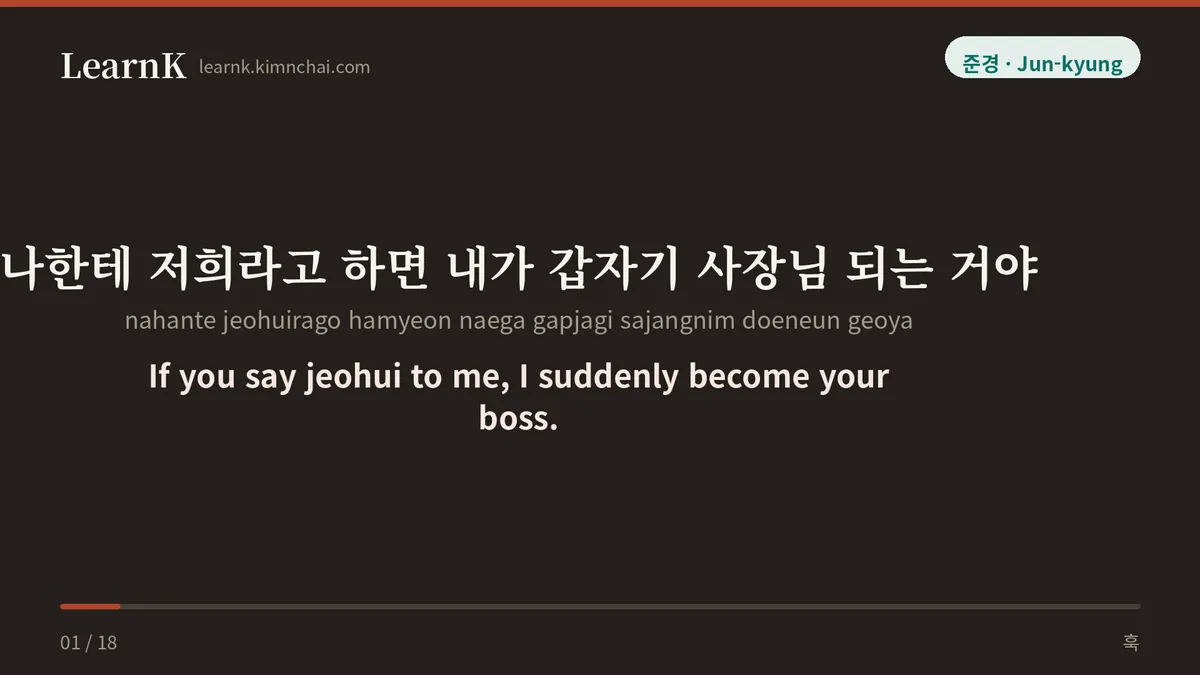
Jun-kyung: 응. 나한테 저희라고 하면 내가 갑자기 사장님 되는 거야. Yeah. If you say “jeohui” to me, I suddenly become your boss.
Emily: 하하, 그건 좀. 그럼 이따 “저희가 전 다 부쳤어요” 이러면 되겠다. Haha, no thanks. So later I’ll say “we fried all the jeon.”
This Is Where It Sounds Off
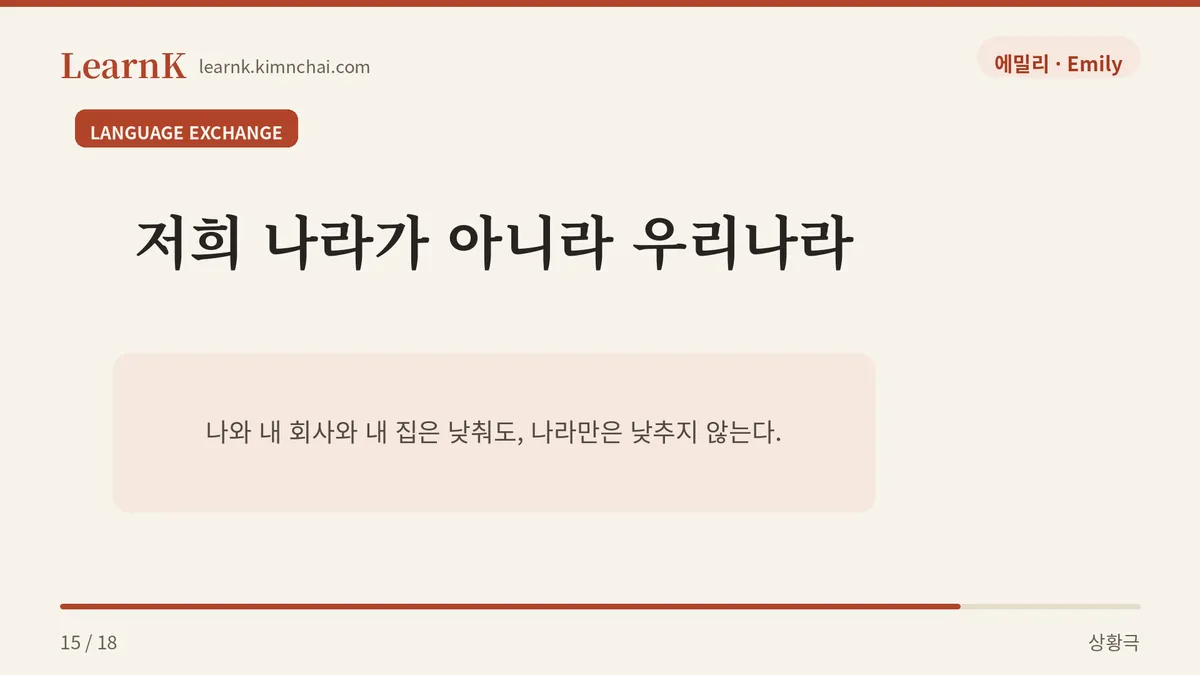
✗ (to a foreign friend) 저희 나라는 사계절이 뚜렷해요. (jeohui naraneun sagyejeori tturyeotaeyo.) ✓ (to a foreign friend) 우리나라는 사계절이 뚜렷해요. (urinaraneun sagyejeori tturyeotaeyo.) — Our country has four distinct seasons. → By long-standing custom, a country is not something an individual gets to lower in front of others. No matter how formal the setting, the country stays one single word: 우리나라 (urinara).
✗ (to your department head) 부장님, 저희 둘이 같이 가시죠. (bujangnim, jeohui duri gachi gasijyo.) ✓ (to your department head) 부장님, 우리 둘이 같이 가시죠. (bujangnim, uri duri gachi gasijyo.) — Sir, let’s the two of us go together. → The listener is never inside 저희 (jeohui). Wrapping your boss into it and then saying 저희 (jeohui) ends up lowering him too — an attempt at politeness that turns into a slight.
Example Sentences by Situation
1) At a shop welcoming a customer A hair-salon employee explaining the situation to a walk-in with no reservation.
저희 가게는 예약제로 운영하고 있어서요. (jeohui gageneun yeyakjero unyeonghago isseoseoyo.) Our shop runs by appointment only, you see.
The customer always sits higher. That’s why in service work, 저희 가게 (jeohui gage) rather than 우리 가게 (uri gage) comes out as the default. Trailing the sentence off with -서요 (-seoyo) takes a good deal of the edge off the refusal.
2) At a first meeting with a client company Two companies meeting for the first time and dividing up the roles.
초안은 저희 팀에서 먼저 보내 드리겠습니다. (choaneun jeohui timeseo meonjeo bonae deurigetseumnida.) Our team will send the first draft to you.
Company to company, you use 저희 회사 (jeohui hoesa) and 저희 팀 (jeohui tim) even when the other person is younger than you. What’s being lowered here isn’t anyone’s age — it’s the organization on my side.
3) To a friend of your parents A friend of the speaker’s mother has come by the house looking for her.
저희 어머니는 지금 안 계세요. (jeohui eomeonineun jigeum an gyeseyo.) My mother isn’t home right now.
When speaking about your own mother to an outsider, you introduce her humbly as 저희 어머니 (jeohui eomeoni) — and yet the verb, 안 계세요 (an gyeseyo), raises her. What’s being lowered is the relationship between me and the listener, not my mother herself. This double structure is the real charm of Korean honorifics.
Related Expressions in Polite and Casual Speech
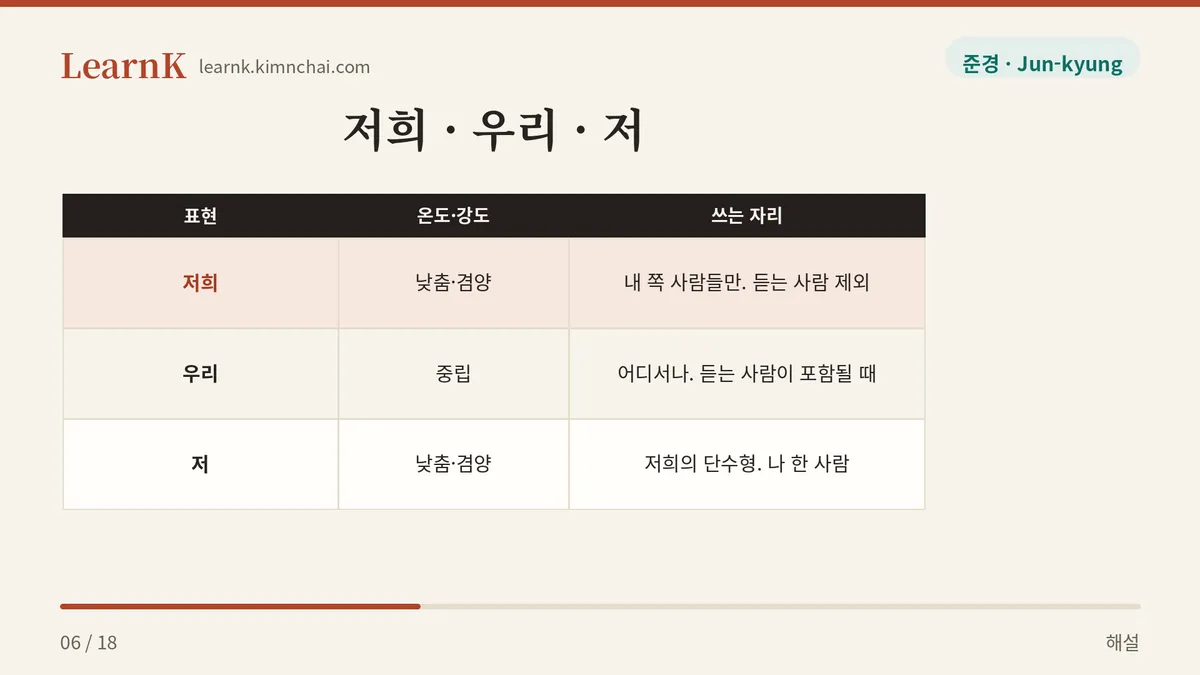
| Expression | Temperature / strength | Where it’s used |
|---|---|---|
| 저희 (jeohui) | Lowering — formal, humble | To seniors, customers, client companies. Does not include the listener |
| 우리 (uri) | Neutral | Anywhere. When the listener is included, this is the one — even in front of a senior |
| 저 (jeo) | Lowering — formal, humble | The singular of 저희 (jeohui). For referring to yourself alone to a senior |
| 나 (na) | Neutral, relaxed | With friends and juniors. Not used toward seniors |
Read the table down the columns and the pairings appear: 나 (na) → 저 (jeo), 우리 (uri) → 저희 (jeohui). In other words, 저희 (jeohui) is simply the plural of 저 (jeo), and Korean keeps its first-person pronouns in two complete sets, one humble and one plain. English we and Spanish nosotros have no such second set, which is why learners so often miss the spot where 저희 (jeohui) belongs.
Cultural Background — What You Lower Is Yourself, What You Keep Is 우리 (uri)
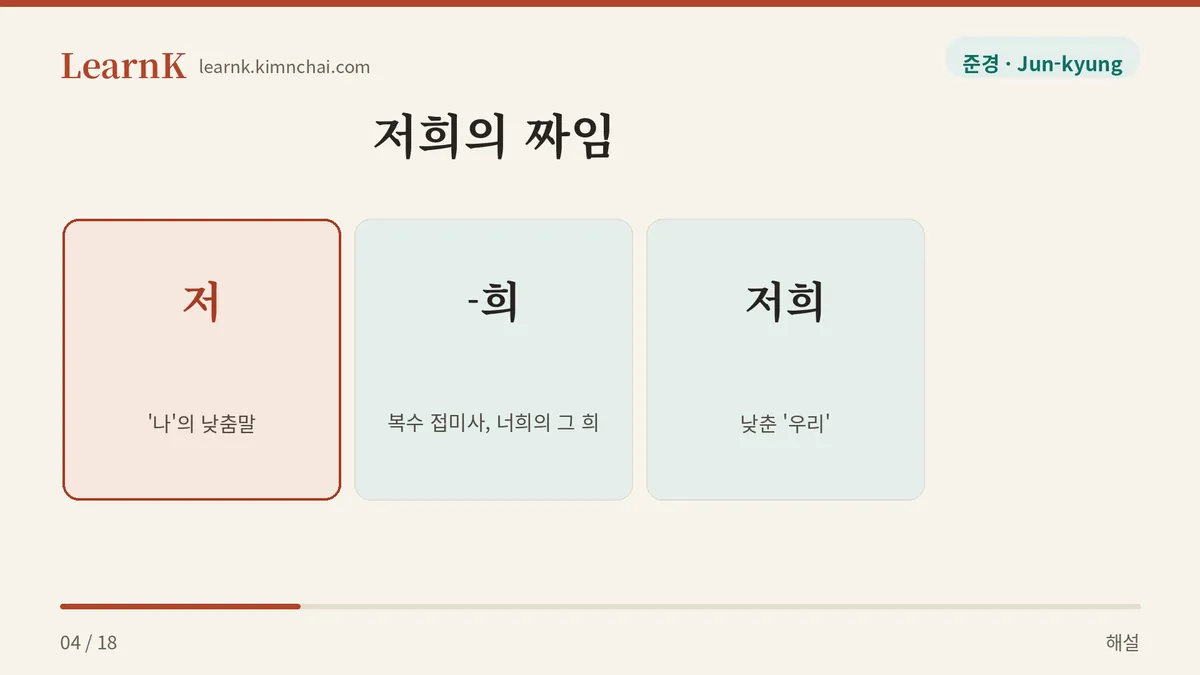
The construction of 저희 (jeohui) is simple. Take 저 (jeo), the humble form of 나 (na), and attach the plural suffix -희 (-hui). The same -희 (-hui) sits inside 너희 (neohui) as well. So 저희 (jeohui) isn’t some difficult new coinage — it’s two pieces you already know, stuck together.
In Korean dramas, this word pops up most often in three places. First, the meeting room where a junior employee starts a presentation in front of the executives. Second, the scene where someone about to marry introduces their family to their partner’s parents. Third, the moment a company employee sent to clean up after an accident bows their head to the victim. In all three, the pecking order is settled by the first word, 저희 (jeohui), before the line itself even matters. Which is why, when a drama character gets angry and cuts ties, you’ll see a directorial touch where they keep the polite speech intact but swap 저희 (jeohui) out for 우리 (uri). With one word, they’re saying: I will no longer make myself small in front of you.
Overdo 저희 (jeohui), though, and a wall goes up. If you keep saying “저희가… (jeohuiga…)” to a senior colleague you’ve already gotten comfortable with over dinner and drinks, it reads less as politeness than as a signal that you haven’t opened up yet. If you had to pin down, in language, the moment a relationship in a Korean company gets closer, it’s exactly the point where 저희 (jeohui) quietly turns into 우리 (uri) over a glass. And on top of all that sits one exception. You can lower yourself, your company, and your home as much as you like — but never your country. It’s never 저희 나라 (jeohui nara); it’s always 우리나라 (urinara).
Today’s Quiz
Which of the three sentences below sounds off?
- (to a professor) 저희 조는 다음 주 화요일에 발표하겠습니다. (jeohui joneun daeum ju hwayoire balpyohagetseumnida.)
- (to a foreign friend) 저희 나라는 사계절이 뚜렷해요. (jeohui naraneun sagyejeori tturyeotaeyo.)
- (to a contact at a client company) 저희 회사 신제품을 소개해 드리겠습니다. (jeohui hoesa sinjepumeul sogaehae deurigetseumnida.)
Answer: number 2. A country isn’t lowered in front of others, so the correct form is 우리나라는 사계절이 뚜렷해요 (urinaraneun sagyejeori tturyeotaeyo). Number 1 lowers the speaker’s own team in front of a professor, a senior, and number 3 lowers the speaker’s own company in front of a client — both are perfectly natural.
Definitions and example sentences are from the National Institute of Korean Language’s Basic Korean Dictionary (krdict.korean.go.kr); that portion of this post, including our translations, is licensed under CC BY-SA 2.0 KR.