전주 (jeonju) Means "Last Week" — So Why Is It on Your Train Ticket Too?
전주 (jeonju)
전주 (jeonju) means “the week immediately before this one” — in other words, last week. Sit through a Monday-morning meeting at a Korean company and you are guaranteed to hear it at least once, and it slips quietly into hospital reception desks and school announcements too. For a Korean learner, though, there’s something a little unfair about this word: there are at least two other 전주 (jeonju) that sound exactly the same. One is 전주 (jeonju), the city famous for bibimbap and its hanok village; the other is 전주 (jeonju), the instrumental intro that plays before a song begins. When you see those two syllables on a train-booking screen, do you picture a date or a destination? Today we stand at that fork in the road.
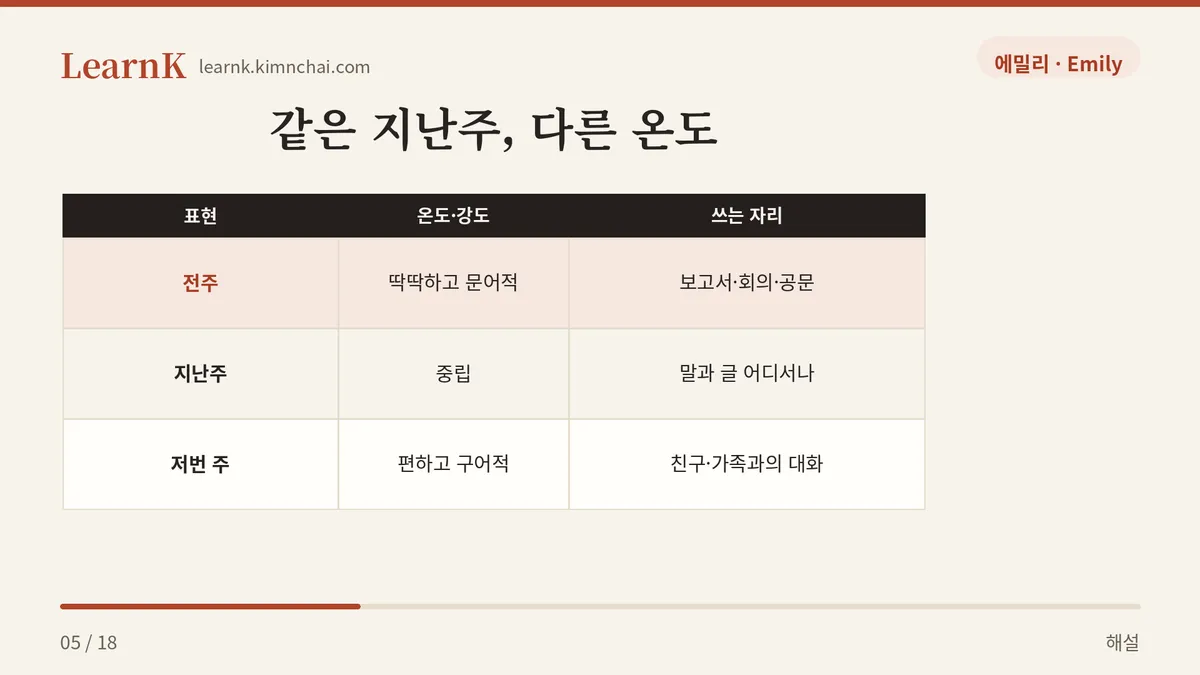
First, let’s set the temperature. Even words that all point to “last week” come in layers in Korean. With friends, it’s 저번 주 (jeobeon ju); the ordinary all-purpose word is 지난주 (jinanju); and in documents and formal reports, it’s 전주 (jeonju). 전주 is a Sino-Korean word, so it sounds short and hard. Short means it fits neatly into tables and charts; hard means that using it in a private setting sounds like reading paperwork out loud. In real life, a Korean almost never says to a friend in a café, 나 전주에 영화 봤어 (na jeonjue yeonghwa bwasseo) — “I saw a movie last week.” But underneath a sales graph, you’ll almost always find the four-syllable phrase 전주 대비 (jeonju daebi), “compared to the previous week.” Where this word sits is more its identity than what it means.
Checking with the National Institute of Korean Language dictionary
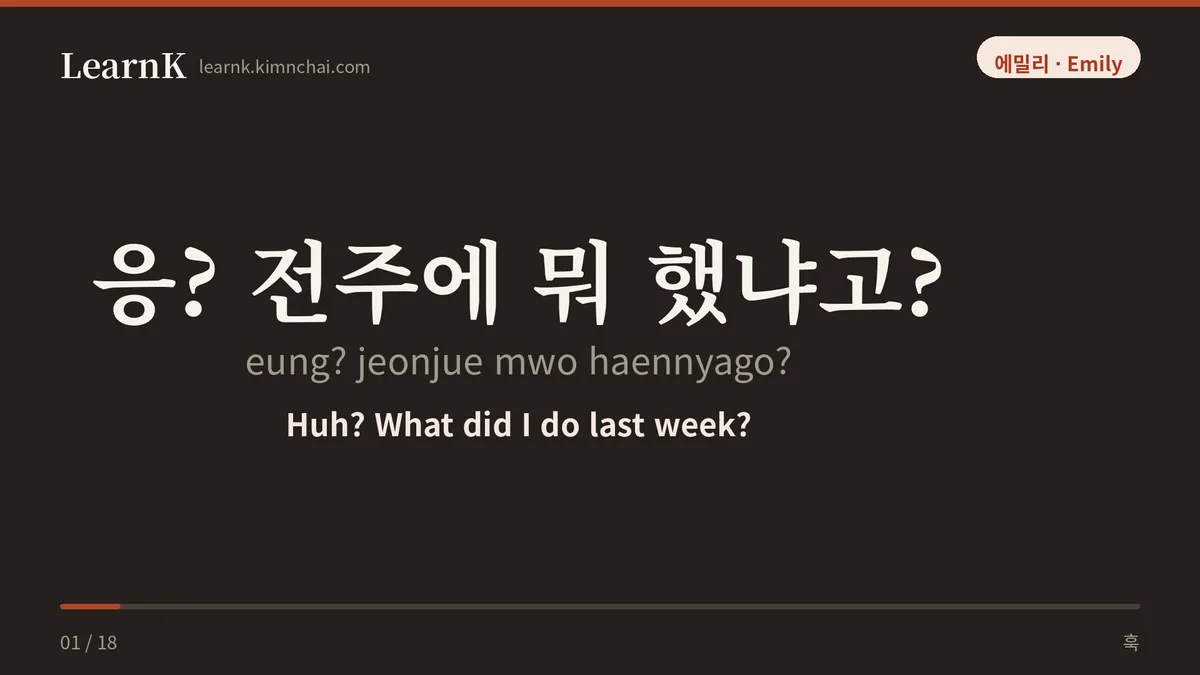
전주 (jeonju) 「noun」 The week immediately before this week. [en] last week; previous week — The week immediately before a certain week. [ja] ぜんしゅう【前週】。せんしゅう【先週】 — 今の週の前の週。 [es] semana pasada — Semana inmediatamente anterior a esta semana. [zh] 上一周 — 这周之前的周。 — National Institute of Korean Language, Basic Korean Dictionary (krdict.korean.go.kr)
The Portuguese definition isn’t listed in the dictionary, so we translated it ourselves — semana passada. That one line alone is our translation, not a dictionary quotation.
Here’s where it gets interesting. If you search the dictionary for the letters ‘전주’, the sentences below come along with it — and reading them, not one of them is solved by the definition above (“last week”). This is exactly the moment learners are most often thrown when they open a dictionary, so rather than skipping past it, let’s take the sentences one at a time.
전주가 시작되고 가수는 아름다운 목소리로 공연장을 가득 울렸다. (jeonjuga sijakdoego gasuneun areumdaun moksoriro gongyeonjangeul gadeuk ullyeotda.) As the intro began, the singer filled the concert hall with her beautiful voice. — National Institute of Korean Language, Basic Korean Dictionary (krdict.korean.go.kr)
This points to those few seconds when the lights go down and the first notes settle in — the stretch of time before the singer has opened their mouth. Here 전주 isn’t “last week” but the instrumental introduction to a song. You’ll see this usage often in concert reviews and in the subtitles of music programs.
전주하고 간주의 멜로디가 같아서 그런가 봐. (jeonjuhago ganjuui mellodiga gataseo geureonga bwa.) I guess it’s because the intro and the interlude have the same melody. — National Institute of Korean Language, Basic Korean Dictionary (krdict.korean.go.kr)
This is the scene where friends are listening to a song together and one says, “Wait — didn’t that part already play?” They’re comparing the instrumental stretch at the very front of the song (전주) with the instrumental stretch between verses (간주). The ‘-나 봐’ at the end carries an unconfident guess, which tells us the two of them are listening together right at that moment.
고전주의 문학을 통해서 17세기 유럽의 사회상을 엿볼 수 있다. (gojeonjuui munhageul tonghaeseo 17segi yureobui sahoesangeul yeotbol su itda.) Through Classicist literature, we can catch a glimpse of 17th-century European society. — National Institute of Korean Language, Basic Korean Dictionary (krdict.korean.go.kr)
This one is a step further removed. 고전주의 (“Classicism”) is 고전 (古典, “the classics”) plus 주의 (主義, “-ism”), so the word 전주 isn’t actually in there at all. The letters just happen to line up that way. It’s an academic sentence, the kind you’d use in a lecture hall or a book review.
고전주의 음악. (gojeonjuui eumak.) 고전주의 시대. (gojeonjuui sidae.) 고전주의 건축. (gojeonjuui geonchuk.) Classicist music. The Classicist era. Classicist architecture. — National Institute of Korean Language, Basic Korean Dictionary (krdict.korean.go.kr)
These three short noun phrases are lined up the way dictionaries do to show common pairings. You’ll meet them in exactly this shape on museum placards and in textbook subheadings.
Put these sentences side by side and today’s lesson becomes clear: sounding the same doesn’t mean the meanings connect. Korean has a great many Sino-Korean words, so this kind of overlap is unusually frequent — which is why Koreans, too, pick the right meaning by context.
A real conversation
Setting: In front of the ticket office at Seoul Station. Jun-kyung is booking weekend train tickets on his phone.
Jun-kyung: 에밀리, 너 전주 가 봤어? Emily, have you been to Jeonju?
Emily: 응? 전주에 뭐 했냐고? 나 계속 집에 있었는데. Huh? What did I do last week? I was home the whole time.
Jun-kyung: 아니 아니, 그 전주 말고. 비빔밥 나오는 전주. No no, not that jeonju. Jeonju, where the bibimbap comes from.
Emily: 아, 도시! 헷갈렸잖아. 거기는 삼 년 전에 가 봤어. Oh, the city! You confused me. I went there three years ago.
Jun-kyung: 발음이 똑같으니까 나도 가끔 헷갈려. 이번 주말에 갈래? 표 두 장 끊는다. The pronunciation is identical, even I mix it up sometimes. Wanna go this weekend? I’m buying two tickets.
Emily: 좋아. 근데 전주에 예매했으면 훨씬 쌌을 텐데. Sure. But it would’ve been way cheaper if you’d booked last week.
That last line is the heart of the conversation. Emily says ‘전주에’ and swings back to the time meaning — but this time nobody gets confused, because ‘예매’ (booking) comes before it and ‘쌌을 텐데’ (would’ve been cheaper) comes after. This is how Korean works: the words on either side hold the meaning in place.
This sounds unnatural
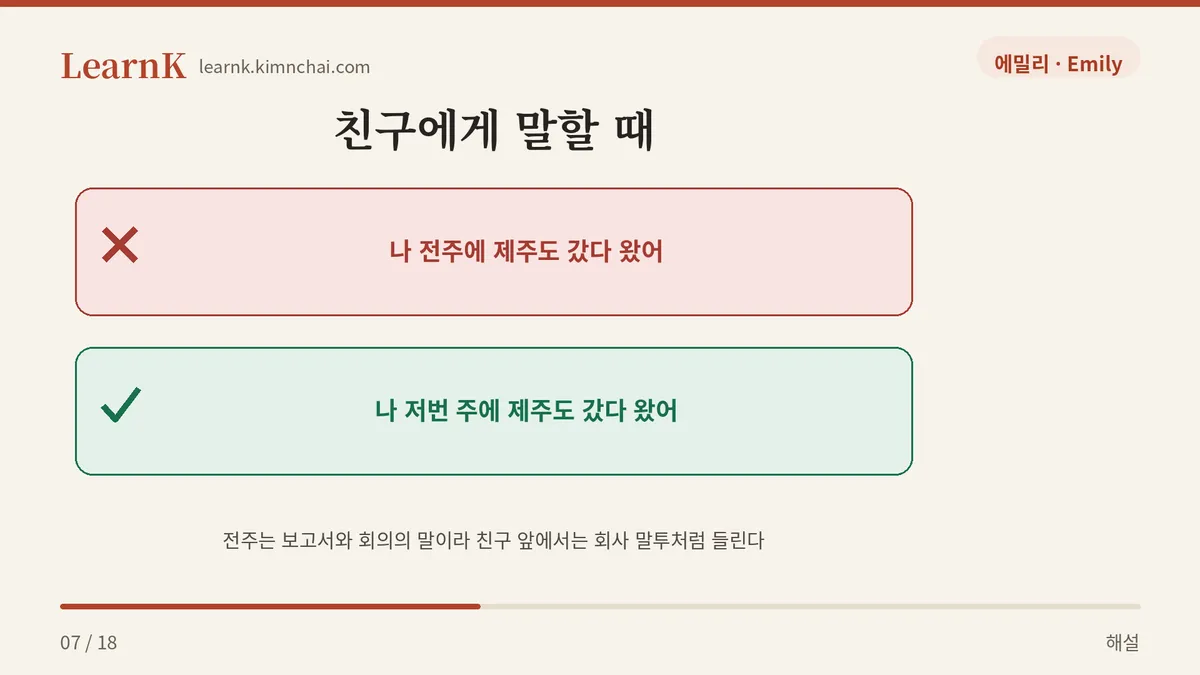
✗ (to a friend) 나 전주에 제주도 갔다 왔어. (na jeonjue jejudo gatda wasseo.) ✓ (to a friend) 나 저번 주에 제주도 갔다 왔어. (na jeobeon jue jejudo gatda wasseo.) I went to Jeju last week. → The meaning is right, but the temperature is off. 전주 is the language of reports and meetings, so using it in front of a friend sounds like an office voice suddenly popping out. In relaxed settings, 저번 주 or 지난주 is the default.
✗ (while chatting about travel) 전주 여행 어땠어? (jeonju yeohaeng eottaesseo?) ✓ (while chatting about travel) 지난주 여행 어땠어? (jinanju yeohaeng eottaesseo?) How was last week’s trip? → The grammar is perfectly fine, but nine times out of ten your listener will picture the city. In a conversation where travel, trains, and food are flying around, ‘전주’ lands as a place before it lands as a time. Here it’s safest to skip the Sino-Korean word and go around it with 지난주.
Example sentences by situation
1. Reporting numbers at the Monday morning team meeting
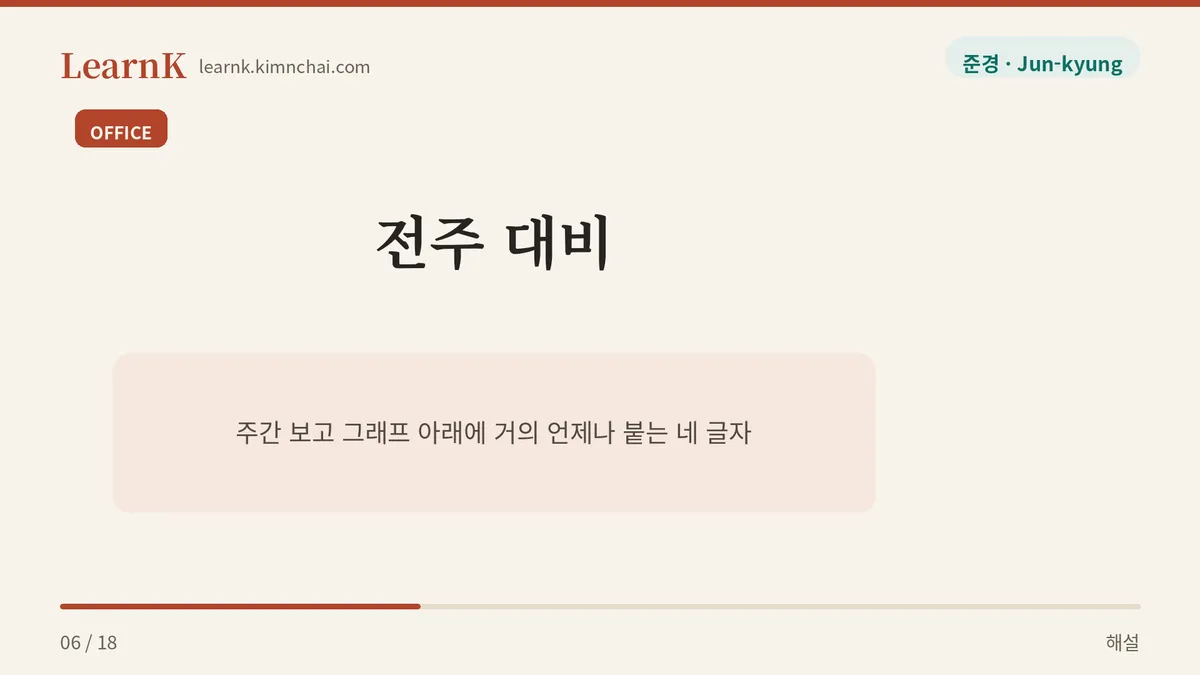
전주 대비 방문자 수가 8퍼센트 늘었습니다. (jeonju daebi bangmunja suga 8peosenteu neureotseumnida.) Visitor numbers are up 8 percent compared to the previous week. — 전주 대비 compresses “compared with last week” into a single unit. In this setting, ‘저번 주보다’ would actually sound out of place. This is the expression that gets dropped straight under a graph axis, into a table header, or into the subject line of a weekly report email.
2. At the hospital reception desk for a follow-up visit
전주에 처방받은 약은 다 드셨나요? (jeonjue cheobangbadeun yageun da deusyeonnayo?) Did you finish all the medication that was prescribed last week? — This is what a nurse or doctor asks while looking at your records. The dates are right there on the chart, so the speaker’s mind is already in document mode. When the patient answers, it’s completely natural to swing back into casual speech: ‘네, 지난주 것 다 먹었어요 (ne, jinanju geot da meogeosseoyo)’ — “Yes, I finished last week’s.” One side is the language of records, the other the language of daily life.
3. On an announcement screen in a lecture hall
전주에 안내드린 대로 시험은 다음 주 금요일입니다. (jeonjue annaedeurin daero siheomeun daeum ju geumyoirimnida.) As announced last week, the exam is next Friday. — This is the kind of sentence that gets written on a slide or a notice board. Spoken aloud, even the professor is more likely to say ‘지난주에 말한 대로 (jinanjue malhan daero)’. Written, 전주; spoken, 지난주 — get a feel for just that, and you’re halfway there.
Politeness levels and similar expressions
전주 is a noun, so there’s no honorific built into the word itself. Politeness is made at the end of the sentence. The difference between ‘전주에 보냈어 (jeonjue bonaesseo)’ and ‘전주에 보냈습니다 (jeonjue bonaetseumnida)’ comes from the ending, not from 전주. What you do need to watch is the layer of formality.
| Expression | Temperature / intensity | Where it’s used |
|---|---|---|
| 전주 (jeonju) | Stiff and literary | Reports, meetings, official documents, news articles. Especially in the form 전주 대비 |
| 지난주 (jinanju) | Neutral | Anywhere. The default in both speech and writing |
| 저번 주 (jeobeon ju) | Casual and colloquial | Conversations with friends and family. Not used in documents |
| 전전주 (jeonjeonju) | Literary, fairly stiff | For “two weeks ago.” Only in workplace documents |
It helps to memorize the other direction at the same time. If backward is 전주, forward is 차주 (chaju) — next week. 차주, too, rarely leaves the meeting room. The person who says ‘전주와 차주 (jeonjuwa chaju)’ in a meeting switches to ‘저번 주랑 다음 주 (jeobeon jurang daeum ju)’ the moment they meet a friend on the way home — and when that switch starts to feel natural, your Korean has gained a layer.
Cultural background — three 전주 that sound alike
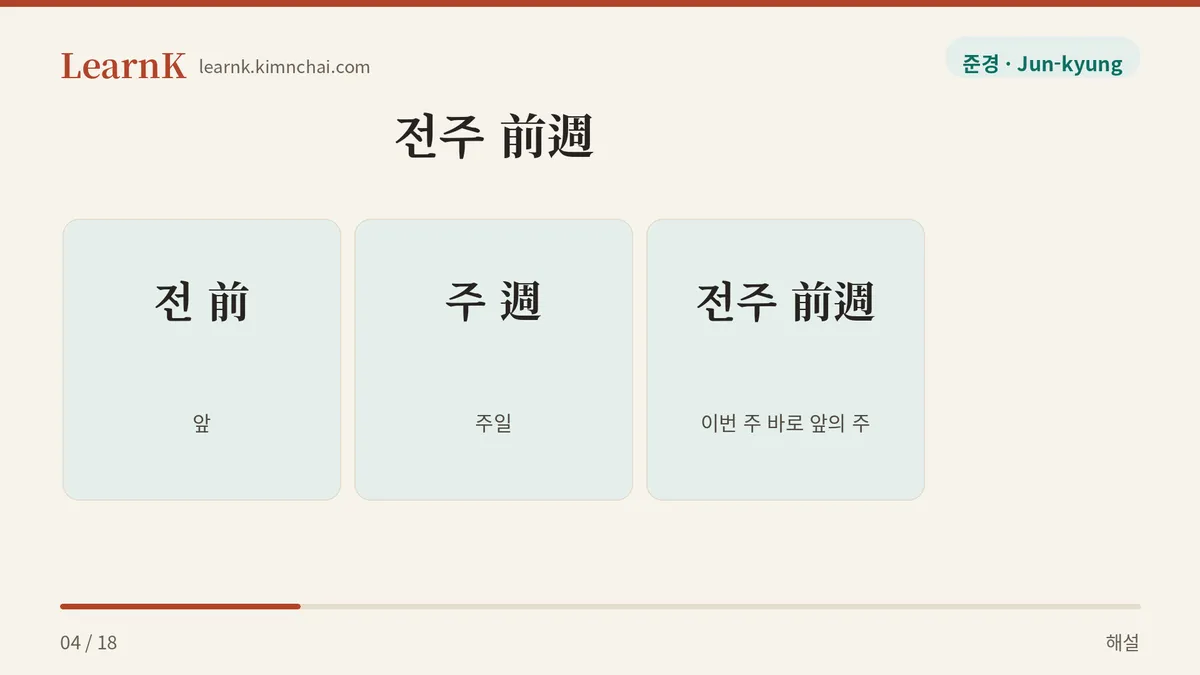
Look at how the words were built and you can see at a glance how the three split apart. The 전주 that means “last week” is 前週, the character 前 (jeon, “before”) attached to 週 (ju, “week”). The preceding week — exactly that. The 전주 that means the opening of a song is 前奏, 前 (jeon, “before”) attached to 奏 (ju, “to play”). The playing that comes before the main playing, again literally what it says. And the city 전주 is 全州, using 全 (jeon, “whole, complete”) and 州 (ju, “district”). Not time, not music, but a place name. It’s worth remembering that the first two share 前 (“before”), while only the city comes from a different character.
For Koreans, the sound ‘전주’ actually arrives as the city first. The hanok village with its layered tiled roofs, bibimbap served in brass bowls, the kongnamul-gukbap that settles your stomach in the morning, the Jeonju International Film Festival every spring — in conversations about travel and food, those two syllables have all but settled in as a proper noun. That’s why in dramas, the line ‘전주 가자 (jeonju gaja)’ — “let’s go to Jeonju” — usually means a trip or a journey back to one’s hometown. A character worn out by life in Seoul packing a bag and heading down to a southern city is an old grammar of Korean drama, and Jeonju often occupies that destination slot.
Conversely, if you hear ‘전주’ in an office-set drama, nine times out of ten it’s about numbers. A boss points at a monitor and asks about last week’s figures, and the table a new employee stayed up all night making has week-over-week change rates marked with arrows. The same two syllables become a vacation or an all-nighter depending on which set they’re placed in. Training your ear for Korean is, in the end, training yourself to hear not one word but everything around it.
Today’s quiz
You’re presenting at a weekly meeting. Which is the most natural word for the blank?
‘이번 주 방문자 수는 12만 명입니다. ( ) 대비 8퍼센트 늘었습니다. (ibeon ju bangmunja suneun sibimman myeongimnida. ( ) daebi 8peosenteu neureotseumnida.)’ This week’s visitor count is 120,000. That’s up 8 percent compared to ( ).
① 전주 ② 저번 주 ③ 전주시 ④ 차주
The answer is ①, 전주 (jeonju). 전주 대비 is the set form that emerged for compressing “compared with last week” into one unit in reporting situations. ② has the same meaning but is far too colloquial — the presentation would suddenly go slack. ③ is the name of the city, so it can’t be compared with a number, and ④ 차주 means next week, so the direction of time is reversed. You can’t compare this week with a week that hasn’t arrived yet.
Definitions and example sentences are from the National Institute of Korean Language’s Basic Korean Dictionary (krdict.korean.go.kr); that portion of this post, including our translations, is licensed under CC BY-SA 2.0 KR.